If you drive an electric car in Maryland, or you’re eyeing a used EV, your comfort level probably comes down to one question: **will I be able to charge when I need to?** The good news is that Maryland’s electric car charging network has quietly become one of the more capable systems on the East Coast, especially along I‑95 and the major commuter corridors around Baltimore and DC.
Maryland is building for EVs on purpose
Why Maryland’s EV charging network matters in 2026
Maryland EV adoption and charging by the numbers
For you, all those numbers boil down to something simple: **Maryland is betting hard on electric driving.** If you stay mostly in the Baltimore–DC orbit, you’ll rarely be more than a few miles from a Level 2 charger. If you’re crossing the Bay Bridge to the Eastern Shore or heading out I‑70 and I‑68 into the mountains, the state’s NEVI corridor build‑out is designed so you’re never stranded between fast chargers.
How Maryland’s electric car charging network is built
Maryland’s EV charging network isn’t one monolithic system. It’s a **patchwork that works together**, state agencies, utilities, and private networks all placing hardware in slightly different contexts. Understanding who owns what makes the map feel less random.
Who’s actually building Maryland’s EV charging?
Same plugs, different players behind the scenes
State agencies
MDOT, MDTA, and DGS place chargers at rest areas, toll facilities, Park & Rides, and state office buildings. These are about coverage and reliability on key routes.
Utilities
BGE EVsmart®, Pepco, Potomac Edison, SMECO and others install Level 2 and DC fast chargers at workplaces, shopping centers, and community hubs, usually on their own networks or partners like ChargePoint.
Private networks
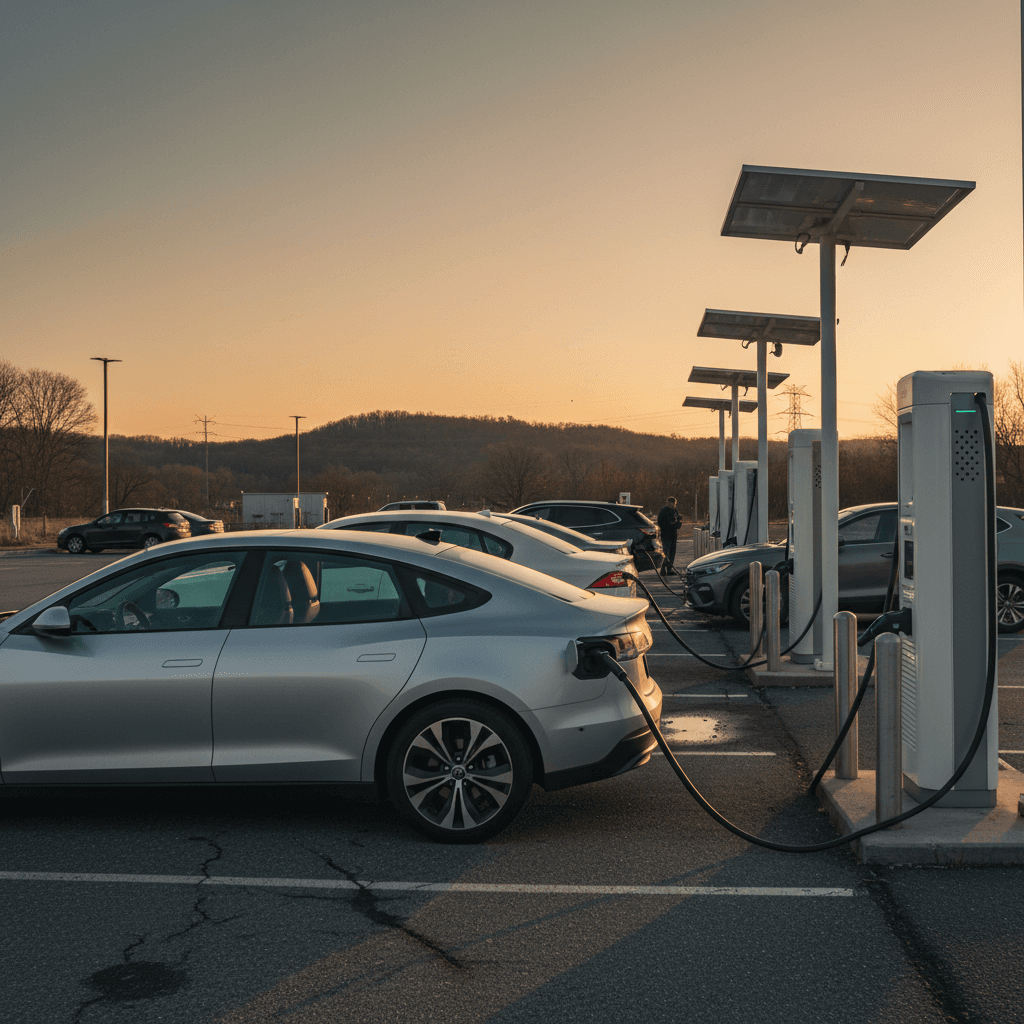
Electrify America, Tesla, EVgo, Shell Recharge, Blink, ChargePoint build and operate most highway DC fast sites plus destination Level 2 stations at retailers and hotels.
Think in layers, not logos
Major charging networks you’ll actually use
Open PlugShare or A Better Routeplanner in Maryland and the same names keep popping up. Each network has its own quirks, but together they create a fairly dense mesh, especially around Baltimore, Columbia, and the DC suburbs.
Key public charging networks in Maryland
The networks you’re most likely to see on your EV’s nav screen.
| Network | Main use in Maryland | Typical power | Where you’ll see it |
|---|---|---|---|
| BGE EVsmart® | Utility-run Level 2 and DC fast | 7 kW L2, 50–150 kW DCFC | Baltimore metro, community centers, park-and-rides |
| ChargePoint | Mixed public & workplace L2, some DCFC | 6–7 kW L2, 50–125 kW DCFC | Office garages, shopping centers, MDTA facilities |
| Electrify America | High-power DC fast | 150–350 kW DCFC | Highway-adjacent Walmarts and retail hubs |
| Tesla Supercharger | Primarily Tesla DC fast, some open to others | 150–250 kW DCFC | I‑95 plazas, major routes and suburbs |
| EVgo, Shell Recharge, Blink | Smaller but growing presence | 50–200 kW DCFC, 6–7 kW L2 | Grocery and drugstores, urban lots |
| DGS / State-owned | Fleet-focused with some public access | L2, some DCFC | State facilities, park-and-ride lots |
Most used-EV drivers will eventually carry accounts with 2–3 of these networks.

Don’t rely on a single network
NEVI corridors and highway fast charging in Maryland
The spine of Maryland’s electric car charging network is the **federal NEVI program**, National Electric Vehicle Infrastructure funds funneled through the state to put DC fast chargers every ~50 miles on designated Alternative Fuel Corridors.
Where NEVI money is going
- I‑95: The main north–south artery gets dense DC fast coverage, including the Maryland House and Chesapeake House travel plazas.
- I‑70 / I‑68: Builds a fast‑charging ladder out toward Hagerstown, Hancock, Cumberland, and the West Virginia border.
- US‑50 / 301: Connects Annapolis, the Bay Bridge, and key Eastern Shore towns so Ocean City trips are practical in an EV.
What’s already funded
- Round 1 (2024): ~118 DC fast chargers funded at 19 sites along Maryland corridors.
- Round 2 (2025): Another 48 DC fast chargers approved at 12 sites in 12 counties.
- Round 3 (2026): Proposals opening to fill remaining gaps and tighten spacing.
In practice, that means by the late 2020s you’ll be able to drive the state end-to-end on DC fast, stopping roughly as often as a gas driver grabs coffee.
What this means for your road trips
Charging at state facilities and I‑95 travel plazas
Some of Maryland’s most strategically placed chargers are on land the state already controls: toll facilities, travel plazas, and government complexes. They’re not glamorous, but they’re the backbone of the **“I just need this to work”** experience.
Key state-linked charging locations to know
Notable for reliability and location, not latte options
Bay Bridge (US‑50/301)
At the Bay Bridge toll facility near Annapolis you’ll find a mix of Level 2 and DC fast chargers, often on the BGE EVsmart® / ChargePoint networks. Great insurance policy before you commit to the Eastern Shore.
Harbor & Fort McHenry Tunnels
Both the Baltimore Harbor Tunnel (I‑895) and Fort McHenry Tunnel (I‑95) have DC fast chargers at MDTA customer service centers, again part of the broader public network.
Maryland House & Chesapeake House
Along I‑95, each travel plaza typically offers a cluster of DC fast chargers plus a bank of Tesla Superchargers, so mixed EV households can charge in one stop.
State facilities vs. utility sites
What public EV charging costs in Maryland
Let’s talk money. Maryland’s public charging landscape is drifting away from “free at the mall” toward **market‑rate energy priced by the kilowatt‑hour.** That sounds dull, but it’s a win for transparency compared with time‑based pricing that penalizes slower‑charging cars.
- Statewide, public charging averages around $0.31 per kWh, though it varies by network, location, and time of day.
- BGE EVsmart® currently charges about $0.18/kWh for Level 2 and around $0.34/kWh for DC fast, with discounts for some program RFID cards.
- MDTA‑hosted DC fast chargers often mirror those utility rates and may cap session costs around $20 at certain sites.
- Some garages, workplaces, and hotels still offer Level 2 charging for free or at heavily subsidized rates, always check the app listing.
Estimate your real-world charging costs
Inspections, new rules, and why reliability is improving
Maryland is doing something many states have only talked about: **treating EV chargers like gas pumps.** That means inspections for accuracy and a new registration system for commercial chargers.
How Maryland is tightening up EV charging
1. Charger inspections underway
The Maryland Department of Agriculture’s Weights & Measures team, yes, the same folks who certify gas pumps, has begun inspecting public EV chargers after a wave of reliability complaints.
2. Commercial charger registration
The state has launched an EVSE (Electric Vehicle Service Equipment) registration program. Public, fee‑based chargers must register with Weights & Measures, with a per‑port fee helping fund oversight and testing.
3. Deadlines extended into 2026
To give site hosts time to comply, Maryland extended the full registration deadline into mid‑2026 while clarifying that free, workplace‑only, and private residential chargers generally don’t need to register.
4. The payoff for drivers
With formal inspections, you’re more likely to get the energy you pay for, and see flaky or failing units tagged out of service instead of quietly disappointing driver after driver.
One thing regulation won’t fix
Planning daily driving vs. road trips
Maryland’s EV network feels very different depending on whether you’re **doing the daily grind** or **crossing the state line.** Plan for each mode separately and your life gets simpler.
Daily driving in Maryland
- If you have home Level 2, public charging will be mostly insurance and top‑ups during errands.
- Apartment dwellers end up leaning on workplace Level 2, utility networks like EVsmart®, and mall or grocery chargers.
- Zones around Baltimore, Columbia, Silver Spring, Rockville, and College Park are particularly dense with public Level 2 options.
When shopping for a used EV, think about where you park overnight. That answer matters more than the size of the public network.
Road trips and weekend escapes
- For I‑95 runs to Philly, New York, or DC suburbs, you’re spoiled: DC fast is frequent and multi‑network.
- For trips west on I‑70/I‑68 or east to the beaches, use a planner like A Better Routeplanner or your car’s nav to lock in NEVI and utility‑backed sites.
- Plan to arrive with at least 15–20% battery at each stop; that gives you options if the first site is busy or offline.
With a little discipline, Maryland becomes a great launch pad for EV trips into Pennsylvania, Virginia, and beyond.
Used EV owners: how to stress less about charging
Most of the anxiety around Maryland’s electric car charging network comes from people in **their first used EV**. The car is new to you, the battery’s older, and you don’t yet trust those blue and green pins on the map. You can fix that with a plan and good information.
A practical Maryland charging playbook for used EV drivers
1. Start with a real battery health check
With any used EV, know what you’re working with. A verified report, like the Recharged Score battery health diagnostics included with every vehicle on <strong>Recharged</strong>, tells you how much usable capacity you actually have, which is key for route planning.
2. Anchor your life to one “home” charger
Identify the charger that will do 80–90% of your work: your garage Level 2, a near‑home EVsmart® site, or a reliable workplace unit. Everything else becomes bonus range, not a lifeline.
3. Build a trusted network short‑list
In your apps, star your go‑to DC fast sites along I‑95, I‑70/I‑68, and US‑50/301. Look for locations with at least 4 plugs, recent check‑ins, and big names (utility + major networks) behind them.
4. Keep your accounts and adapters sorted
Set up accounts for at least two non‑Tesla networks plus BGE EVsmart® if you’re in their footprint. If your EV uses CCS and you plan to use Tesla Superchargers that have opened to other brands, make sure you have the right adapter and have tested it close to home first.
5. Let the car’s nav do the heavy lifting
Most newer EVs will suggest fast‑charging stops automatically as you set a long route. Treat those suggestions as a starting point, then cross‑check against PlugShare or another directory for the latest status.
How Recharged fits into this picture
Ready to find your next EV?
Browse VehiclesFAQ: Maryland electric car charging network
Frequently asked questions about Maryland’s EV charging network
The bottom line on Maryland’s EV charging network
Maryland’s electric car charging network isn’t perfect. You’ll still find the occasional broken plug, the odd station hidden behind a half‑empty office park, the coffee shop that locked its garage right when you needed 20 more miles. But zoom out, and the picture is impressive: thousands of public ports, over a thousand DC fast chargers, and a clear, funded plan to fill the gaps along every major corridor.
If you pair that landscape with the right car, and real data on its battery health, EV life in Maryland becomes pleasantly boring in the best way. Your weekday charging becomes muscle memory. Your road trips become a series of planned coffee breaks. And if you’re stepping into a used EV, platforms like Recharged give you the transparency, financing, and nationwide delivery to match the car to the map before you ever unplug from your old life.