If you’re driving, or thinking about buying, a Lucid Air, you’ve probably heard that brake pads on EVs last “forever” thanks to regenerative braking. There’s truth to that, but when you eventually do need a Lucid Air brake pad replacement, the bill won’t feel magical. This guide breaks down realistic costs in 2026, how long pads tend to last on the Air, and how to budget if you own or are shopping for a used Lucid.
Quick answer
Lucid Air brake pad replacement cost overview
Typical Lucid Air brake pad costs in 2026 (per axle)
There isn’t yet a huge volume of published, Lucid-specific brake menu pricing, but we can triangulate from luxury EV brake service costs and what owners are seeing in the field. For a Lucid Air, you’re generally looking at $250–$500 per axle for brake pads at a competent independent shop, including parts and labor. At a Lucid service center, the same work is more likely to land in the $350–$700 per axle range, especially if rotors or hardware need attention at the same time.
Those ranges assume a straightforward pad swap. If your rotors are rusted or scored, or if the calipers need extra work, your total can easily climb another $150–$400 per axle. That’s not unique to Lucid, high-end German sedans, Teslas, and other luxury EVs show similar patterns, but it’s important context when you’re budgeting for a premium 5,000‑lb sedan that can run 0–60 in three seconds.
Pads vs. “a brake job”
How regenerative braking affects Lucid Air pad life
The Lucid Air’s strong regenerative braking does most of the slowing in everyday driving. Owners routinely report using the friction brakes only lightly, sometimes tapping the pedal once a day just to keep the rotors clean. In practice, that means the Air’s pads should last far longer than comparable gasoline luxury sedans, where 30,000–40,000 miles on front pads is normal.
- In city driving with active regen, many Air owners barely touch the brake pedal in normal traffic.
- On long highway trips, the car coasts efficiently, again minimizing friction brake use.
- Because pad use is low, time (age and corrosion) can matter as much as mileage.
The catch: rust and “under‑used” brakes
Lucid’s own maintenance schedule focuses more on brake fluid changes and inspections than on pad replacement at specific mileages. That’s typical for EVs. The expectation is that, driven normally, pads will often go 60,000–80,000 miles or more before hitting minimum thickness. But if you live where roads are salted or you park outside near the coast, you may need pads and rotors sooner simply to deal with rust and noise.
What drives Lucid Air brake pad replacement costs
Key factors behind Lucid Air brake pad pricing
Why one owner pays $300 and another pays $900 for “brakes”
Luxury EV hardware
Local labor rate
Scope of work
The Lucid Air also uses an electrically boosted, brake‑by‑wire system. That doesn’t automatically make pad replacement exotic, but it does mean technicians need to understand how to safely place the system in service mode and bleed it correctly if they open the hydraulic circuit. Some independent shops will be more comfortable with this than others, and that comfort level often shows up in the quote you receive.
Ask specifically what’s included
Lucid service center vs independent shop pricing
Lucid service center
- Pros: Factory-trained techs, OEM parts, access to full diagnostics and recalls.
- Typical pricing: Expect brake pad service to cost roughly 20–40% more than a comparable independent shop.
- Best for: Airs under warranty, brake system warning lights, or any case where software or ABS calibration might be involved.
Independent EV-savvy shop
- Pros: Lower labor rate, more flexibility on pad brands, often easier scheduling.
- Typical pricing: Many EV‑competent independents will quote $250–$500 per axle for pads-only on a luxury sedan platform.
- Best for: Out-of-warranty cars, straightforward pad/rotor service, or owners looking to save without cutting corners.
If your Air is still under Lucid’s basic warranty and you’re seeing any brake warnings or odd pedal behavior, the conservative move is to start with a Lucid service center. For a routine pad and rotor job on an out-of-warranty car, it’s reasonable to shop around among independent specialists who advertise EV experience and are comfortable with brake‑by‑wire systems.
Don’t be the shop’s first Lucid
When do Lucid Air brake pads actually wear out?
The honest answer: we don’t yet have a giant dataset of Lucid Airs running around on their second or third set of brake pads. Many cars on the road today are still under 60,000 miles, and regen does a lot of the work. But we can outline realistic expectations based on EV behavior and the Air’s size and performance.
Expected Lucid Air brake pad life by use case
These are reasonable planning ranges, not hard guarantees. Inspections matter more than rules of thumb.
| Driving pattern | Climate | Front pad life (est.) | Rear pad life (est.) | What usually fails first |
|---|---|---|---|---|
| Daily mixed driving, moderate regen use | Mild/dry (U.S. Sun Belt) | 70,000–100,000+ miles | 80,000–120,000+ miles | Pads hit minimum thickness before corrosion issues |
| Short trips, heavy regen, stop‑and‑go | Wet/snowy with road salt | 40,000–70,000 miles | 50,000–80,000 miles | Rotor rust, sticky hardware, noise before pad wear |
| Mostly highway commuting | Any | 80,000–120,000+ miles | 80,000–120,000+ miles | Age/rotor corrosion more than pad thickness |
| Infrequent use, lots of outdoor parking | Coastal or damp | Time‑based (5–8 years) | Time‑based (5–8 years) | Rusted rotors and uneven pad deposits |
Estimate based on EV brake wear patterns and owner reports as of 2026.
Think in years as well as miles
Signs your Lucid Air needs brake pads or other brake work
Because regen masks how hard your friction brakes are working, it’s easy to ignore them, until something feels or sounds wrong. Watch for the same warning signs you’d see on a gasoline car, plus a few EV‑specific tells.
Warning signs you shouldn’t ignore
1. Squealing, scraping, or grinding noises
High‑pitched squeal when you touch the pedal can mean the pads’ wear indicators are contacting the rotor. A grinding noise suggests pads are gone and metal is hitting metal, get service immediately to avoid destroying the rotors.
2. Pulsation or vibration when braking
If the steering wheel or pedal shakes under braking, rotors may be warped or have uneven deposits. On a heavy luxury EV like the Air, heat spots can develop quickly after a hard stop or two.
3. Longer stopping distances
If the car doesn’t slow as confidently as it used to, especially with regen set higher, your pads may be thin, or the system may be using friction more often due to battery temperature or state of charge.
4. Soft, spongy, or inconsistent pedal feel
A soft pedal can indicate air in the brake lines, moisture‑contaminated fluid, or a problem with the electrically boosted system. This is not a DIY bleed job; get the car to Lucid or an experienced EV shop.
5. Visual pad or rotor issues
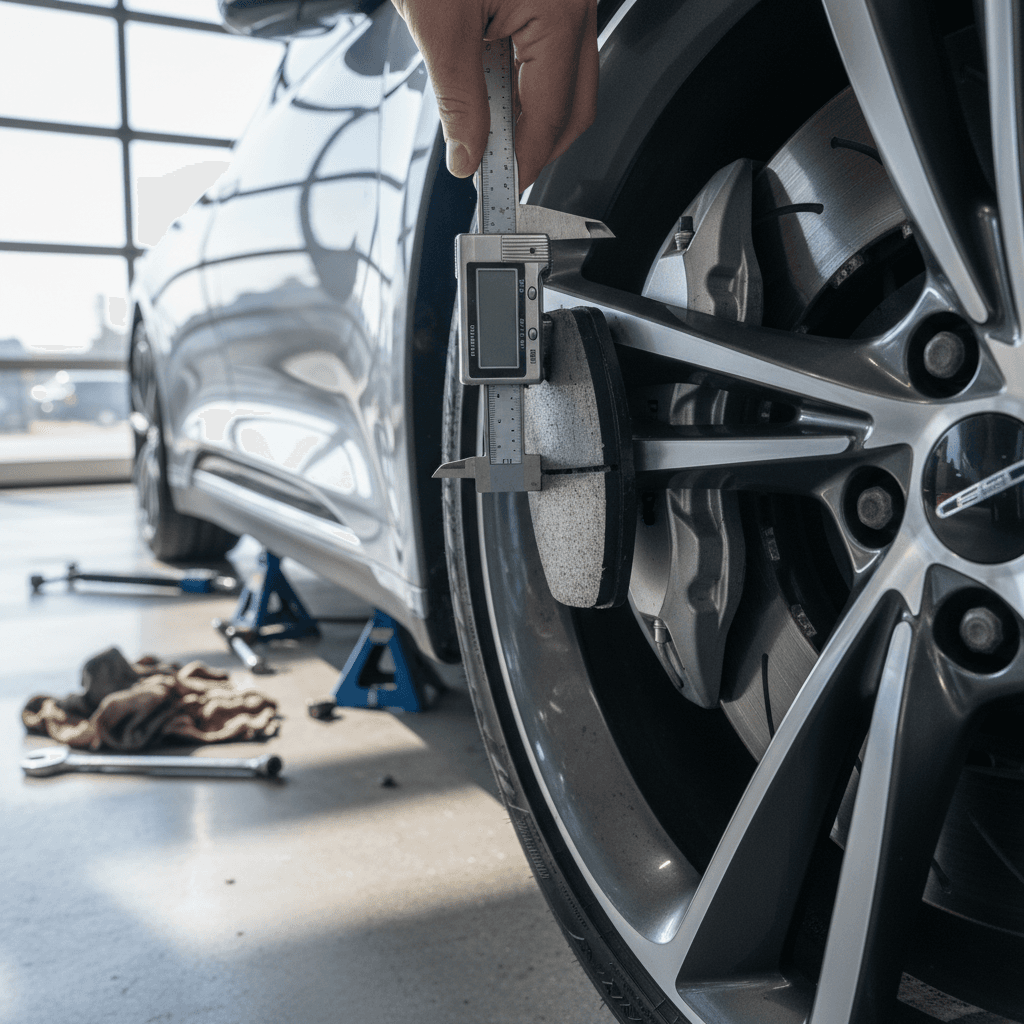
If you can see the pad through the wheel spokes and there’s barely any friction material left, typically less than 3 mm, or the rotor face looks deeply grooved and rusty, it’s time for a professional inspection.
Brake warnings are not optional
How to save money on Lucid Air brake pad replacement
You can’t turn the Lucid Air into a cheap Toyota to maintain, but you can keep its brake costs under control with a few smart strategies. Most of them revolve around prevention and picking the right shop rather than squeezing every last mile out of worn pads.
Cost‑control strategies that actually work
Save on brakes without compromising safety
Use an EV‑savvy independent shop
Prevent rust and sticking
Plan ahead, don’t panic‑buy
Used EV financing can help
Ready to find your next EV?
Browse VehiclesBrake pads and buying a used Lucid Air
For used Lucid Air shoppers, brakes are one of those boring line items that tell you a lot about how the car was used and maintained. Because pads on an Air often last a long time, the real story is whether anyone has been paying attention to the system, not how many times it’s been overhauled.
- Ask for service records showing brake inspections, pad measurements, or any pad/rotor replacements.
- Look closely (or ask for photos) of the rotor surfaces. Heavy rust ridges or deep grooves on a low‑mileage car are red flags.
- On a test drive, perform a few medium stops from 40–50 mph with regen set as you’d normally drive. Feel for pulsation, noises, or inconsistent pedal response.
- Confirm that there are no brake or stability warnings on the dash and that regen behaves consistently over a few different stops.
How Recharged evaluates Lucid brakes
Lucid Air brake pad replacement FAQ
Frequently asked questions about Lucid Air brake pad costs
Bottom line: what to budget for Lucid Air brakes
The Lucid Air’s combination of strong regenerative braking and premium hardware means your pads should last a long time, but when you finally need them, the car’s weight and performance put you in luxury EV brake pricing territory. Planning for roughly $250–$500 per axle at a good independent shop, or a bit more at a Lucid service center, is a reasonable starting point in 2026.
If you’re already an owner, prioritize regular inspections and simple preventive work to avoid corrosion‑driven surprises. If you’re shopping used, treat brakes as part of the broader total cost of ownership picture, right alongside tires and battery health. A marketplace like Recharged that surfaces brake condition in a Recharged Score Report, offers EV‑specialist support, and can help with financing and trade‑in makes it much easier to enjoy a Lucid Air without anxiety about the next big maintenance bill.