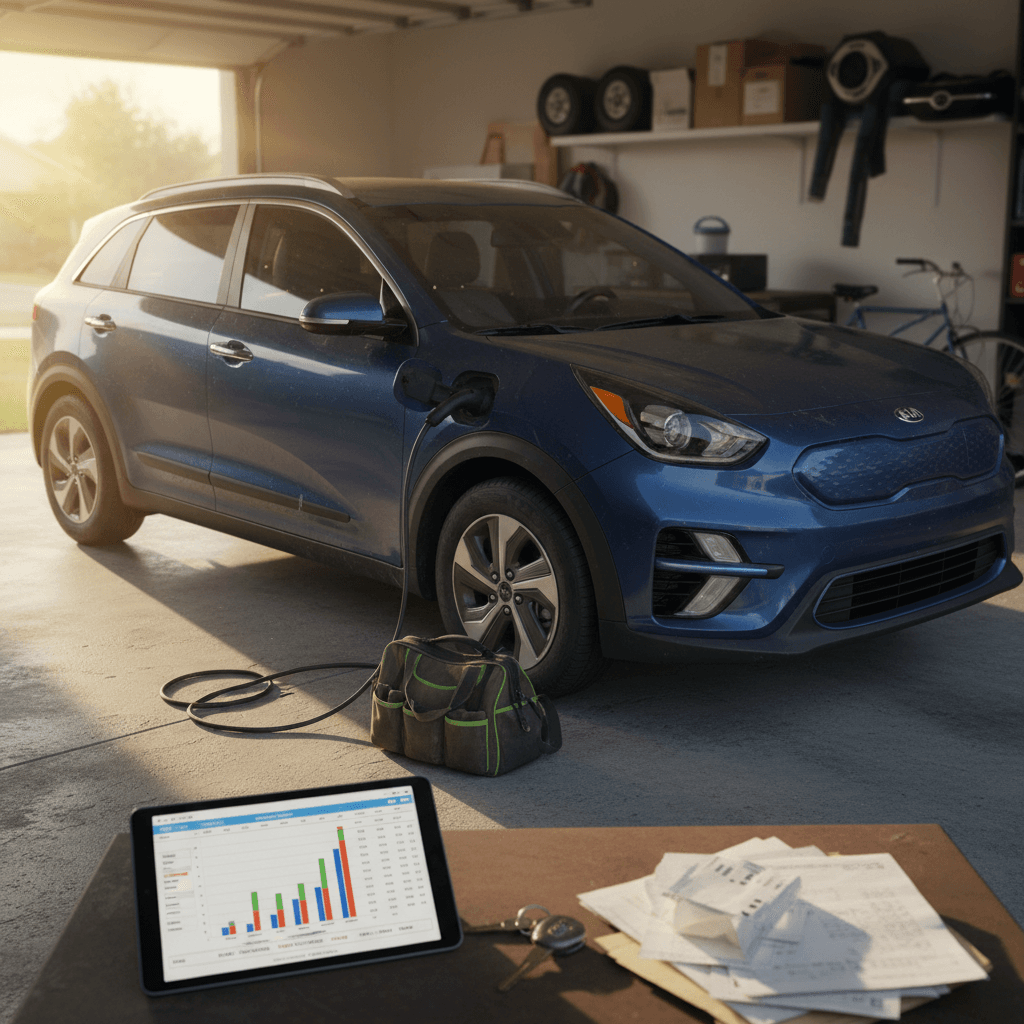
You don’t buy a Kia Niro EV just because it’s electric. You buy it because you want quiet, low‑drama commuting and you’d like your money to work harder than your engine ever did. To figure out whether that actually happens, you need to look at the Kia Niro EV true cost of ownership over 5 years, payments, charging, maintenance, insurance, and what the thing is still worth when you’re done with it.
What this guide covers
Kia Niro EV basics that shape your 5‑year costs
- Compact front‑wheel‑drive electric crossover, similar size to a Kia Seltos or Hyundai Kona.
- Battery: roughly 64–65 kWh usable in most U.S. models, with EPA range in the 230–250 mile ballpark depending on year and trim.
- Real‑world efficiency: often around 3.0–3.5 miles per kWh in mixed driving, which is excellent for a small crossover.
- Charging: AC charging up to 7.2 kW (older) or 11 kW (newer); DC fast‑charging around 75–85 kW peak in many trims, fine for road trips, great for daily duty.
- Positioning: practical, efficient commuter with low running costs, not a “performance EV.”
Key takeaway
5‑year Kia Niro EV cost of ownership: quick snapshot
Illustrative 5‑year Kia Niro EV ownership snapshot
Those are broad, realistic ballpark numbers, not guarantees. Your actual true cost of ownership over 5 years will depend on whether you buy new or used, how you drive, electricity prices where you live, and how good a deal you negotiate. So let’s break it down line by line.
Purchase price and depreciation: new vs used Niro EV
Depreciation is the silent giant in any 5‑year cost of ownership story. EVs, including the Kia Niro EV, tend to drop faster from MSRP than comparable gas models, bad news for the first owner, very good news for the second one.
Illustrative 5‑year price and depreciation for Kia Niro EV
Approximate numbers for a mainstream trim in the U.S. market, assuming normal use and no major accidents.
| Scenario | Purchase price | Estimated value after 5 years | Estimated depreciation |
|---|---|---|---|
| Buy new Niro EV | $36,000 | $20,000–$22,000 | $14,000–$16,000 |
| Buy 2‑year‑old used Niro EV | $24,000 | $16,000–$18,000 | $6,000–$8,000 |
| Buy 4‑year‑old used Niro EV | $18,000 | $11,000–$13,000 | $5,000–$7,000 |
These ranges are directional, not appraisals. Local market, mileage and condition matter, and a clean battery health report can support higher resale.
Depreciation is where new buyers get hurt
Financing and monthly payment expectations
Most people think in monthly payment, not MSRP. So let’s put the Kia Niro EV into that language. We’ll use simple, realistic assumptions to illustrate: no huge down payment, mainstream loan terms, average credit.
Sample 5‑year payment scenarios for a Kia Niro EV
Illustrative numbers only; your rate and terms will vary.
New Niro EV
Price: ~$36,000
Loan: 72 months, 7% APR
Down: $3,000
Approx. payment: around $500–$550/mo.
5‑year total paid: about $33,000 including interest and down payment.
2‑year‑old Niro EV
Price: ~$24,000
Loan: 72 months, 7% APR
Down: $2,000
Approx. payment: around $400/mo.
5‑year total paid: about $26,000 including interest and down payment.
4‑year‑old Niro EV
Price: ~$18,000
Loan: 60 months, 7.5% APR
Down: $2,000
Approx. payment: around $320–$340/mo.
5‑year total paid: about $21,000 including interest and down payment.
Where Recharged fits in
Home and public charging costs over 5 years
Charging is where the Niro EV quietly pays you back for all those years you spent in the 87‑octane aisle. Because the Niro is efficient, your electricity bill grows modestly while your fuel bill more or less disappears.
Home‑dominant charging (most owners)
Assumptions:
- 12,000 miles per year, 60,000 miles over 5 years.
- Average efficiency: ~3.2 miles per kWh.
- Electricity: about $0.14 per kWh all‑in.
- 90% of charging done at home, 10% on the road at fast chargers.
Energy used: roughly 18,750 kWh over 5 years.
Home cost: about $2,350.
Public fast‑charge cost: another $500–$800 depending on trips.
Heavy road‑trip use
If you lean hard on DC fast charging, say 40–50% of your miles, your per‑kWh cost can double relative to home rates.
- Same 60,000 miles, but half at fast chargers.
- Fast charging at $0.30–$0.45/kWh.
5‑year electricity cost: more like $6,000–$7,000. Still often cheaper than gasoline for a similar‑size crossover, but your EV’s advantage narrows.
Install home charging wisely
Maintenance, repairs and tires: where EVs win
The Kia Niro EV doesn’t need oil changes, spark plugs, timing belts, or exhaust work. What it does need is surprisingly ordinary: tires, brake fluid, cabin air filters, and a few inspections. Over 5 years, that’s typically a much calmer story than a gas crossover.
Typical 5‑year maintenance items on a Kia Niro EV
Tires: your biggest routine expense
Many Niro EVs roll on low‑rolling‑resistance all‑season tires. Driven normally, expect one full replacement set in 5 years, sometimes two if you rack up highway miles, roughly $700–$1,200 per set installed depending on brand and wheel size.
Brake pads and rotors last longer
Regenerative braking means physical brakes work less. With mostly city/suburban driving, it’s not unusual to see pads last well beyond 60,000 miles. Budget a few hundred dollars only if inspection shows wear or corrosion.
Cabin filters and basic fluids
A cabin air filter every 2–3 years, brake fluid service, and periodic coolant checks for the battery/drive system are modest line items, think a few hundred dollars total across 5 years if you follow Kia’s schedule.
Out‑of‑warranty repairs
EV drivetrains tend to be robust, but things like door locks, infotainment, or air‑conditioning can still fail. Setting aside $500–$1,000 over 5 years as a repair buffer is sensible, especially on an older used Niro.
Battery and high‑voltage components
Insurance, registration and monthly fees
Insurance for a Kia Niro EV usually lands in the same ballpark as a well‑equipped gas compact crossover, sometimes a touch higher because parts and bodywork on EVs can be pricier, sometimes lower because Niro drivers tend to skew toward the cautious side of the bell curve.
- Expect insurance to sit somewhere around $130–$200 per month for many U.S. drivers with clean records, depending heavily on location and coverage choices.
- Some states tack on annual EV registration or road‑use fees, often $100–$250 per year, to make up for lost gas taxes. Over 5 years, that can be another $500–$1,250.
- Telematics or “usage‑based” insurance can favor the Niro EV’s typical gentle commuting profile. If you don’t rack up miles or tickets, it’s worth a quote.
Watch local EV fees
Tax credits and incentives that change the math
Federal and state incentives can turn a good deal into a great one, and they’re especially powerful with used EVs, where the price is already lower thanks to depreciation.
Incentives that affect your 5‑year Niro EV cost
Always check current rules; they change by year and by state.
Federal used EV credit (when available)
Depending on current IRS rules, a qualifying used Kia Niro EV bought from a dealer may be eligible for a federal used EV tax credit, up to several thousand dollars, subject to income and price caps.
That is effectively a discount on day one, which lowers your 5‑year cost of ownership and can make your monthly payment look a lot healthier.
State and utility rebates
Some states and utilities offer rebates for buying an EV or installing a home charger. A $500–$1,000 charger rebate, or a $1,000–$2,500 EV rebate, can materially shift your 5‑year cost curve.
Before you buy, spend 15 minutes checking your state energy office and local utility websites. It’s some of the easiest money you’ll ever earn.
Stack the incentives
Why a used Kia Niro EV can be a sweet spot
If you’re chasing the lowest true cost of ownership over 5 years, the smart money often skips the showroom balloons and heads straight for the used lot, or, better yet, an online marketplace that can actually tell you what shape the battery is in.
Illustrative 5‑year total cost comparison: new vs used Niro EV
Approximate 5‑year totals for 60,000 miles, excluding taxes and fees, to show how depreciation and purchase price drive outcomes.
| Cost component (5 yrs) | New Niro EV purchase | 2‑year‑old used Niro EV |
|---|---|---|
| Depreciation | $14,000–$16,000 | $6,000–$8,000 |
| Financing interest | $3,000–$4,000 | $2,000–$3,000 |
| Electricity | $3,000–$5,000 (home‑heavy vs travel‑heavy) | $3,000–$5,000 |
| Maintenance & repairs | $1,000–$1,500 | $1,500–$2,000 (older car, more wear) |
| Insurance & fees | $8,000–$10,000 | $8,000–$10,000 |
| Estimated 5‑year total | ≈$29,000–$36,000 | ≈$24,000–$30,000 |
Again, these are broad, directional numbers, use them as a framework, not a quote.
Why Recharged leans used
How Recharged helps you predict your real Niro EV costs
Buying any used EV without understanding the battery is like buying a laptop without turning it on. It might be fine; it might be a brick with upholstery. The Kia Niro EV is generally a solid citizen, but battery health, charging history, and previous use patterns still matter for your 5‑year cost outlook.
What you get with a Kia Niro EV from Recharged
Tools designed specifically to lower your 5‑year ownership risk.
Recharged Score battery report
Every EV on Recharged comes with a Recharged Score Report that measures battery health, charging behavior and more. You’re not guessing whether the pack has been fast‑charged to death, you’re seeing the data.
Fair, market‑based pricing
Recharged benchmarks every Niro EV against the broader EV market, so the price you see already reflects depreciation, mileage and battery condition. That makes planning your 5‑year cost far less of a shot in the dark.
Financing, trade‑in & delivery
From financing and trade‑ins to nationwide delivery and in‑person help at the Recharged Experience Center in Richmond, VA, you can treat a used Niro EV purchase as a modern, fully digital process, not a weekend‑killing negotiation.
Ready to find your next EV?
Browse VehiclesFAQ: Kia Niro EV true cost of ownership
Common questions about 5‑year Kia Niro EV costs
Bottom line: is the Kia Niro EV cheap to own for 5 years?
Viewed over 5 years, the Kia Niro EV is a quietly brilliant piece of personal finance. It’s not flashy, it doesn’t dominate social media feeds, but it turns expensive gasoline into relatively cheap kilowatt‑hours and trims out a bunch of moving parts that love to fail just after the warranty expires. If you buy smart, ideally a used example with verified battery health, and mostly charge at home, your true cost of ownership over 5 years can undercut a similar gas crossover while being nicer to drive and easier to live with.
The homework is in the details: how much you pay up front, what you’re paying for electricity, what your insurer thinks of you, and how healthy the battery really is. That’s the space Recharged was built for, helping you demystify those numbers with Recharged Score Reports, fair‑value pricing, EV‑savvy financing and nationwide delivery. Do that work up front, and five years from now you’re far more likely to look back at your Niro EV as one of the best financial decisions you made on four wheels.