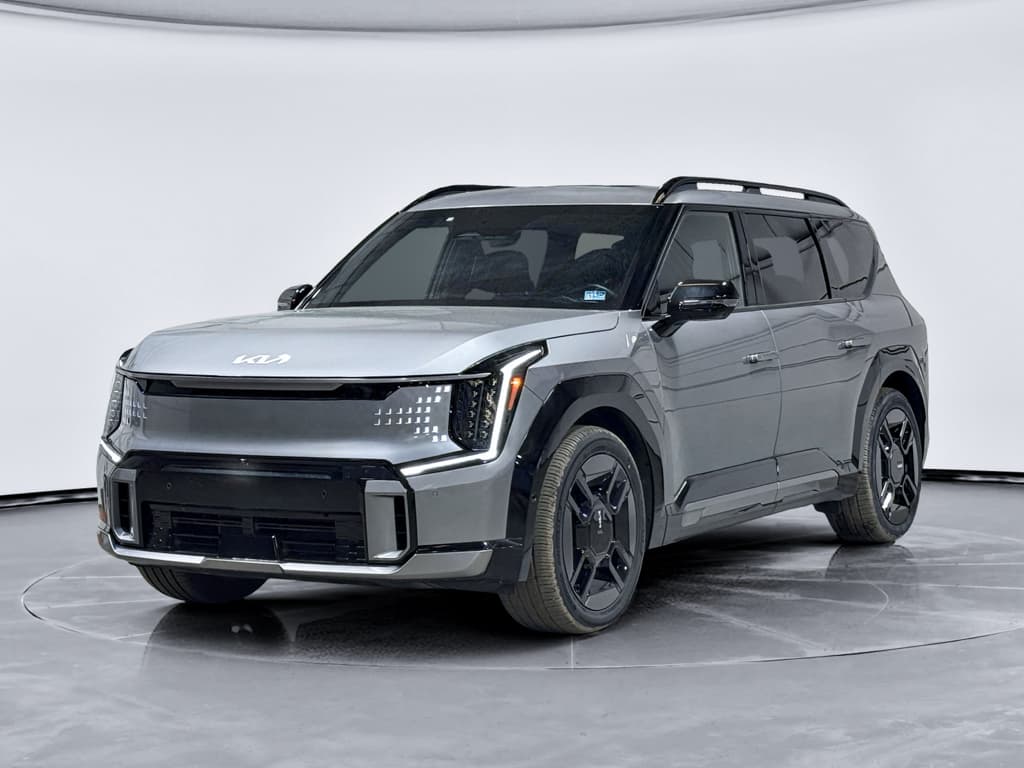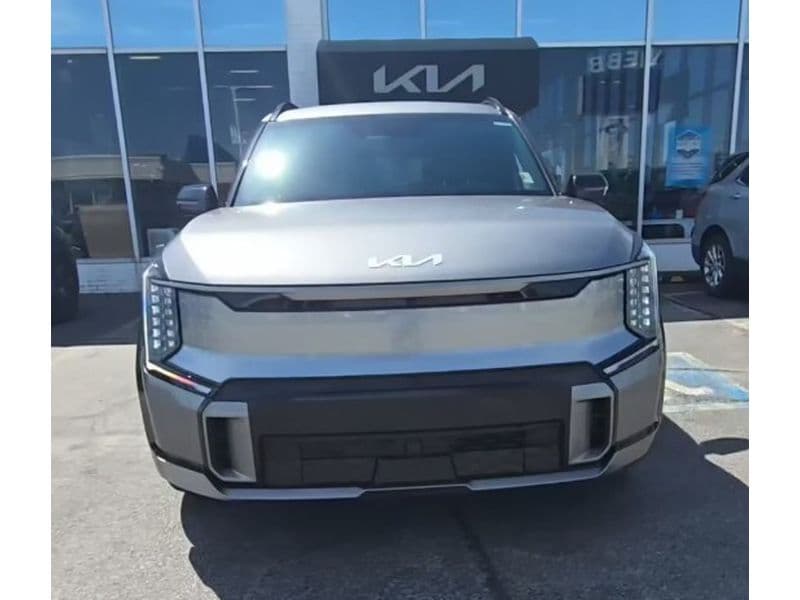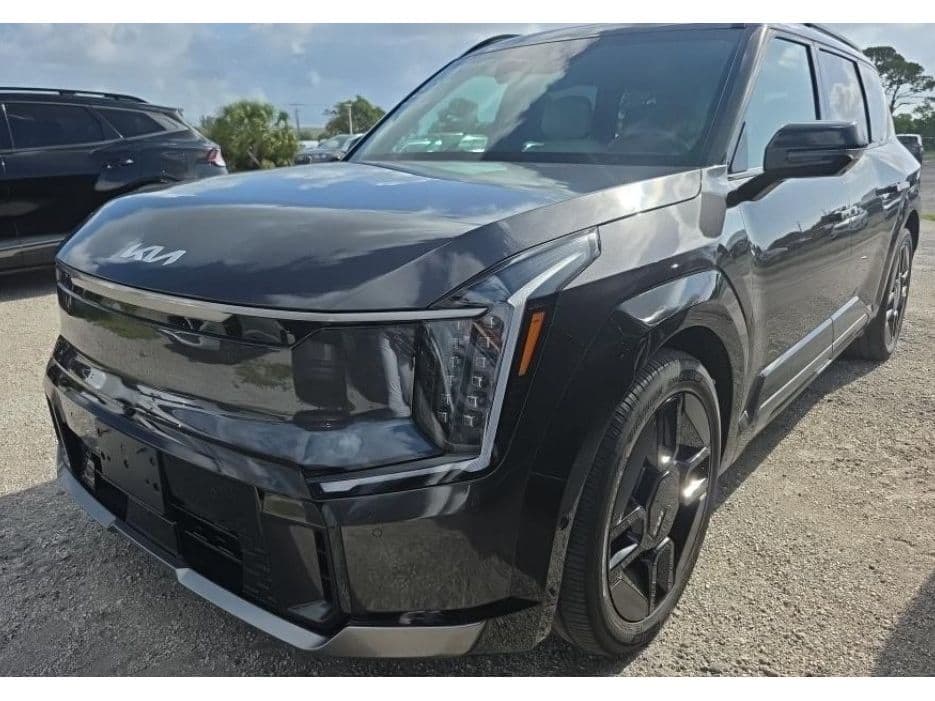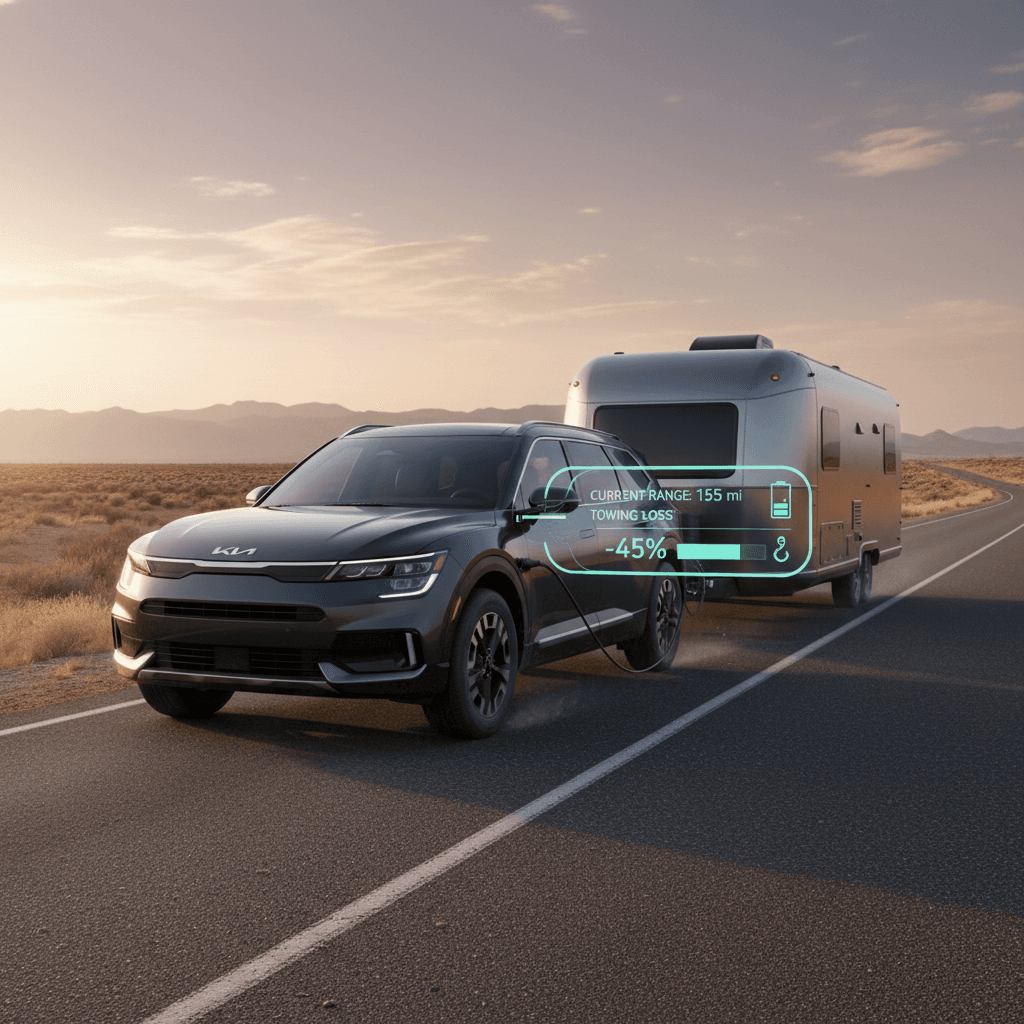
If you’re eyeing a Kia EV9 as the family road-trip rig, you’re probably wondering two things: what can it tow, and how badly does that hurt range. The good news is that the Kia EV9’s towing capacity tops out at 5,000 pounds when properly equipped. The catch is that towing can cut your effective range by a third to half, depending on your trailer and driving style.
Why towing with an EV feels different
Kia EV9 towing capacity by trim and package
In the U.S. market, Kia effectively splits the EV9 into two towing tiers. The lighter, base trims are rated for modest loads, while the higher trims with the factory tow package unlock the headline numbers you see in ads.
Kia EV9 towing capacity by trim (U.S.)
Approximate U.S. tow ratings for the 2024–2026 Kia EV9. Always confirm your exact vehicle’s rating in the owner’s manual and door jamb label.
| Trim (U.S.) | Drivetrain | Tow package | Max towing (with trailer brakes) | Max towing (no trailer brakes) |
|---|---|---|---|---|
| Light (Standard battery) | RWD | No tow package | 2,000 lbs | 1,000 lbs |
| Light Long Range | RWD | Available (varies by market/dealer) | 2,000 lbs | 1,000 lbs |
| Wind AWD | Dual-motor AWD | Factory tow package | 5,000 lbs | 1,653 lbs |
| Land AWD | Dual-motor AWD | Factory tow package | 5,000 lbs | 1,653 lbs |
| GT-Line AWD | Dual-motor AWD | Factory tow package | 5,000 lbs | 1,653 lbs |
Kia EV9 towing capacity depends on trim, drivetrain, and whether the factory tow package is installed.
“When properly equipped” really matters
- Unbraked trailers: typically limited to about 1,000–1,650 lbs on the EV9.
- Braked trailers with tow package: up to 5,000 lbs on AWD trims.
- Tongue weight: usually 10–15% of trailer weight, important for cargo loading and hitch selection.
- Payload trade-off: passengers + cargo + tongue weight all count against the EV9’s payload rating.
Kia EV9 range ratings before you add a trailer
To talk honestly about Kia EV9 towing capacity and range loss, you first need to know what you’re starting from. EPA estimates vary by trim, battery, drivetrain, and wheels, but they all orbit the same ballpark.
2024–2026 Kia EV9 EPA range snapshot (unladen)
In real U.S. highway driving at 70–75 mph without a trailer, most owners see ~2.5–2.8 mi/kWh, which usually works out to 220–260 miles of usable range on a long-haul road trip in good weather. That’s your baseline before you start hanging trailers and bikes on the back.
How much range do you lose when towing with an EV9?
There’s no single number, but based on physics, early owner data, and experience from similar-size EV SUVs, you can think in ranges rather than absolutes. The big drivers are weight, aerodynamics, speed, and temperature.
Typical Kia EV9 range loss when towing
Ballpark figures at U.S.-style highway speeds (65–70 mph) in mild weather, starting from an AWD long-range trim.
Light utility or small boat (1,000–2,000 lbs)
- Range loss: ~20–30%
- Example effective range: 170–210 miles from a 250–260 mile baseline
Medium camper or cargo (2,000–3,500 lbs)
- Range loss: ~35–45%
- Example effective range: 140–170 miles
Large travel trailer (3,500–5,000 lbs, tall & boxy)
- Range loss: ~50–60%+
- Example effective range: 100–140 miles
Why weight isn’t the whole story
Owner reports so far line up with these ranges. Light open trailers can cost an EV9 only a quarter of its range, while full-height campers tend to put you into the “half range” reality that long-time EV towers are used to.
Real-world examples: light vs. heavy trailers
Scenario 1: Small utility trailer, local runs
You’re towing a 5x8 utility trailer with lawn equipment or home-improvement supplies, about 1,200–1,500 lbs total, mostly below roofline.
- Speed: 55–65 mph, mostly suburban highway.
- Expected efficiency: ~2.0–2.3 mi/kWh.
- Effective range (AWD long range): roughly 170–190 miles between 10–90% state of charge.
For this use case, towing with an EV9 barely changes how you use the vehicle day-to-day. You’ll just charge a little more often.
Scenario 2: 4,000–5,000 lb camper, interstate road trip
Now you’re pulling a 20–23 foot, full-height travel trailer near the EV9’s rated limit, fully loaded for vacation.
- Speed: 65–70 mph, mostly interstate.
- Expected efficiency: ~1.2–1.6 mi/kWh.
- Effective range: more like 100–140 miles between practical charge stops.
This is where EV towing requires genuine planning. Your road trip becomes a series of 90–120 minute hops from one fast charger to the next.
Key factors that drive EV9 range loss while towing
What really affects your towing range
You control more of this than you might think.
1. Aerodynamic drag
The EV9 is already a big brick pushing air; a tall trailer adds another brick. Drag rises with the square of speed, so 75 mph is dramatically worse than 60 mph.
2. Trailer weight & rolling resistance
Heavier trailers increase tire deformation and rolling losses. Big off-road tires or underinflated trailer tires can sap efficiency even more.
3. Temperature & climate control
Cold weather thickens lubricants and increases HVAC demand. Heating both the cabin and sometimes the pack can easily chop another 10–20% off your towing range.
4. Terrain & wind
Long grades and headwinds are brutal. A steady uphill climb with a crosswind can feel like towing a trailer that magically got 1,000 lbs heavier.
5. Speed & driving style
Smooth driving, staying in Eco mode, and holding 60–65 mph instead of 75 mph often makes the difference between a stressful and a relaxed towing day.
6. State of charge window you use
If you tow mostly between 15–80% instead of 5–100% to protect the battery and keep fast charging quick, your effective towing range shrinks, even if the physics are unchanged.
Slow down to go farther
Planning road trips with a towing Kia EV9
EV towing isn’t about finding a magic number; it’s about building a conservative plan and then adjusting with real data. Here’s how to translate the Kia EV9’s towing capacity and range loss into a workable trip plan.
Step-by-step: building a realistic EV9 towing plan
1. Start with the right baseline range
Use the <strong>lower of</strong> your trim’s EPA rating or your own unladen highway experience. If your Land AWD normally does ~240 highway miles, use that as your starting point.
2. Apply a conservative towing discount
For a mid-size camper, assume <strong>40–50% range loss</strong> on the first trip. If you expect 240 miles unladen, plan around 120–140 miles per leg at most.
3. Limit your charge window
To keep fast charging quick and protect the battery, plan to stay mostly between <strong>10–80%</strong>. You’ll rarely want to sit around from 80–100% unless you truly need the range.
4. Use EV trip-planning tools
Apps like A Better Routeplanner (ABRP) let you plug in a trailer consumption multiplier (for example, 1.6–2.0× normal). This gives you a first-pass route with realistic stop spacing.
5. Pre-check charger access with a trailer
Look at satellite view for each station. Can you pull through or park along the curb? Or will you need to unhitch? Factor that hassle into your route and stop choices.
6. Adjust after the first leg
Watch your live mi/kWh on the first 50–100 miles. If you’re beating your estimate, you can stretch legs slightly; if you’re doing worse, tighten your margins and slow down.
Charging while towing: strategy and station etiquette
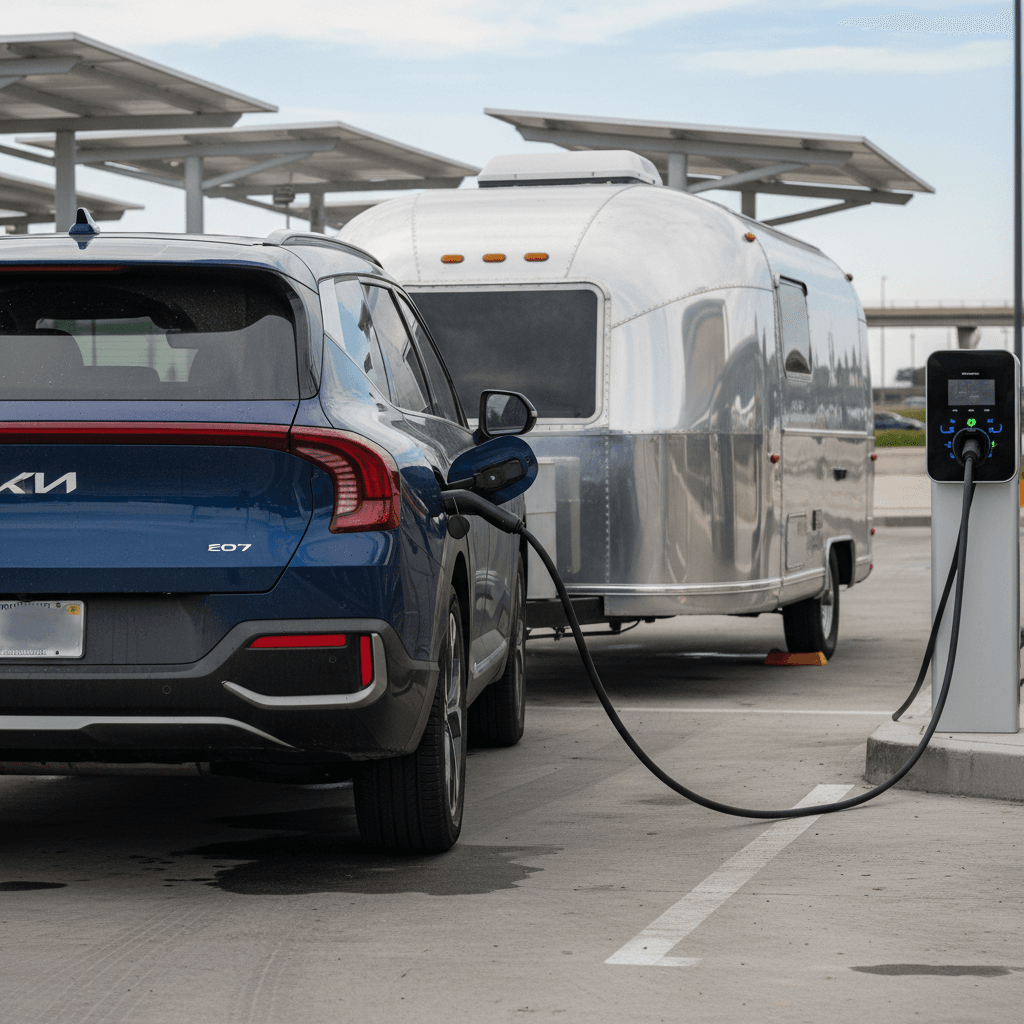
The EV9’s 800-volt E-GMP platform lets it pull strong DC fast-charging rates, which helps offset the extra stops that towing demands. But vanilla charging behavior that works in a solo EV doesn’t always translate when you’ve got a camper on the back.
Best practices for charging an EV9 with a trailer
These small habits make towing life much easier, for you and everyone else.
Choose trailer-friendly chargers
- Favor sites with pull-through spots (often along the edge of a lot or at newer highway sites).
- Look for chargers on the outer rows where you can angle in without blocking lanes.
- Consider slightly slower but easier-to-access sites over ultra-fast but cramped ones.
Don’t be “that” trailer at the station
- If you must block multiple stalls, try to charge at off-peak times.
- Where feasible and safe, unhitch and park the trailer nearby before charging.
- Leave as soon as you hit your planned state of charge; no long lunches on the cable.
Work with, not against, the charge curve
- Plan shorter hops (90–130 miles) and charge more often to ~70–80% instead of doing long, slow sessions.
- Use preconditioning when available so the pack is warm when you reach the charger.
Have a Plan B (and C)
- When towing, always know the next two chargers in range.
- If one site is full or down, you don’t want to improvise with a 5,000 lb trailer behind you and 8% left.
Protecting your battery while towing
Towing doesn’t inherently “kill” EV batteries, but it does mean higher sustained loads and more frequent DC fast charging. If you’re planning to tow regularly, especially with a used EV9, it’s worth building a few battery-friendly habits into your routine.
Avoid living at the extremes
- Use Eco or normal drive modes when towing; sport modes add unnecessary stress and wheelspin risk.
- When you don’t need the range, keep daily charging under ~80% to reduce time at high state of charge.
- On long trips, try to arrive at fast chargers between 5–20% and unplug around 70–85% unless you truly need the extra buffer.
- Give the car a few minutes after hard climbs or long towing stints before immediately fast-charging at max power.
- If you’re buying a used Kia EV9 for towing, ask for a battery health report, Recharged provides a Recharged Score with verified pack diagnostics on every used EV we list.
Is the Kia EV9 actually good for towing?
On paper, the Kia EV9 looks like the electric equivalent of a Telluride: three rows, real SUV proportions, and up to 5,000 lbs of towing capacity. In practice, it’s a mixed bag, strong in some areas, with predictable EV-specific compromises in others.
Where the EV9 shines as a tow vehicle
- High rated capacity: 5,000 lbs is competitive with many gas three-row SUVs.
- Instant torque: Dual-motor AWD trims pull confidently up to speed, even on grades.
- Stable platform: Long wheelbase, available self-leveling rear suspension, and low center of gravity make it composed with a trailer.
- Fast DC charging: The 800V system means you can recover meaningful range in 20–30 minutes when conditions are right.
- Quiet powertrain: No engine noise makes long towing days less fatiguing.
Where you’ll feel the compromises
- Frequent stops with big campers: 100–150 mile towing legs are normal for tall, heavy trailers.
- Charging logistics: Many existing fast chargers were not designed with trailers in mind, you may have to unhitch or block lanes.
- High consumption at speed: A big, blunt SUV plus a big, blunt trailer is worst-case aerodynamics for an EV.
- Payload juggling: With passengers, camping gear, and tongue weight, it’s easy to bump into payload limits.
Who the EV9 is perfect for
Kia EV9 towing capacity & range loss: FAQ
Frequently asked questions about Kia EV9 towing & range loss
The Kia EV9 is one of the first mass-market EVs that can credibly replace a gas three-row SUV for family duty and light-to-medium towing. Its towing capacity, up to 5,000 lbs, and comfortable cabin are the easy part; accepting the range loss that comes with a big trailer is where expectations need to shift. If you plan around 100–150 mile legs with a tall camper, choose trailer-friendly chargers, and treat the battery kindly, the EV9 can be a compelling all-electric tow rig. And if you’re considering a used EV9, working with a retailer like Recharged that provides verified battery health and expert EV guidance can make sure the SUV you buy is ready for the adventures you’re planning.