Kia didn’t just build another electric crossover with the EV9, it built one of the first genuinely family-ready, three-row electric SUVs. But once you’re sold on the idea, you hit the real headache: **Kia EV9 Light vs Wind vs Land vs GT-Line**. Same body, same basic battery, wildly different prices and equipment. Which one actually makes sense for how you drive and what you tow?
Model years covered
Kia EV9 trims at a glance
All EV9 trims share the same three-row body, E‑GMP 800V architecture, and core safety tech. The differences come down to **battery size, driven wheels (RWD vs AWD), equipment, and tuning**. Here’s the high-level picture before we go deep.
Kia EV9 trims: quick side‑by‑side
Core layout and capability differences between EV9 Light, Wind, Land and GT-Line.
| Trim | Drivetrain | Battery | Seats | EPA Range (approx.) | Max Tow Rating |
|---|---|---|---|---|---|
| Light (Short Range) | RWD, single motor | 76.1 kWh | 7 (bench) | ~223–230 mi | 2,000 lbs |
| Light Long Range | RWD, single motor | 99.8 kWh | 6 (captain’s chairs) or 7* | ~300–304 mi | 2,000 lbs |
| Wind | AWD, dual motor | 99.8 kWh | 7 (bench) | ~280 mi | 3,500–5,000 lbs** |
| Land | AWD, dual motor | 99.8 kWh | 6 (captain’s chairs) | ~253–280 mi | 5,000 lbs |
| GT-Line | AWD, dual motor (higher output) | 99.8 kWh | 6 (captain’s chairs) | ~270 mi | 5,000 lbs |
Exact equipment can vary slightly by model year and option packages, especially on used EV9s.
Footnotes that matter
Why the EV9 trim choice really matters
Price & value: Light vs Wind vs Land vs GT-Line
New or used, the first thing most shoppers see is the spread between base Light and top GT‑Line. For 2025–2026 model years in the U.S., MSRP (before destination, taxes, or incentives) lines up roughly like this:
Approximate new MSRP by EV9 trim (2025–2026)
Representative base MSRPs; individual vehicles may differ based on options, incentives, and later price adjustments.
| Trim | 2025 MSRP (approx.) | 2026 MSRP (approx.) | What changes |
|---|---|---|---|
| Light Short Range | ~$54,900–$56,200 | ~$54,900 | Entry price holds steady; smallest battery. |
| Light Long Range | ~$59,900–$61,400 | ~$57,900 | Price dipped for 2026 while keeping the big battery. |
| Wind (AWD) | ~$63,900–$65,400 | ~$63,900 | Middle‑trim sweet spot; price broadly stable. |
| Land (AWD) | ~$69,900–$71,400 | ~$68,900 | Adds luxury kit; modest price trim for 2026. |
| GT-Line (AWD) | ~$73,900–$75,400 | ~$71,900 | Top dog; 2026 models see a noticeable price drop. |
Destination charges (~$1,495) and local incentives are typically added on top of these figures.
How this plays out on the used market
Real‑world value by trim
Where each EV9 trim delivers the most bang for your buck
Light (Short Range) – budget entry
If you mostly drive locally, live in a warm climate, and want the cheapest path into an EV9, the base Light can make sense. You sacrifice range, towing, and some comfort features, but the three-row packaging and safety tech are still there.
Light Long Range – range value
This trim pairs the big 99.8 kWh battery with RWD efficiency. It’s the longest-range EV9, ideal for highway commuters or families who road‑trip but don’t need AWD traction.
Wind – value sweet spot
Wind adds dual‑motor AWD and more equipment while keeping price below Land. For many buyers, it’s the best all‑weather, all‑rounder balance of price, power, and features.
Land & GT-Line – luxury and performance
Land piles on comfort and tech, ventilated rear seats, premium audio, ambient lighting, while GT-Line adds sportier tuning and styling. You pay for it, but you feel it every day if you care about refinement.
Battery, range & charging by trim
Under the skin, every EV9 sits on Hyundai–Kia’s E‑GMP platform with an 800‑volt architecture. That means **very fast DC charging across the board** compared with most non‑Tesla rivals. The main variable is battery size and motor configuration.
Kia EV9 battery & range by trim
EPA figures for early model years; later tweaks and wheel choices can move these a few miles in either direction.
| Trim | Battery | Drivetrain | EPA Range (approx.) | Notable charging traits |
|---|---|---|---|---|
| Light (Short Range) | 76.1 kWh | RWD | ~223–230 mi | Slightly smaller pack but can peak at very high DC rates. |
| Light Long Range | 99.8 kWh | RWD | ~300–304 mi | Longest‑range EV9; most efficient on highway. |
| Wind | 99.8 kWh | AWD | ~270–280 mi | Dual motors eat some range but add traction. |
| Land | 99.8 kWh | AWD | ~253–280 mi | Heavier, especially with 20" wheels, so range dips. |
| GT-Line | 99.8 kWh | AWD, higher output | ~270 mi | Sportier tune but still solid range for a big three‑row. |
Think of these as ballpark numbers for cross‑shopping. Always check the specific vehicle’s Monroney or window sticker for the official rating.
Charging reality check
When range matters most
If you regularly drive 200+ miles in a day, especially in cold climates, start your search with Light Long Range. Its combination of big battery and RWD efficiency gives the largest buffer for winter penalties, headwinds, and roof boxes.
When you can compromise a bit
If your use case is mostly suburban duty with occasional trips, a Wind or Land still offers competitive real‑world range, plus AWD security. Even the GT-Line’s ~270 miles compares well to other three‑row EVs today.
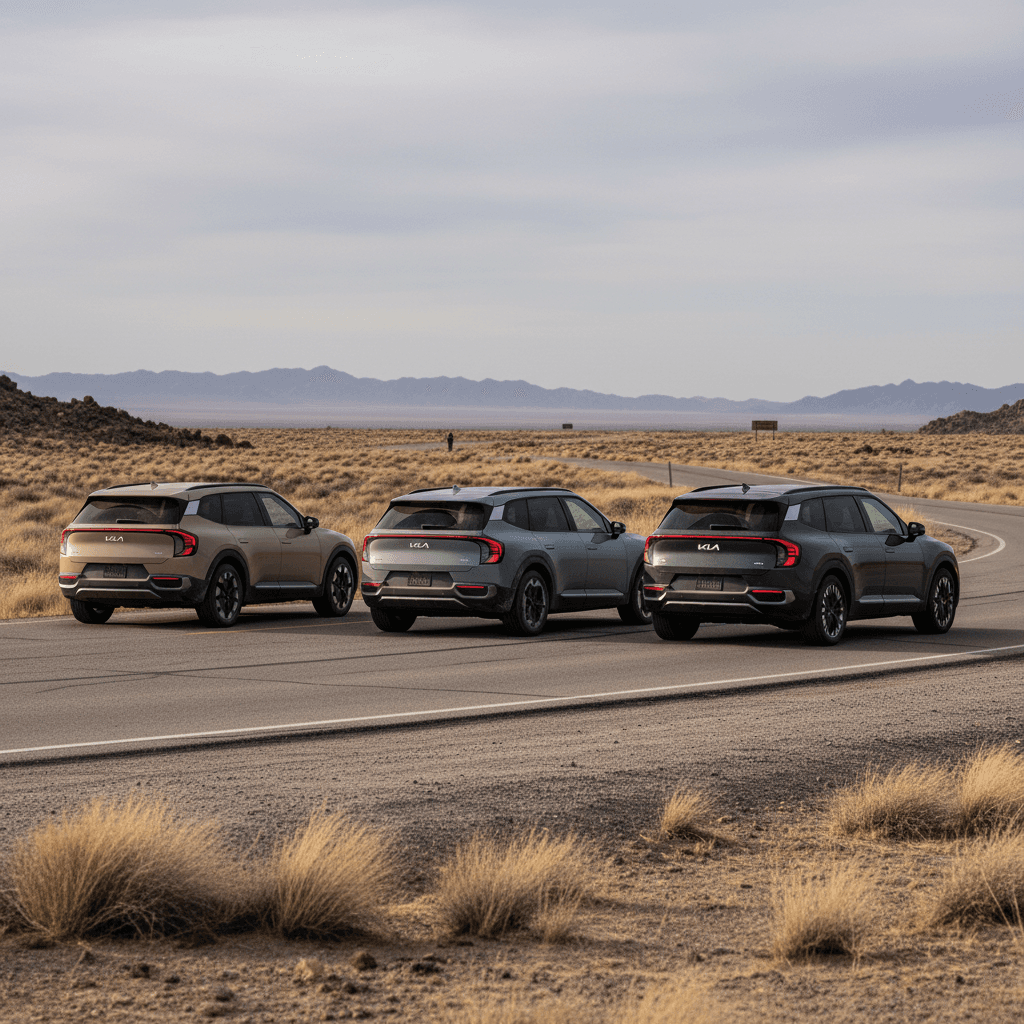
Performance & towing: Which EV9 can do what?
Power figures vary a bit by market and software, but the pattern is straightforward: **single‑motor RWD EV9s prioritize efficiency, dual‑motor AWD trims prioritize traction and acceleration**. Towing capability also scales quickly as you move up the ladder.
Kia EV9 power & towing by trim (U.S.)
Representative performance and tow ratings; always verify the specific VIN’s ratings before you hitch a trailer.
| Trim | Motors & Output (approx.) | 0–60 mph (est.) | Max Tow Rating | Best for |
|---|---|---|---|---|
| Light (Short Range) | Single motor RWD, ~215 hp | ~8.0–8.5 s | 2,000 lbs | School runs, local errands, light utility. |
| Light Long Range | Single motor RWD, ~201 hp | ~8.5–9.0 s | 2,000 lbs | Max range, mild climates, no heavy towing. |
| Wind | Dual‑motor AWD, ~380 hp | ~5.7 s (or ~5.0 s w/ Boost) | 3,500–5,000 lbs* | All‑weather traction, moderate towing, punchy acceleration. |
| Land | Dual‑motor AWD, ~380 hp | ~5.7 s (or ~5.0 s w/ Boost) | 5,000 lbs | Family towing and comfort road‑trips. |
| GT-Line | Dual‑motor AWD high‑output, ~380+ hp w/sport tune | ~5.0 s | 5,000 lbs | Quickest launches, most capable towing spec. |
Towing at highway speeds will significantly reduce any EV’s real‑world range, often by 40–60%.
Towing with an EV9: don’t wing it
- If you never tow, you’re paying for unused capability when you skip Light trims for Land or GT-Line.
- If you tow occasionally and lightly (small utility trailer, a pair of jet skis), Wind’s lower price can make more sense than Land.
- If you tow campers or boats, skip straight to Land or GT-Line and accept that you’ll live closer to chargers on tow trips.
Features & comfort: What you actually live with
The spec sheets make all EV9s look well‑equipped, because they are. But the day‑to‑day feel of a Light vs Land vs GT-Line is dramatically different. Here’s how the experience changes as you climb the ladder.
Key comfort & tech differences by trim
What you notice in the first 5 minutes behind the wheel
Light / Light Long Range
- Heated & ventilated front seats
- Twin 12.3" screens plus 5" climate screen
- Seven seats (bench) on Light; captain’s chairs often on Light LR
- Strong baseline of driver‑assist tech (Highway Driving Assist, etc.)
Wind
- Adds dual‑panel sunroof (model‑year dependent)
- Heat pump for more efficient cabin heating
- Heated steering wheel
- Roof rails, extra convenience touches for active families
Land
- Standard captain’s chairs (6‑seat layout)
- 20" wheels and upgraded exterior lighting
- Heated & ventilated second row
- Meridian premium audio, ambient lighting, surround‑view camera
GT-Line
- Most aggressive exterior styling
- Higher‑output AWD tune with sportier feel
- Top‑end driver‑assist and lighting options
- Unique wheels and interior trim details
Seating realities
Captain’s chairs (common on Light Long Range, Land, GT-Line) improve adult comfort and kid access to the third row, but cut maximum passenger count to six. If you truly need seven seats regularly, prioritize Light or Wind with a second‑row bench.
Noise & refinement
Wind already feels grown‑up, but Land and GT-Line add extra acoustic glass and sound‑deadening, which you’ll notice on coarse highways. If you’re sensitive to noise, the upgrade can feel bigger than the spec sheets imply.
The “don’t overthink it” rule
Which Kia EV9 trim is best for you?
Picking trims by VIN instead of brochure copy is where things get real. Here’s how to narrow it down based on how you actually drive, not how automakers hope you’ll see yourself.
EV9 trim recommendations by use case
Daily suburban family duty
Mostly trips under 60 miles a day, with occasional weekend outings.
You don’t tow, or only tow very light loads once or twice a year.
You want a calm, comfortable cabin more than the quickest 0–60.
Road-trip heavy families
You regularly drive 150–250 miles in a day with kids and cargo.
You care about DC fast‑charging stops and want range headroom.
You may run a roof box or hitch rack that eats into efficiency.
Outdoors & towing crowd
You plan to tow a camper, boat, or toys several times a year.
You drive on snow, dirt, or gravel enough to value AWD traction.
You’re willing to plan charging around campgrounds and DC stations.
Enthusiasts & early adopters
You value distinctive styling, the quickest tune, and top tech.
You’re fine trading some efficiency and money for feel‑good features.
You want something that still feels special in five years.
If you’re mostly local
Look at Light and Light Long Range. In warm states with good public charging, the short‑range Light can be a bargain family shuttle. If you road‑trip even once or twice a year, the Light Long Range’s extra battery is cheap insurance.
If you need an all‑weather family EV
Wind is the go‑to recommendation. You get AWD, good range, and core comfort features without paying for every luxury box. If you want quieter highway manners, captain’s chairs, and a genuinely premium feel, step up to Land.
The GT-Line is fantastic if you like top‑spec cars, but from a purely rational standpoint, a well‑equipped Land or even a Wind with the right options will cover 95% of what real families ask of a three‑row EV.
Think in total cost, not just MSRP
Buying a used Kia EV9: What to watch for
By 2026, the earliest EV9s are already cycling into the used market. That’s good news for buyers, but a three‑row EV is a complex piece of hardware. Trim choice is only half the story; battery health, software, and prior use matter just as much.
Used EV9 checklist: beyond trim names
Confirm the exact trim and options
Don’t rely on ads that just say “EV9 Wind.” Verify the build sheet or window sticker: seating layout, wheel size, tow package, and any software‑locked features can all change the experience.
Check battery health, not just mileage
Two EV9s with identical miles can have very different battery histories depending on DC fast‑charging habits and climate. A proper battery health report gives you much more confidence than odometer alone.
Understand prior use (especially towing)
Frequent heavy towing or max‑payload road trips aren’t a deal‑breaker, but they do put more thermal stress on the pack and drive units. Ask how the vehicle was used, and look for signs of hitch wear.
Inspect tires, brakes and suspension
EV9s are heavy. Worn tires, tired shocks, or marginal brakes can turn a great EV into a sloppy one. On a test drive, listen for suspension clunks and feel for vibration under braking.
Verify software and recall status
Make sure the EV9 has current firmware and that any recalls or service campaigns have been performed. Over‑the‑air updates can change charging behavior, range estimates, and driver‑assist performance.
How Recharged fits into this
Kia EV9 Light vs Wind vs Land vs GT-Line FAQ
Frequently asked questions about EV9 trims
The Kia EV9 lineup looks simple on paper, Light, Wind, Land, GT-Line, but each step up represents a different philosophy: efficiency vs traction, value vs luxury, towing vs speed. If you keep your actual use case front and center, how far you drive, what you tow, how many people you carry, it’s much easier to see where you can save money and where cutting corners would make the vehicle worse for you. And if you’re looking at a used EV9, pairing the right trim with verified battery health and transparent pricing turns a complicated three‑row flagship into a straightforward, confident purchase.