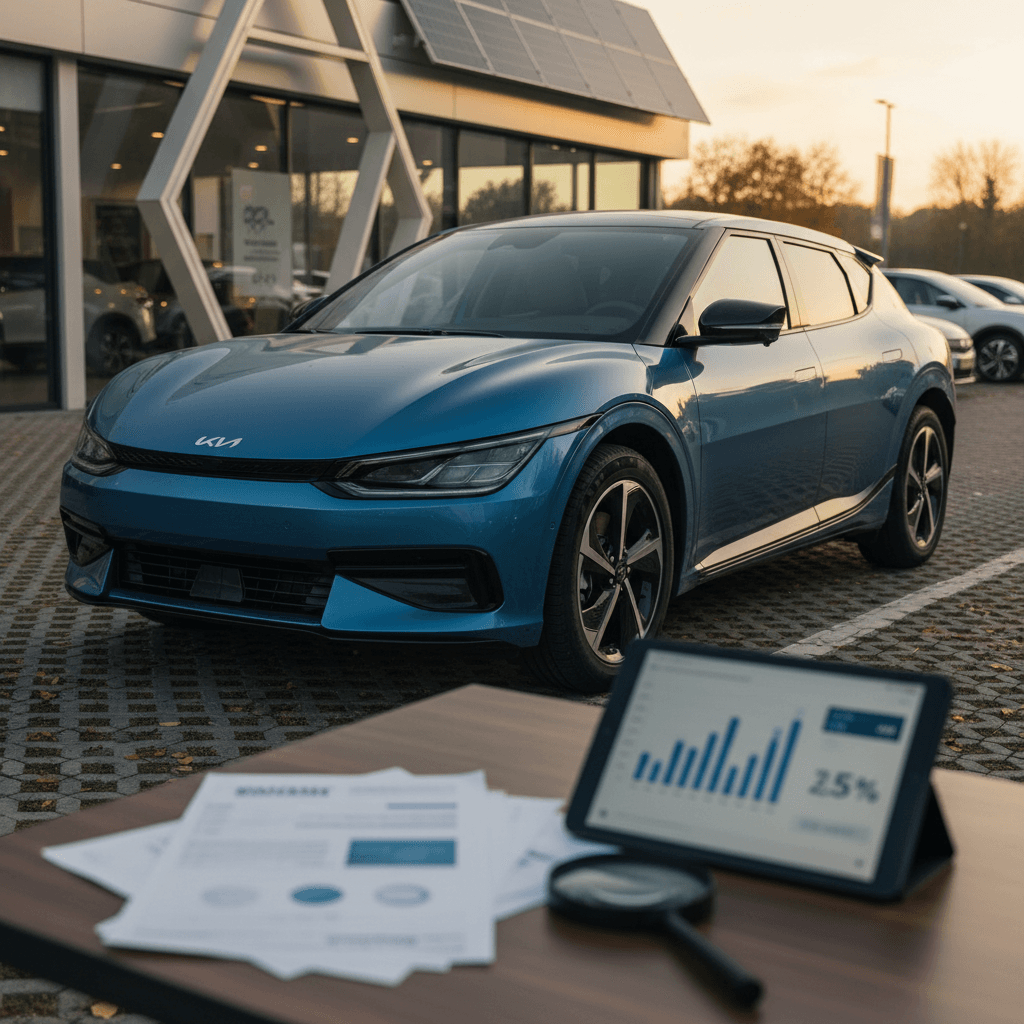
You’re eyeing a used Kia EV6 in 2025 and the prices are all over the map. One dealer wants new‑car money for a two‑year‑old Wind AWD; a private seller’s GT‑Line looks suspiciously cheap. So what’s a fair price for a used Kia EV6 in 2025, and how do you know when to walk away?
Context: why 2025 is a strange year
Why used Kia EV6 prices are weird in 2025
When the EV6 launched for 2022, it was the cool Korean kid with Porsche Taycan vibes and Hyundai‑Kia’s ultra‑fast 800‑volt charging hardware. By 2025, it’s facing a crowd of rivals and a shopper base that knows a lot more about range, degradation, and incentives. New 2025 EV6 models now come with updated batteries, up to about 319 miles of EPA range on certain trims, and native NACS ports for Tesla Supercharger access, which quietly drags down prices on the older CCS‑only cars.
At the same time, real‑world data shows that early EV6s have seen sharper‑than‑average depreciation. Some estimates put a 2022–2023 EV6 down roughly 40–45% from MSRP by year two, depending on trim and mileage. That sounds scary if you bought new, but it’s great news if you’re shopping used. Your job now is to turn that macro‑trend into an individual, concrete number for the car in front of you.
Kia EV6 value snapshot for 2025 shoppers
Numbers are guideposts, not gospel
Quick answer: fair price ranges for a used Kia EV6 in 2025
Fair used price ranges for Kia EV6 in 2025 (typical trims, average miles)
Ballpark “fair deal” ranges assuming clean history, no major cosmetic damage, and mileage that roughly matches model year. Subtract a few thousand for rougher examples; add for low‑milers or rare option packages.
| Model year | Typical trims in this band | Miles (approx.) | Good-value private sale | Good-value dealer/retail |
|---|---|---|---|---|
| 2022 | Light / Wind RWD, some AWD | 35,000–55,000 | $24,000–$29,000 | $26,500–$31,500 |
| 2023 | Light LR, Wind, some GT‑Line | 25,000–45,000 | $27,000–$33,000 | $29,500–$36,000 |
| 2024 | Light LR, Wind, GT‑Line (mostly CCS) | 15,000–30,000 | $31,000–$38,000 | $33,500–$41,000 |
| Early 2025 (used/demo) | Light, Light LR (with NACS) | Under 15,000 | $37,000–$43,000 | $39,000–$45,000 |
Use this as a starting point, then adjust for trim, mileage, battery health, and local market.
How to use this table
How the Kia EV6 depreciates vs expectations
Traditional wisdom said EVs would crater in value. The EV6 mostly obeyed that prophecy. Early data for 2022–2023 cars shows a one‑year slide of a bit over 20% from MSRP into the high‑$30,000s, and around 40% or more off sticker by year two for many trims. That’s steeper than a comparable gas crossover, but in line with the 2020s EV price rollercoaster.
What pushes EV6 prices down
- New‑car discounts: Automakers have been cutting prices and offering low‑APR deals to keep EV sales growing.
- Fast tech turnover: 2025 EV6s gain bigger batteries, cleaner styling, and native NACS ports, making earlier years feel older, faster.
- Lost tax credits: As federal credits phase out for some new EVs, the pricing chessboard keeps moving.
What props EV6 prices up
- Charging speed: The EV6 remains one of the quickest‑charging EVs you can buy at any price.
- Design and cabin: Still looks and feels fresh next to newer rivals.
- Warranty: Kia’s battery and powertrain warranties transfer, which reassures used buyers.
Where the value sweet spot lives
Trims, batteries, and options that move the price
All EV6s share the same basic sculpture, but underneath you’ve got a tangle of trims and battery sizes. Understanding them turns a mysterious asking price into a number you can actually judge.
Core Kia EV6 trims and how they price on the used market
Prices increase as you add battery capacity, power, and features.
Light / Light Long Range
Role: Value and range sweet spot.
- Early years: 58 kWh (shorter range) and 77.4 kWh packs.
- 2025: 63 kWh and 84 kWh packs with improved range.
- Usually the best price‑per‑mile choice used.
Wind / GT‑Line
Role: Comfort and style.
- 77.4 / 84 kWh batteries with solid range.
- Heated/ventilated seats, nicer audio, more tech.
- Expect to pay $2k–$4k more than a comparable Light LR.
GT (performance)
Role: Straight‑line lunacy.
- Up to ~576 hp, AWD, big brakes.
- Shortest range and pricey tires.
- Used GTs often command a $5k–$10k premium over non‑GT cars of same year.
NACS vs CCS: why 2025 cars may cost more
- Add $1,000–$2,000 for dual‑motor AWD versus RWD on the same trim and year.
- Add $500–$1,500 for desirable packages (Meridian audio, panoramic roof, advanced driver‑assist bundles) when they’re well advertised in the listing.
- Subtract $1,000–$3,000 for unpopular colors, worn wheels and tires, or obviously missing features buyers in your region expect (heated seats in cold climates, for instance).
Mileage, condition, and battery health: the big three
When you’re pricing a used EV6, trim and model year get you in the stadium. Mileage, condition, and battery health decide which section you’re actually sitting in.
How non‑obvious factors can swing EV6 value
Three cars, same year, three very different fair prices.
High‑miler commuter
2022 EV6 Wind RWD, 60,000 miles, lots of highway use.
- Pricing should sit at the bottom of the 2022 range table.
- Budget for earlier tire and brake work.
- Good candidate if you drive less than the previous owner did.
Garage queen
2023 EV6 GT‑Line AWD, 18,000 miles, great records.
- Reasonable to be $2k–$4k above mid‑range prices.
- Battery likely closer to original usable capacity.
- Check it hasn’t just been sitting at 100% charge constantly.
Battery‑question mark
2022 EV6 Light LR, 40,000 miles, range seems low.
- Range test shows notably less than expected for that trim.
- Pricing should be discounted heavily until battery health is verified.
- Use this to negotiate, or walk.
Do not skip a battery health check
Mini‑checklist: judging a used EV6’s condition fairly
1. Compare odometer to model year
Rough yardstick: 10,000–15,000 miles per year is normal. If a 2022 EV6 is already over 60,000 miles, it belongs at the lower end of any fair‑price range.
2. Look past detailing
Fresh ceramic coating can’t hide curb‑rashed wheels, mismatched paint, or uneven panel gaps. Those point to a harder life, or prior accident repairs.
3. Ask for a battery health report
Ideal: a third‑party diagnostic like the <strong>Recharged Score</strong>. At minimum, do a full‑to‑low range test and compare to the trim’s quoted EPA figure, adjusting for weather and driving style.
4. Scan the Carfax/AutoCheck carefully
Multiple owners, auctions, or accident entries don’t automatically kill the deal, but they should move the price down compared with a one‑owner, clean‑history car.
5. Inspect tires and brakes
A set of performance tires on an EV6 GT can cost four figures. Worn tires or rotors are negotiation ammo: you’ll be paying that bill soon.
6. Test fast‑charging behavior
If possible, plug into a DC fast charger. An EV6 that refuses to take a charge anywhere near its expected peak rate may deserve a discount until diagnosed.
Tax credits, incentives, and sneaky fees in 2025
In 2025, incentives around the EV6 are a moving target, and that absolutely affects what “fair” looks like. A price you’d accept from a private seller might be too high from a dealer that’s also capturing a tax credit or padding the deal with junk fees.
Federal used EV credit (through Sept 30, 2025)
Through September 30, 2025, many buyers can claim up to $4,000 for a qualifying used EV purchased from a dealer, including older EV6s, if:
- Your income is under the federal cap for your filing status.
- The EV6 is at least two model years older than the year you buy it.
- The sale price is below the used‑EV cap for that program.
Always confirm current IRS and Department of Energy guidance before counting on the credit, rules can change, and some credits are being phased out after late 2025.
Dealer fees that quietly ruin a fair price
- “Market adjustment” add‑ons: The EV6 isn’t exotic in 2025; big markups are pure fluff.
- Mandatory add‑ons: Nitrogen, VIN etching, ceramic, and paint packages rarely justify four‑figure prices.
- Doc fees and accessories: Reasonable paperwork fees are normal; piles of dealer accessories are negotiable.
Headline price vs out‑the‑door
How to sanity-check any used Kia EV6 price
You don’t need a PhD in residuals to know whether an EV6 is fairly priced. You just need a simple framework and the discipline to walk away when the numbers don’t add up.
5‑step sanity check for a used EV6 price
1. Anchor to original MSRP
Look up the approximate window‑sticker price for that trim and model year. For many non‑GT EV6s, MSRP landed somewhere in the <strong>low‑$40,000s to low‑$60,000s</strong>. A three‑year‑old car asking 85–90% of original MSRP better be flawless and rare.
2. Apply a realistic depreciation band
As a rough rule, a mainstream EV6 that’s two to three years old and properly used should fall somewhere around <strong>55–65% of original MSRP</strong>, before adjusting for mileage and options.
3. Compare to similar listings
Pull three to five comparable EV6 listings in your region, same year, trim, and similar miles. If the car you’re considering is an outlier, the seller owes you a very good explanation.
4. Layer in battery health info
A clean battery report can justify being at the high end of a fair range. Unknown or questionable pack health should push the price down until proven otherwise.
5. Convert everything to monthly cost
Use a loan calculator to compare total cost, not just sticker. A slightly higher price from a seller that offers fair financing and transparent reconditioning may cost less per month than a “deal” with a brutal interest rate.
Negotiation playbook: turning data into a better deal
The EV6 attracts a certain kind of shopper: you’ve done your homework, you appreciate the engineering, and you’re not easily dazzled by underbody LEDs. That gives you leverage. You can speak in numbers, not vibes.
Scripts you can actually say at the table
Data‑backed lines that keep the conversation grounded in reality.
When the price is above fair market
“Comparable 2023 EV6 Wind AWDs with this mileage are selling around $32,000–$34,000 in this region. You’re at $38,000. If we can get the out‑the‑door price to $34,000 including fees, I’m ready to move forward today.”
When fees are bloated
“I’m fine with a reasonable doc fee, but I’m not paying $1,200 for paint protection or nitrogen. Take those off, and your price lines up with the market data I’m seeing.”
When battery health is unknown
“Without a third‑party battery report, I have to assume more risk. Either let me get an independent battery health test or reduce the price by $1,500 to reflect that uncertainty.”
When the deal is close but not quite there
“We’re not far apart. If you can include fresh tires and a full multi‑point EV inspection at this price, I’m comfortable calling it fair.”
Leverage a marketplace built for used EVs
Where to shop and why the marketplace matters
The same EV6 can feel fairly or unfairly priced depending on who’s selling it and how much information they’re willing to share. A rock‑bottom price from a seller who won’t let you inspect or test‑drive isn’t a deal; it’s a dice roll.
Franchise & independent dealers
- Pros: Easy financing, trade‑in options, test‑drives.
- Cons: Widest spread between asking and fair price, plus fees.
- Watch for: Markups and vague answers on battery health.
Private sellers
- Pros: Often the lowest headline prices.
- Cons: Limited recourse, no built‑in inspections.
- Watch for: Incomplete service history, reluctance to allow a pre‑purchase EV inspection.
EV‑focused marketplaces
- Pros: Listings tailored to EVs, with battery health reports and transparent pricing.
- Cons: Inventory can be more curated than enormous.
- With Recharged: You get a Recharged Score Report, EV‑specialist guidance, financing, trade‑in options, and even nationwide delivery or an in‑person visit at our Richmond, VA Experience Center.
FAQ: used Kia EV6 fair price in 2025
Frequently asked questions
Bottom line: what a fair used Kia EV6 deal looks like
In 2025, a fair price for a used Kia EV6 is the intersection of four things: realistic depreciation, transparent battery health, honest fees, and your own use case. For most buyers, that means a 2022–2024 Light Long Range, Wind, or GT‑Line in the low‑to‑mid‑$30,000s with verified pack health and clean history. The EV6 is still one of the most compelling all‑round EVs on the road; the trick is refusing to pay new‑car money for yesterday’s tech.
Use the ranges and checklists here as your guardrails, lean on independent battery data where you can, and remember that walking away is the strongest negotiating tactic you have. If you’d rather skip the guesswork entirely, a used EV6 listed on Recharged comes with the homework already done, pricing tied to real diagnostics, not hand‑waving, and support from EV specialists who buy, sell, and live with cars like this every day.