If you’ve spent years in a Jeep Wrangler, you already know what real-world capability feels like: solid axles, low range, lockers, and the kind of trail cred you can’t fake. Now you’re eyeing a Rivian R1S, an all-electric, three-row adventure SUV, and wondering if trading gasoline and gear whine for instant torque and silence is a leap of faith or a smart evolution. This review is written specifically for Wrangler owners trying to decide if a Rivian R1S fits their life on and off the trail.
A note before we dive in
Who this Jeep-to-Rivian R1S review is for
- You currently own (or recently owned) a Wrangler, anything from a JK to a 392, and are EV‑curious.
- You love off‑roading, overlanding, or at least unpaved adventures, but you’re tired of highway noise, fuel bills, or wrenching every other weekend.
- You’re looking seriously at a used Rivian R1S to keep the adventure capability but gain space, comfort, and efficiency.
- You want a realistic comparison, not EV hype or Jeep tribalism.
We’ll assume you know your way around a transfer case and a trail map. What you may not know yet is how an electric, air‑suspended, quad‑motor SUV actually feels when you stop comparing brochure specs and start comparing it to the Wrangler sitting in your driveway.
Quick take: Jeep Wrangler owner’s view of the Rivian R1S
Rivian R1S vs Jeep Wrangler: at a glance
The short version
Off-road showdown: Rivian R1S vs Jeep Wrangler
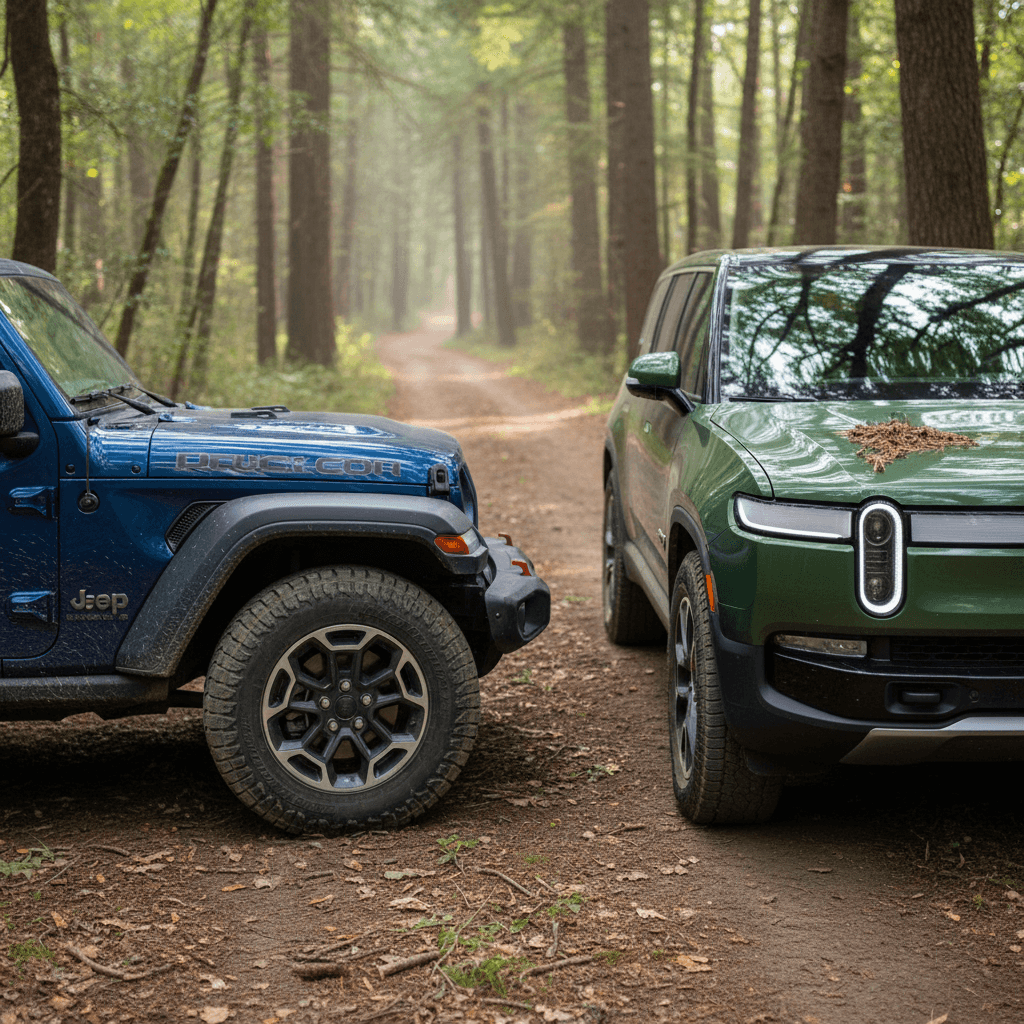
Let’s start where your heart is: the trail. A Wrangler’s recipe is old-school and effective, solid axles, mechanical lockers, body‑on‑frame, excellent approach and departure angles. The Rivian R1S gets to the same destination with a very different toolkit: an adjustable air suspension, independent suspension at all four corners, and either dual‑ or quad‑motor all‑wheel drive with precise software‑controlled torque vectoring.
Key off-road specs: Rivian R1S vs typical Jeep Wrangler
Approximate stock numbers; individual trims and tire options vary.
| Spec | Rivian R1S (air suspension, off-road height) | Jeep Wrangler Rubicon (factory) |
|---|---|---|
| Ground clearance | Up to ~14.5–14.9 in | About 10.8–12.9 in (depending on generation and tire) |
| Water fording | Around 40+ in (Rivian claims ~43 in) | About 30 in (factory Rubicon) |
| Approach/departure | Aggressive but more bumper overhang | Excellent short overhangs, especially 2‑door |
| Traction devices | Software torque vectoring, drive modes | Mechanical lockers, sway bar disconnects |
| Low-speed control | One‑pedal style creeps, rock crawl modes | Traditional low range, manual throttle and brake control |
On paper, the Rivian R1S hangs with serious Wranglers. Tires, lines, and driver judgment still matter most.
Where the Wrangler still wins
How the R1S feels off-road
- Instant torque at each wheel makes climbing loose, steep sections feel almost casual.
- Drive modes like All-Terrain or Rock raise the suspension, soften damping, and adjust pedal mapping for control.
- The long wheelbase and independent suspension mean less head toss than a short‑wheelbase Jeep on washboard and forest roads.
- Downside: it’s heavier, wider, and you’re always a little more aware of the price tag and electronics underneath.
How your Wrangler feels by comparison
- More mechanical drama: you feel the diffs, the frame, and every clunk. Some of that is charm; some is fatigue.
- Better at tight turns and threading between rocks, especially in a 2‑door.
- After years of aftermarket parts, you know exactly what will drag or scrape and what won’t.
- Downside: on long, corrugated dirt, the live axles can beat you up in ways the R1S simply doesn’t.
Tires matter more than badges
On-road manners: where the R1S leaves the Wrangler behind
If you daily‑drive your Wrangler, you already know the compromise: wandering on the highway, wind noise around the windshield frame, and a cabin that’s more upright than refined. The Rivian R1S simply lives in another universe on pavement.
Daily driving: Rivian R1S vs Wrangler
Same driver, very different days.
Comfort & noise
The R1S rides like a premium SUV, not a truck. Air suspension smooths broken pavement and the cabin insulation hushes wind and tire roar. Your commute suddenly feels shorter.
Power & passing
Even the dual‑motor R1S feels brutally quick; quad‑motor versions are sports‑car fast. Merging, passing semis, or climbing mountain grades is effortless compared with any stock Wrangler.
Family and cargo
Three rows, a huge cargo area, a front trunk, and flat load floors make the R1S an easy family hauler. It turns a trail toy into a true everything‑vehicle.
The fatigue factor
Range and real-world usage for Jeep owners
You’re used to thinking in gallons and MPG. The R1S asks you to think in kilowatt-hours and miles of range, but the planning mindset is the same: know your route, know your refuel points, and give yourself a cushion.
- Most dual‑motor R1S configurations deliver roughly 250–320 miles of real‑world range, depending on battery, tires, speed, and weather.
- Off‑road, expect range to drop faster, just like your MPG plummets in 4‑Low. Soft surfaces, steep climbs, and low‑speed crawling all eat into the battery.
- Regenerative braking helps on long descents, giving you back a bit of range you’d normally burn as heat in your Wrangler’s brakes.
- For typical commuting and weekend errands, especially if you charge at home, you may only “refuel” on road trips or big adventure weekends.
Range reality check for trail days
Networks like DC fast chargers and, increasingly, Tesla Superchargers with adapters or NACS support make that planning easier each year. But if your favorite trails live in charging deserts, you’ll need to be honest about how often you’re willing to route your adventures around high‑speed chargers.
Running costs, maintenance, and reliability
Here’s where the R1S starts paying you back. A Wrangler is simple, but it’s not cheap to feed or maintain if you really use it. Oil changes, diffs, transmission service, brakes cooked on big descents, those add up. The Rivian R1S deletes a lot of that.
Typical cost differences: Jeep Wrangler vs Rivian R1S
Exact numbers depend on your local electricity, fuel prices, and driving style, but the pattern is clear.
Fuel vs electricity
At US fuel prices, a Wrangler on all‑terrains can easily live in the teens for MPG. At 12–18 mpg, a 15,000‑mile year burns a painful amount of gas. An R1S at home‑charging rates often cuts per‑mile energy cost by half or more, sometimes much more if you can charge off‑peak.
Maintenance & wear
The R1S still has brakes, suspension, cooling systems, and tires to care for, but there’s no engine oil, spark plugs, or exhaust, and regen braking can stretch pad life. One caveat: out‑of‑warranty repairs on a young EV brand can be expensive and slower than grabbing parts for a decades‑old Wrangler platform.
Off-road damage is a bigger deal in an R1S
What you’ll miss from your Jeep, and what you won’t
Things most Jeep owners miss
- Open‑air driving: No doors‑off, no folded windshield, no bikini top. If that’s your religion, you’ll feel the loss on day one.
- Aftermarket ecosystem: Jeep’s bolt‑on world is infinite. Rivian’s is young and far more limited (so far).
- Simple, analog feel: The R1S is a rolling computer. For some Jeep traditionalists, that’s a turn‑off.
Things you won’t miss for a second
- Highway noise and wandering, especially on lifted rigs with mud‑terrains.
- Frequent fill‑ups and the sting of paying for fuel on long road trips.
- Cramped space when you’re hauling friends, kids, dogs, and camping gear.
The surprising joy factor
Buying a used Rivian R1S as a Jeep upgrade
Shopping used is where Wrangler owners are most at home, you already know to check for bent brackets, trail rash, and half‑finished mods. A used Rivian R1S demands a slightly different checklist, with a heavy emphasis on battery health, software history, and charging behavior instead of lift kits and lockers.
Used Wrangler vs used R1S: what you inspect
Same idea, different priorities.
| Area | Used Wrangler focus | Used Rivian R1S focus |
|---|---|---|
| Drivetrain | Leaks, diff noise, transfer case function | Smooth motor operation, no drive unit noises, correct drive modes |
| Undercarriage | Rust, skid plate hits, bent control arms | Battery pack shield damage, suspension arms, air lines, corrosion |
| Mods | Quality of lift, tires, gearing, wiring | Wheel/tire changes, tow wiring, any non‑OEM electrical add‑ons |
| Electronics | Simple, lights and accessories | Screen function, driver‑assist, phantom alerts, OTA update history |
| History | Off‑road abuse, floods, salvage | Charging habits, previous repairs, software campaigns |
With a Rivian R1S, the battery and electronics are as important as the body and suspension.
Why a third-party health report matters
On Recharged, you also get fair‑market pricing data, EV‑savvy support, and options like financing, trade‑in, and nationwide delivery. For a Wrangler owner stepping into their first EV, having specialists who understand both the adventure and the electrons takes a lot of anxiety out of the process.
Checklist: Are you ready to switch from Wrangler to R1S?
Key questions to ask yourself
1. How often do you truly wheel hard?
If you’re on black‑rated rock trails every other weekend, you may want to keep a Wrangler (or build one) as a dedicated toy. If most of your “off‑road” is forest roads, sand, snow, or mild rock, the R1S will likely match or exceed what you actually do.
2. Can you charge at home or work?
A Level 2 home charger or consistent workplace charging turns the R1S into a set‑and‑forget daily. If you rely 100% on public charging, especially in a sparse region, be sure you’re comfortable planning around chargers.
3. Are your favorite trails near fast chargers?
Look at your most common trailheads. Are there DC fast chargers within 30–50 miles? If not, will you be okay choosing new destinations that play nicer with public charging?
4. Do you value quiet comfort more than open-air drama?
Be honest: what do you love about your Wrangler? If doors‑off, top‑down summer nights are the whole point, no EV SUV will replace that. If you mainly want capability and character, the R1S has its own kind of charm.
5. Is this your only vehicle?
As a one‑car solution for family, commuting, and light‑to‑moderate overlanding, the R1S shines. If you already have a comfortable daily and want a pure toy for hardcore wheeling, sticking with a Wrangler (or adding a used one) may make more sense.
6. Are you prepared for a software‑centric vehicle?
Rivian leans heavily on over‑the‑air updates and digital controls. If you hate touchscreens and love mechanical switches, there’s an adjustment period. If you like seeing your vehicle get better over time, you’ll appreciate it.
Frequently asked questions for Jeep owners
Jeep Wrangler owner FAQs about the Rivian R1S
Bottom line: Should a Jeep Wrangler owner switch to a Rivian R1S?
If your Wrangler life is built around SEMA‑grade rock parks, body armor, and the satisfying clunk of a front locker engaging, the Rivian R1S is not a one‑for‑one replacement, and it doesn’t try to be. But if you’re an adventure‑minded driver who wants real off‑road ability, far better comfort, shocking performance, and dramatically lower day‑to‑day running costs, the R1S is an evolution of the same idea: go anywhere, bring everyone, and enjoy the drive.
The smart play for many Jeep owners in 2026 is to let the R1S handle commuting, road trips, snow storms, and light‑to‑serious trails, and either retire the Wrangler gracefully or keep a simpler, older rig as a dedicated toy. If you’re ready to explore that path, a used Rivian R1S on Recharged, with verified battery health, transparent pricing, financing, trade‑in, and delivery, turns what feels like a huge leap into a confident next step.