You’re not imagining it: gas prices feel like a roller coaster, and every spike makes electric cars look better. But is EV charging actually cheaper than gas in 2025, or is that just marketing spin? Let’s put real numbers on the table and see when an electric car really saves you money, and when it doesn’t.
In one sentence
EV charging vs gas: the short answer
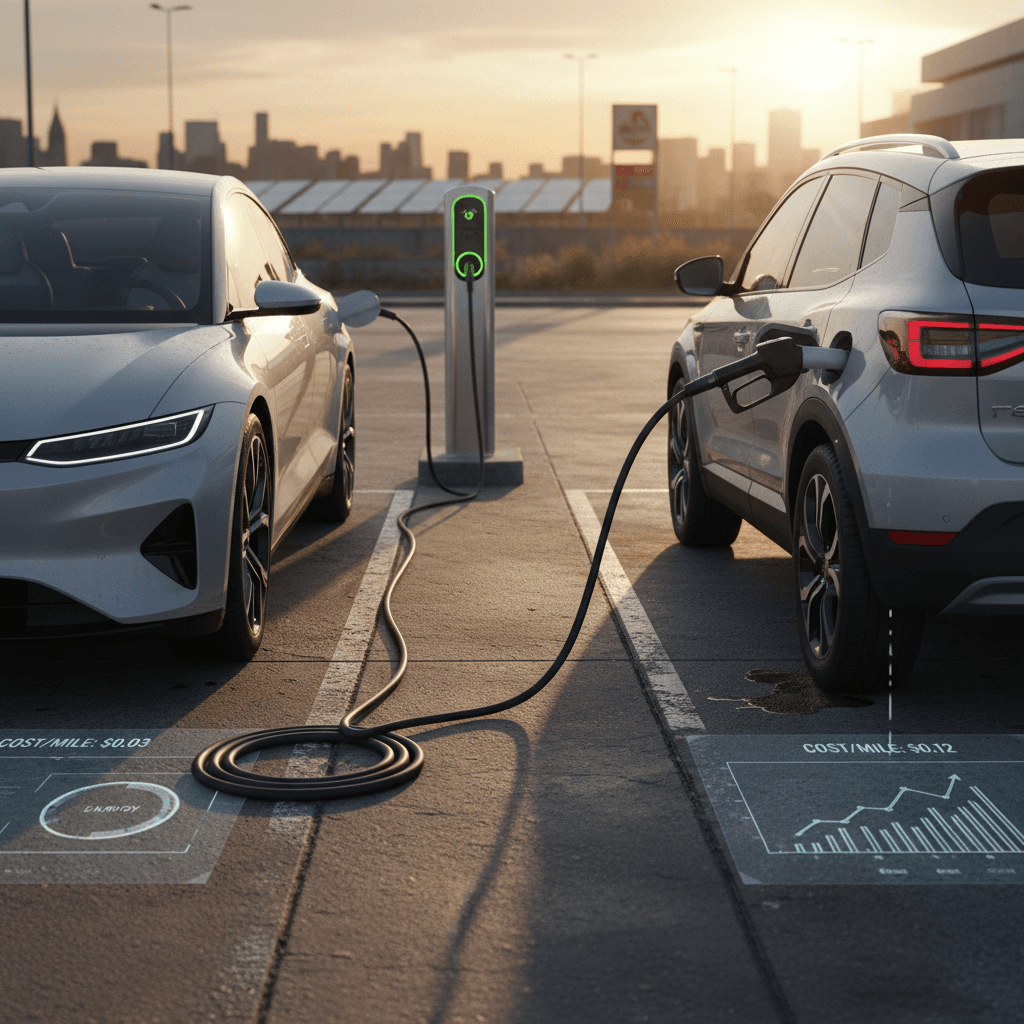
Let’s start with the big-picture math most drivers care about: cost per mile. That’s what shows up in your budget, whether you’re commuting or road-tripping.
Typical 2025 cost-per-mile ranges (U.S.)
Rule of thumb
How cost per mile really compares
Typical electric car
Take a popular EV with an efficiency of about 3.5 miles per kWh (many modern EVs fall between 2.7 and 4.2).
- Electricity price (home): $0.14 per kWh (rough U.S. average)
- Cost per mile: $0.14 ÷ 3.5 ≈ $0.04/mile
Drive 1,000 miles in a month and you’re spending around $40 on electricity.
Typical gas car
Now look at a compact or midsize gas car getting about 32 mpg.
- Gas price: $3.50 per gallon (many areas hover around this or higher)
- Cost per mile: $3.50 ÷ 32 ≈ $0.11/mile
Drive that same 1,000 miles and you’re closer to $110 in fuel, almost three times the home-charged EV.
Where the math flips
Home EV charging costs with real examples
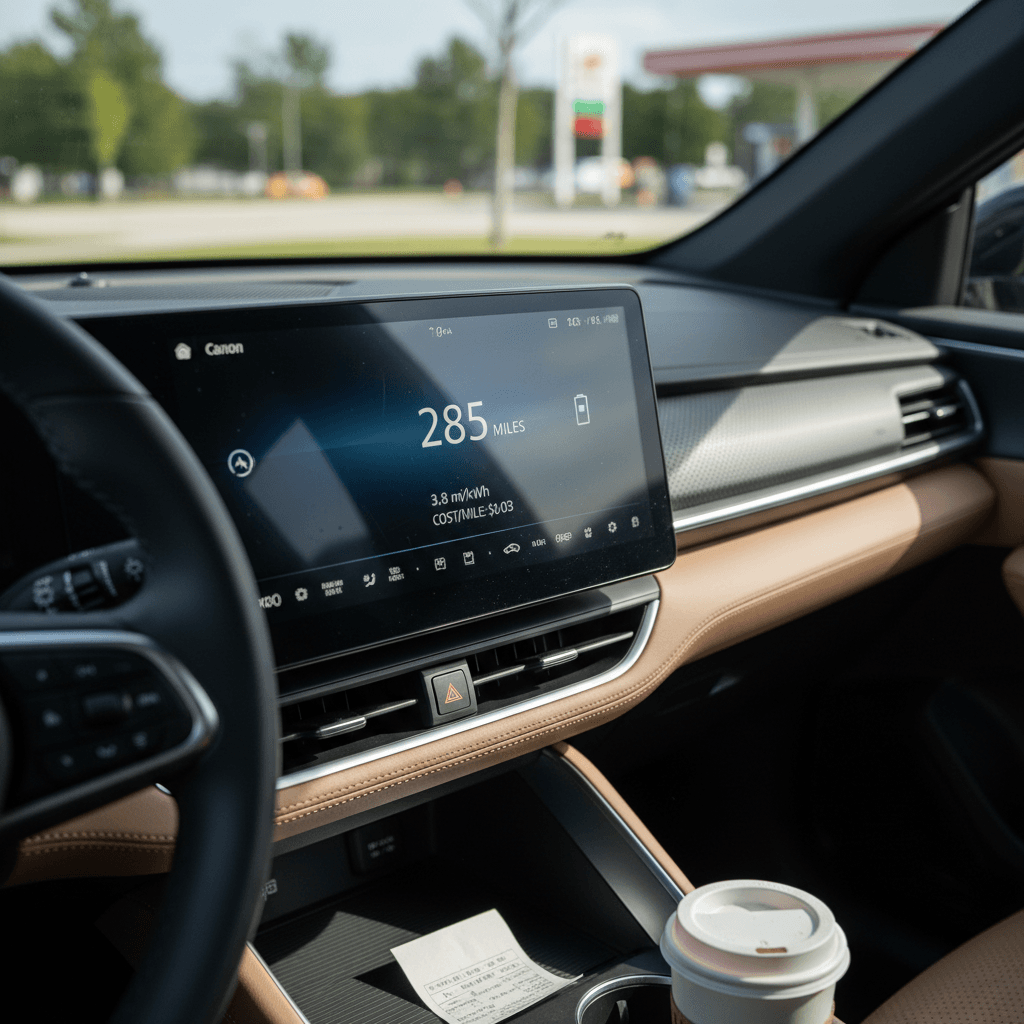
Home charging is the quiet hero of EV ownership. It’s not flashy like a DC fast charger, but it’s usually where you save the most money. Here’s how the numbers stack up in a typical U.S. home in 2025.
Sample monthly cost: EV vs gas at different electric rates
Assumes 1,000 miles/month, EV efficiency of 3.5 mi/kWh, gas car at 32 mpg.
| Scenario | Electricity rate | EV cost/month | Gas price | Gas cost/month |
|---|---|---|---|---|
| Low-cost power | $0.10/kWh | ≈ $29 | $3.50/gal | ≈ $110 |
| Average U.S. | $0.14/kWh | ≈ $40 | $3.50/gal | ≈ $110 |
| High-cost power | $0.22/kWh | ≈ $63 | $3.50/gal | ≈ $110 |
Your local electricity and gas prices will shift these numbers, but the pattern is consistent: home-charged EVs usually win.
What about off-peak EV rates?
3 quick checks before you count on cheap home charging
1. Know your kWh price
Look at your utility bill for the line that shows your total cost per kWh, including fees, rather than only the base rate. That’s the number to use in your EV math.
2. Confirm outlet capacity
A full battery pack is hungry. A basic 120V outlet works in a pinch, but a proper 240V Level 2 charger makes charging faster and more predictable.
3. Ask about EV or off-peak plans
Many utilities have special programs for EVs. A phone call or web chat can uncover a plan that makes your charging <strong>much</strong> cheaper than the default rate.
Public and fast charging: when EVs stop being cheaper
Fast charging is the EV equivalent of eating out: convenient, sometimes necessary, and definitely more expensive than “cooking at home” with your own Level 2 charger.
How public charging stacks up against gas
Approximate 2025 prices in many U.S. regions (your local rates will vary).
Level 2 public stations
Price: Often $0.20–$0.35/kWh, and sometimes free at workplaces or hotels.
Typical cost per mile: about $0.06–$0.10.
Still usually cheaper than gas, especially if paired with some home charging.
DC fast charging networks
Price: Commonly around $0.35–$0.60/kWh; some busy or premium locations can be higher.
Typical cost per mile: roughly $0.10–$0.17.
Now you’re in the same ballpark as an efficient gas car.
Gasoline at the pump
Price: Often $3.00–$4.50/gal depending on region.
Typical cost per mile: ~$0.10–$0.18 for modern cars, higher for trucks and SUVs.
The less efficient the vehicle, the more an EV looks good, even fast-charged.
Watch the idle fees
Beyond fuel: insurance, maintenance, and resale
Fuel is only part of the story. When you’re deciding between gas and electric, you’ve also got to consider the silent line items: maintenance, insurance, and long-term value.
- EVs generally have lower routine maintenance costs: no oil changes, fewer moving parts in the drivetrain, and regenerative braking that stretches brake life.
- Insurance can sometimes be higher for newer EVs, but used EVs have become more affordable and often sit closer to comparable gas cars in premiums.
- Battery health matters more than mileage for resale value. A used EV with a healthy pack can be a fantastic total-cost-of-ownership play.
How Recharged fits in
Ready to find your next EV?
Browse VehiclesWhen an EV saves you money, and when it doesn’t
Situations where EV charging is clearly cheaper
- You can install (or already have) home Level 2 charging. You’ll live in that $0.03–$0.05 per mile world most days.
- Your commute is predictable. Consistent daily driving lets you charge overnight on cheaper rates.
- You live where gas is expensive. The higher the local gas price, the more every kWh you add at home is worth.
- You drive a lot of miles. High mileage amplifies every cent you save per mile compared with gas.
Situations where savings are smaller, or vanish
- You rely mostly on pricey fast chargers. Apartment dwellers without workplace or home charging fall into this group.
- Your utility rates are unusually high. In some places, residential electricity can nudge EV energy costs close to gas.
- You pick a very inefficient EV. Heavy, high-performance models use more kWh per mile, just like a V8 burns more fuel than an economy car.
- You rarely drive. If you only drive a few hundred miles a month, fuel savings alone may not justify the switch.
Seven ways to lower your EV charging costs
Practical steps to keep charging cheaper than gas
1. Charge mostly at home
Even a basic Level 2 charger at home can keep most of your miles on low-cost electricity. If you’re shopping used, factor a home charger install into your budget.
2. Use time-of-use or EV rates
Ask your utility about special EV or off-peak plans. Charging after 9 or 10 p.m. can sometimes cut your kWh cost in half.
3. Precondition while plugged in
In hot or cold weather, preheat or precool your EV while it’s plugged in. That keeps energy-hungry climate control off your battery when you start driving.
4. Watch your speed
Above highway speeds, aerodynamics start to punish both EVs and gas cars. Keeping it closer to the limit can noticeably drop your kWh per mile.
5. Plan road trips around efficient stops
Not all fast chargers are priced the same. Use apps that show kWh pricing, not just location, and favor networks and locations with better rates.
6. Combine errands
Short trips with a cold battery are less efficient. Batch your errands into fewer, longer trips to stretch every kWh.
7. Buy the right-size battery
A massive battery is nice for road trips but costs more upfront. If most of your driving is local, a moderate pack can hit a sweet spot for total cost.
Used EVs, battery health, and the Recharged angle
If you’re trying to decide between a used gas car and a used EV, you’re already asking the right question: Will my real-world cost of ownership actually go down? Charging vs gas is a huge part of that, but so is buying the right EV in the first place.
Why a vetted used EV makes the math work
How Recharged can help you get the savings you’re expecting.
Verified battery health
The biggest wild card in a used EV is battery condition. With a Recharged Score Report, you see clear battery health data up front, no guessing whether you’ll still get the range you’re paying for.
Fair market pricing
Each vehicle on Recharged is priced against real-time market data, with the battery’s health factored in. That helps you avoid overpaying compared with similar gas cars.
Financing and trade-in options
Recharged offers financing, trade-ins, instant offers, and consignment, plus nationwide delivery and EV-specialist support. That lets you focus on the math, monthly payment and fueling costs, without juggling a dozen separate errands.
Want to see it in person?
FAQ: is EV charging cheaper than gas?
Frequently asked questions
Bottom line: is EV charging cheaper than gas?
If you have reliable home or workplace charging, yes, EV charging is usually meaningfully cheaper than gas, especially once you add in lower maintenance and the fact that used EV prices have become more accessible. You’re likely looking at a fuel bill that’s cut by a third to half compared with a similar gas car.
If you’ll depend mostly on public fast charging, the answer shifts to “it depends.” The more you pay per kWh and the less efficient your EV, the closer your cost per mile gets to gas, so your decision should hinge on the whole ownership picture, not just charging receipts.
When you’re ready to run the numbers on an actual car, browsing used EVs with a Recharged Score Report gives you a head start. You know the battery’s health, the price is benchmarked to the market, and EV specialists can help you estimate your real-world fueling and maintenance costs. That way, you’re not just buying an electric car, you’re buying a monthly budget that makes sense.