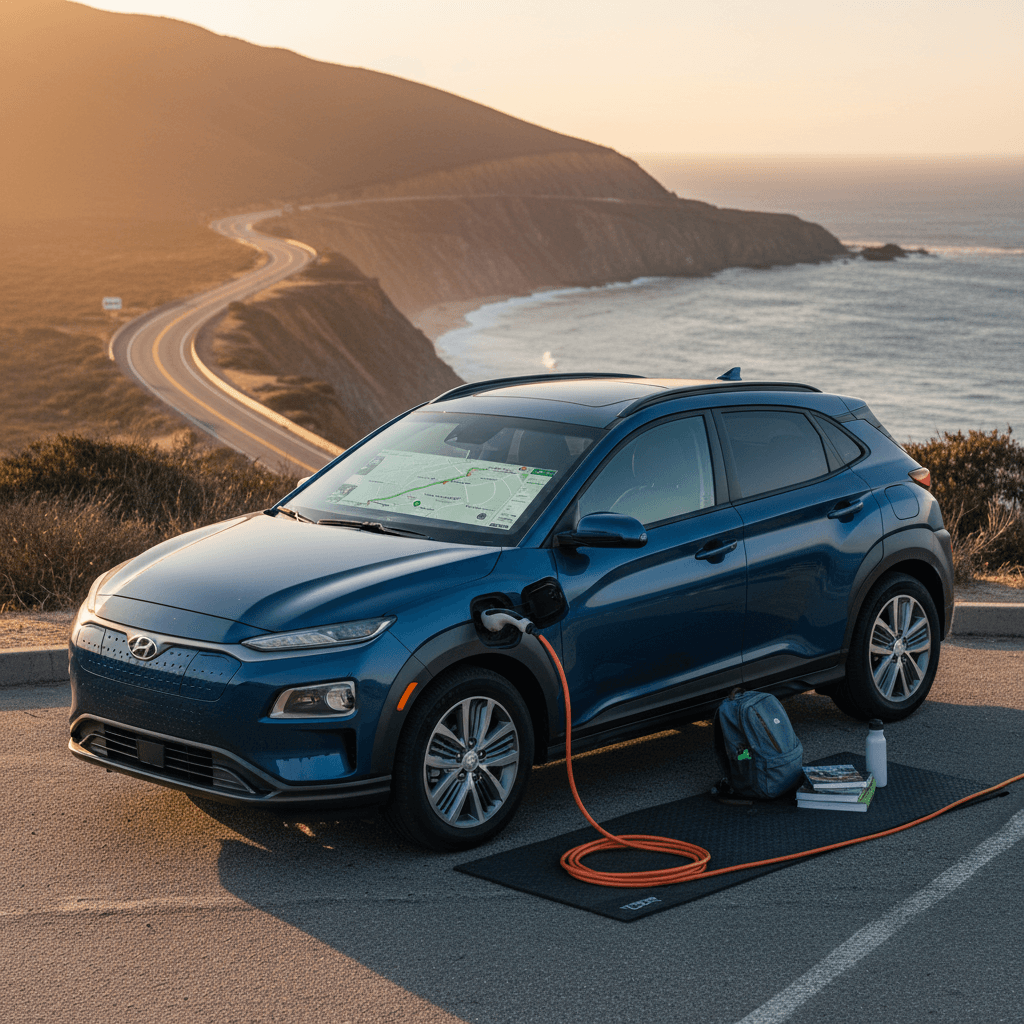
If you own a Hyundai Kona Electric, you already have one of the most efficient EVs on the road. Many owners use it as a daily commuter and quietly wonder: can this thing actually handle long distance driving? The answer is yes, if you understand its real‑world range, plan your charging, and use a few Kona‑specific long distance driving tips.
The Kona Electric’s quiet superpower
Why the Kona Electric Makes Sense for Long Trips
Core strengths for long distance driving
Where the Kona Electric shines once you leave the city
Efficiency = Flexibility
The Kona Electric regularly beats its official range rating in mixed driving. That means more usable highway miles per kWh and shorter stops at fast chargers.
Right‑sized Battery
Newer Konas pair a ~48–65 kWh pack with excellent efficiency. You won’t win a battery-size arms race, but you’ll avoid carrying costly, heavy capacity you rarely use.
CCS Fast Charging
With up to ~100 kW DC fast charging (trim and generation dependent), the Kona can comfortably tackle multi‑stop highway days so long as you plan around chargers rather than gas stations.
The key with any compact‑battery EV isn’t to turn every drive into a hypermiling experiment. It’s to know what the car can realistically do, then shape your route, speed, and charging plan to match. The Kona Electric rewards that kind of disciplined planning more than most.
Know Your Kona Electric Battery and Realistic Range
Long distance tips only make sense if they’re grounded in realistic numbers. Exact specs vary by model year and market, but recent U.S. and European Kona Electrics generally fall into two buckets:
Typical Hyundai Kona Electric battery and range configurations
Representative figures for common Kona Electric variants. Always verify your exact model year and battery size.
| Battery version | Approx. usable capacity | Official range (EPA/WLTP) | Comfortable highway planning range* |
|---|---|---|---|
| Standard battery (around 48 kWh) | ≈48–49 kWh | ~200–230 miles / 320–370 km | 140–170 miles / 225–275 km |
| Long‑range battery (around 64–65 kWh) | ≈64–65 kWh | ~250–300 miles / 400–500 km | 180–220 miles / 290–355 km |
Use these as planning baselines; your actual range will vary with speed, temperature, terrain and wind.
Planning range vs. marketing range
Useful real‑world Kona Electric efficiency benchmarks
Before your first serious trip, reset one of the Kona’s trip computers and track your mi/kWh (or kWh/100 km) over a couple of tanks of driving that look like your planned route. That personal baseline is far more valuable than any lab number.
How Speed, Weather and Terrain Affect Kona Range
1. Speed: the range killer you control
Like every EV, the Kona Electric’s drag goes up with the square of speed. The difference between cruising at 65 mph and 80 mph is dramatic:
- 65 mph (105 km/h): often around 4.0 mi/kWh in good conditions.
- 75–80 mph (120–130 km/h): it’s easy to drop into the 3.0–3.3 mi/kWh range.
That’s the difference between 220+ miles from a 64 kWh Kona and something closer to 170. Over an all‑day drive, it can mean one extra fast‑charge stop.
2. Temperature and climate use
Hyundai’s later‑generation Konas offer a heat pump in many markets, which helps in cold weather, but physics still wins:
- Cold battery = lower power and less capacity, especially below freezing.
- Cabin heat can add several kW of continuous draw on long highway legs.
- Seat and wheel heaters give much more comfort per kWh than blasting the HVAC.
Plan for significantly shorter legs in winter, especially if you start the day with a truly cold‑soaked pack.
Precondition whenever you can
Terrain matters less than drivers think over a full day. Long climbs will spike consumption, but you’ll earn some of it back on the descent via regenerative braking. The bigger penalty tends to come from sustained high‑speed sections and headwinds, which the car can’t “pay back” later.
Plan Your Route and Charging Stops
EV road trips are easiest when you plan around chargers, not just distance. The Kona’s moderate battery size and good efficiency mean you should think in terms of 2–3 hour hops rather than gas‑car marathon stints.
Best tools to plan a Kona Electric road trip
Use more than one app so you’re never flying blind
A Better Routeplanner (ABRP)
Enter your specific Kona Electric trim, state of charge, and preferences. ABRP will choose charging stops and even model how speed, weather, and elevation affect your arrival SOC.
Charging‑network apps
Apps from Electrify America, ChargePoint, EVgo and others show real‑time stall availability, pricing, and error codes. They’re essential for day‑of‑travel reality checks.
Google Maps / Apple Maps
Still valuable for traffic, food, and restroom planning. Add charging stops from your EV apps, then let the navigation handle the rest of the logistics.
Kona Electric long‑trip planning checklist
1. Confirm your exact battery and trim
Check your owner’s manual or window sticker for battery size and fast‑charging capability. A standard battery Kona wants <strong>tighter stop spacing</strong> than a long‑range one.
2. Set a realistic energy consumption target
Base this on previous drives. For example, if you’ve historically seen 3.6 mi/kWh at 70 mph, plan the day around that, not wishful thinking.
3. Aim to arrive between 10–20% state of charge
This keeps a healthy buffer for detours and charger issues while letting the pack charge quickly once you plug into DC fast charging.
4. Prefer stations with multiple fast‑charge stalls
A 4‑ or 6‑stall site is much more resilient than a lonely 1‑stall charger at the back of a parking lot. It’s worth a small detour for redundancy.
5. Always have a Plan B and Plan C
On each leg, identify at least one backup site in case your primary station is down, full, or severely throttled.
6. Think in time, not just distance
A 160‑mile hop at 70 mph is under 2.5 hours. Add a 20–30 minute fast‑charge, and you’ve got a sustainable rhythm that mimics normal rest stops.
How Recharged can help
Smart DC Fast Charging Strategy for Kona Electric
The Kona Electric’s DC fast‑charging curve is designed around shorter, more frequent top‑ups rather than charging from nearly empty to 100% in one go. Understanding that curve can save you serious time over a full day’s driving.
- Best power band: the Kona charges fastest roughly between 10–60% state of charge. Above ~70–80%, charge power often tapers significantly.
- Ideal road‑trip window: many owners find a 10–70% or 15–75% cycling window offers the best blend of speed and range.
- Don’t chase 100% unless you must: that last 20% can easily double your stop time and is rarely necessary if chargers are reasonably spaced.
- Use battery‑warmup opportunities: a hard acceleration ramp or a few minutes at highway speeds before a fast‑charge stop can nudge a cold pack into a more favorable temperature zone.
Think in 20–30 minute chunks
When you plug in, monitor both the charging power (kW) and your % state of charge. If power has tapered heavily and you already have 20–30% more than you need for the next leg plus a safety buffer, it’s often more time‑efficient to unplug and get back on the road.
Drive More Efficiently (Without Being “That Slow EV”)
You don’t need to poke along in the right lane to unlock the Kona Electric’s strengths. Small, deliberate choices in how you use the car’s features will give you most of the efficiency benefit without annoying everyone around you.
Kona‑specific driving techniques that pay off
Each of these can buy you 5–15% more range with minimal sacrifice
Use adaptive cruise on gentle speeds
Set cruise a bit below the prevailing fast lane speed, say 67 in a 70, or 72 in a 75. This keeps you flowing with traffic while avoiding the huge drag penalty of the top 5 mph.
Dial in regen paddles
Many Kona drivers like using stronger regen in city and rolling terrain, then a medium setting on the highway to avoid constant speed modulation. Experiment and stick with the setting that feels natural, not just the strongest one.
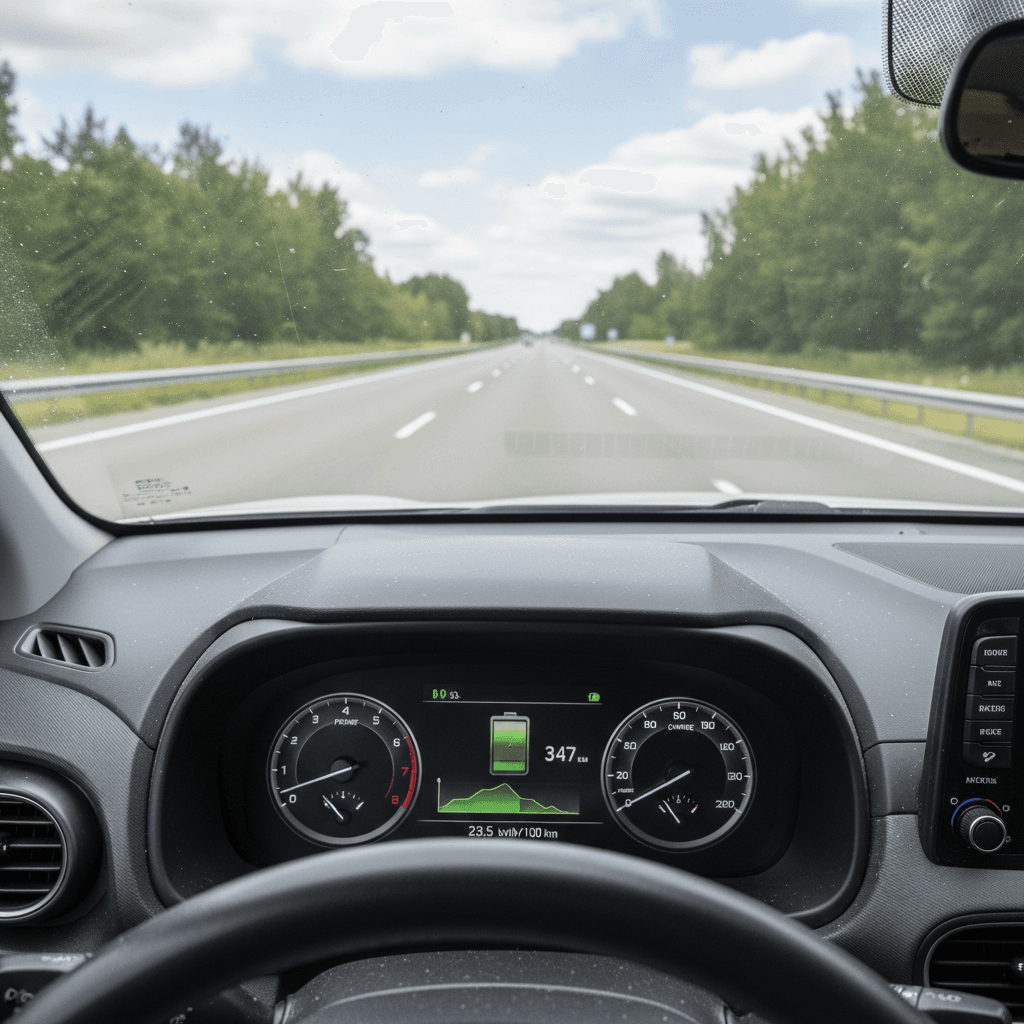
Watch the power gauge, not just speed
The instant power bar in the cluster tells you more about efficiency than the speedometer. Smooth, moderate inputs that keep that bar low are worth more than fixating on a specific mph.
What “good” looks like on a highway day
Optimize Climate Control and Comfort on Long Drives
Range anxiety and comfort anxiety often pull in opposite directions. The Kona’s climate system and seats give you some levers to optimize both if you use them thoughtfully.
Use seat and wheel heaters first
In cold weather, heated seats and steering wheel warm you quickly for far less energy than heating all the cabin air. Combine them with a modest cabin temperature instead of blasting the heat at max.
If your Kona has a heat pump, it will already be more efficient than resistance heating, but the hierarchy still holds: touch‑point heat first, then air.
Set realistic cabin temps
Being comfortable at 70–72°F (21–22°C) instead of insisting on 78°F in winter or 65°F in summer can easily trim a couple of kWh per hour off your HVAC draw.
Over a 3‑hour leg, that’s the difference between arriving with almost no buffer and having a healthy margin for a construction detour.
Beware of “set and forget” climate on remote start
Also pay attention to tire pressure. Long highway stints magnify the penalty of under‑inflation. Set pressures to the door‑jamb values (or a couple of psi higher for heavy loads) when the tires are cold, not after you’ve driven to the charger.
Protecting Battery Health on Frequent Road Trips
The Kona Electric’s battery packs have generally held up well in the real world, but long distance drivers put more cycles and more DC‑fast‑charge events on their packs than average commuters. A few habits go a long way toward keeping degradation manageable.
- Avoid living at 100% SOC. For daily use, parking around 40–80% is ideal. Save full charges for mornings when you’re actually leaving on a long leg.
- Limit time spent at very low SOC. Arriving at a charger with 5–10% remaining is fine. Letting the car sit at 1–2% overnight is not.
- Mix in AC charging when practical. Level 2 at home or work is gentler on the pack than constant DC fast charging, even though occasional fast‑charge road trips are expected.
- Use scheduled charging or charge limits. If your Kona supports it, schedule overnight charging so it finishes near your departure time instead of sitting at a high state of charge for hours.
When to be cautious with a high‑mileage Kona
Used Kona Electric? How to Check Road Trip Readiness
A used Kona Electric can be a fantastic value for long distance driving, but only if the battery and charging hardware are up to the task. Before you commit to cross‑country plans in a pre‑owned car, do a bit of due diligence.
Used Kona Electric road‑trip readiness checklist
1. Look at real‑world range, not just the guess‑o‑meter
On a full charge in mild weather, take a mixed drive and note consumption and remaining SOC. Extrapolate range from <strong>mi/kWh</strong>, not from the car’s projected miles alone.
2. Inspect DC fast‑charging behavior
Do a test DC fast charge from around 15–20% SOC. Confirm that power ramps up into a healthy range and tapering isn’t happening unusually early, which can indicate pack or thermal issues.
3. Scan for charging error history
Check service records for repeated DC fast‑charge faults, on‑board charger replacements, or connector issues. Chronic charging problems are a red flag for a road‑trip car.
4. Consider a third‑party health report
A proper battery diagnostic looks beyond simple range estimates to cell‑level health and usable capacity. That’s exactly what Recharged’s <strong>Recharged Score</strong> report is built to show on every EV we list.
5. Verify tires and brakes are road‑trip ready
EVs are heavier than comparable gas cars, so tired tires and marginal brakes show up quickly on mountain passes or emergency stops. Don’t discover this 600 miles from home.
If you’re buying through Recharged, you’ll see a detailed battery health snapshot and fair‑market pricing baked into each Kona Electric listing. That transparency makes it much easier to choose a car you’d trust far from your local charging safety net.
Hyundai Kona Electric Long Distance FAQ
Frequently asked questions about Kona Electric road trips
Key Takeaways for Kona Electric Road Trips
Long distance driving in a Hyundai Kona Electric isn’t about memorizing every quirk of the car, it’s about matching your expectations to what the hardware is good at. Keep speeds reasonable, plan your days around 2–3 hour legs with 20–30 minute fast‑charge stops, and use the car’s efficiency and smart climate controls to your advantage.
If you’re shopping for a Kona Electric specifically as a road‑trip‑capable daily driver, focus on battery health, fast‑charging performance, and real‑world efficiency rather than purely on model year or trim. That’s exactly the information Recharged surfaces in every listing with our Recharged Score report, so you can buy a used Kona that’s ready to comfortably carry you far beyond your normal commute.