If you’re considering a Hyundai IONIQ 5 for road trips, you’re asking the right question. On paper, its 800‑volt architecture, ultra‑fast DC charging and lounge‑like cabin make it one of the most road‑trip‑friendly EVs you can buy, new or used. But how does the Hyundai IONIQ 5 really behave on a long highway drive, and what should you expect in the real world?
Quick Take
Why the Hyundai IONIQ 5 Makes Sense for Road Trips
Core Road Trip Strengths of the IONIQ 5
The big-picture reasons it works so well beyond the daily commute
Fast DC Charging
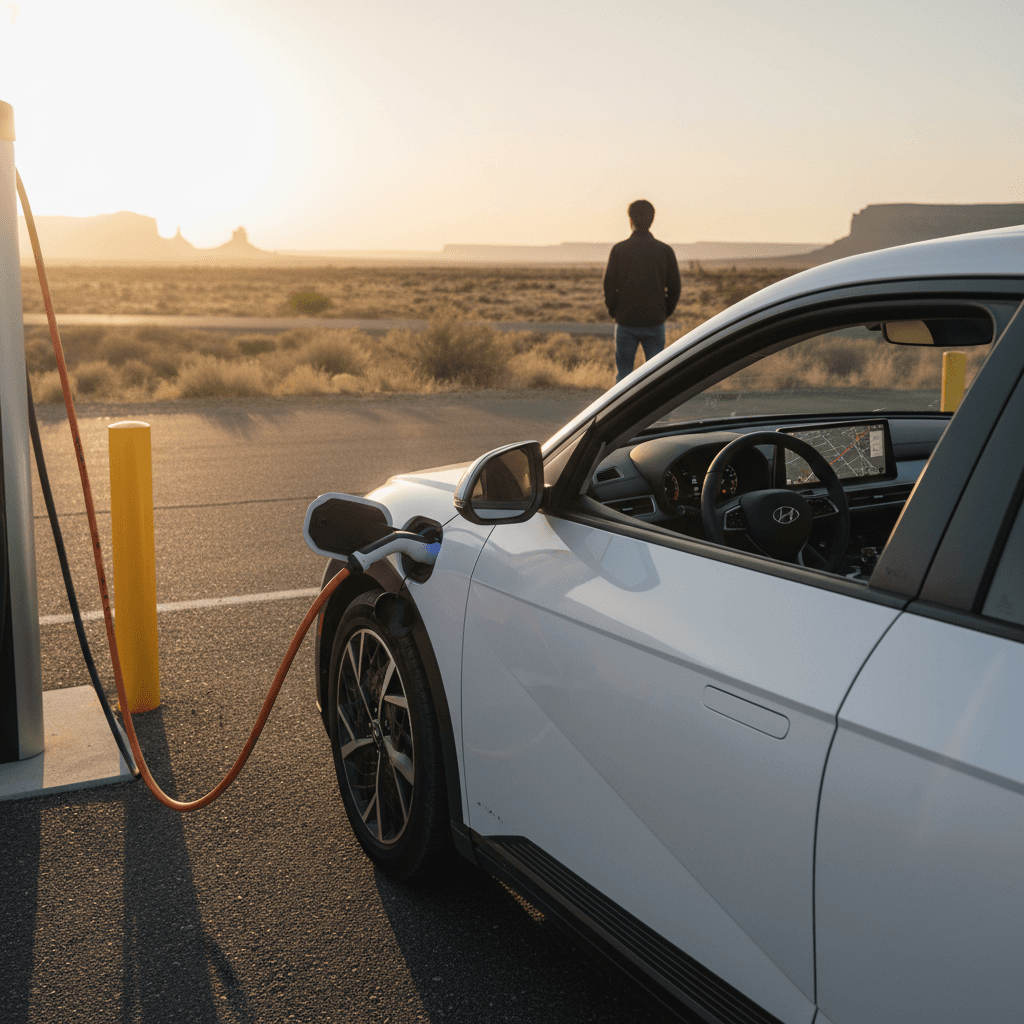
The IONIQ 5’s 800‑volt platform lets it pull well over 200 kW on compatible DC fast chargers, going from about 10% to 80% in roughly 18–20 minutes under ideal conditions. That keeps your highway stops short and predictable.
Spacious, Calm Cabin
A long wheelbase and flat floor create near‑mid‑size‑SUV interior space, with a very relaxed seating position, plenty of legroom and a quiet, refined ride that shines on long stints behind the wheel.
Flexible Charging Options
Later models add a native NACS port for Tesla Superchargers, while all IONIQ 5s work on CCS public fast charging networks. Vehicle‑to‑load (V2L) even lets you power camping gear or laptops at your destination.
From a road‑trip perspective, the combination of high‑speed charging and comfort is what sets the Hyundai IONIQ 5 apart. You may not always have the most miles of range in the parking lot, but you can replenish that range very quickly and ride in a cabin that feels more like a modern lounge than a traditional compact SUV.
Hyundai IONIQ 5 Road Trip Numbers at a Glance*
About These Numbers
Battery, Range and Real-World Highway Efficiency
The Hyundai IONIQ 5 has been offered with battery packs around 77–84 kWh usable, depending on model year and trim. Official EPA range varies by configuration, but for road‑trip planning what matters most is how far you can comfortably drive between 10% and 80% state of charge at highway speeds.
Typical Real-World Highway Range by Configuration*
Approximate ranges at steady 70–75 mph, mild weather, starting near 90% and stopping around 10–15%. Your results will vary.
| Configuration | Battery (usable) | EPA Range (est.) | Realistic Highway Range |
|---|---|---|---|
| RWD, long-range pack | ~77–80 kWh | ~300 miles | 230–260 miles |
| AWD, long-range pack | ~77–80 kWh | ~260–270 miles | 210–240 miles |
| Latest 84 kWh RWD | ~80 kWh usable | ~310 miles | 240–270 miles |
*Approximate planning figures, not official ratings.
Planning Buffer
At typical American freeway speeds, many IONIQ 5 drivers see around 3.0–3.4 miles per kWh in good conditions. On a 77–80‑kWh pack, that’s enough for comfortable 200‑plus‑mile legs without stretching things. If you regularly cruise at 80+ mph or drive in very cold weather, build in more conservative assumptions, think 2.4–2.8 mi/kWh and slightly shorter legs.
Charging Performance and Network Coverage
Charging is where the Hyundai IONIQ 5 really earns its road‑trip reputation. Thanks to its 800‑volt E‑GMP platform, it can use high‑power DC fast chargers to add a lot of range very quickly. On a capable 250–350 kW DC station, Hyundai quotes about 10–80% in roughly 18 minutes in ideal conditions, and independent testing has regularly confirmed times in the high‑teens to low‑20‑minute range for that window.
What Fast Charging Feels Like
- Best from 10–60%: The car charges hardest in this window. If you arrive near 10–20%, you’ll see impressive power numbers and rapid range gain.
- Taper after ~60–70%: Like every EV, the IONIQ 5 slows the charge rate as it nears a fuller pack. Pushing beyond 80% can easily double your stop time for relatively little extra range.
- Temperature matters: In freezing weather, preconditioning the battery (by setting a DC fast charger as your nav destination) can significantly improve charge speed.
Charging Networks You’ll Use
- CCS public fast chargers: All IONIQ 5s use CCS for DC fast charging. In the U.S., that means networks like Electrify America, EVgo, ChargePoint and others.
- Tesla Superchargers (NACS): Newer IONIQ 5 models with the NACS port can plug directly into compatible Tesla Superchargers. Earlier CCS‑only models can access some Superchargers via Tesla’s CCS adapter program where available.
- Level 2 at destinations: Hotels, Airbnbs and public Level 2 stations are great for overnight top‑ups so you start the day with a full battery.
Watch Out for Underpowered Stations
New vs. Older IONIQ 5: What Changes for Road Trips?
If you’re looking at a used Hyundai IONIQ 5 or comparing model years, a few updates matter specifically for road‑trip duty. The basic recipe, big battery, fast charging, comfortable cabin, has stayed consistent, but Hyundai has been quietly improving the package.
Key Road-Trip Differences by Model Year
What you’ll notice most when you’re covering 300–800 miles in a day
Charging & Connector Updates
- Early model years: CCS-only DC fast charging, still extremely quick on 800‑V stations.
- Later models: Add a native NACS (Tesla) charge port in some markets, improving Supercharger access and simplifying long‑distance planning.
- Software tweaks: Over time, Hyundai has refined charging curves and battery preconditioning logic for more consistent real‑world performance.
Range & Efficiency Tweaks
- Battery capacity: Long‑range packs hover around 77–84 kWh usable; some later trims use slightly larger packs with modest range gains.
- Tires & trims: Sportier or off‑road styled trims (like XRT‑type packages) may sacrifice a bit of range for looks and capability.
- EPA ratings: Gradual improvements and options mean a wider spread, always check the specific trim you’re considering.
Battery Health on a Used IONIQ 5
Comfort, Noise and Storage on Long Drives
One of the Hyundai IONIQ 5’s biggest strengths is that it doesn’t feel like a compact crossover from the driver’s seat, it feels larger, calmer and more premium than its footprint suggests. That’s a huge advantage when you’re on the road for 5–10 hours in a day.
Comfort & Practicality Highlights for Road Trips
1. Relaxed Seating Position
The IONIQ 5’s seats are cushy without being mushy, with generous thigh support and optional leg rests on some trims. Taller drivers appreciate the tilt/telescoping wheel and wide range of seat adjustment.
2. Quiet, Composed Ride
At highway speeds, road and wind noise are well controlled for this class. You’ll hear some tire thrum on rough pavement, but overall the cabin is a calm place to spend hours.
3. Spacious Second Row
Rear passengers get plenty of legroom and headroom, even for adults. The sliding rear bench lets you trade rear legroom for cargo space if needed.
4. Cargo Room That Works
The hatch area is shaped cleanly, so even though some rivals claim more cubic feet, you can realistically fit lots of luggage, strollers or camping gear. Split‑folding seats make carrying long items possible.
5. Thoughtful Small-Item Storage
The open center floor, cupholders, and door bins make it easy to keep snacks, water bottles, charging cables and devices organized on the move.
Pack a Cable & a Cooler
Tech, Driver Assistance and Navigation
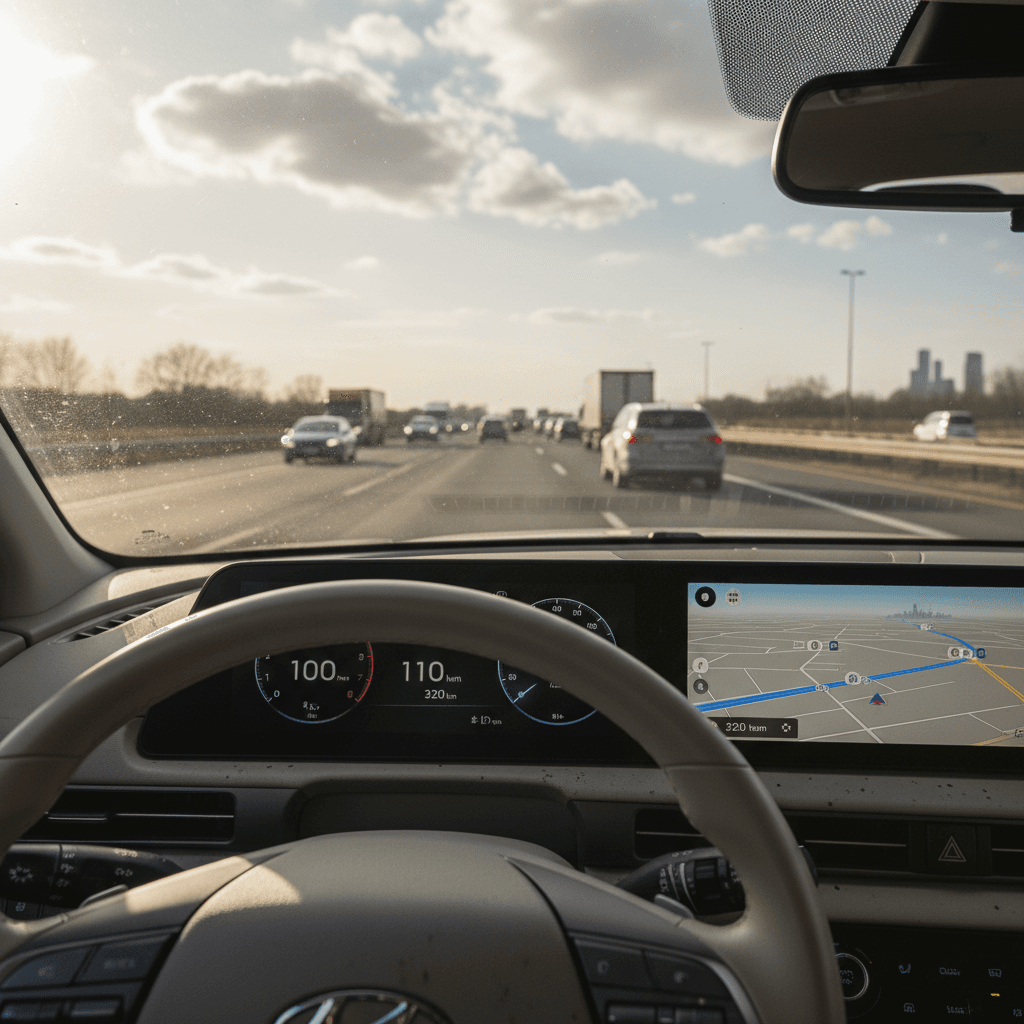
The Hyundai IONIQ 5 strikes a nice balance between modern screens and straightforward controls. That matters on a road trip: you want navigation, charging info and driver‑assist systems to help you, not distract you.
Driver-Assistance for Long Days
- Highway Driving Assist: Combines adaptive cruise control with lane‑centering to take the edge off long highway stretches. It’s not self‑driving, but it does reduce fatigue.
- Smart cruise control: Smoothly maintains distance and can adjust speed with the flow of traffic.
- Blind‑spot & rear cross‑traffic alerts: Particularly useful in unfamiliar cities or tight parking lots on the way.
Infotainment & Navigation
- Dual 12‑inch displays: Crisp graphics and a logical layout make it easy to keep tabs on range, nearby chargers and your route.
- Android Auto & Apple CarPlay: Available wireless in newer models, giving you familiar navigation apps and streaming on the road.
- Charging‑aware routing: The built‑in nav can suggest charging stops, but it’s smart to cross‑check with apps like A Better Routeplanner or PlugShare for redundancy.
Don’t Rely on a Single App
How the IONIQ 5 Compares to Tesla Model Y on a Road Trip
If you’re cross‑shopping, you’re not alone, the Tesla Model Y is the IONIQ 5’s most common rival on the highway. On a long road trip, they trade blows in interesting ways.
Hyundai IONIQ 5 vs Tesla Model Y: Road-Trip Snapshot
General tendencies for popular trims; exact numbers depend on year, wheel size and configuration.
| Factor | Hyundai IONIQ 5 | Tesla Model Y |
|---|---|---|
| Highway Range | Generally a bit shorter; many trims in the ~230–270 mi real‑world band | Typically longer; many trims offer 280–330+ mi real‑world |
| Fast Charging Speed | Among the quickest 10–80% times in its class on strong DC fast chargers | Very good, but 10–80% can be a bit slower in many tests |
| Charging Networks | CCS fast charging everywhere; newer models add native NACS for Superchargers | Native access to the vast Tesla Supercharger network |
| Cabin & Comfort | Airy, lounge‑like cabin with friendlier controls and physical buttons | Minimalist interior; interface is more screen‑centric |
| Cargo & Utility | Practical hatch with good space, but modest front trunk | Very generous cargo room including a usable front trunk |
Both are capable road‑trip EVs; which you prefer comes down to priorities.
When the IONIQ 5 Wins
Planning a Road Trip in a Hyundai IONIQ 5: Step-by-Step
IONIQ 5 Road Trip Planning Checklist
1. Know Your Trim and Realistic Range
Look up your specific IONIQ 5 trim’s EPA rating, then plan around a realistic highway range (often 15–25% lower at 70–75 mph). For conservative planning, use about 70% of that number per leg.
2. Map DC Fast Chargers Along Your Route
Use the car’s built‑in nav plus third‑party tools to identify 150–350 kW chargers roughly every 120–180 miles. If your IONIQ 5 can use Tesla Superchargers, include those in your plan too.
3. Aim for 10–80% Charging Windows
Plan your major stops so you arrive between 5–20% state of charge and leave around 70–80%. This is where the IONIQ 5 charges the quickest and keeps your total trip time low.
4. Build in Redundancy
For each planned stop, have a backup charger within 20–40 miles, just in case a station is busy or offline. Save network apps (Electrify America, EVgo, etc.) and sign up ahead of time.
5. Use Battery Preconditioning in Cold or Hot Weather
If your IONIQ 5 supports it, set the fast charger as your nav destination so the car can warm or cool the battery on the way, improving charging performance when you arrive.
6. Pack for Comfort and Charging Flexibility
Bring your portable charge cable, a tire repair kit, snacks, water and whatever you need to stay comfortable if you’re at a busy station or need to wait out a storm.
Buying a Used Hyundai IONIQ 5 for Road Trips
A lot of shoppers look at the Hyundai IONIQ 5 on the used market specifically because they want an EV that can do double duty: efficient commuting during the week and effortless long‑distance travel a few times a year. That’s a smart move, the IONIQ 5’s fast charging and strong equipment levels age very well.
Key Things to Check on a Used IONIQ 5
Road‑trip readiness starts with the right example
Battery Health & Warranty
Verify how much real‑world range the car still delivers and where it sits within Hyundai’s battery warranty window. A professional battery health report, like the Recharged Score that comes with every vehicle on Recharged, gives you an objective read before you commit.
Charging History & Hardware
Ask how the car has been charged (mostly DC fast or mostly home Level 2) and inspect the charge ports and cables. Confirm that any needed adapters (for example, if you plan to use specific networks) are included or readily available.
Software, Options & Driver Aids
Confirm that key driver‑assistance features, navigation and smartphone integration all work properly. For heavy road‑trip use, trims with Highway Driving Assist, heat pump (for cold climates) and upgraded audio are worth seeking out.
How Recharged Can Help
Ready to find your next EV?
Browse VehiclesHyundai IONIQ 5 Road Trip FAQ
Frequently Asked Questions About Hyundai IONIQ 5 Road Trips
Final Thoughts: Is the Hyundai IONIQ 5 a Good Road Trip EV?
If your idea of a great road trip is covering hundreds of miles with short, predictable charging stops and arriving relaxed instead of wrung out, the Hyundai IONIQ 5 belongs on your short list. It may not always offer the very longest single‑charge range, but it makes up for that with ultra‑fast charging, an inviting cabin, and user‑friendly tech that takes the stress out of long‑distance EV travel.
For many drivers, especially those who mix commuting with several big trips a year, a well‑chosen new or used IONIQ 5 hits a sweet spot of value, comfort and road‑trip capability. If you’re exploring used options, leveraging tools like the Recharged Score battery health report and EV‑specialist guidance can help you find the right car and hit the road with confidence, whether you’re crossing a few states or a few time zones.