If you’re shopping for a used EV, a Hyundai IONIQ 5 100,000-mile review is exactly the kind of reality check you need. Shiny press cars are easy to love at 2,000 miles; the question is what this pixel‑perfect Hyundai looks like after years of commuting, fast charging, Costco runs, and winter slush.
The short version
Why a 100,000-Mile IONIQ 5 Review Matters
The IONIQ 5 arrived for 2022 as one of the first mainstream EVs on an 800‑volt platform. On paper it was a moonshot: 10–80% DC fast charges in around 18 minutes, up to roughly 300 miles of rated range, and spaceship styling that actually fit children and dogs. Three or four years later, the first wave of cars is rolling past 80,000 and 100,000 miles, and landing in the used market at prices that undercut new compact crossovers.
If you’re considering one of those cars, you’re really asking three questions: How is the battery holding up? What does it cost to keep running? And does it still feel like a modern EV next to newer rivals? Let’s walk through each of those with a 100,000‑mile lens, and, where it’s helpful, we’ll call out what Recharged looks for when evaluating used IONIQ 5s.
Key Specs That Shape Long-Term Ownership
Hyundai IONIQ 5 Specs That Matter at 100,000 Miles
These headline numbers are what make the IONIQ 5 such an interesting used buy: it was overbuilt on charging and comfort, which tends to age well if the software and hardware behave long term.
Battery Health and Degradation at 100,000 Miles
Hyundai’s warranty tells you how confident they are in the chemistry: the high‑voltage battery is covered for 10 years or 100,000 miles (sometimes more on earlier cars) against excessive capacity loss, with fine print that varies by market. Real‑world data from high‑mileage owners suggests most IONIQ 5 packs are aging gracefully when they aren’t abused with constant 100% fast charges.
How the IONIQ 5 Battery Typically Ages
Assuming normal use and mostly 20–80% daily charging
Year 1–3 / 0–40,000 mi
Capacity loss is usually modest, often in the single digits. Many owners see the guess‑o‑meter drop by only a few percent if they avoid living at 100%.
Year 4–6 / 40,000–90,000 mi
This is where patterns diverge. Highway commuters who DC fast charge weekly may lose more capacity than garage‑parked, home‑charged cars.
Past 100,000 mi
Well‑treated packs can still deliver strong range. Abuse shows up as exaggerated winter loss, earlier tapering on DC fast charge, and lower predicted range.
Pro tip: read the pack, not the ad
In broad strokes, an IONIQ 5 that’s been home‑charged most of its life and kept between roughly 20–80% state of charge will typically show moderate capacity loss by 100,000 miles, enough that your real‑world range shrinks but not enough to make the car unusable. High‑mileage rides that lived their lives on road‑trip duty with frequent DC fast charging may see noticeably more degradation and slower peak charge speeds as the car protects itself.
Real-World Range After Years of Driving
When new, a Long Range rear‑drive IONIQ 5 could be rated around the low‑300‑mile mark on the EPA cycle, with all‑wheel drive trims in the 250–270‑ish band depending on wheel size. After 100,000 miles, the number you care about is not the brochure range, but how far it actually goes on your commute in your climate.
Typical Real-World Range on a High-Mileage IONIQ 5
Illustrative numbers for a Long Range car in good health; individual vehicles will vary.
| Scenario | New Long Range RWD (est.) | At ~100,000 mi (healthy pack) | Comments |
|---|---|---|---|
| Mild city/suburban driving | 290–300 mi | 250–270 mi | Lower speeds and regen help offset modest degradation. |
| 70–75 mph highway, fair weather | 240–260 mi | 210–230 mi | Aero and speed dominate the equation here. |
| Cold winter highway (below freezing) | 190–210 mi | 160–190 mi | Heat use and cold chemistry hit harder on older packs. |
| Mixed daily commute, four seasons | 250–270 mi | 220–240 mi | What many owners will see in normal mixed use. |
Use this as a sanity check, not a promise, battery care, tires, and climate all matter.
Cold weather hurts more as the pack ages
The upside is that the IONIQ 5’s thermal management is competent, and Hyundai has continued to tweak software. If you live somewhere with real winters, look for a car whose previous owner actually used scheduled charging and preconditioning; it’s gentler on the pack and better for range.
Charging Experience: 800V Brilliance and Real-World Caveats
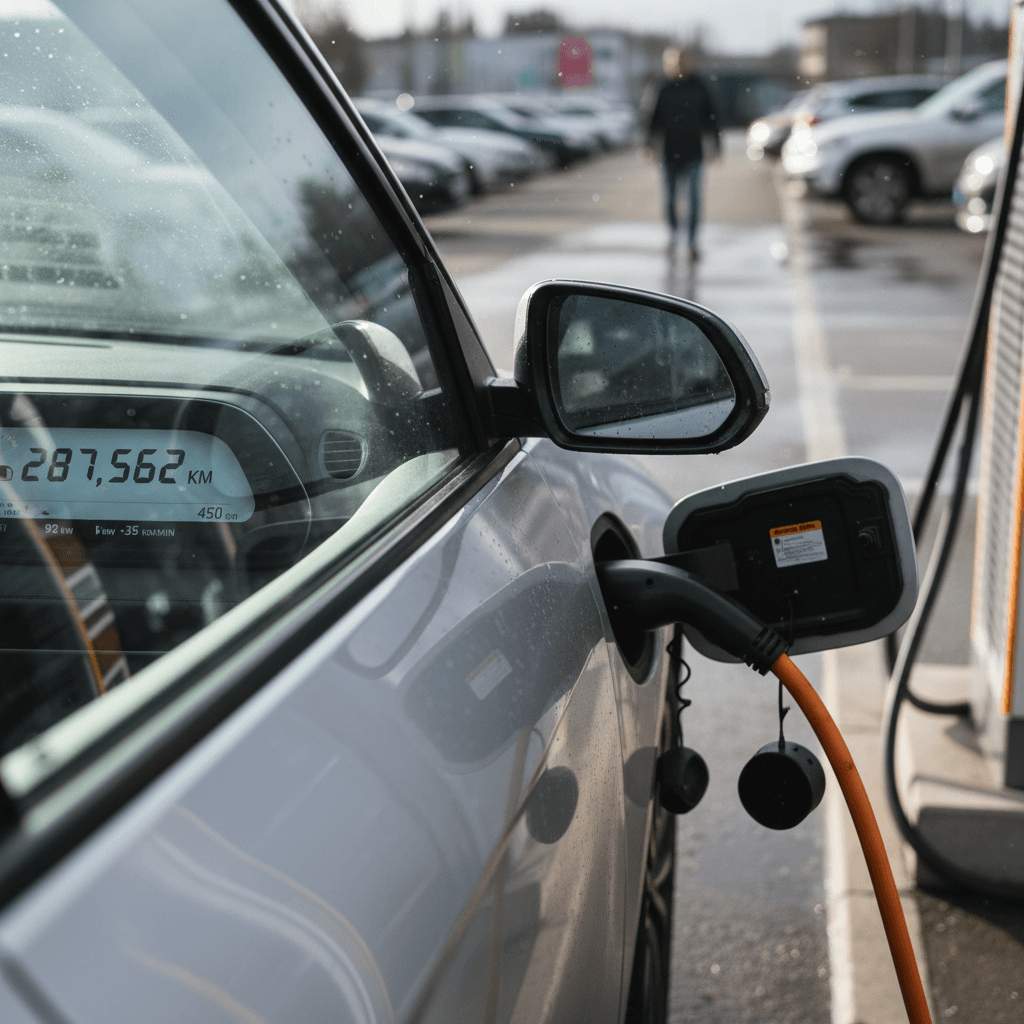
On a spec sheet, the IONIQ 5 is still one of the charging monsters of the market. Hyundai quotes roughly 10–80% in about 18 minutes on a 350 kW DC fast charger, and independent tests have seen peak power in the 230–250+ kW range when the stars align. That’s the sort of performance that makes a 1,000‑mile road trip feel…plausible.
At 100,000 miles, two questions matter: does it still charge that fast, and what has the charging lifestyle been like to live with?
DC fast charging after 100K
- On a healthy pack, you can still see very quick 10–60% sessions if the battery is warm and the charger is truly capable.
- Older or harder‑used cars may hit a lower peak and taper earlier as the BMS protects the pack.
- If the car has lived on road‑trip duty, expect some loss of outright speed, but still competitive with most EVs in its price class.
Day‑to‑day Level 2 charging
- The onboard AC charger is around 10.9 kW, enough for an overnight 0–100% at home on a 40–48A Level 2.
- Most owners plug in, schedule to finish before departure, and wake up to a full battery with negligible degradation impact.
- If you’re coming from gas, the convenience of never visiting a station again might be the biggest long‑term win.
A note on Tesla Superchargers
Maintenance and Repair Costs to 100,000 Miles
The IONIQ 5 doesn’t have oil changes, spark plugs, or transmission services, but it does have tires, brakes, coolant, cabin filters, and the occasional Oh No moment. The question is whether those moments are rare and manageable or frequent and wallet‑shredding.
What Typically Needs Attention by 100,000 Miles
You’ll spend more on rubber than electrons.
Tires
The IONIQ 5 is quick, heavy, and often wears big wheels. Expect to be on your second or third set of tires by 100,000 miles, especially if you have all‑wheel drive.
Brakes & regen
Regen braking means pads and rotors can last a long time, but cars that lived in wet or salty climates may need rotor replacement due to rust more than wear.
Fluids & odds and ends
Coolant, brake fluid, and cabin filters all have schedules. High‑mileage cars may also have had one‑off fixes: door handles, alignment, software updates, occasional infotainment gremlins.
The EV maintenance advantage is real
What you want to see in the service history is boring regularity: tire rotations, annual inspections, recalls taken care of, a brake fluid change roughly on schedule. Spotty history and mismatched, cheap tires on an EV with this much torque are a red flag.
Comfort, Interior Wear, and Tech Aging
Hyundai bet big on the IONIQ 5’s interior, flat floor, lounge‑chair front seats, sliding console, and enough ambient light to land planes with. The big question after 100,000 miles is whether the materials and screens still feel premium or whether it’s all gone to squeaks and rattles.
- Seats: The front buckets hold up well for most body types, though lighter‑colored upholstery shows jeans dye and kid grime. Check for sagging bolsters and collapsed foam on high‑milers.
- Surfaces: Soft‑touch plastics and door cards generally resist scratches, but piano‑black trim around switches tends to collect micro‑swirls and fingerprints.
- Screens: The dual‑screen layout ages better than you’d expect. Burn‑in is rare, but check for dead pixels, laggy boot‑ups, or glitchy CarPlay/Android Auto connections.
- Noise: Listen for new rattles over rough pavement and expansion joints; heavy EVs can loosen interior bits over time if they’ve lived on bad roads.
Watch for tech feature attrition
The good news is that the IONIQ 5’s cabin design feels genuinely future‑leaning even in earlier model years. It doesn’t suddenly look old parked next to newer EVs the way some first‑gen efforts do. If anything ages it, it’s software polish, not the architecture of the dashboard.
Winter Driving and Highway Road-Trip Manners
On the highway, the IONIQ 5 is more grand‑tourer than hot hatch. The ride is on the supple side, the steering is light, and the whole thing feels like a lounge on 20‑inch wheels. At 100,000 miles, suspension wear, tire choice, and alignment decide whether that lounge still glides or has developed a wobble.
Highway & road‑trip character
- Stable and relaxed at American freeway speeds, with quick passing power in dual‑motor trims.
- Expect some extra wind and tire noise on high‑mileage examples, especially on aggressive all‑season or all‑terrain rubber.
- Driver‑assist features like adaptive cruise and lane‑centering are genuinely helpful, verify they still track lanes cleanly.
Winter competence
- All‑wheel drive versions are confident in snow with proper winter or all‑weather tires.
- Range drops more sharply in cold weather, which is more noticeable on older packs.
- Pre‑conditioning before departure or before a DC fast charge is more important the older the car gets.
Don’t cheap out on tires
What to Check on a Used IONIQ 5: Inspection Checklist
If you’re eyeing a 90,000‑mile IONIQ 5 that’s temptingly cheap, here’s how to separate the road‑trip hero from the rolling headache. This is essentially the playbook Recharged uses when evaluating high‑mileage EVs for our marketplace.
High‑Mileage IONIQ 5 Inspection Checklist
1. Pull a battery health report
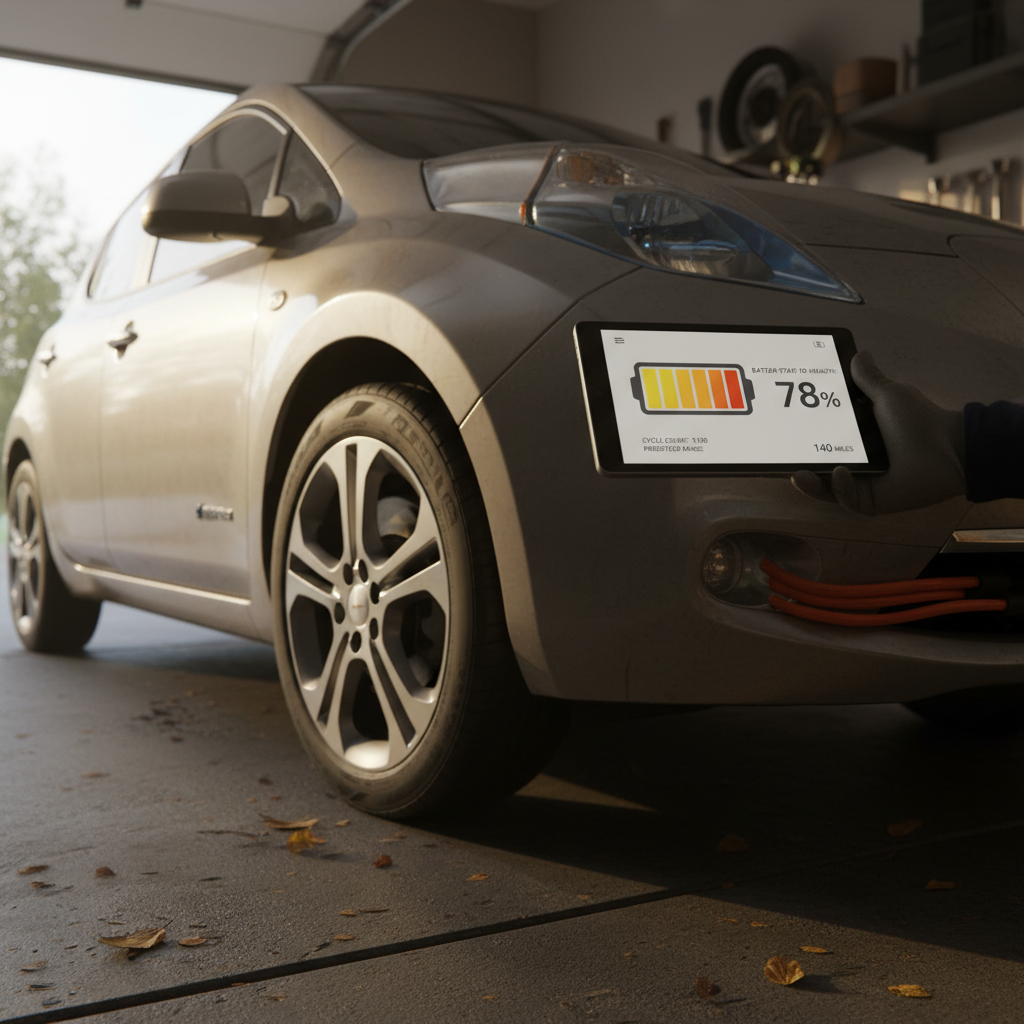
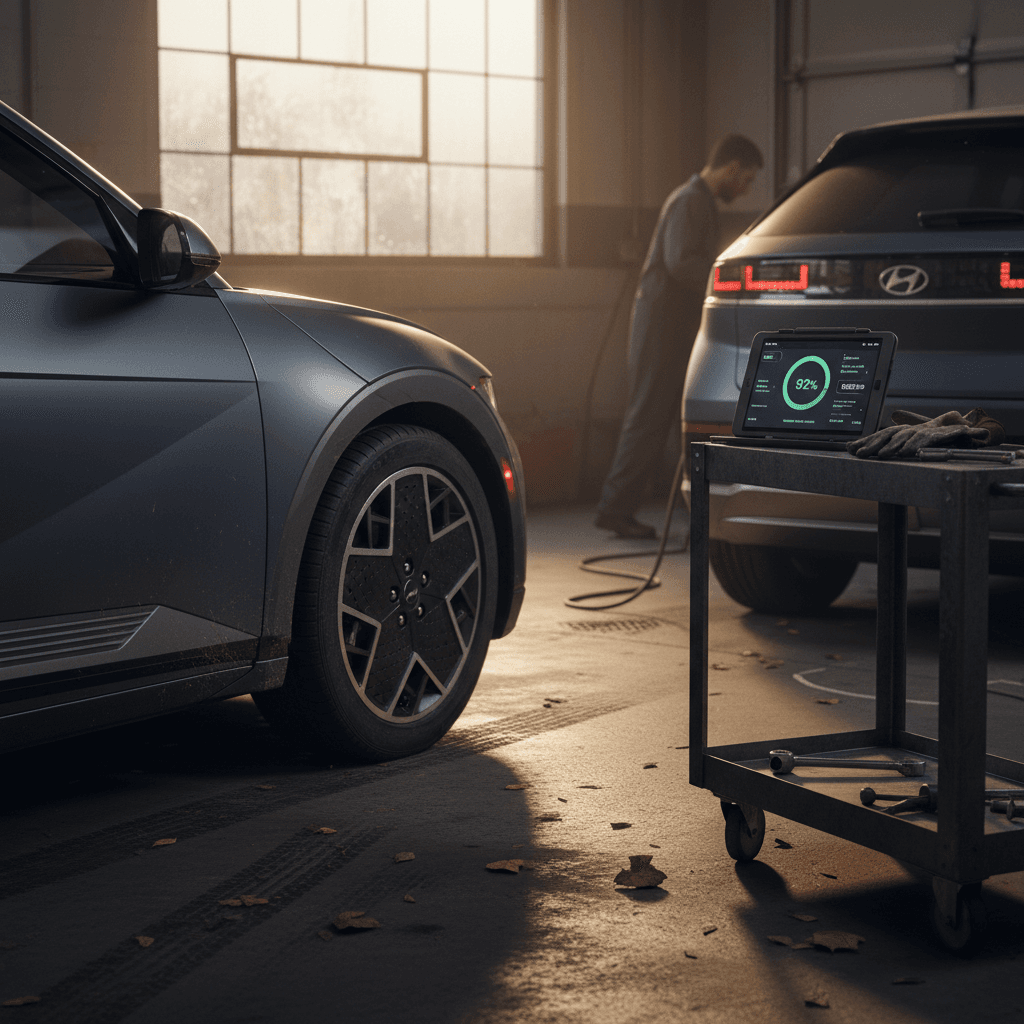
Use a professional diagnostic scan or a service like the Recharged Score to see remaining capacity, cell balance, and DC fast‑charging history where available. This is the single most important data point on a 100K‑mile EV.
2. Verify DC fast‑charging behavior
If you can, do a short DC fast‑charge session from around 20–40% state of charge and watch the power curve. A healthy car should ramp quickly and hold strong through at least 60% before tapering.
3. Inspect tires, wheels, and alignment
Uneven wear, cupping, and curb‑rashed wheels suggest a hard life. A car that tracks straight with even tire wear tells you someone cared.
4. Check for software and recall completeness
Scroll through the service records or ask a Hyundai dealer to verify that safety recalls and major software updates have been applied.
5. Test every button and feature
Don’t rush the test drive. Try every window, seat adjustment, camera view, drive mode, and driver‑assist feature. On a tech‑heavy EV, little annoyances add up quickly.
6. Listen on bad pavement
Find a rough road and drive with the radio off. Squeaks from the dash, tailgate rattles, or a thumping suspension can turn into repair bills.
Let someone else crawl around under it
IONIQ 5 vs Rivals as a High-Mileage Used EV
Stack a 100,000‑mile IONIQ 5 against used rivals, a Tesla Model Y, a Ford Mustang Mach‑E, a Volkswagen ID.4, and its character comes into focus. The Hyundai is the design kid in art school who secretly aces math: extroverted styling wrapped around a very rational long‑term ownership proposition.
How the IONIQ 5 Ages Versus Key Rivals
Generalized comparison of high‑mileage examples; individual cars will vary widely.
| Model | Charging Strength | Battery Aging Reputation | Interior Aging | Standout Trait at 100K mi |
|---|---|---|---|---|
| Hyundai IONIQ 5 | Excellent 800V DC performance, quick 10–80% | Generally strong with proper care | Cabin still feels modern, lounge‑like | Ultra‑fast charging + comfort |
| Tesla Model Y | Very good Supercharger access, strong network | Good, backed by deep data set | Minimalist but can squeak and rattle | Range and charging ecosystem |
| Ford Mustang Mach‑E | Decent but not class‑leading DC speeds | Mixed; early packs had more issues in some trims | Sportier seating, some material wear | Driving feel and badge appeal |
| VW ID.4 | Moderate DC speeds, improving with updates | Reasonable but less 800V headroom | Conservative, more traditional cabin | Value and practicality |
This is a directional guide, not a substitute for inspecting the exact vehicle you’re buying.
Where the IONIQ 5 shines used
Should You Buy a High-Mileage IONIQ 5?
If your daily driving fits comfortably within 150–220 miles and you have access to home or workplace charging, a 100,000‑mile Hyundai IONIQ 5 can be an extremely rational, even desirable, buy. You’re letting the first owner absorb the steepest depreciation while you inherit an EV that still feels current in design and charging tech.
- Buy with your head, not just your heart. Insist on objective battery health data, not just “it still goes pretty far.”
- Prioritize clean histories and boring maintenance over flashy wheels and cheap pricing.
- If you road‑trip often, make sure the car still fast‑charges briskly and consider how 400V vs 800V networks map onto your routes.
- Factor in tires and brakes immediately; many 100,000‑mile cars are on worn rubber that needs replacement day one.
Done right, a high‑mileage IONIQ 5 isn’t a consolation prize, it’s a smart shortcut into EV life. If you’d rather not decode battery graphs and service records alone, a platform like Recharged can help you browse used IONIQ 5s with verified battery health, transparent pricing, financing options, trade‑in support, and even in‑depth EV education so you know exactly what you’re buying.