If you’ve ever pulled into a DC fast charger on a cold day and wondered why the numbers crawl instead of rocket upward, you’ve already met the problem battery preconditioning is designed to solve. Learning how to precondition your EV battery properly can cut your charging time dramatically, improve winter range, and protect long‑term battery health.
Quick definition
What is EV battery preconditioning?
In simple terms, EV battery preconditioning means warming or cooling the battery pack before you ask much of it. Most modern EVs can do this automatically using built‑in heaters, coolant loops, and software that manages temperature. You’ll see it described in menus as Precondition, Battery conditioning, Winter mode, or bundled into a Scheduled departure or Climate feature.
- Cold weather driving – when the pack is cold, you lose range and performance, and charging slows down.
- DC fast charging – fast charging a cold battery can be slow and, in extreme cases, harder on the cells, so the car tries to warm the pack first.
Why preconditioning your EV battery matters
How much difference can preconditioning make?
Lithium‑ion cells don’t like extremes. In cold weather, the chemistry slows down, internal resistance goes up, and the car’s battery management system (BMS) responds by limiting power. That shows up as slower acceleration, a lower maximum charging rate, and more energy burned on heating.
By preconditioning, you’re nudging the pack toward its ideal temperature before you drive or plug into a high‑power charger. The result is faster charging sessions, more consistent regen braking, and less energy wasted just getting the pack up to temperature once you’re already on the road.
How preconditioning works inside your battery
1. Hardware: heaters and coolant loops
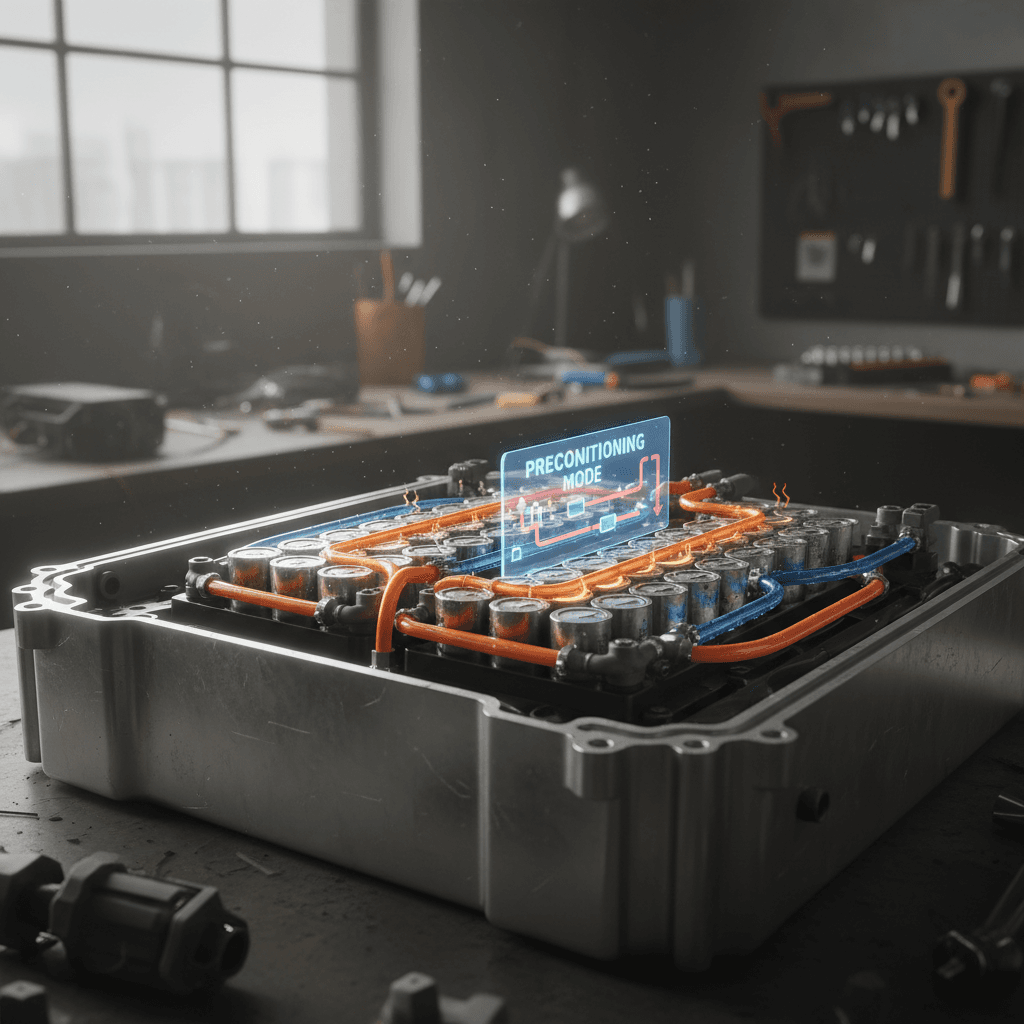
Your EV’s pack is surrounded by a thermal management system, usually liquid‑cooled:
- Coolant loop moves heat in or out of the battery.
- PTC heaters or heat pump warm the coolant and sometimes the pack directly.
- Valves & pumps route heat between the battery, motor, and cabin.
When you enable preconditioning, those components wake up and start targeting a set temperature for the pack, often in the mid‑teens to mid‑20s °C (around 60–75°F).
2. Software: your car’s brain
The BMS and vehicle software decide when and how hard to precondition. Common triggers include:
- Scheduling a departure time in the app or infotainment.
- Routing to a DC fast charger in the built‑in navigation.
- Outside temps dropping below a threshold (often near freezing).
- Manually turning on a precondition or winter mode.
Under the hood, the car is balancing energy use, time, and battery safety each time it preconditions.
Best practice: stay plugged in
Four ways to precondition your EV battery
Most EVs sold in the last few years support at least one of these approaches; many support all four. The exact menus vary by brand, but the logic is the same.
Main ways to precondition an EV battery
1. Scheduled departure (set‑and‑forget)
You tell the car what time you plan to leave each day. The car back‑calculates when to start preconditioning so the pack and cabin are ready by that time. This is ideal for daily commutes and morning school runs. Many EVs let you choose weekdays vs weekends and align with off‑peak utility rates.
2. Navigation‑triggered preconditioning
When you set a DC fast charger or specific fast‑charge waypoint in the car’s native navigation, it automatically warms the battery en route. You’ll often see a snowflake or battery icon with a status message like “Preconditioning battery for fast charging.” Start routing 15–30 minutes before you arrive for maximum effect.
3. Manual preconditioning via app or vehicle menu
Some brands offer an explicit <strong>Battery preconditioning</strong> toggle in the app or infotainment settings, while others bundle it into climate controls. You typically want to start 30–45 minutes before departure in freezing weather, longer in single‑digit or sub‑zero temps.
4. Old‑school workaround: drive gently first
If your EV lacks explicit preconditioning, light driving for 20–40 minutes before a fast‑charge stop will warm the pack naturally. Combine that with cabin pre‑heat while plugged in at home to mitigate cold‑start penalties.
How to precondition your EV battery by brand
Typical preconditioning options by brand
Your exact menus may differ, but these are the common patterns owners see across popular models.
Tesla
- Daily use: Use Scheduled Departure in the Charging menu to warm battery and cabin before you leave.
- Fast charging: Set a Supercharger as your destination in the built‑in navigation. The car automatically preconditions the pack en route.
- On demand: From the Tesla app, tap Climate. In cold weather you’ll see a preconditioning icon; turning climate on will also warm the pack.
Hyundai / Kia
- Automatic: On many IONIQ 5, IONIQ 6, EV6, and EV9 trims, routing to a DC fast charger in the factory nav triggers battery conditioning.
- Manual: Look under EV → Battery conditioning or Winter mode in the infotainment settings to toggle on when it’s very cold.
- Tip: Not every trim has a battery heater, so if your manual mentions conditioning “if equipped,” check your spec sheet.
Ford, GM & others
- Ford (Mach‑E, Lightning): Navigation to a DC fast charger usually triggers preconditioning. Some models also have battery preheat options tucked under Vehicle or Charging settings.
- GM Ultium EVs: Many models warm the pack automatically when you route to a DC fast charger through their native nav.
- Others (VW, Volvo, Rivian, etc.): Most newer EVs use the same pattern: route to a supported fast charger and, in some cases, enable a winter or battery‑conditioning mode in settings.
Check your manual
Preconditioning for DC fast charging stops
For most drivers, fast charging in cold weather is where preconditioning really pays off. A pack that’s been sitting outside at 20°F overnight can turn a promised 20–30 minute stop into a 45–90 minute slog if you plug in completely cold.
Cold‑weather DC fast charging: with vs. without preconditioning
Approximate impact of temperature and preconditioning on fast‑charging time from roughly 10–20% up to 80%, assuming your EV and charger both support high power levels.
| Battery temperature | Without preconditioning | With preconditioning | What you’ll notice |
|---|---|---|---|
| 70–80°F (ideal) | 20–30 min | 20–30 min | No real difference; pack is already warm. |
| Around 32°F | 40–70 min | 30–45 min | Charging feels much slower if you plug in cold; preconditioning recovers a big chunk of speed. |
| Around 20°F or below | 60–90+ min | 40–60 min | Cold pack may start at very low power and slowly ramp; arriving preconditioned avoids the worst of this. |
These are ballpark figures to illustrate trends; your exact times depend on model, charger, and starting state of charge.
How to precondition before a DC fast charge
1. Plan your stop in the car’s navigation
From your infotainment screen, choose your DC fast charger from the built‑in navigation rather than CarPlay/Android Auto or a phone app. Many EVs only trigger battery preconditioning if the charger is set as a destination or waypoint in the native system.
2. Aim for 15–30 minutes of lead time
Start navigation to the charger at least 15–30 minutes before you arrive, especially in freezing weather. That gives the thermal system time to warm the pack gradually instead of blasting heat at the last minute.
3. Arrive with a lower state of charge
Most EVs charge fastest between about 10–60%. If it’s practical, arrive at the fast charger below ~40–50% so you can take advantage of the highest charge rates once the battery is warmed.
4. Stay plugged in during cabin warm‑up
If you’re starting from home or a hotel, pre‑heat the cabin while plugged in. The excess heat from warming the pack can often be reused to warm the cabin once you’re on the road, especially in EVs with heat pumps.
5. Watch for on‑screen indications
Look for messages like “Battery preconditioning” or icons near the battery gauge. If you don’t see any sign that the car is preparing the pack, check settings or your owner’s manual, some models require an explicit toggle.
Road‑trip hack
Daily driving vs. road‑trip preconditioning strategies
For everyday commuting
- Use Scheduled Departure: Set a weekday departure time that matches your normal routine so the battery and cabin are ready when you unplug.
- Keep it plugged in: Let the car sip power to maintain temperature when it’s well below freezing.
- Don’t chase perfection: For level 2 home charging, cold weather doesn’t hurt nearly as much as with DC fast charging, your overnight window is long enough that a slightly cold pack isn’t a big deal.
For long highway trips
- Precondition before every fast‑charge stop in real winter conditions; that’s where you’ll feel the biggest time savings.
- Drive first, then charge: Avoid pulling straight from a hotel parking lot into a fast charger with a completely stone‑cold battery.
- Factor it into route planning: Add 10–15 minutes of drive time before the first fast charge on frigid mornings so the pack can begin to warm up.
Where Recharged fits in
Ready to find your next EV?
Browse VehiclesCommon preconditioning mistakes and myths
- “Preconditioning wastes energy, so I shouldn’t use it.” In reality, a short preconditioning session typically costs less electricity than the extra energy you’d burn driving a cold battery, and you get your charge done faster.
- “I can just floor it on a frozen pack; the car will protect itself.” The BMS will limit power, but that means sluggish performance and reduced regen. Preconditioning gives you a safer, more consistent feel from the start.
- “If I remote‑start climate, the battery is definitely warmed.” On some older or simpler EVs, remote climate only heats the cabin, not the pack. Newer models often link the two, but it’s worth checking your manual.
- “All EVs precondition the same way.” They absolutely don’t. Some require a specific nav step, some have manual toggles, and a few budget models still lack active pack heating entirely.
- “Preconditioning on battery power is fine every time.” It’s safe, but you’re burning range. Treat preconditioning on battery power as an exception, use it for comfort or emergency fast charges, but favor doing it while plugged in.
Avoid fast‑charging a truly frozen battery
EV battery preconditioning FAQs
Frequently asked questions about preconditioning EV batteries
Bottom line: when and how to precondition your EV battery
You don’t need to micromanage pack temperature for every errand run, but knowing how to precondition your EV battery is one of those small habits that pays off disproportionately, especially in winter and on road trips. Use scheduled departure for your daily routine, route to fast chargers through your car’s built‑in navigation, and whenever possible warm the battery while you’re still plugged in.
If you’re considering a used EV, pay attention to how each model handles preconditioning and cold‑weather charging. Features like active battery conditioning, heat pumps, and robust thermal management aren’t just spec‑sheet trivia; they shape your real‑world charging stops for years to come. And if you’d rather not guess, start your search with a car that comes with a transparent Recharged Score, so you know exactly what kind of battery you’re trusting on that first winter road trip.