If you’re curious about going electric but worried you’ll get stranded with a dead battery, you’re not alone. Surveys in 2024–2025 consistently show that **range and charging concerns** are the top reasons Americans hesitate to buy an EV, often outranking price. The good news: with today’s vehicles, growing charging networks, and a few simple habits, you can learn how to overcome EV range anxiety and drive with the same confidence you have in a gas car.
Range anxiety vs. charging anxiety
What is EV range anxiety (and how bad is it today)?
EV range anxiety is the **fear that your electric vehicle won’t have enough charge to reach your destination or the next charger**. It’s emotional as much as it is technical, people imagine worst‑case scenarios even if the numbers say they’ll be fine.
Range anxiety by the numbers
So why does range anxiety still feel so real? Because **habits and expectations were built around gas stations everywhere**, and EVs ask you to think a little differently about energy. Once you adapt, most owners report that range anxiety fades and driving becomes routine.
Why EV range anxiety happens in the first place
Four common triggers for EV range anxiety
If you know what sets it off, you can design around it.
1. New math vs. old habits
2. Fear of the unknown
3. Weather and conditions
4. Used‑EV and battery health worries
Think “energy budget,” not “empty tank”
Step 1: Know your real-world EV range
The single best way to overcome EV range anxiety is to **understand your realistic range in your real life**, not just the marketing number. Rated range (EPA miles) assumes a standardized test. Your range depends on speed, terrain, temperature, cargo, and driving style.
Calculate a conservative daily range
Start with the EPA range, then knock off some miles to create a built‑in safety margin. A simple rule of thumb:
- Subtract 20–30% for mixed highway/city driving.
- Subtract another 10–20% for very cold or hot days.
- Plan your life around that **reduced** number, not the brochure figure.
Use a week of driving as your test
For your first week with an EV (or test drive), note:
- Daily miles driven.
- State of charge (SoC) when you leave and return home.
- How much one overnight charge adds back.
You’ll quickly see that normal commuting uses a small slice of the battery, which builds confidence.
Don’t chase 0%, plan around 20–30%
Step 2: Build a simple home charging routine
Most EV owners say range anxiety disappears once they treat **home like their gas station**. Instead of hunting for fuel at the last minute, your car quietly refills while you sleep.
Home charging habits that kill range anxiety
1. Install (or plan for) Level 2 charging
A 240‑volt Level 2 charger can add roughly **20–40 miles of range per hour**, depending on your car. For many drivers, that means you can fully recharge from typical weekday driving in just a couple of hours overnight.
2. Use scheduled charging for off‑peak hours
Most EVs and chargers let you schedule charging when electricity is cheapest (often overnight). Set it once. Then you wake up to a car that’s charged to your target level, no mental load, no last‑minute panic stops.
3. Set a daily charge limit (not 100%)
Charging to 80–90% for daily use is usually healthier for long‑term battery life than going to 100% every night. Save full 100% charges for road trips or big days when you know you’ll need the extra buffer.
4. Make plugging in a habit, not a decision
Pick a rule like “Plug in any night I’m below 60%” and stick to it. Once plugging in becomes **automatic**, you stop thinking about whether you have enough range tomorrow, it’s just there.
5. If you rent or live in a condo, get creative
Talk to property managers about shared Level 2 chargers, look for nearby workplace charging, or use a mix of public Level 2 and DC fast charging. Even **one or two good charging sessions a week** can be enough for light‑mileage drivers.
Where Recharged fits in
Ready to find your next EV?
Browse VehiclesStep 3: Plan smarter for road trips, not perfect
Road trips are where range anxiety shows up the loudest. The solution isn’t to buy the biggest battery on the market, it’s to **plan like a pilot instead of a passenger**. A little prep makes long drives surprisingly straightforward.
Sample road-trip charging strategy
How often you’ll likely stop to charge vs. real‑world needs.
| Trip Type | Typical Leg (mi) | Arrival SoC Target | Charge To | Stop Length (min) |
|---|---|---|---|---|
| Weekend visit to family (150 mi each way) | 120–140 | 20–30% | 70–80% | 20–30 |
| Regional work trip (250–300 mi) | 130–170 | 15–25% | 70–80% | 25–35 |
| Cross‑country day (400+ mi) | 120–160 | 10–20% | 60–75% | 25–40 |
You rarely need to run your EV from 100% to 0%, small, well‑timed stops work best.
On modern DC fast chargers, you’ll usually **charge in shorter bursts** rather than one big, slow 0–100% session. Batteries charge fastest from roughly 10–60% or 10–80%, then slow down. Plan your food and bathroom breaks around those windows and the anxiety melts away.
Use your stomach and bladder as your range guide
Step 4: Use better apps and data to kill uncertainty
A lot of range anxiety comes from old‑school navigation that doesn’t understand EVs. Today’s EV‑specific apps and built‑in route planners factor in **elevation, temperature, your driving style, and real‑time charging data** to predict whether you’ll make it, and where to stop if not.
Tools that make EV range feel predictable
Combine a few of these and uncertainty drops fast.
In‑car route planner
- Plots charging stops automatically.
- Shows arrival % at each stop.
- Re‑routes if you drive faster or conditions change.
Third‑party apps
- Show station ratings and reliability feedback.
- Let you filter by speed, network, and amenities.
- Help you avoid known problem sites.
Utility & network apps
- Real‑time charger status and pricing.
- Idle‑fee info so you’re not surprised.
- Usage history to understand your costs.
Plan for one backup option
Step 5: Manage range in cold and hot weather
Temperature is one of the biggest wildcards in real‑world range. In very cold weather, your EV uses energy to warm both the battery and the cabin; in extreme heat, it spends power on cooling. That can temporarily cut usable range by **20–40%** in harsh conditions.
- Precondition your car while it’s plugged in so the battery and cabin are warmed or cooled using grid power, not your battery.
- Use seat and steering‑wheel heaters instead of blasting hot air, these sip energy compared to heating the whole cabin.
- On cold days, plan slightly shorter legs between chargers and charge a bit higher (for example, 80–90% instead of 70–80%).
- Slow down 5–10 mph on highway stretches if your projected arrival drops lower than you’d like, small speed changes can add meaningful range.
- Keep tires properly inflated; under‑inflation increases rolling resistance and eats into range.
Don’t confuse seasonal swings with permanent battery loss
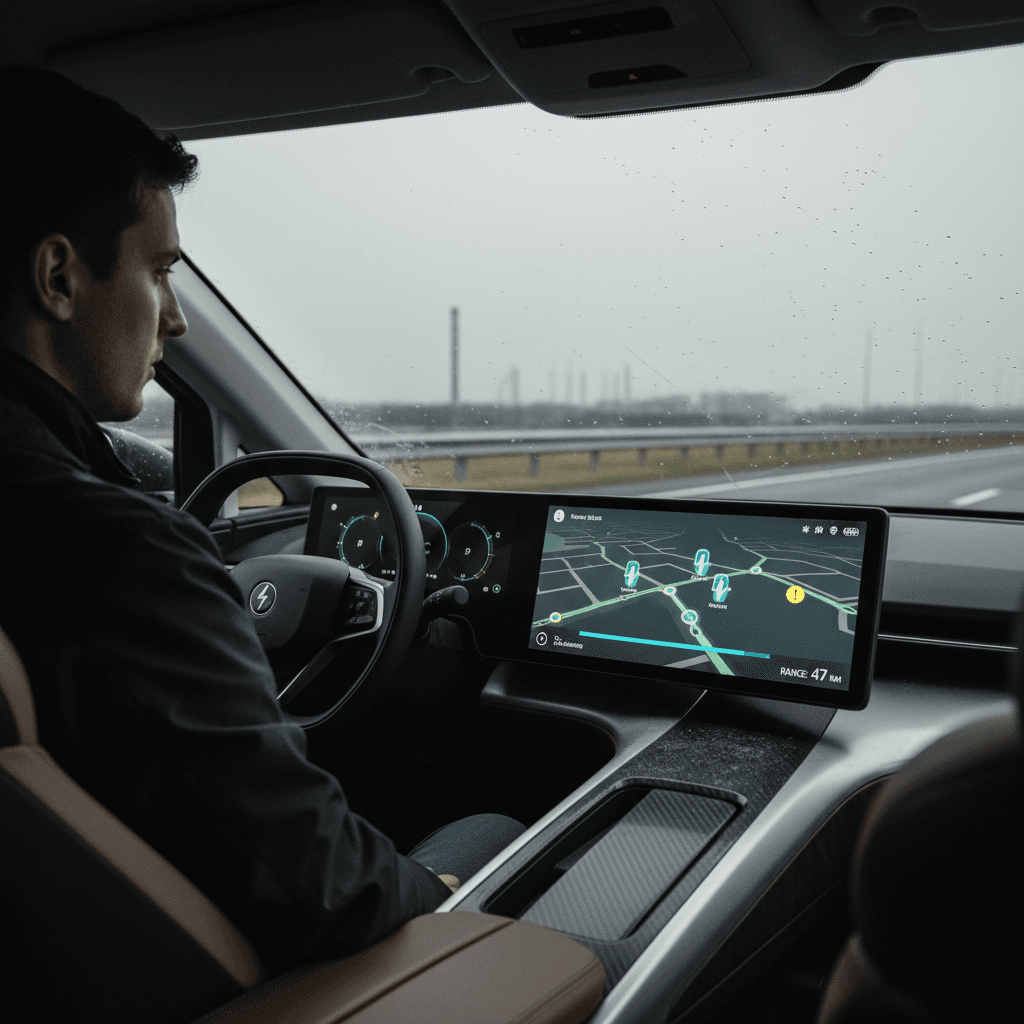
Choosing the right EV to avoid range anxiety
Some range anxiety comes from a mismatch: using a small‑battery city car for **regular long‑distance highway travel**, or buying more battery than you’ll ever use. The sweet spot is an EV that comfortably covers your routine with headroom for bad weather and occasional detours.
Match your lifestyle to the right range
Think needs first, not just the biggest number on the window sticker.
Daily commuter (under 60 mi/day)
Frequent highway traveler (200+ mi trips)
Rural or winter‑heavy driving
Budget‑focused buyer
Rule of thumb: 3x your daily need
How used EV buyers can feel confident about range
Used EVs are where range anxiety and battery‑health anxiety often blur together. Shoppers worry that a five‑year‑old battery might have lost a huge chunk of range. In reality, most modern EV batteries **degrade far more slowly** than early fears suggested, but the key is having data, not guesses.
Questions to ask about a used EV
- What was the car’s **original EPA range**?
- What does it report today at 100% charge?
- How was it charged, mostly at home, or mostly DC fast?
- Is there a **battery warranty** still in effect?
These answers help you separate normal wear from potential red flags.
How Recharged helps de‑stress used EVs
Every vehicle sold through Recharged includes a Recharged Score Report with verified battery health and fair‑market pricing. That means:
- Independent diagnostics on **battery condition** and capacity.
- Clear visibility into how much range you can realistically expect.
- Expert guidance to match your driving and charging habits.
Instead of guessing how a previous owner treated the battery, you get objective data to base your decision on.
Why battery transparency matters
EV range anxiety: Frequently asked questions
Common questions about EV range anxiety
Key takeaways: How to overcome EV range anxiety
- Treat range anxiety as a **planning problem**, not a deal‑breaker. With home charging and today’s EV ranges, most daily driving needs are easy to cover.
- Build simple, repeatable habits, like plugging in at home and sticking to a comfortable state‑of‑charge window, to keep your battery in a healthy, stress‑free zone.
- For road trips, let **route planners and charging apps** do the heavy lifting, and always keep one backup charger in your mental or digital plan.
- Understand how **weather and speed** affect range so surprises don’t feel like emergencies; you’ll know exactly what levers you can pull to stretch miles if needed.
- If you’re shopping used, insist on **transparent battery health data**. Tools like Recharged’s Score Report turn unknowns into clear, confident decisions.
- Once you’ve lived with an EV for a few weeks, range anxiety usually gives way to something else: the comfort of leaving home every morning with a “full tank” waiting in your driveway.
Range anxiety won’t vanish from the headlines overnight, but it doesn’t have to define your experience. With the right EV, honest battery information, and a few new habits, you can turn that nervous "Will I make it?" into a calm, data‑backed "Of course I will." If you’re considering a used EV, Recharged is built to make that transition easier, pairing verified battery health with expert guidance so you can enjoy the benefits of electric driving without the stress.