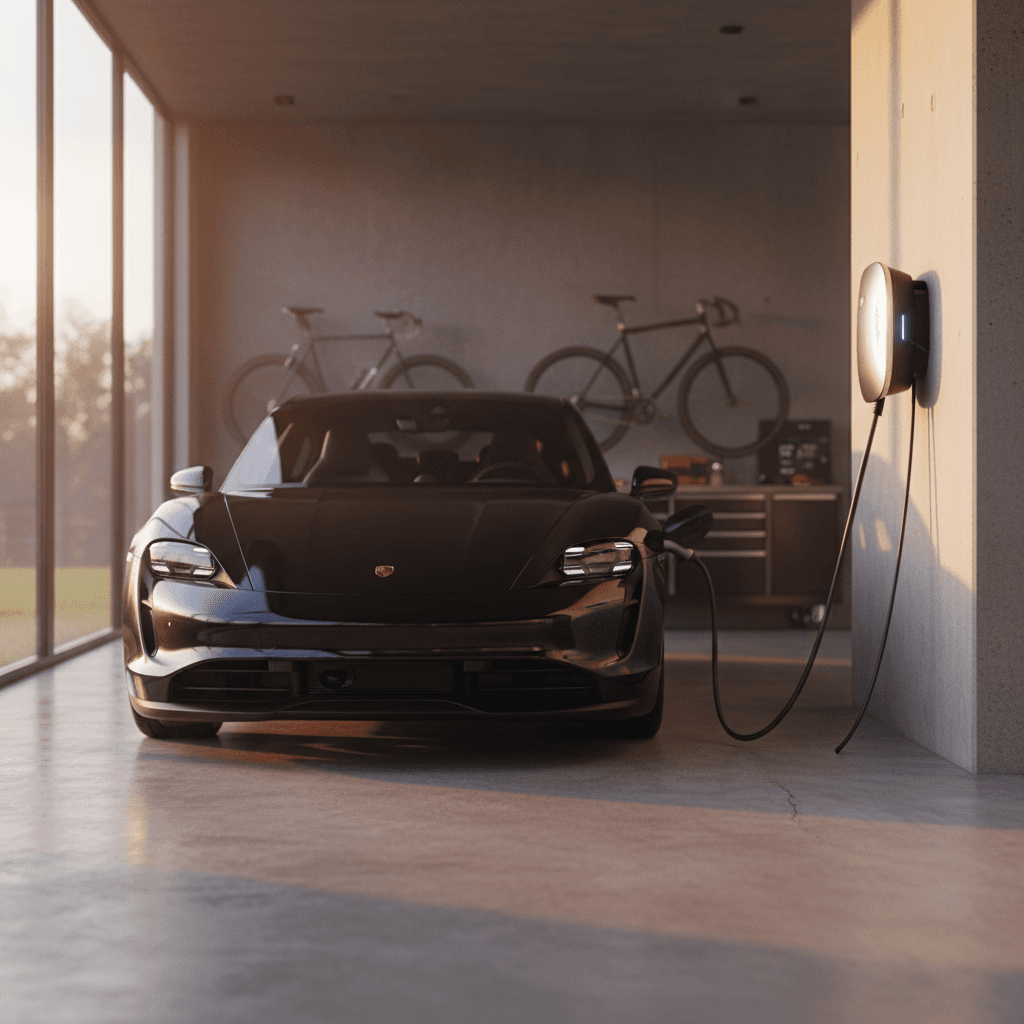
If you’re wondering how to charge your Porsche Taycan at home, you’re not alone. The Taycan’s 800‑volt architecture and fast DC charging get all the headlines, but the quiet hero of ownership is a simple, well‑set‑up home charging routine. Done right, you wake up every morning with a “full tank,” lower energy costs, and a healthier battery over the long run.
Good news for Taycan owners
Porsche Taycan home charging basics
Before you start comparing wallboxes, it helps to understand how the Taycan actually charges at home. At home you’ll be using AC charging, not the ultra‑fast DC charging you see at highway stations. The Taycan’s onboard charger converts that AC power from your house into DC power the battery can store.
How the Taycan charges at home vs on the road
Two different systems, two different use cases
Home: AC charging
- Uses 120V or 240V power from your house
- Relies on the Taycan’s onboard charger (typically 9.6–11 kW, with an optional 19.2 kW upgrade)
- Ideal for overnight charging and battery longevity
Away: DC fast charging
- High‑power public stations on trips
- Bypasses the onboard charger and feeds DC directly to the battery
- Great for road trips, but harder on the battery if used constantly
Most U.S. Taycan models are delivered with an AC onboard charger that can accept around 9.6–11 kW on Level 2. Many later cars (or earlier cars that have been upgraded) support a 19.2 kW onboard charger, which can roughly halve home charging time when paired with a suitably powerful wallbox and circuit.
Check your Taycan’s onboard charger
Home charging options for your Taycan
From a homeowner’s point of view, there are three practical ways to charge a Taycan at home: Level 1 (standard outlet), Level 2 using Porsche’s Mobile Charger, and Level 2 using a dedicated wallbox or hardwired EVSE. The right choice depends on your daily mileage, your panel capacity, and whether you own or rent.
Taycan home charging options compared
Overview of the most common ways to charge a Porsche Taycan at home in the U.S.
| Option | Electrical supply | Approx. power | Miles of range per hour* | Best for |
|---|---|---|---|---|
| Level 1 (120V outlet) | Standard 15 A household outlet | ~1.2–1.4 kW | ~3–5 mi/hr | Very light drivers, overnight top‑ups, temporary use |
| Level 2 – 240V with Mobile Charger | 240V NEMA outlet (e.g., 14‑50, 6‑50) | Up to ~9.6–11 kW (standard onboard charger) | ~25–30 mi/hr | Typical daily commuting, most owners |
| Level 2 – 240V wallbox / EVSE | Dedicated 40–80 A circuit | Up to 11–19.2 kW (depending on car) | ~30–40+ mi/hr | Heavy drivers, multiple EVs, future‑proof setups |
Charging speeds and practicality assume a typical Taycan battery and U.S. electrical service.
Avoid using extension cords
Option 1: Level 1 (120V) charging
Level 1 charging uses a regular 120V outlet, the same type you’d use for a lamp or laptop. It’s slow, think in terms of overnight top‑ups rather than refueling from empty. On a Taycan, you’re typically looking at roughly 3–5 miles of added range per hour on the plug. That can work if you drive only 20–30 miles a day and can plug in for 10–12 hours each night.
Option 2: Level 2 with Porsche Mobile Charger
Many Taycan owners use the factory Porsche Mobile Charger Connect or Mobile Charger Plus with a 240V outlet. This effectively turns your garage into a Level 2 station without a permanently mounted wallbox. With the standard onboard charger and a 40 A circuit, you can usually add around 25–30 miles of range per hour.
Option 3: Level 2 wallbox or hardwired EVSE
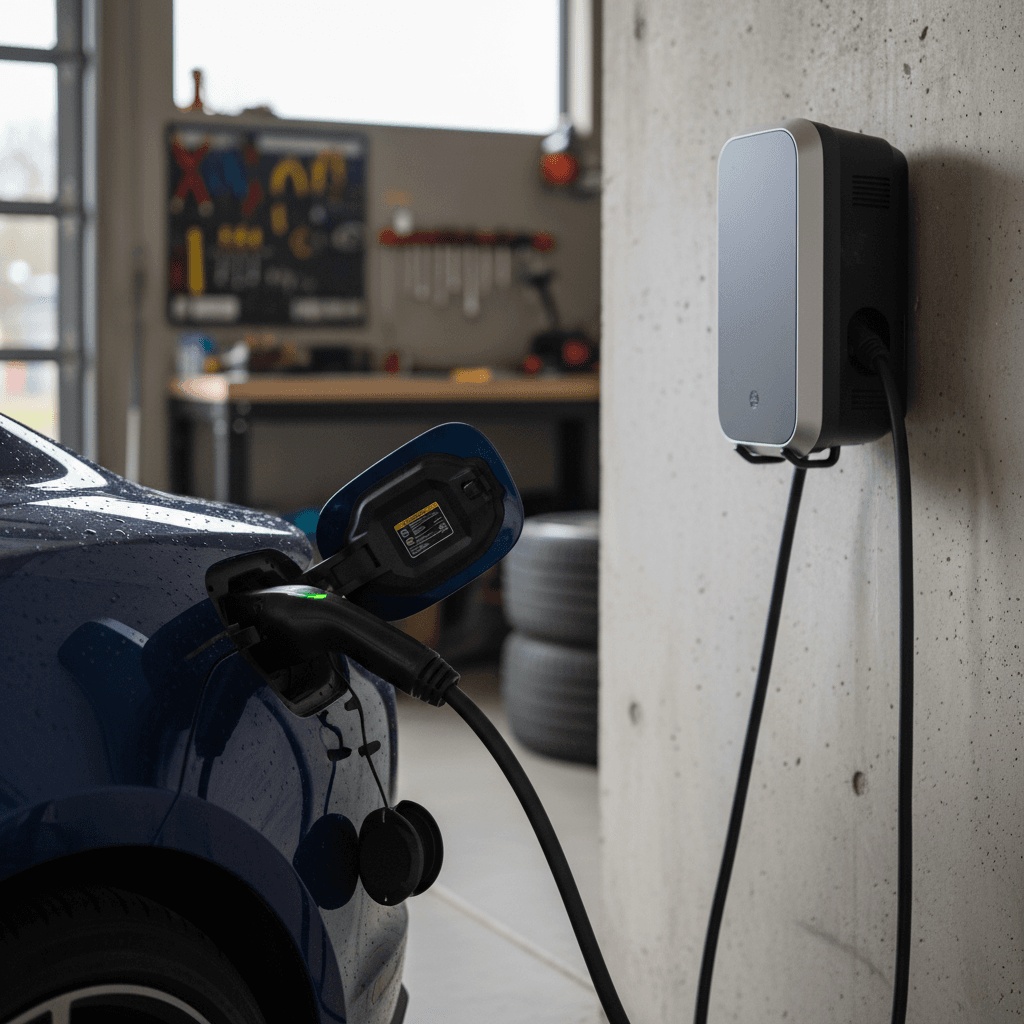
A dedicated Level 2 wallbox (whether Porsche‑branded or third‑party J1772) gives you cleaner cable management, better durability, and higher power options. If your Taycan has the 19.2 kW onboard charger and you install a 100 A circuit with a suitably rated unit, you can reduce full‑charge times to roughly five hours from empty. For most households, a 40–60 A wallbox is more than enough, plug in when you get home, and you’re back at your target state of charge well before morning.
How long does it take to charge a Taycan at home?
Actual charging time depends on your Taycan’s battery size, your onboard charger rating (standard vs 19.2 kW), and how low you let the battery get. But we can get close enough for real‑world planning.
Typical Taycan home charging times (approximate)
You rarely need 0–100% at home
- If you plug into a 240V Level 2 charger every evening, it’s realistic to regain 150–200 miles of range overnight, even with the standard onboard charger.
- With the 19.2 kW onboard charger and a high‑amp wallbox, you can easily refill the whole pack between dinner and bedtime if you ever arrive home nearly empty.
- On 120V, think of your Taycan like a slow‑filling bathtub, fine to maintain level, impractical to refill from empty on a tight schedule.
How much does it cost to charge a Taycan at home?
In the U.S., home electricity is usually far cheaper per mile than gasoline, and often cheaper than public DC fast charging. Taycan owners with a large battery (around 93 kWh usable) typically see a full home charge cost in the ballpark of $12–$15 at average residential rates, which works out to only a few cents per mile for normal driving.
Simple cost math
If your electricity rate is $0.15/kWh and your Taycan has a ~93 kWh battery, then a full charge from empty costs about:
93 kWh × $0.15 = $13.95
Even if your local rate is closer to $0.20/kWh, you’re still around $18–$19 for a full charge, often less than a single tank of gas in a comparable performance car.
Compare to gasoline
Assume a Taycan delivers around 2.5–3 mi/kWh in mixed driving. At $0.15/kWh, that’s about 5–6 cents per mile. A gas sports sedan getting 20 mpg on $4/gal fuel costs roughly 20 cents per mile. Over 10,000 miles a year, that’s a four‑figure fuel savings in your favor.
Use off‑peak electricity
Setting up a safe Level 2 home charger
The electrical work involved in Level 2 charging is simple but serious. You’re pulling 30–80 amps for hours at a time. That demands a dedicated circuit, correct wire gauge, and a proper breaker. For Taycan owners, especially in older U.S. homes, this is a job for a licensed electrician, not a DIY Saturday project.
Level 2 Taycan home charging setup checklist
1. Confirm your panel capacity
Have an electrician inspect your main panel. They’ll determine whether you can safely add a 40–60 A or 100 A EV circuit without overloading the system.
2. Choose outlet vs hardwired
A 240V outlet (like NEMA 14‑50) is flexible and works with Mobile Charger units. A hardwired wallbox looks cleaner and can support higher power. Your electrician can advise based on your garage layout and future needs.
3. Match circuit to your needs
For most Taycan owners, a 40 or 50 A circuit (32–40 A continuous charging) is plenty. If you have the 19.2 kW onboard charger and long daily drives, you might justify a 100 A circuit and a high‑output wallbox.
4. Consider cable length and placement
Think about where the Taycan’s charge ports are and how you park. It’s worth spending a little extra on cable management now to avoid awkward parking gymnastics later.
5. Pull permits and pass inspection
In many jurisdictions, EV circuits require a permit and inspection. It’s an extra step, but it protects you and your home’s resale value.
6. Label and test the circuit
Have your electrician clearly label the EV breaker, then test the setup with the Taycan and your charger. Check that current levels and temperatures stay within spec.
Don’t oversubscribe your panel
Using Porsche Mobile Charger Connect at home
Porsche’s Mobile Charger Connect is a popular solution because it works both at home and on the road. It supports up to 11 kW on AC in North America and can be wall‑mounted in your garage with the supplied bracket. It also offers Wi‑Fi connectivity and can integrate with Porsche’s Home Energy Manager for price‑optimized or solar‑aware charging.
- Mount the Mobile Charger Connect in its bracket where the cable can comfortably reach your Taycan’s charge port.
- Plug its input cable into a properly wired 240V outlet, typically on a 40–50 A circuit.
- Set the maximum current on the charger (and in the Taycan’s charging menu) to match the circuit rating your electrician configured.
- Use the touchscreen or web interface to connect the unit to your home Wi‑Fi if you want monitoring and smart charging features.
Pay attention to derating
For most drivers, an 11 kW Level 2 setup paired with smart charging profiles is the sweet spot, fast enough to refill overnight without pushing your home’s electrical system to the edge.
Smart charging: timers, profiles, and battery care
The Taycan gives you more control over home charging than most owners initially use: charging profiles, timers, preferred charging periods, and target states of charge (SoC). Using these features turns your garage into a very smart “gas station” that quietly optimizes cost and battery health.
Key Taycan smart charging features for home use
Set it up once, benefit every day
Charging timers
Charging profiles
Target SoC limits
Use AC at home, save DC for trips
Common Taycan home charging mistakes to avoid
- Relying on 120V long‑term when you drive 50+ miles a day, your battery will never fully catch up, and you’ll constantly “manage” range.
- Installing a big wallbox on an undersized panel instead of upgrading the service first.
- Leaving the car at 100% SoC for days when you don’t need the range.
- Running the Mobile Charger on an old, questionable outlet that gets warm to the touch, this is a warning sign.
- Ignoring utility off‑peak programs that could cut your charging costs by 30–50%.
What “good” looks like
Frequently asked questions about Taycan home charging
Taycan home charging FAQ
Is home charging right for you?
For most Porsche Taycan owners in the U.S., the answer is an easy yes. A thoughtfully installed Level 2 home charger, paired with the Taycan’s smart charging tools, turns your garage into the most convenient and cost‑effective “fuel station” you’ll ever use. You reduce your running costs, simplify your daily routine, and, if you manage SoC wisely, help your battery stay healthy longer.
If you’re still shopping for a Taycan, or you’re considering upgrading from a different EV, a platform like Recharged can help you compare used Taycans with verified battery health, transparent pricing, and expert guidance on charging and ownership. When you’re ready, you can shop used EVs, explore financing, and get support on everything from home charging to nationwide delivery, all in one place.