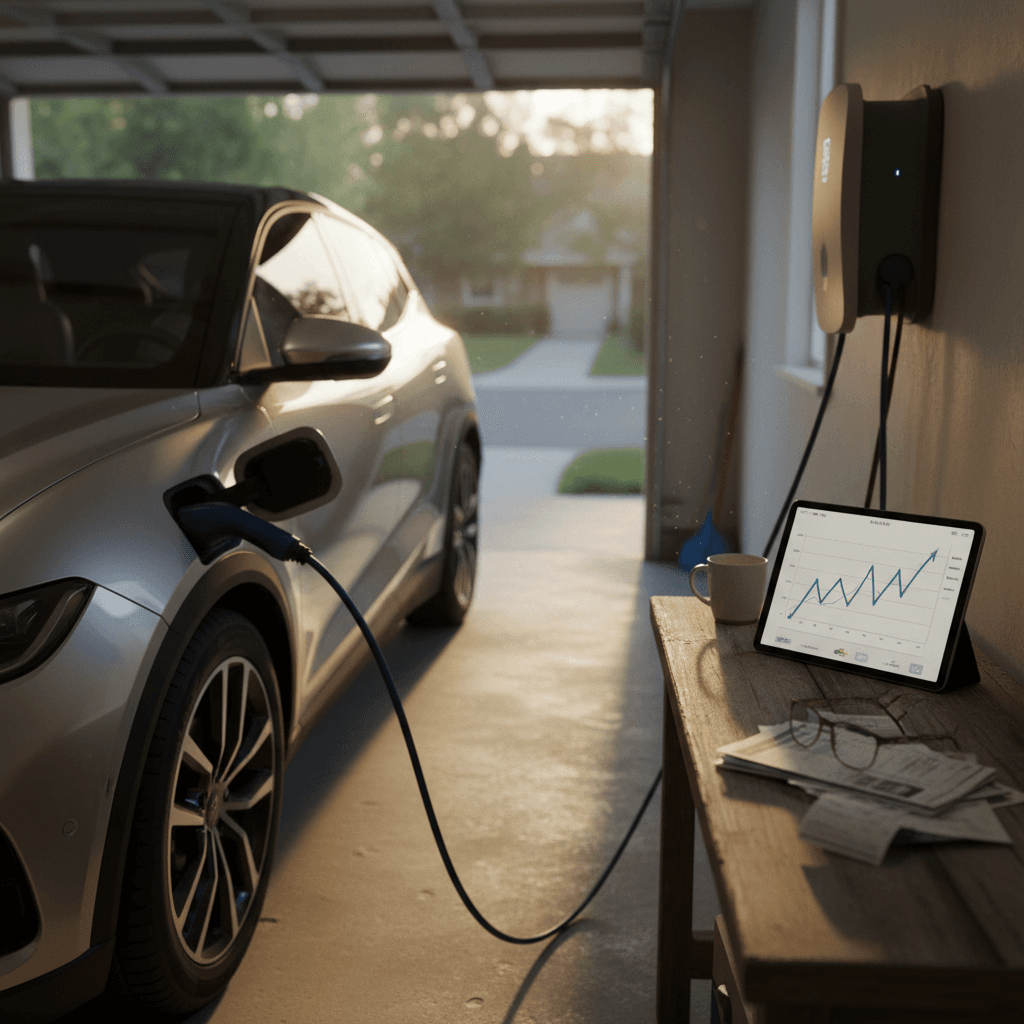
If you’re thinking about going electric, one of your first questions is probably, “How much electricity cost for electric car use every month?” The good news: in most parts of the U.S., driving on electricity is still noticeably cheaper per mile than gasoline, especially if you can charge at home.
Key takeaway
How much does it cost to charge an electric car?
The simplest way to think about how much electricity costs for an electric car is to break it into three views:
- Cost per kWh (what you pay for electricity, like $0.15 per kWh)
- Cost per full charge (e.g., $8 to “fill” a 60 kWh battery at home)
- Cost per mile (e.g., 3–5 cents per mile at home, 8–15 cents on DC fast)
Typical EV charging cost ranges in the U.S. (2025)
Use cost per mile as your anchor
Electricity cost basics: kWh, battery size, and range
To understand how much electricity you’ll pay for an electric car, you need just three numbers: your power price per kWh, your EV’s battery size, and its efficiency.
- kWh (kilowatt-hour): The “gallon” of electricity. Your utility charges you cents per kWh.
- Battery size (kWh): Many mainstream EVs today have 55–80 kWh packs.
- Efficiency (Wh/mi or mi/kWh): How far your EV goes on 1 kWh. Many real-world EVs land around 3–4 miles/kWh.
Once you know those, you can estimate costs with two simple formulas:
Cost for a full charge ≈ Battery size (kWh) × Electricity rate ($/kWh)
Cost per mile ≈ Electricity rate ($/kWh) ÷ Miles per kWh
Example: 60 kWh battery at $0.15/kWh
Home charging costs: what you’ll pay per kWh
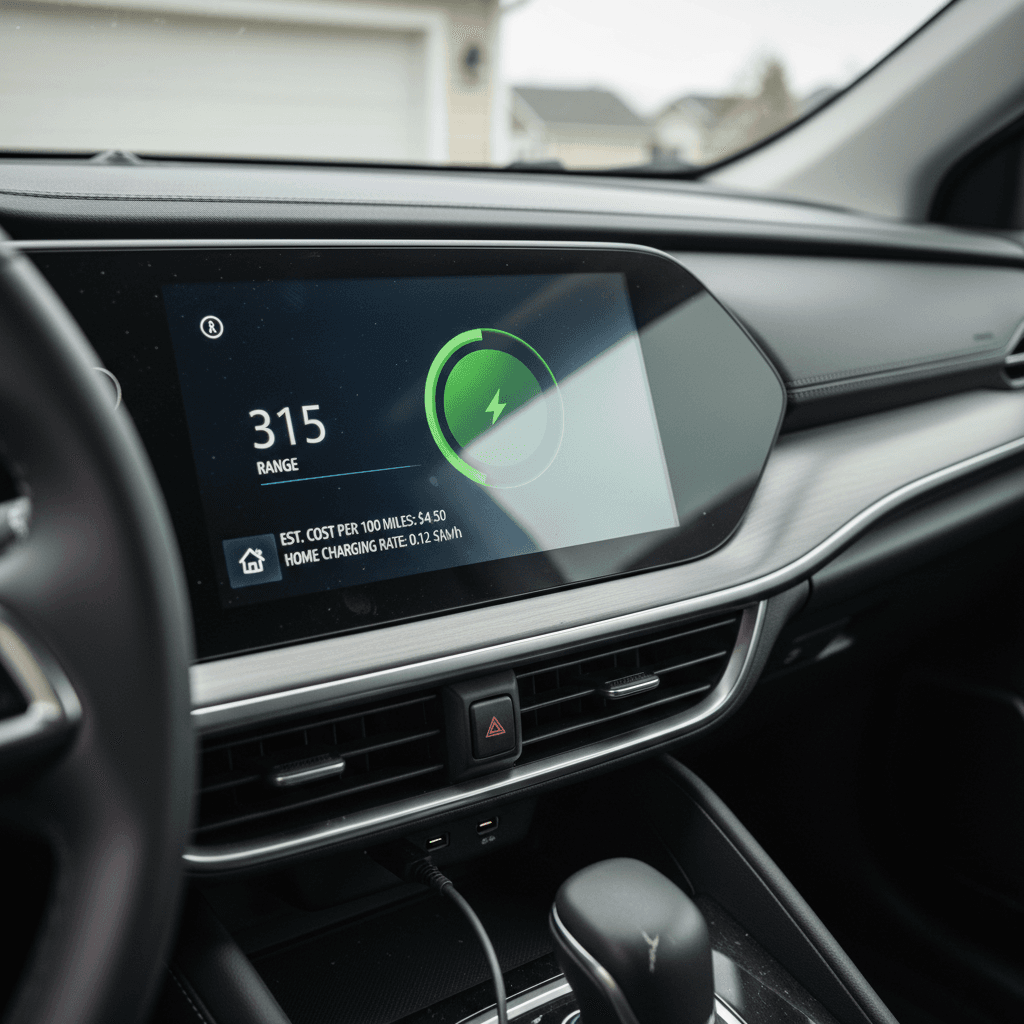
In the U.S., many households pay somewhere between 13 and 25 cents per kWh, depending on region and time of day. Some utilities now offer special EV or time-of-use rates that are cheaper at night and more expensive during late afternoon peaks.
What a full charge costs at home
Assuming a 60 kWh battery charged from 0–100% (you’ll usually charge less than this in daily life).
Low-cost power
$0.13/kWh (some Midwest/South utilities)
60 × $0.13 ≈ $7.80 for a full charge.
Average rate
$0.17/kWh (typical blended rate in many states)
60 × $0.17 ≈ $10.20 per full charge.
High-cost markets
$0.23/kWh (some coastal / urban regions)
60 × $0.23 ≈ $13.80 per full charge.
Watch for tiered and peak pricing
Cost per mile: electric vs gasoline
The fairest way to compare an EV and a gas car is to look at fuel cost per mile. Here are ballpark numbers using typical 2025 U.S. gas and electricity prices:
Estimated cost per mile: electric vs gasoline
Assumes $0.17/kWh residential electricity, $0.40/kWh average DC fast, and $3.75/gal gasoline. Numbers are rounded.
| Vehicle type | Efficiency assumption | Home charging cost per mile | DC fast charging cost per mile | Gasoline cost per mile |
|---|---|---|---|---|
| Efficient EV | 3.5 mi/kWh at $0.17/kWh | ≈ $0.049/mi (4.9¢) | ≈ $0.11/mi (11¢) at $0.40/kWh | , |
| Large / less efficient EV | 2.5 mi/kWh at $0.17/kWh | ≈ $0.068/mi (6.8¢) | ≈ $0.16/mi (16¢) at $0.40/kWh | , |
| Gas car, 30 mpg | 30 mi/gal at $3.75/gal | , | , | ≈ $0.125/mi (12.5¢) |
| Gas SUV, 20 mpg | 20 mi/gal at $3.75/gal | , | , | ≈ $0.188/mi (18.8¢) |
Your actual cost depends on your local fuel prices and your driving style, but EVs typically win on energy cost per mile.
Why EVs usually win on fuel cost
Public charging costs: Level 2 and DC fast
Public charging prices vary widely by network, region, and membership plan, but a few patterns hold across most of the U.S. in 2025.
Typical public charging price ranges
Exact numbers vary, but these bands are common in many U.S. markets.
Public Level 2
Often $0.20–$0.35 per kWh when priced by energy, sometimes flat hourly fees.
Good for topping up while shopping or at work.
DC fast charging
Commonly around $0.35–$0.55 per kWh, or per‑minute equivalents.
Best for road trips and emergency charging, not daily use if you’re cost‑sensitive.
Membership discounts
Many networks offer lower rates with a monthly fee or automaker partnership. If you road‑trip often, those plans can trim your per‑kWh cost noticeably.
Relying only on DC fast is expensive
How to estimate your monthly EV electricity bill
You don’t need a spreadsheet to figure out how much electricity will cost for your electric car each month. A quick back‑of‑the‑envelope calculation gets you very close.
5‑step shortcut to your monthly EV charging cost
1. Estimate monthly miles
Start with how much you drive now. Many U.S. drivers are around <strong>1,000–1,200 miles per month</strong>, but use your own history if you track it.
2. Look up your electricity rate
Check your utility bill for your <strong>$/kWh rate</strong>. If you’re on a time‑of‑use plan, use the off‑peak rate you’ll charge at most often.
3. Find your EV’s efficiency
Your owner’s manual or EPA label lists mi/kWh. If you’re shopping for a used EV, look at the EPA rating and assume <strong>real‑world is 10–20% worse</strong> to stay conservative.
4. Calculate monthly kWh used
Monthly miles ÷ mi/kWh = kWh per month. Example: 1,000 miles ÷ 3 mi/kWh ≈ <strong>333 kWh/month</strong>.
5. Multiply by your rate
kWh per month × $/kWh = monthly electricity cost for your EV. Using the example above at $0.17/kWh: 333 × 0.17 ≈ <strong>$57/month</strong>.
Sample: efficient compact EV
Assumptions:
- 1,000 miles/month
- 3.5 mi/kWh real‑world
- $0.15/kWh overnight rate
1,000 ÷ 3.5 ≈ 285 kWh × $0.15 ≈ $43/month.
Sample: larger SUV EV
Assumptions:
- 1,000 miles/month
- 2.5 mi/kWh real‑world
- $0.20/kWh
1,000 ÷ 2.5 = 400 kWh × $0.20 = $80/month.
Real-world cost examples for popular EVs
Let’s plug in some familiar models so you can see how much electricity might cost for an electric car you’re actually considering. We’ll assume 1,000 miles per month and home charging at $0.17/kWh.
Illustrative monthly charging costs by EV model
Estimates use rounded EPA-style efficiencies adjusted slightly for real-world driving. Your results will vary by climate, speed, and driving style.
| Model example (class) | Assumed efficiency (mi/kWh) | kWh per 1,000 mi | Monthly cost @ $0.17/kWh |
|---|---|---|---|
| Compact crossover (e.g., Hyundai Kona Electric, Chevy Bolt EUV) | 3.5 mi/kWh | ≈ 285 kWh | ≈ $48 |
| Midsize crossover (e.g., Tesla Model Y, VW ID.4) | 3.1 mi/kWh | ≈ 323 kWh | ≈ $55 |
| Large SUV / pickup (e.g., Ford F‑150 Lightning, Kia EV9) | 2.5 mi/kWh | 400 kWh | ≈ $68 |
| Luxury performance EV (e.g., Porsche Taycan, older performance sedans) | 2.3 mi/kWh | ≈ 435 kWh | ≈ $74 |
These examples are directional, but they make it easier to compare EV classes when you’re budgeting.
Used EVs behave similarly, if the battery is healthy
7 ways to lower your EV charging costs
Once you understand the basics, lowering how much electricity costs for your electric car is mostly about when and where you charge, and a little bit about how you drive.
Practical strategies to cut your EV charging bill
1. Charge off‑peak at home
Ask your utility about <strong>time-of-use or EV-specific plans</strong>. Setting your car to charge after 9–10 p.m. can shave several cents per kWh.
2. Dial in a reasonable charge limit
Keeping daily charging between <strong>20% and 80%</strong> helps battery health, which means you maintain good range and avoid charging more often than needed.
3. Use Level 2 instead of DC fast when you’re not in a hurry
Home or workplace Level 2 is usually far cheaper than DC fast. Save the fast chargers for road trips or truly tight schedules.
4. Take advantage of free or subsidized workplace charging
Many employers offer low-cost or free charging. That can reduce how much electricity you pay for at home each month.
5. Precondition while plugged in
In very hot or cold weather, use the app to heat or cool the cabin <strong>while the car is still connected</strong>. That energy comes from the grid instead of your battery.
6. Drive smoothly and mind your speed
EVs are very efficient in city driving but can lose efficiency quickly above 70 mph. Smarter driving improves mi/kWh and lowers cost per mile.
7. Right-size your EV
If you rarely tow or haul, a smaller, more efficient EV can knock <strong>20–30% off your electricity use per mile</strong> compared with a big pickup or three‑row SUV.
How charging costs impact buying a used EV
When you’re considering a used EV, it’s tempting to focus just on the sticker price. But understanding how much electricity will cost for that electric car over the next 3–5 years can be just as important, especially if you’re swapping out a fuel‑thirsty SUV or truck.
Questions to ask yourself
- Can I charge overnight at home (driveway, garage, or reliable street outlet)?
- What is my utility’s off‑peak kWh rate and can I switch plans?
- How many miles do I drive monthly and is that likely to change?
- Will I need to rely heavily on public DC fast charging?
How Recharged can help
Every vehicle sold through Recharged comes with a detailed Recharged Score Report that verifies battery health and estimates real‑world range. That makes it easier to connect the dots between a particular used EV and your real‑world electricity costs.
You can also lean on our EV specialists to talk through local electricity rates, at‑home charging options, and whether a given model fits your budget and driving habits.
Think in total cost of ownership
Ready to find your next EV?
Browse VehiclesFAQ: how much electricity costs for an electric car
Frequently asked questions about EV electricity costs
Bottom line: what you should budget for EV charging
When you strip away the acronyms and charging jargon, the core answer to “how much electricity cost for electric car ownership?” is surprisingly straightforward. For a typical U.S. driver with access to home charging, you’re often looking at roughly $30–$80 per month in added electricity usage, less if your rates are low and your EV is efficient, more if you drive a big SUV or rely heavily on DC fast chargers.
The bigger story is that those electricity dollars usually replace far more expensive gasoline. That can free up budget for a newer vehicle, a longer-range battery, or a higher‑trim model, especially in the used EV market, where depreciation has already worked in your favor.
If you’re ready to see how EV charging costs fit into your own budget, explore the used EVs available through Recharged. Every car comes with a Recharged Score Report so you can connect battery health and range to real‑world electricity costs, and our EV specialists can help you compare options, estimate monthly bills, and even pre‑qualify for financing, all online, on your schedule.