If you’re wondering how much it costs to run an electric car in 2025, you’re asking the right question. Purchase price gets all the attention, but it’s the ongoing cost per mile that determines whether an EV actually saves you money compared with a gas car.
Key takeaway up front
How much does it cost to run an electric car in 2025?
To keep things practical, let’s start with national averages for the United States in late 2025:
- Average residential electricity price: about 16–19¢ per kWh depending on state.
- Average gasoline price for regular: around $3.00–$3.20 per gallon.
- Typical modern EV efficiency: roughly 25–32 kWh per 100 miles (3.1–4.0 miles per kWh).
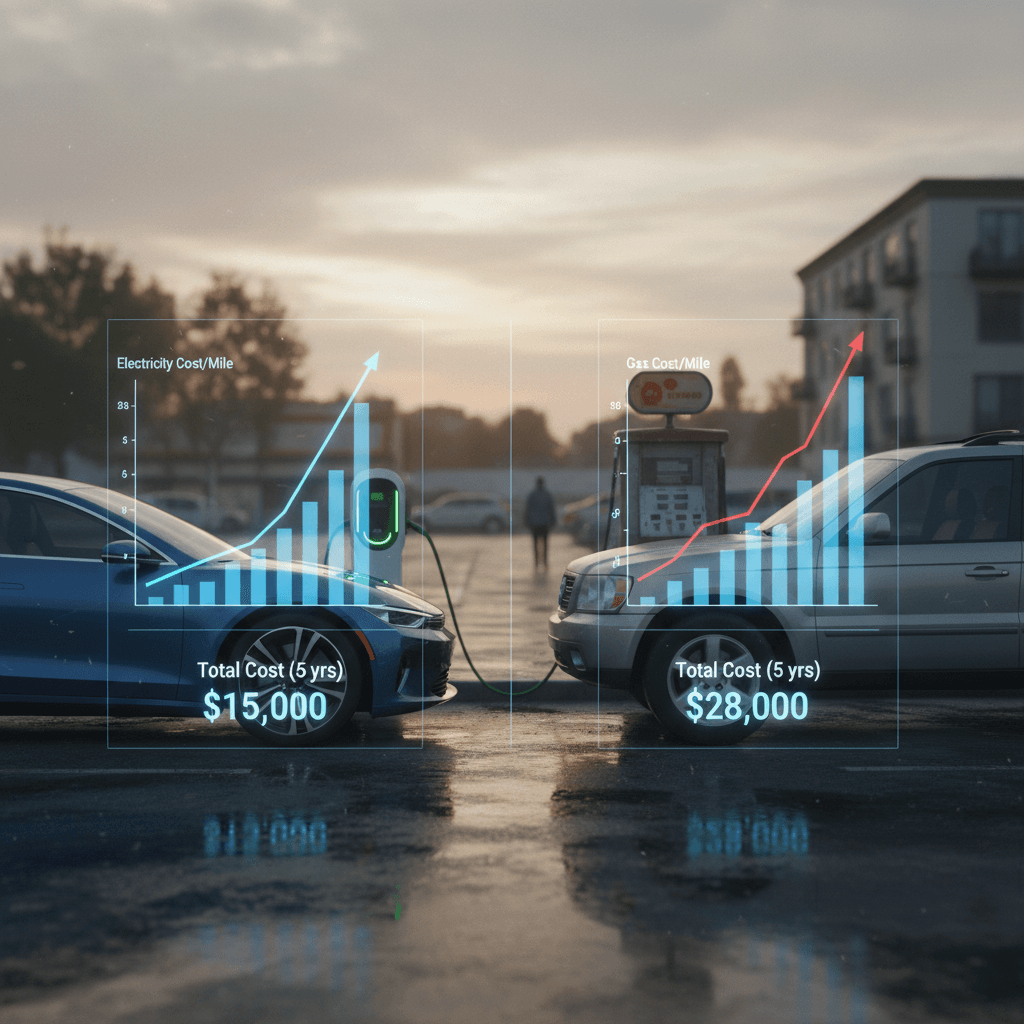
Using those numbers, many EV drivers paying typical residential rates will see a cost to run their electric car of roughly $40–$70 in electricity per 1,000 miles. A similar gas car usually lands closer to $120–$160 in fuel per 1,000 miles. That’s the heart of the EV advantage.
The simple formula
Typical U.S. running-cost benchmarks (2025)
The 3 numbers that determine your EV running costs
Every electric car, whether it’s brand‑new or a used EV you find on Recharged, follows the same basic math. Your cost to run it depends on three things:
- Your electricity price (¢ per kWh). This varies a lot by state and utility. Many U.S. households now pay somewhere around the mid‑teens to high‑teens (¢/kWh), with some states much lower and some much higher.
- Your EV’s efficiency (kWh per 100 miles). This is the electric equivalent of MPG. You’ll see it on the window sticker or EPA site as something like “28 kWh/100 mi” or “107 MPGe.” Lower kWh/100 miles means cheaper running costs.
- How and where you charge. Home Level 2 charging is usually cheapest and most consistent. Public DC fast charging can be two to three times more expensive per kWh, but you may only use it occasionally.
Why your friend’s numbers may not match yours
Typical cost-per-mile examples for popular EVs
Let’s put the formulas to work with some realistic examples using typical 2024–2025 EV efficiency numbers. We’ll assume home charging at $0.16 per kWh as a national ballpark and then show what changes if your power is cheaper or more expensive.
Illustrative EV cost-per-mile examples (home charging)
Assumes $0.16 per kWh home electricity rate. Efficiency values rounded from recent model data; this is meant as a guide, not a lab test.
| Example vehicle type | Approx. efficiency (kWh/100 mi) | Energy cost per 100 miles | Energy cost per mile |
|---|---|---|---|
| Efficient compact EV (e.g., small hatchback) | 26 kWh | $4.16 | $0.04 |
| Mainstream crossover EV | 30 kWh | $4.80 | $0.048 |
| Large SUV/pickup EV | 38 kWh | $6.08 | $0.06 |
| Performance EV | 40 kWh | $6.40 | $0.064 |
Your actual results will vary based on driving style, temperature, terrain, and electricity price.
If your electricity is closer to $0.20 per kWh, multiply those per‑mile numbers by 1.25. If you’re lucky enough to pay around $0.12 per kWh, multiply by 0.75.
What about cold weather?
Home charging vs public charging costs
Where you charge has as much impact on what it costs to run an electric car as which EV you buy. Think of it like cooking at home versus eating out, groceries are cheaper per meal, but you pay for convenience at restaurants.
How charging location changes your cost per mile
Assumes a typical crossover EV using 30 kWh per 100 miles.
Home Level 2
Typical effective rate: 12–20¢/kWh (before any special EV plan).
- Cost per 100 mi: about $3.60–$6.00
- Cost per mile: about $0.036–$0.06
- Best for daily commuting and routine driving.
Public Level 2
Typical rate: sometimes free, often 20–30¢/kWh.
- Cost per 100 mi: about $4.00–$9.00
- Cost per mile: roughly $0.04–$0.09
- Great for workplaces, shopping centers, and apartments.
DC fast charging
Typical rate: roughly 35–60¢/kWh on major networks, sometimes more in high‑cost areas.
- Cost per 100 mi: about $10.50–$18.00
- Cost per mile: roughly $0.11–$0.18
- Best reserved for road trips and occasional top‑ups.
Fast doesn’t always mean cheap
EV vs gasoline: how much are you really saving?
To answer "how much does it cost to run an electric car" in a way that matters, you have to stack it up against a gas vehicle you might otherwise drive.
Illustrative EV vs gas fuel costs (12,000 miles/year)
Assumes a typical crossover EV using 30 kWh/100 mi and a comparable gasoline crossover averaging 30 mpg, with $0.16/kWh electricity and $3.10/gal gas.
| Vehicle type | Assumptions | Annual energy use | Annual fuel/energy cost |
|---|---|---|---|
| Gasoline crossover | 30 mpg, 12,000 mi/yr | 400 gallons | ≈ $1,240 |
| Electric crossover (home charging) | 30 kWh/100 mi, 12,000 mi/yr | 3,600 kWh | ≈ $576 |
| Electric crossover (mostly fast charging) | Same EV, paying $0.45/kWh | 3,600 kWh | ≈ $1,620 |
These are fuel/energy costs only, taxes, insurance, and depreciation are separate.
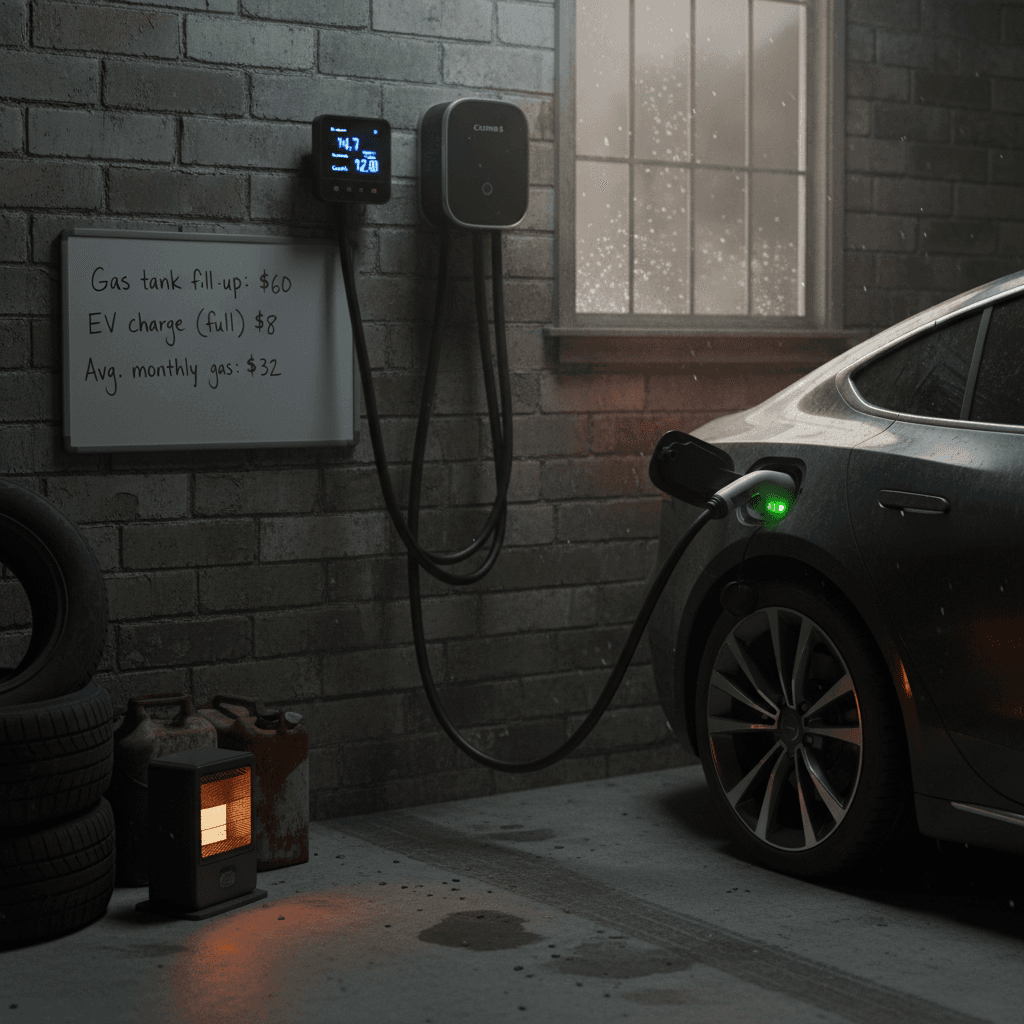
In this scenario, charging at home saves you around $664 per year versus the gas crossover. Lean on fast charging for most of your miles, and the advantage disappears.
Where many EV households land
Other running costs: tires, maintenance, and more
Fuel (or electricity) isn’t the only cost of running an electric car. The good news is that EVs tend to need less routine maintenance than gas vehicles, but there are a few trade‑offs.
Key non-fuel running costs for EVs
Brake pads and rotors
Regenerative braking means EVs often go much longer between brake jobs than comparable gas cars. Many owners report pads lasting well past 60,000 miles if driven reasonably.
Tires
EVs are heavy and have instant torque, so they can wear tires faster, especially performance models. Budget for slightly higher tire spend than a comparable gas car, rotating on schedule helps.
Fluids and filters
No oil changes, no spark plugs, no exhaust system. You still have coolant, cabin air filters, and sometimes gear oil, but visits are fewer and simpler.
Repairs and unexpected issues
Like any vehicle, things can break, suspension components, window regulators, infotainment screens. These are not EV‑specific, but they’re part of total running cost.
Average maintenance cost picture
How battery health affects your cost per mile
Battery health doesn’t usually change your electric bill directly, you still pay for the kWh you use, but it does affect how far each kWh takes you and how confident you feel using most of your range.
Range and efficiency
As an EV battery ages, it loses some usable capacity. A car that started with 250 miles of range might offer 225 miles several years later. The motor and electronics are still efficient, but you may charge a bit more often.
If a degraded battery pushes you to rely more on DC fast charging, because you feel you must “top up” frequently, your real‑world cost per mile can creep up.
Why verified battery health matters
When you buy a used EV, you’re also buying the battery’s history. A car that’s been fast‑charged daily and stored in extreme heat may age faster than one that’s been gently treated.
That’s exactly why every vehicle on Recharged comes with a Recharged Score Report, including third‑party battery diagnostics. You can see how healthy the pack is before you commit, which helps you forecast long‑term running costs more accurately.
Practical rule of thumb
7 ways to lower the cost of running an electric car
Once you understand what drives your EV running costs, there’s a lot you can do to keep them in check, without babying the car or turning every drive into a science project.
Simple cost-cutting moves for EV owners
1. Charge at home whenever you reasonably can
Even with 2025’s higher electricity rates, home charging is usually far cheaper per mile than DC fast charging. A basic Level 2 unit plus a 240‑volt circuit can pay for itself in fuel savings over a few years.
2. Ask your utility about EV or off‑peak rates
Many utilities offer time‑of‑use plans with lower overnight prices. If you can schedule charging after 9–10 p.m., your effective cost per mile can drop significantly.
3. Use public fast charging strategically
Think of DC fast charging like airport food, great in a pinch, expensive as a lifestyle. Plan trips so you use it when you need to, but not for every local errand.
4. Keep your tires properly inflated
Under‑inflated tires increase rolling resistance and energy use, raising your cost per mile. Check pressures monthly; many EVs can show this right on the dash.
5. Precondition while plugged in
On very hot or cold days, use the car’s app to preheat or precool while connected to the charger. That way, some of the climate‑control energy comes from the grid, not the battery.
6. Avoid chronic 0–100% cycles
You don’t need to baby your battery, but regularly bouncing between very low and very high states of charge isn’t ideal. Living mostly in the 20–80% range can support long‑term health.
7. Shop smart for a used EV
A fairly priced used EV with proven battery health can deliver nearly the same running‑cost advantage as a new one, with a much lower monthly payment. This is where platforms like <strong>Recharged</strong> are designed to shine.
Used EVs and total cost of ownership
When you’re evaluating a used EV, it’s helpful to think in terms of total cost of ownership rather than just the purchase price. That means looking at:
- Monthly payment (or opportunity cost if you pay cash).
- Insurance and registration.
- Electricity and occasional fast‑charging costs.
- Maintenance and tires.
- Long‑term battery health and potential replacement risk.
A thoughtfully chosen used EV can keep your monthly outlay surprisingly low: you slash fuel and maintenance, and you let the first owner absorb the heaviest depreciation. On Recharged, you also get fair‑market pricing and the Recharged Score battery report, which reduces the guesswork that usually surrounds high‑voltage packs.
How Recharged helps you run the numbers
Ready to find your next EV?
Browse VehiclesFAQ: Electric car running costs
Frequently asked questions about EV running costs
Bottom line: what to expect when you switch to an EV
When you cut through the noise, the answer to “how much does it cost to run an electric car?” in 2025 is straightforward: for most U.S. drivers who can charge at home, you’re looking at roughly 4–7 cents per mile for electricity, plus slightly lower maintenance than a comparable gas car. That’s a meaningful advantage over gasoline for everyday driving.
The key is understanding your own situation, your utility rates, commute, access to home or workplace charging, and how often you really need DC fast charging. Get those pieces right, and an EV can be one of the most cost‑effective ways to get around, especially if you choose a well‑priced used model with verified battery health.
If you’re ready to see how those numbers could work in your favor, explore used EVs with Recharged. Every car includes a Recharged Score battery health report, fair‑market pricing, and EV‑savvy support to help you understand not just what you’re paying today, but what it will cost to run your electric car for years to come.