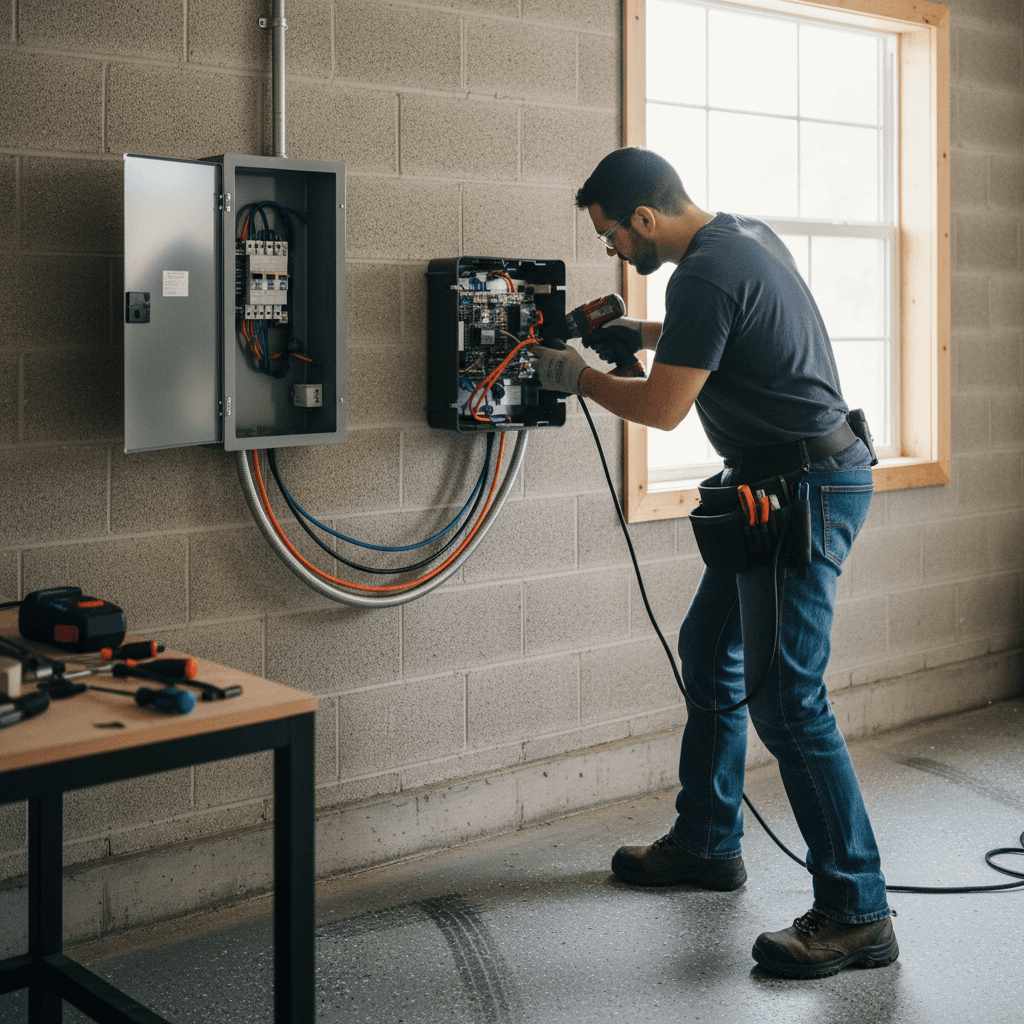
You type “how much does home EV charger installation cost 2026” into a search bar and see everything from $500 to $5,000. That’s not helpful when you’re just trying to budget for your first (or next) electric vehicle. The truth in 2026 is that most U.S. homeowners pay in the low thousands for a Level 2 home charger, but the spread is wide, and the quote you get will depend heavily on your home’s electrical system, where you park, and how fast you really need to charge.
Quick 2026 snapshot
What does home EV charger installation cost in 2026?
National cost picture for 2026 (Level 2, single‑family homes)
Those numbers come from a mix of 2024–2026 installer quote data and consumer reports, as well as national averages published by charger‑installation marketplaces and energy agencies. They also line up with what many homeowners now share publicly: all‑in costs of roughly $1,000–$3,000 are common, with occasional outliers under $800 or above $5,000 for very easy or very complex jobs.
Don’t anchor on the extremes
Home EV charger cost breakdown for 2026
To understand what you’ll actually pay, break the project into four buckets: charger hardware, installation labor and materials, permitting and inspection, and any electrical upgrades. Once you see each line item, it’s a lot easier to compare quotes and spot padding or shortcuts.
Typical 2026 cost breakdown for a Level 2 home charger
These are realistic ranges for many U.S. homeowners in 2026. Your specific numbers will depend on local labor rates and your electrical system.
| Cost component | What it covers | Typical 2026 range |
|---|---|---|
| Charger hardware | Wall‑mounted Level 2 charger (32A–48A), Wi‑Fi/app features, load sharing, NACS/J1772 cable | $400–$1,000 |
| Basic installation labor & materials | Electrician time (2–4 hours), wiring, conduit, new breaker, mounting the unit | $400–$1,500 |
| Permits & inspection | Electrical permit, inspection fees where required | $50–$300 |
| Panel or circuit upgrades (if needed) | Panel capacity check, new subpanel, service upgrade, load management device | $500–$3,000+ |
| Trenching or long wire runs (if needed) | Running power to detached garages or parking pads, concrete/asphalt work | $500–$3,500+ |
Use this table as a budgeting tool, not a promise, get a site visit for firm pricing.
A simple budgeting rule of thumb

Key factors that move your installation cost up or down
The biggest cost drivers for a 2026 home EV charger install
Why your neighbor’s price might be nothing like yours
1. Distance from panel to parking
The longer the wire run from your electrical panel to your charger, the more you’ll pay for copper, conduit, and labor. A 5‑foot run inside a garage is cheap; a 60‑foot run through finished walls or across a yard is not.
2. Panel capacity and age
If your panel is modern and has open breaker spaces, you might get by with a simple breaker and circuit. Older or maxed‑out panels may require a service upgrade, subpanel, or smart load‑management device, adding $1,000 or more in some markets.
3. Local labor rates & permitting
Electricians in high‑cost coastal cities often charge double what you’ll see in smaller or Midwestern markets. Some jurisdictions also require multiple inspections or higher permit fees, adding a few hundred dollars to the job.
4. Where you park
Indoor garage charging is almost always simpler. If you park in a carport, on a driveway, or in a detached garage, expect more work: longer runs, outdoor‑rated conduit, and sometimes trenching or paving repairs.
5. Housing type
Single‑family homes are usually straightforward. Townhomes, condos, and apartments may require HOA approval, load studies for shared panels, or shared-meter solutions, factors that can raise both cost and timeline.
6. Charger features and amperage
A basic 32A charger is cheaper than a fully loaded 48A Wi‑Fi unit with power‑sharing and bidirectional capability. Higher‑amp units sometimes need thicker wire and larger breakers, modestly increasing installation cost.
Safety isn’t the place to cut corners
Sample price scenarios from real 2025–2026 installs
Price ranges are helpful, but it’s easier to plan when you can see concrete examples. These scenarios are based on real‑world quotes U.S. homeowners are reporting in late 2024 through early 2026, adjusted into simple, round numbers.
Scenario 1: Simple garage install
- Panel on garage wall, 10–15 ft from parking spot
- Modern 200A panel with free breaker slots
- Hard‑wired 40A Level 2 charger
- Basic local permit
Typical 2026 cost: Around $900–$1,400 all‑in.
Scenario 2: Longer run, finished walls
- Panel in basement, charger in attached garage
- 40–60 ft wire run through finished space
- Some drywall cutting/patching, conduit in garage
- Standard permit and inspection
Typical 2026 cost: $1,500–$2,500, depending on labor rates.
Scenario 3: Panel upgrade + charger
- Older or already loaded 100A service
- Need 200A panel upgrade or smart load management
- New Level 2 charger on or near garage wall
- Utility coordination and multiple inspections
Typical 2026 cost: $3,000–$6,000+ for panel + charger install.
Where do $5,000+ quotes come from?
Which charger should you buy in 2026, and what does it cost?
The good news is that hardware prices have stayed relatively competitive even as more brands enter the market. In 2026, most mainstream Level 2 chargers from reputable manufacturers fall in the mid‑hundreds of dollars, not the thousands.
Typical 2026 prices for popular Level 2 home chargers
Representative price ranges; actual retail prices vary by retailer and promotions.
| Charger type | Common use case | Typical 2026 price |
|---|---|---|
| 32A plug‑in Level 2 (NEMA 14‑50) | Good for most daily drivers, easy to relocate | $350–$550 |
| 40A–48A hard‑wired Level 2 | Faster charging, cleaner install, often preferred for permanent setups | $400–$700 |
| “Universal” NACS + J1772 charger | Multi‑brand households mixing Tesla and non‑Tesla EVs | $450–$800 |
| Smart/Bidirectional‑ready charger | Future‑proofing for vehicle‑to‑home or vehicle‑to‑grid (where supported) | $700–$1,200+ |
Always check what connector standard your EV uses (NACS vs J1772) and whether you want a plug‑in unit or a hard‑wired one.
Don’t overbuy on amperage
Checklist: Choosing the right home charger in 2026
Confirm your connector standard
Most 2026 EVs in North America are moving to the <strong>NACS</strong> connector, but plenty of used EVs still use <strong>J1772</strong>. Make sure the charger you buy matches your car, or includes the right adapter.
Match charger amperage to your EV
If your EV only accepts 32A on AC, a 48A charger won’t charge it any faster. Spend the difference on a better cable, app, or features you’ll actually use.
Decide on plug‑in vs. hard‑wired
Plug‑in (NEMA 14‑50) chargers are easier to replace or move. Hard‑wired units can look cleaner, may be slightly more weather‑resistant, and are sometimes required by local code outdoors.
Check for utility or automaker rebates
Some utilities only offer rebates if you choose a charger from an approved list with specific smart‑charging features. Check before you buy.
Federal and state incentives for home EV chargers in 2026
In 2026, incentives can still take a meaningful bite out of your home charger bill, but the calendar matters. Recent federal tax law changes shortened the lifespan of several clean‑energy incentives, including the EV charger credit.
- Federal Alternative Fuel Refueling Property Credit (Section 30C): For residential installs, this credit is generally worth 30% of qualifying costs, up to $1,000 per home, for equipment placed in service by June 30, 2026. After that date, current law ends the credit unless Congress extends it.
- What usually qualifies: The cost of the charger hardware itself, plus reasonable installation costs (wiring, breaker, labor). Always confirm with a tax professional and IRS guidance for your situation.
- State and utility rebates: Many states and local utilities offer their own rebates or bill credits for installing a qualified Level 2 charger at home. These can range from $100 to well over $1,000, sometimes on top of federal benefits.
- Stacking incentives: In many cases, you can use a state/utility rebate and still claim the federal credit on the net cost you paid, but rules vary, read the fine print or ask your tax advisor.
Timing matters in 2026
How to get an accurate quote without overpaying
Installation is where costs swing the most, and it’s also where homeowners are most likely to overpay or accept a needlessly complex solution. A bit of prep work before you call an electrician can easily save a few hundred dollars, and hours of confusion.
7 steps to a fair, accurate installation quote
1. Document your electrical panel
Take clear photos of your main panel with the door open, including the label showing total amperage (often 100A or 200A) and all existing breakers. This helps electricians spot obvious capacity issues before visiting.
2. Measure the distance to your parking spot
Step off or measure the distance from your panel to where you want the charger. Note whether the route goes through finished walls, unfinished basement, or outdoors, each affects time and materials.
3. Decide on charger location and type
Know whether you want the unit inside or outside, hard‑wired or plug‑in, and where the cable should reach. Changing your mind mid‑project is an easy way to add cost.
4. Get at least two itemized quotes
Ask each electrician for a breakdown: charger install, permits, materials, panel or service upgrades, and any trenching. Itemized quotes make it easier to compare apples to apples.
5. Ask about load calculations and alternatives
If someone jumps straight to a pricey panel upgrade, ask whether a formal load calculation or a smart load‑management device could safely avoid it. In some homes, that’s a major cost saver.
6. Confirm permits and inspection
Reputable installers will typically pull any required permits and schedule inspections. Make sure that’s included in the quote, not tacked on later.
7. Check contractor reviews and insurance
Look for licensed, insured electricians with recent EV charger experience and solid reviews. An EV‑savvy installer will usually finish faster and leave you with a cleaner, more reliable setup.
Use Recharged as a sanity check
Home charging vs. public charging: ongoing costs
Installation is a one‑time hit; energy is forever. Even if a home charger install looks pricey on day one, it often pencils out when you compare ongoing fuel costs to public fast charging or gasoline over several years.
Home Level 2 charging
- Uses standard residential electricity rates, often equivalent to roughly $0.03–$0.06 per mile for many EVs.
- Off‑peak or EV‑specific rates can cut that further if your utility offers them.
- Most drivers can recover a full day’s commute overnight without thinking about it.
Public DC fast charging
- Per‑kWh prices are typically much higher than home rates, especially at travel‑oriented stations.
- Great for road trips and occasional top‑ups but expensive as a primary fuel source.
- Dynamic pricing and idle fees can surprise you if you’re not careful.
Think in total cost of ownership
Home EV charging and used EVs: what buyers should know
If you’re shopping used, especially through a digital retailer like Recharged, home charging should be part of your decision, not an afterthought. The right setup at home can make a lower‑priced used EV feel like a far more expensive one in day‑to‑day use.
How home charging ties into a used EV purchase
Smart planning now prevents regret later
Battery health + charge speed
A used EV with strong battery health will make better use of a 40A–48A Level 2 charger than one that’s heavily degraded. Recharged’s Score battery health report helps you understand how much real‑world range you’re getting for your charging dollars.
Match the car to your home
Before you fall in love with a particular EV, think about where it will live. If your home is an easy, low‑cost install, you have more flexibility; if it’s complex or constrained, you might favor models with smaller batteries or higher AC charging efficiency.
Roll costs into your budget
On Recharged, you can look at monthly payment, expected fuel savings, and a ballpark home charging install budget at the same time. That makes it easier to choose the right car and financing package for your overall household budget.
FAQ: Home EV charger installation cost in 2026
Frequently asked questions
Bottom line: how to budget for home EV charging in 2026
If you’re trying to decide whether an EV makes sense this year, the essential question isn’t just “how much does home EV charger installation cost in 2026?” It’s “What will it cost for my house, and how does that compare to what I’ll save over time?” For many households, a well‑planned Level 2 install lands somewhere around $1,000–$2,000, money that’s often paid back over several years of lower fuel and maintenance costs.
The smart move is to treat home charging like part of the car purchase, not an afterthought. Get photos of your panel, rough measurements, and a couple of itemized quotes before you sign on the dotted line. And if you’re considering a used EV, explore options on Recharged, where you’ll see verified battery health with every car and can factor realistic home‑charging costs into your decision from day one.