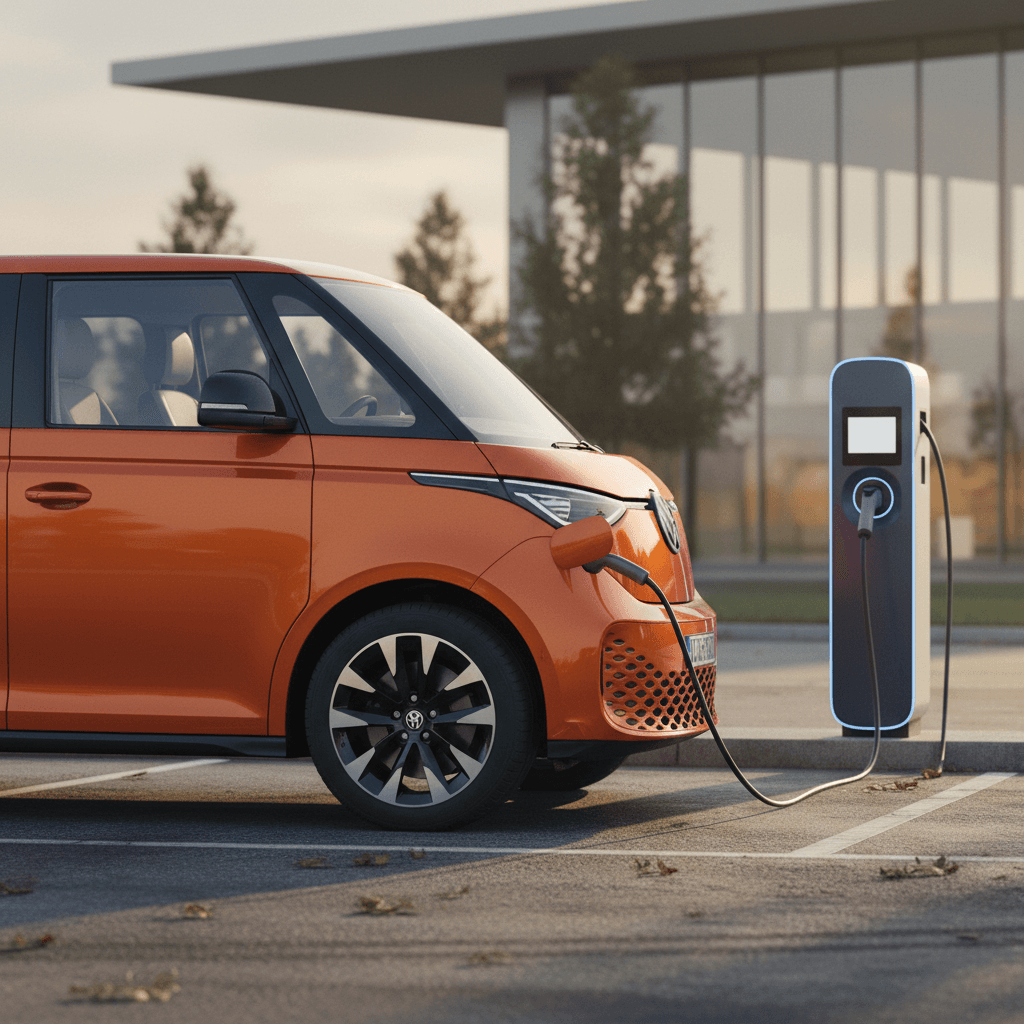
If you’re eyeing a Volkswagen ID. Buzz, whether as a family hauler or a retro‑cool work van, the big practical question is simple: **how long does it take to charge a Volkswagen ID. Buzz** at home and on the road? The answer depends a lot on the outlet or charger you’re using, your starting battery percentage, and even the weather, but there are clear patterns you can plan around.
Short answer
Volkswagen ID. Buzz charging time: quick overview
Typical Volkswagen ID. Buzz charging times
Those are headline numbers. To really understand **how long to charge a Volkswagen ID. Buzz** in your situation, you need to know what’s under the floor and what kind of charger you’re plugging into.
ID. Buzz battery size and charging hardware
Most North American‑spec and recent European ID. Buzz models use a high‑voltage pack in the **80–86 kWh usable** range, depending on version and model year. Across trims, the charging hardware is broadly similar:
- Onboard AC charger: up to 11 kW on a suitable 240V circuit, which is what matters for home and most workplace charging.
- DC fast‑charging peak: early European ID. Buzz models advertise up to about 170 kW; newer long‑wheelbase and U.S.‑market versions support up to roughly **200 kW DC** on a capable charger.
- Typical DC window: 10–80% in the mid‑20‑minute range when everything is ideal (warm battery, high‑power charger, not sharing power).
- Battery warranty: 8 years / 100,000 miles against dropping below 70% of original capacity on most markets, which also indirectly caps how much slower a healthy pack should get over time.
Rule of thumb
How long to charge a Volkswagen ID. Buzz on Level 1 (120V)
Level 1 charging means plugging your ID. Buzz into a **regular household outlet (120V in the U.S.)**, usually at 10–12 amps. That’s convenient, but it’s the slowest way to charge any large‑battery EV, and the Buzz’s battery is big.
Volkswagen ID. Buzz Level 1 (120V) charging time
Approximate times using a ~1.2 kW portable cord on a typical 120V outlet in the U.S.
| Scenario | Start → End | Energy Added (approx.) | Estimated Time |
|---|---|---|---|
| Full charge from empty | 0% → 100% | ≈80 kWh | 60–70 hours |
| Overnight top‑up | 40% → 80% | ≈32 kWh | 25–30 hours |
| Workday top‑up | 50% → 70% | ≈16 kWh | 12–14 hours |
Use Level 1 for emergencies or very light daily use; not as your primary long‑term solution for an ID. Buzz.
Be careful with 120V outlets
In practice, **Level 1 is best as a backup**. If you drive only a few miles a day and can leave the van plugged in for 24–48 hours at a time, it can work, but the ID. Buzz is much happier on Level 2.
How long to charge an ID. Buzz on Level 2 at home
Level 2 is what most people mean by “home charging”: a **240V circuit** feeding either a wallbox or Volkswagen’s dual‑voltage portable cable. This is where the ID. Buzz’s 11 kW onboard charger really matters.
Typical ID. Buzz Level 2 home charging times
Realistic overnight and daytime scenarios on 240V power
Standard home wallbox (32A / ~7 kW)
Common on a 40A circuit:
- 0–100%: roughly 11–12 hours
- 20–80%: about 7–8 hours
- Per hour: ~7 kWh, or ~15–20 miles of real‑world range
Higher‑power home setup (40–48A / 9–11 kW)
On a 50–60A circuit, closer to the Buzz’s 11 kW limit:
- 0–100%: ~8–9 hours
- 20–80%: around 5–6 hours
- Per hour: ~9–11 kWh, or ~20–30 miles of range
Workplace or destination Level 2
Public 6–11 kW chargers at hotels, offices, or garages:
- 3–4 hour stop: add ~30–40% charge
- Overnight hotel stay: effectively full by morning
Good news for daily driving
Getting the most from Level 2 charging at home
1. Size your circuit correctly
Have an electrician install at least a 40A circuit if you can, which lets a wallbox deliver up to 32A (about 7 kW). A 50–60A circuit lets you get closer to the Buzz’s full 11 kW capability if you need it.
2. Use scheduled charging
Set the Buzz or your charger to start charging during your utility’s off‑peak hours. You’ll save money and often wake up at 80–90% without thinking about it.
3. Stop chasing 100% every night
For battery health, it’s usually better to charge to around 70–90% for daily use and only go to 100% before a longer trip.
4. Consider smart chargers
A smart Level 2 charger can track energy use, coordinate with time‑of‑use rates, and integrate with solar, useful if you’re running a home or small business around your ID. Buzz.
Volkswagen ID. Buzz DC fast charging times (road trips)
On the highway, you’ll care far more about **10–80% DC fast‑charge time** than you will about home charging. That’s what determines how long you’ll sit at Electrify America, ChargePoint, or other high‑power stations between legs of a trip.
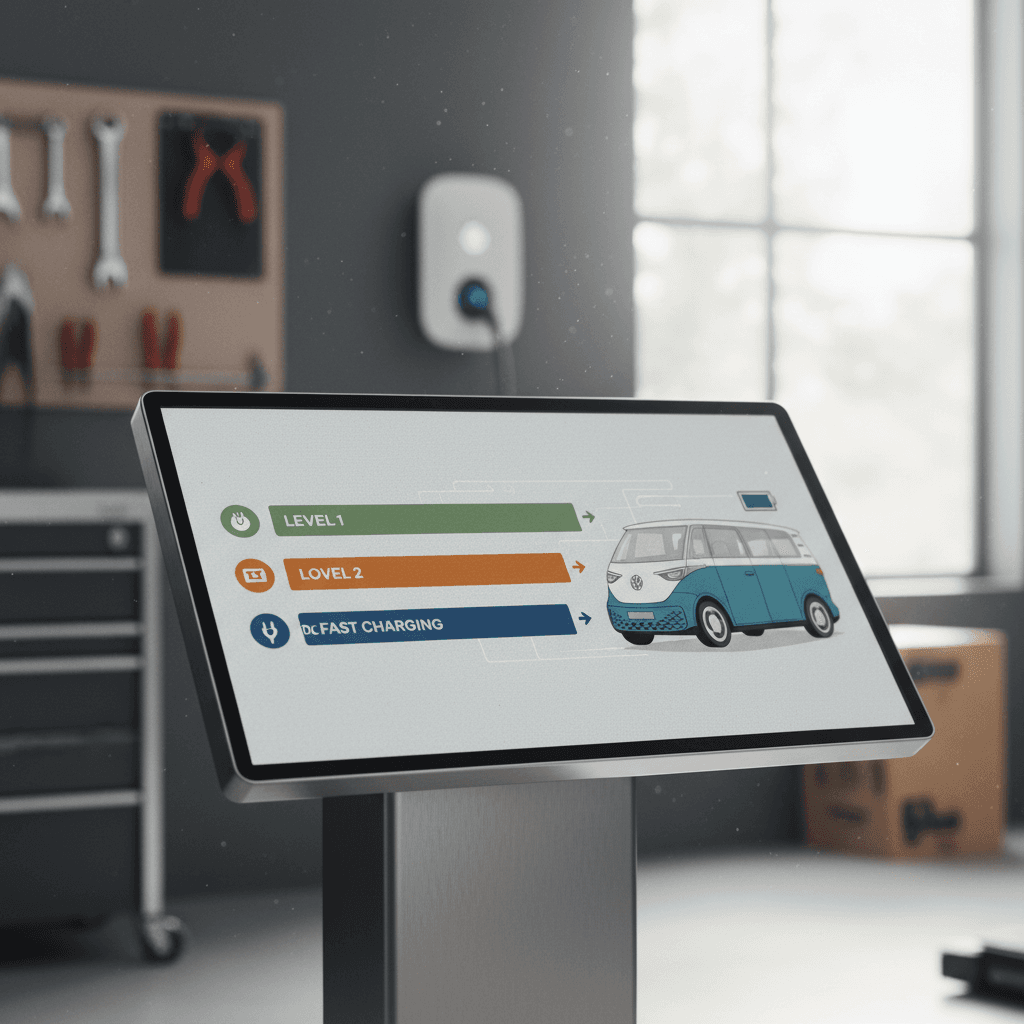
Volkswagen ID. Buzz DC fast charging time estimates
Approximate real‑world DC fast‑charging times on a modern high‑power charger with a warm battery.
| Scenario | Battery Window | Approx. Time | Notes |
|---|---|---|---|
| Road‑trip top‑up | 10% → 80% | ~25–30 minutes | The sweet spot: fastest overall and easiest on the battery. |
| Shorter stop | 20% → 60% | ~15–18 minutes | Good if you’re stopping frequently for kids, pets, or deliveries. |
| Push it further | 10% → 90% | ~30–35 minutes | Slows down above ~80%; only worth it if the next charger is far away. |
| Near‑empty rescue | 1–50% | ~15–20 minutes | Plan conservatively; don’t arrive at stations under 5–10% on purpose. |
Times assume a working high‑power charger (150–350 kW), moderate weather, and the van not sharing a cabinet with another heavy‑charging EV.
Think in chunks, not in full charges
Why 10–80% is the magic window
Like most modern EVs, the ID. Buzz charges fastest when the battery is in the middle of its state‑of‑charge window. Below ~10% and above ~80%, the battery management system reduces power to protect the pack.
That’s why you’ll often see the van pull high power (100–170+ kW) early in the session and then slowly ramp down as it approaches your target.
When DC fast charging makes sense
- Road trips and long‑distance work routes where you’re burning through most of the pack between stops.
- Occasional quick top‑ups when you mis‑judged range or plans changed.
- Charging perks: many new ID. Buzz buyers get a DC fast‑charging package on Electrify America, which can knock down your operating costs early on.
For everyday commuting, though, AC home charging will usually be cheaper and easier on the battery.
Why real-world ID. Buzz charging times differ from the brochure
Volkswagen’s marketing numbers, like “10–80% in about 26 minutes” on a high‑power DC charger, are **achievable**, but only under ideal conditions. In the real world, a few variables stretch or shrink that number:
- Charger power and sharing: If the station maxes out at 50–75 kW, your Buzz will only charge that fast, regardless of its 170–200 kW capability. Shared cabinets can also reduce power when another car plugs in.
- Battery temperature: After a long highway drive, your pack is usually warm and ready to take high power. After an overnight sit in the cold, you’ll often see slower ramp‑up until the battery warms.
- State of charge when you plug in: Arriving at 30–40% instead of 5–10% shortens the session but also means you’re not using the very fastest part of the charging curve.
- Weather and HVAC use: In extreme cold or heat, the Buzz may borrow some power for cabin and battery conditioning, and consumption between chargers will go up, changing how often you need to stop.
- Degradation over time: As a used ID. Buzz loses some capacity, you’re filling a slightly smaller battery. That can actually shorten “0–100%” time, but you also have less total range to work with.
Charging time ≠ time parked
How much charge you really need day to day
A lot of new EV shoppers fixate on 0–100% times, but day‑to‑day life with a Volkswagen ID. Buzz is about **how often you have to think about charging at all**. With an ~80 kWh pack, most owners simply don’t use all that capacity on a typical day.
Typical ID. Buzz use cases and charging needs
Match your driving pattern to a realistic charging routine
Urban family / errands
Daily miles: 20–40
Plug in a few nights a week on Level 2, target 60–80%, and you may rarely see the battery under 30% or above 90%.
Service or delivery van
Daily miles: 80–150
Overnight Level 2 to 80–100% is usually enough. Add a midday Level 2 stop or occasional DC fast‑charge if you’re pushing range or carrying heavy loads.
Road‑trip / adventure use
Mixed miles: Long weekends and holidays
Use home Level 2 to leave at 90–100%, then rely on DC fast‑charging in 10–80% chunks along your route.
Don’t overbuild your home charging
Used ID. Buzz? How battery health changes charging time
If you’re shopping the used market, the same question, **how long does it take to charge a Volkswagen ID. Buzz**, comes with an extra twist: how healthy is the pack you’re charging? Degradation and past fast‑charging history can subtly change both charging time and usable range.
What age and mileage do to charging
- Slightly smaller tank: A Buzz that’s lost, say, 10% of its original capacity now has about 72 kWh usable instead of 80 kWh. That technically means a 0–100% charge might be a bit faster, but you also go fewer miles on that charge.
- Charging curve changes: In a well‑treated pack, DC fast‑charge behavior may look very similar for many years. But heavy fast‑charging or lots of hot‑climate use can lead the car to be more conservative at high SOC or high power.
How Recharged helps you see it clearly
Every used EV sold through Recharged comes with a Recharged Score Report, which includes verified battery health and fast‑charge history. That tells you:
- How much usable capacity is left compared to new.
- Whether the van lived mostly on gentle Level 2 or has seen constant DC fast‑charging.
- What kind of real‑world range and charging behavior you can expect.
That transparency matters far more than a theoretical 0–100% time when you’re planning how this van fits into your life.
Volkswagen ID. Buzz charging time: FAQ
Frequently asked questions about ID. Buzz charging times
Bottom line: planning your ID. Buzz charging strategy
For most owners, the practical answer to **how long it takes to charge a Volkswagen ID. Buzz** is simple: on a decent Level 2 charger at home, it’s “overnight,” and on a good DC fast charger, it’s “about a coffee and bathroom break” to get from low battery back into the comfortable middle. The big battery means Level 1 is strictly for backup, but it also gives you breathing room between stops on the road.
If you’re looking at a **used ID. Buzz**, focusing only on brochure numbers misses the point. What matters is the specific van’s battery health, how it was charged in its past life, and how that lines up with your driving pattern. That’s exactly what the **Recharged Score Report** is designed to surface, alongside fair pricing and expert guidance so you know what kind of range and charging behavior you’re actually buying. With the right setup at home and realistic expectations on the road, the ID. Buzz can be a genuinely easy‑living EV van, not a science project in your driveway.