You don’t buy a Rivian R1T because you like to sit still. But to enjoy the truck, you do need to understand how long it takes to charge. The answer to “how long to charge a Rivian R1T” depends on your battery pack, the type of charger, and even the weather, so let’s translate all the specs into real-world minutes and hours you can actually plan around.
The quick answer
Rivian R1T charging time at a glance
Typical Rivian R1T charge times (real-world planning numbers)
Those are big-picture averages shared by R1T and R1S owners and testing data: enough to plan road-trip stops and overnight charging. To get more precise, you need to know which battery pack is in your R1T and what kind of charger you’re plugged into.
Rivian R1T battery packs and why they change charge time
Rivian has shuffled names and chemistries over the years, but from a charging-time standpoint you can think in terms of small, medium, and large batteries. Bigger packs go farther, but they also take longer to refill from low state of charge (SOC), even if the peak charging power is similar.
Approximate Rivian R1T battery pack sizes and behavior
These kWh figures are approximate and can shift slightly as Rivian tweaks chemistry and usable capacity, but they’re close enough to explain why some R1Ts take longer to charge than others.
| Pack name | Approx. usable size (kWh) | Typical EPA range (R1T) | Max AC power | Max DC power (peak) |
|---|---|---|---|---|
| Standard | ≈106 kWh | ~270 miles | 11.5 kW | Up to ~200 kW |
| Standard Plus / Large | ≈121–135 kWh | ~350 miles | 11.5 kW | Up to ~200–220 kW |
| Max | ≈149 kWh (newer chemistry) | ~400+ miles | 11.5 kW | Up to ~220 kW |
Battery size is the single biggest driver of how long your R1T takes to charge from low to high state of charge.
Rule of thumb
How long to charge a Rivian R1T at home
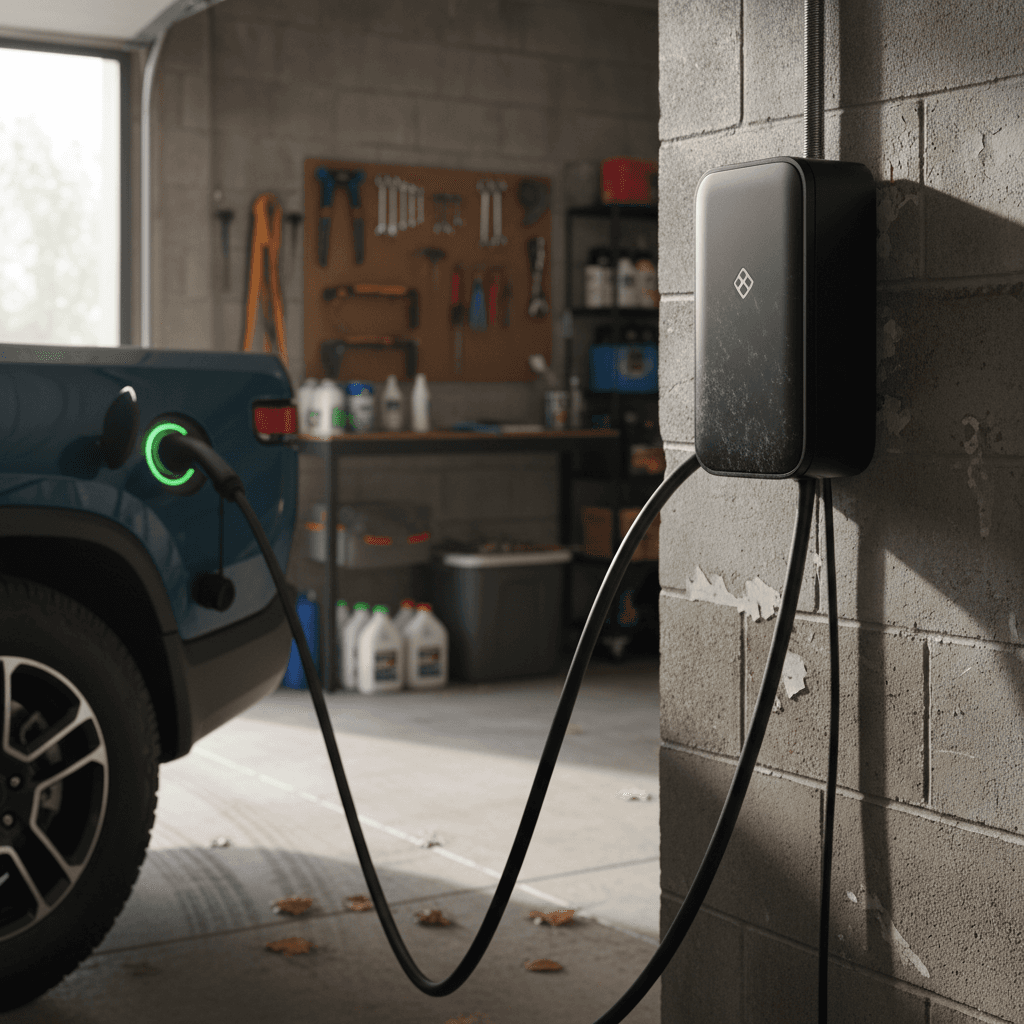
Home is where most R1T charging happens, and it’s usually done with AC power on either a basic household outlet (Level 1) or a 240V circuit (Level 2). Every R1T includes a portable charger, and Rivian (along with many third parties) sells wall-mounted Level 2 units.
Level 1: 120V household outlet
This is the humble three-prong outlet you plug your phone into. It delivers roughly 1–1.5 kW to the truck.
- Great for: Apartments without 240V access, very low daily miles, emergency top-ups.
- Typical R1T rate: ~3–4 miles of range per hour.
- Full 0–100% charge: 90–130 hours depending on pack size.
Think of Level 1 as a trickle charger. It works, but it’s slow for a big-battery truck.
Level 2: 240V home or public charger
This is where the R1T feels like a normal daily driver. On a 48-amp, 240V circuit your truck can use up to 11.5 kW of AC power.
- Great for: Overnight charging at home, workplace chargers, most public “destination” stations.
- Typical R1T rate: ~25–35 miles of range per hour.
- Full 0–100% charge: 16–24 hours depending on pack size.
Most owners simply plug in at night and wake up with the battery back at their chosen target, often 70–80%.
Rivian R1T Level 2 charging times (approximate)
These estimates assume a healthy R1T, a 48-amp Level 2 charger on a dedicated 60-amp circuit, and moderate temperatures.
| Battery pack | Charge window | Use case | Approx. time |
|---|---|---|---|
| Standard (~106 kWh) | 0–100% | Occasional deep refill | ≈16 hours |
| Standard (~106 kWh) | 20–80% | Typical overnight top-up | ≈7–9 hours |
| Standard Plus / Large (~121–135 kWh) | 0–100% | Deep refill | ≈18–21 hours |
| Standard Plus / Large (~121–135 kWh) | 20–80% | Overnight top-up | ≈8–10 hours |
| Max (~149 kWh) | 0–100% | Largest pack, deep refill | ≈22–24 hours |
| Max (~149 kWh) | 20–80% | Overnight top-up | ≈10–12 hours |
For day-to-day life, focus on 20–80% times, those are the numbers that define your overnight routine.
Don’t chase 100% every night
How long to charge a Rivian R1T on DC fast chargers
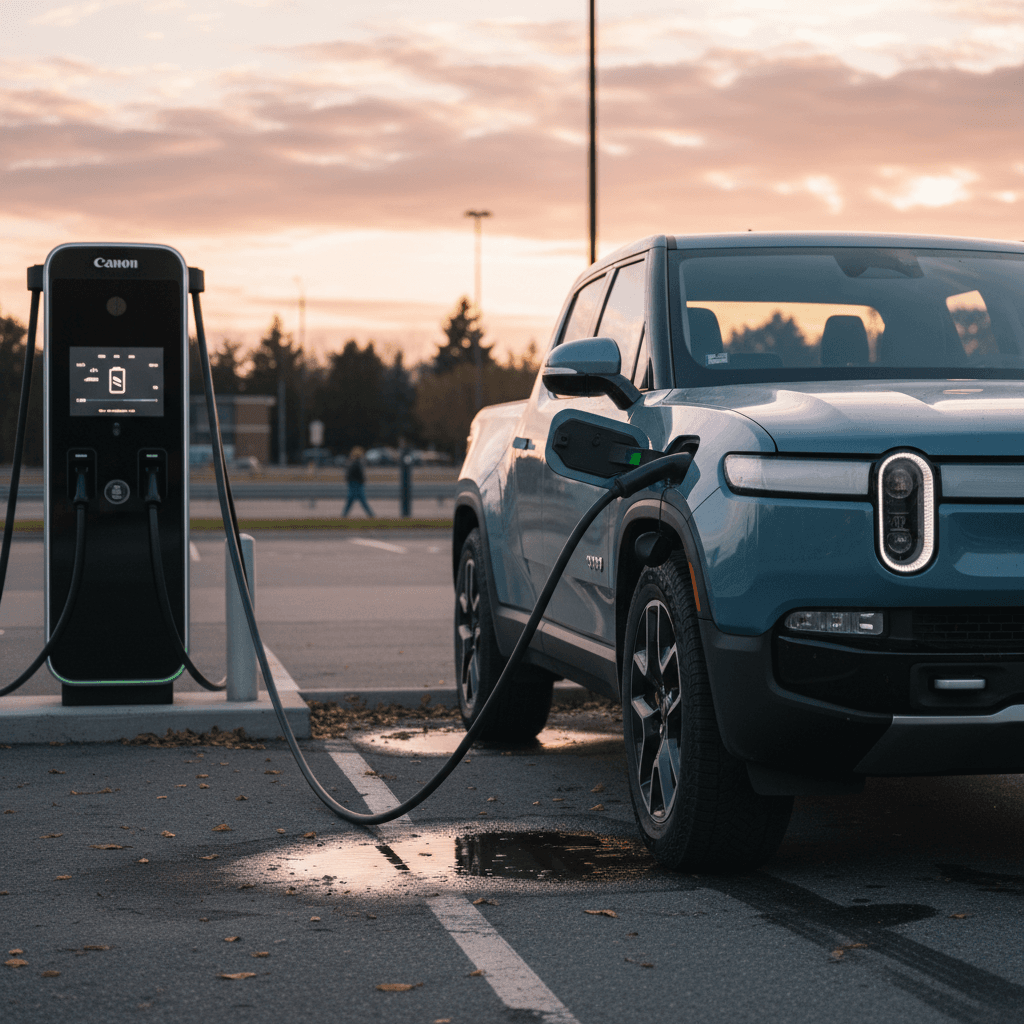
DC fast chargers are what make electric road trips work. Instead of dribbling power in like a home charger, they feed the R1T’s battery directly at up to 200–220 kW peak on newer packs. That’s enough to add well over 100 miles of range in the time it takes you to hit the restroom and grab a snack.
Like most modern EVs, the R1T follows a charging curve: very fast from low SOC, then gradually tapering off to protect the battery as it fills. That’s why we talk about 10–80% times instead of 0–100%, living in the middle of the pack is faster and healthier.
Rivian R1T DC fast charging times (planning numbers)
Real-world DC fast charging is affected by pack temperature, the specific charger, and how busy the station is. Treat these numbers as realistic expectations, not promises.
| Battery pack | Charger power | Charge window | Approx. time | Miles added (ideal conditions) |
|---|---|---|---|---|
| Standard (~106 kWh) | 150–200 kW | 10–80% | ≈40–45 minutes | ≈180–200 miles |
| Standard Plus / Large (~121–135 kWh) | 150–220 kW | 10–80% | ≈45–50 minutes | ≈200–230 miles |
| Max (~149 kWh) | 150–220 kW | 10–80% | ≈50–55 minutes | ≈230–260 miles |
| Any pack | 100 kW | 10–80% | ≈55–70 minutes | Less, but still road-trip friendly |
| Any pack | 50 kW | 10–80% | ≈90–120 minutes | Good in a pinch, but slower than ideal |
Aim for 10–80% sessions on road trips, that’s where your time is used most efficiently.
Pro road-trip strategy
Tesla Superchargers and Rivian: how long do they take?
Many Rivian owners now tap into Tesla Superchargers thanks to the North American Charging Standard (NACS) rollout and adapter support. In practice, an R1T on a strong Supercharger looks a lot like it does on a high-quality CCS fast charger: quick at low SOC, then tapering.
R1T on Tesla Superchargers vs other fast chargers
What you can realistically expect at today’s public stations
On a Tesla Supercharger
- On a high-power site, expect similar 10–80% times to a good CCS station: roughly 40–55 minutes depending on pack size.
- Some sites may limit power for non-Tesla vehicles, so speeds can vary more.
- Great for filling in gaps where CCS networks are sparse.
On CCS fast chargers
- Well-matched 150–200 kW stations are still the baseline for R1T road trips.
- Legacy 50 kW units work, but expect longer stops, this is closer to a “lunch stop” than a quick splash-and-go.
- Networks like Electrify America, EVgo, and others remain key outside the Supercharger footprint.
Watch for station limits
Factors that make your R1T charge faster or slower
- Battery temperature: A cold pack charges much slower at first. Using the built-in navigation to a DC fast charger preconditions the battery so it’s warm when you arrive.
- State of charge when you plug in: Charging from 10–60% is dramatically faster than 70–100%.
- Charger power and sharing: A 350 kW unit shared with another car may effectively behave like a 150 kW, or less, charger.
- Cable and connection quality: Worn or poorly maintained connectors can force lower currents.
- Wind, speed, and terrain: Higher consumption on the road means you arrive at chargers lower and need bigger refills, increasing total trip time.
- Software updates: Rivian has already sharpened the R1T’s charging curve via OTA updates, and future refinements can subtly affect how long sessions take.
Cold-weather penalty
Planning real-world stops with a Rivian R1T
Specs are nice, but what you care about is: how does this feel on an actual day behind the wheel? Here’s how those charging times translate into day-to-day living with an R1T.
Everyday charging scenarios for R1T owners
1. The commuter with a driveway
You drive 30–60 miles a day and have 240V in your garage or driveway. Plug in each night, set a 70–80% target, and your R1T will usually recover in <strong>2–4 hours</strong>. You rarely see the battery below 30% or above 85%.
2. The weekend warrior
Most weekdays you only drive a bit, but weekends mean hiking trails, home improvement runs, and towing. A Level 2 home charger gives you the flexibility to hit the road with a nearly full pack on Saturday morning after an overnight top-up.
3. The long-haul road tripper
You’re running interstate miles. Plan to stop every <strong>150–220 miles</strong>, arriving near 10–20% and charging back up to 60–80%. Expect 30–45 minute breaks on good chargers, or 45–60 minutes on slower ones.
4. The apartment dweller
No home charger, but you’ve got a mix of workplace Level 2 and public DC fast charging. Your life looks a bit like owning a gas truck, you plan stops, but most R1T owners in this situation still do fine with <strong>1–3 charging sessions a week</strong>.
Good news: it’s predictable
Charging tips to protect your R1T battery
Charge time isn’t the only story; how you charge affects long-term battery health and resale value. That matters a lot if you’re buying, or planning to sell, a used R1T.
Smarter charging habits for your R1T
Simple tweaks that protect range and keep sessions efficient
Live in the middle
Schedule home charging
Treat DC fast as a tool
Habits to avoid
Charging considerations when buying a used Rivian R1T
If you’re shopping the used market, charging behavior matters just as much as paint condition or tire tread. A truck that has lived on a sensible home-charging diet is usually a better bet than one that lived its life chained to a fast charger off the interstate.
Questions to ask about charging history
- Home vs fast charging: Did the previous owner mostly use a Level 2 at home, or rely on DC fast charging?
- Daily charging habits: Did they typically charge to 70–80%, or push 100% frequently?
- Climate: Did the truck live in a very hot or very cold region, and was it garaged?
The answers won’t always be perfect, but they paint a picture of how the battery has been treated.
How Recharged can help
Every used R1T sold through Recharged includes a Recharged Score Report with verified battery health, charging performance, and fair-market pricing. Our EV specialists walk you through what those charging numbers mean in plain English, so you’re not guessing about how much range you’ll have three winters from now.
If you already own an R1T and are thinking about selling or trading, Recharged can give you an instant offer or help you consign the truck, with its charging history and battery health clearly documented for the next owner.
FAQ: Rivian R1T charging times
Frequently asked questions about R1T charging times
Bottom line: how long to charge a Rivian R1T
Living with a Rivian R1T doesn’t mean babysitting a charge cable; it means understanding a few key numbers. Plan on 40–55 minutes for a healthy 10–80% DC fast charge, 7–12 hours for a typical overnight 20–80% Level 2 session, and only worry about 0–100% times when you truly need a deep refill. Get your home charging sorted, learn how your favorite fast chargers behave, and the truck will quickly melt into the background of your life, leaving you to focus on the road, not the plug. And if you’re eyeing a used R1T, Recharged is here to decode battery health, charging history, and real-world ownership costs before you commit.