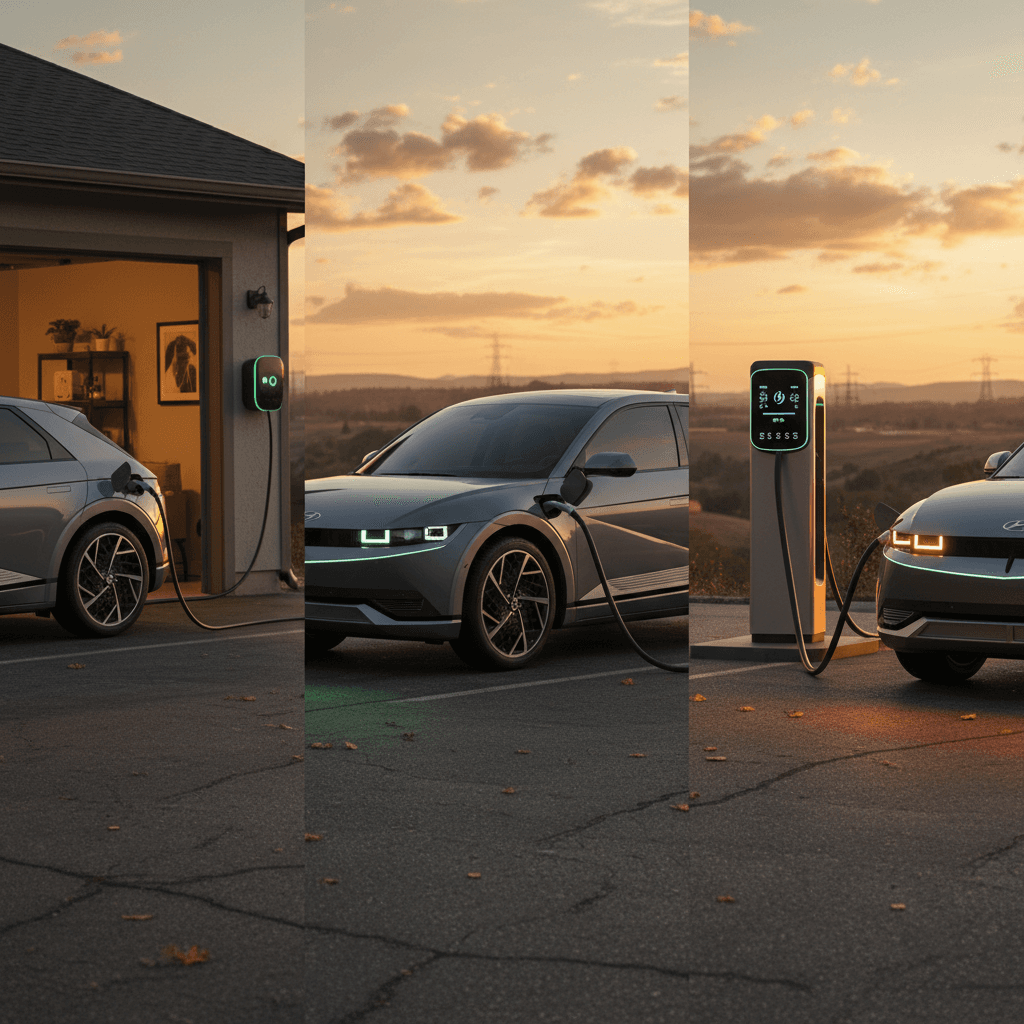
If you’re trying to figure out how long it takes to charge a Hyundai Ioniq 5, the honest answer is: it depends a lot on where you plug in. The same car that needs well over a day on a regular wall outlet can jump from 10–80% in under 20 minutes on a strong DC fast charger. This guide breaks down realistic charge times for home, workplace, public CCS fast chargers, and Tesla Superchargers so you can plan around your life, not your battery.
Key takeaway
Hyundai Ioniq 5 battery and charging basics
Charging time starts with battery size and how much power the car can accept. Earlier U.S. Ioniq 5 models offered a standard-range pack around 58–63 kWh and a long‑range pack around 77–77.4 kWh. Newer model years in some markets are moving toward slightly larger packs, but the charging behavior is similar: the bigger the battery, the longer it takes to fill from the same outlet.
For AC charging (home and most workplace/public Level 2 stations), the Ioniq 5’s onboard charger is effectively in the 7–11 kW range depending on region and trim. For DC fast charging, Hyundai’s official claim is that the Ioniq 5 can go from 10–80% in about 18–20 minutes on a 350 kW DC fast charger, thanks to its 800‑volt E‑GMP platform.
Hyundai Ioniq 5 charging specs at a glance
Hyundai Ioniq 5 charging time summary
Typical Hyundai Ioniq 5 charging times by outlet type
Approximate U.S. charging times for a long‑range Ioniq 5 (≈77 kWh battery). Standard‑range models will be a bit quicker; short top‑ups are usually faster than full 0–100% sessions.
| Charging type | Approx. power | 10–80% time | 0–100% time | Miles of range per hour* |
|---|---|---|---|---|
| Level 1 (120V wall outlet) | ~1.2 kW | 24–30 hours | 30–40+ hours | ~3–5 mi/hr |
| Level 2 (240V, 32A – 40A) | 7–9.6 kW | 5–7 hours | 7–9 hours | ~25–35 mi/hr |
| DC fast (50 kW) | 50 kW | 60–70 minutes | ~90+ minutes | ~120+ mi in 30 min |
| DC fast (150 kW) | 100–150 kW (tapered) | 25–35 minutes | ~50–70 minutes | ~180+ mi in 20–25 min |
| DC ultra‑fast (250–350 kW) | Up to ~235 kW peak | 18–25 minutes | ~45–60 minutes | ~200+ mi in 15–20 min |
| Tesla Supercharger (NACS, V3/V4) | Typically 120–250 kW | 20–35 minutes (10–80%) | ~50–70 minutes | Similar to 150–250 kW CCS |
Use these numbers as planning tools, not promises, real‑world times vary with temperature, charger quality, and starting battery level.
These are ballpark numbers
Level 1 home charging (120V): slow but workable
Level 1 means plugging your Hyundai Ioniq 5 into a standard 120‑volt household outlet using the portable cord that comes with the car (or the newer 120V/240V combo cord on recent models). Power is low, usually around 1.2 kW, so charging is measured in days, not hours, for a full battery.
- Typical power: about 1.2 kW from a standard 15‑amp 120V circuit
- Real‑world rate: roughly 3–5 miles of range added per hour
- 0–100% long‑range pack: often 30–40+ hours from empty
- Best use case: topping up 20–40 miles overnight when you drive modest daily miles
When Level 1 is enough
Level 2 home & work charging (240V): the sweet spot
Level 2 charging uses a 240‑volt circuit, similar to an electric dryer. You either install a wallbox at home or use a portable Level 2 unit on a 240V outlet. This is the setup that makes EV ownership feel easy: you plug in, walk away, and wake up to a full battery.
Ioniq 5 Level 2 charging power
- Onboard AC charger effectively in the 7–11 kW range, depending on market/trim.
- Common home setups in the U.S. deliver 7–9.6 kW (32–40 amps on 240V).
- Your actual rate is limited by the lower of your charger, circuit, and car’s onboard rating.
Typical Level 2 charge times
- 10–80%: about 5–7 hours on a long‑range pack.
- 0–100%: roughly 7–9 hours, depending on amperage and losses.
- Each hour on a decent Level 2 adds around 25–35 miles of usable range.
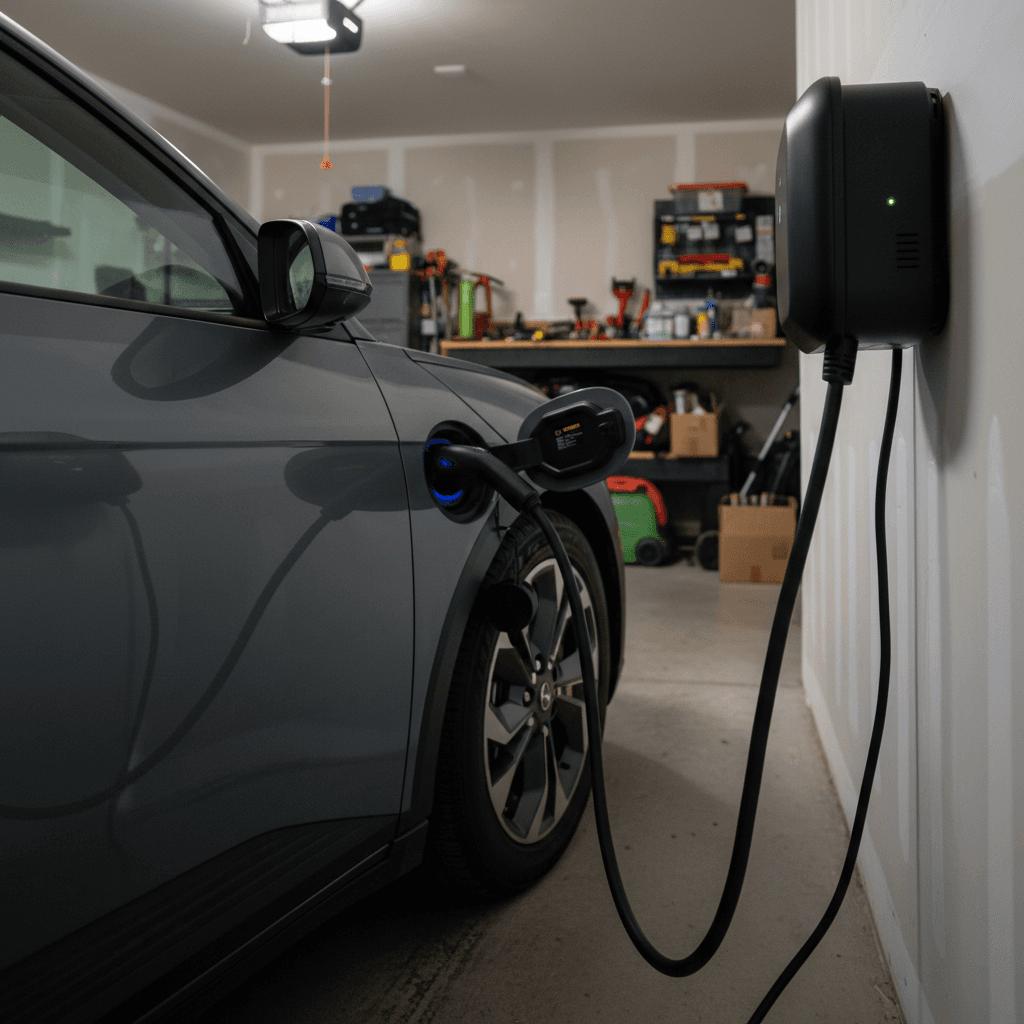
Checklist: making Level 2 work for your Ioniq 5
1. Confirm your panel capacity
Have an electrician confirm you have enough capacity in your breaker panel for a 40‑ or 50‑amp 240V circuit without overloading the system.
2. Match charger amps to your usage
A 32‑ to 40‑amp charger is plenty for an Ioniq 5. Higher‑amp wallboxes cost more but won’t make the car charge faster than its onboard limit.
3. Think about daily mileage
If you routinely arrive home with 40–60% battery and drive under 80–100 miles a day, a mid‑power Level 2 will easily top the car off overnight.
4. Consider installation logistics
Shorter cable runs, surface‑mounted conduit and a charger installed near your parking spot keep costs and complexity down.
Why Level 2 is the Ioniq 5’s “sweet spot”
Ready to find your next EV?
Browse VehiclesDC fast charging (CCS & Tesla Superchargers)
DC fast charging skips the car’s AC onboard charger and feeds high‑power DC current straight into the battery. This is what you’ll use on road trips or when you need a quick boost away from home. The Ioniq 5 shines here: Hyundai advertises 10–80% in about 18–20 minutes on a 350 kW charger under ideal conditions.
How long DC fast charging takes for a Hyundai Ioniq 5
Rough, real‑world times for a long‑range pack starting near 10–20% state of charge.
50 kW DC fast charger
- 10–80%: about 60–70 minutes.
- Useful in rural areas or older highway sites.
- Good for grabbing a full charge while you eat or shop.
150 kW DC fast charger
- 10–80%: often 25–35 minutes.
- The car won’t hold peak power the whole time; it tapers.
- Best balance of speed and availability at many networks.
250–350 kW ultra‑fast charger
- 10–80%: as low as 18–25 minutes in good conditions.
- Ioniq 5 usually peaks around 200–235 kW, not the full 350.
- Time jumps above 80%, expect another 15–25 minutes for 80–100%.
From the 2025 model year forward in North America, the Ioniq 5 is also available with the NACS (Tesla) charge port, letting you use many Tesla Superchargers without an adapter. Real‑world results vary by site, but you can broadly expect Supercharger sessions to look a lot like good 150–250 kW CCS chargers in terms of charge time.
Don’t live on DC fast charging
Real-world examples: how long charging actually takes
Specs and tables are helpful, but what does charging look like in everyday life? Here are realistic scenarios based on a long‑range Ioniq 5 in typical U.S. driving.
Commuter: 40‑mile round‑trip days
You drive 40 miles a day and park in a driveway with a Level 2 charger.
- You arrive home with ~70% battery.
- Plug in on Level 2 at 9 PM, set charge limit to 80%.
- By midnight or sooner, you’re back at 80% and the car stops charging.
In practice, charging takes 1–3 hours per night, even though the car is plugged in longer.
Road‑trip stop: 15–25 minute break
You reach a highway DC fast charger with 15% left and want to keep moving.
- Plug into a 150–350 kW station.
- The car ramps up quickly, often 150–200+ kW at low state of charge.
- In roughly 20–25 minutes you’re around 70–80% and ready to go.
By the time you hit the restroom and grab a snack, most of the charging session is already done.
Apartment dweller: 120V plus workplace Level 2
You can only plug into 120V at home but have decent workplace charging.
- At home, a Level 1 cord adds ~30–40 miles overnight.
- Once or twice a week, you use a 7 kW Level 2 at work during the day.
- Those 3–4 hour workplace sessions quickly bump you back to 80–90%.
Weekend warrior: arriving home low
You return from a weekend trip with 15% remaining Sunday evening.
- Plug into a 9.6 kW home Level 2 at 6 PM.
- By midnight, you’re typically near 90–100%.
- There’s still plenty of buffer before Monday’s commute.
Factors that change your Ioniq 5 charge time
Why your Hyundai Ioniq 5 might charge faster or slower than the brochure
Several variables can stretch or shrink your actual charging time, especially on DC fast chargers.
Battery temperature
Cold batteries charge more slowly, especially below freezing. The Ioniq 5 can pre‑condition its battery on the way to a DC fast charger when you set the station as a destination in the nav, which helps you hit those 18–20 minute 10–80% times more often.
Starting & target %
Charging from 10–50% is much faster than 70–100%. The last 20% always tapers hard for battery protection. If you’re time‑limited, aim to ride the 10–80% window instead of insisting on 100% on road trips.
Charger quality & sharing
Some stations are power‑limited or share output between stalls. A “350 kW” unit might deliver 90–150 kW in practice if it’s hot, busy, or derated. That directly adds minutes to your charging session.
Home circuit limits
If your home charger is set to 24 amps on a 30‑amp circuit, you’ll charge more slowly than someone with a 40‑ or 48‑amp setup, even though the cars are identical.
Driving before charging
Hard highway driving warms the battery and can help DC fast charging speeds, while a short, gentle drive straight to a charger on a cold day might leave the pack too chilly for high power.
Software & updates
Hyundai has updated Ioniq 5 charging behavior over time. Used cars may perform slightly differently depending on software version and past service history.
Plan around time, not just state of charge
Charging-time tips that also protect battery health
The Hyundai Ioniq 5 is engineered to handle frequent fast charging, but a few habits will keep your pack happier over the long haul, and often save you time and money in the process.
Smart habits to balance charge time and battery life
Avoid living at 100% when you don’t need it
Use the car’s charge limit feature, keeping daily charging around 70–80% reduces stress on the battery and still gives plenty of range for most commutes.
Reserve DC fast charging for trips and true time crunches
For daily use, Level 2 is cheaper and gentler. Save those 18–25 minute 10–80% DC sessions for long highway drives or emergencies.
Pre‑condition the battery for fast charging
On newer software, set the DC fast charger as your destination so the Ioniq 5 can warm or cool the battery on the way there, improving speed and consistency.
Mind extreme heat and cold
In very hot or very cold weather, expect slower charge times. Parking in shade, using cabin pre‑conditioning and planning slightly longer stops helps smooth things out.
Check charging history on a used Ioniq 5
If you’re shopping used, ask how the previous owner charged the car. At Recharged, every vehicle includes a <strong>Recharged Score</strong> battery health report so you can see how the pack is actually holding up, not just guess from the odometer.
Hyundai Ioniq 5 charging time FAQ
Frequently asked questions about Ioniq 5 charging times
Understanding how long it takes to charge a Hyundai Ioniq 5 is mostly about matching the right charging solution to your life. Level 1 can work for light daily driving, Level 2 at home or work is the sweet spot for nearly everyone, and DC fast charging or Tesla Superchargers turn road‑trip top‑ups into quick breaks instead of long waits. If you’re considering a used Ioniq 5, or comparing it with other EVs, Recharged can help you decode real‑world charge times, battery health, and total ownership costs so you end up with an EV that fits your driveway, and your schedule.