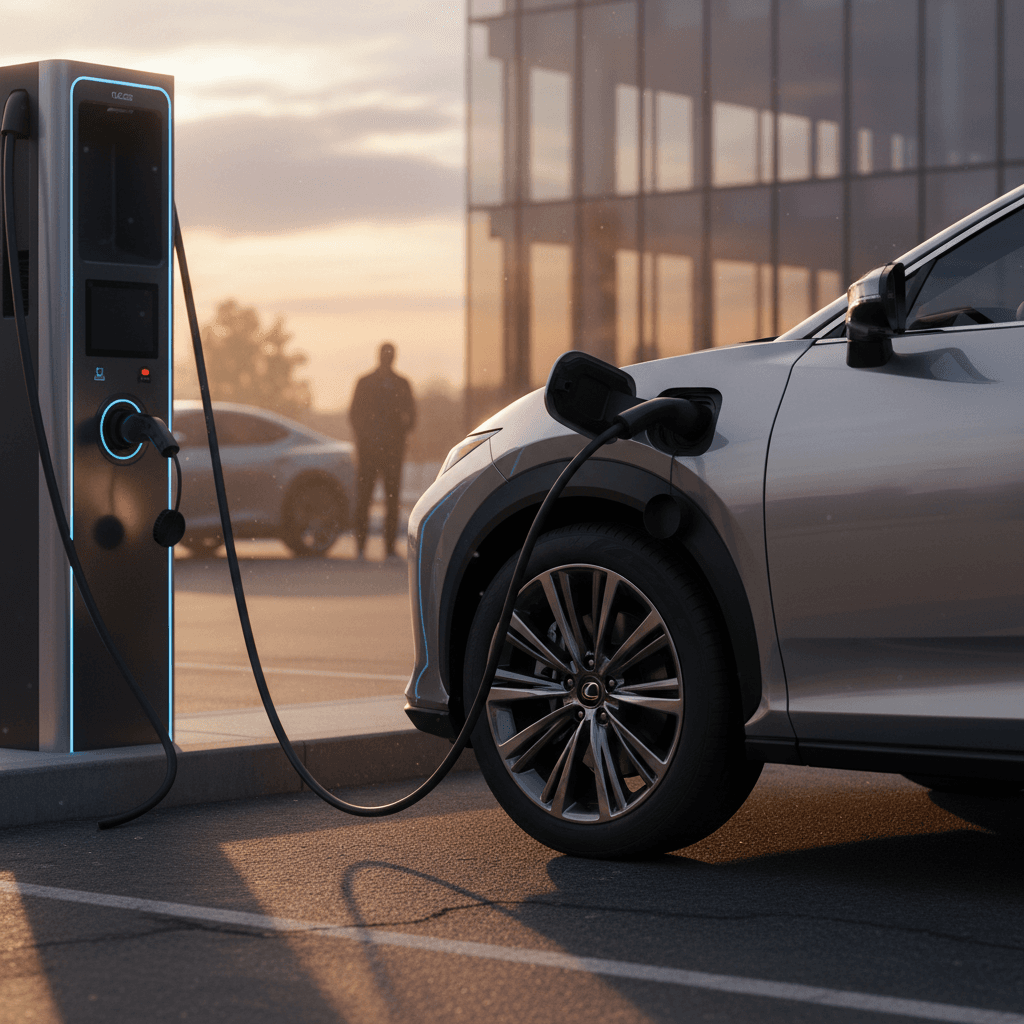
When you’re on a road trip or low on range, the key question is simple: how long does it take to charge an EV at a DC fast charger? In real-world 2025 terms, most modern EVs take roughly 20–45 minutes to go from about 10% to 80% on a capable fast charger, but the exact time can swing from under 20 minutes to well over an hour depending on the car, charger, and conditions.
Short answer
DC fast charging basics: the 20–60 minute rule of thumb
DC fast charging (often called Level 3 charging) sends high‑power DC electricity directly into your battery, bypassing the slower onboard AC charger. Power levels typically range from 50 kW up to 350 kW at public stations today, allowing much faster charging than Level 2 home charging.
Typical DC fast charging time ranges
Those headline “10–80% in 18 minutes” claims you see in ads are possible, but usually only under ideal conditions: a warm battery, high‑power charger, and an EV engineered for high‑rate charging. In more ordinary situations, say a 150 kW charger, cool weather, and a mainstream crossover, 30–40 minutes is a more realistic expectation to add a big chunk of range.
What really determines how long your EV takes to DC fast charge
Two EVs can pull into the same 350 kW station and finish charging at very different times. That’s because charging time is the product of battery size, charging power, and your car’s charging curve, all wrapped inside real‑world variables like temperature and station sharing.
6 main factors that control DC fast charge time
Understanding these makes “how long to charge” much less mysterious
1. Battery size (kWh)
Bigger batteries take longer to fill. A 60 kWh pack might go 10–80% in ~25–35 minutes on a good charger. A 200 kWh truck pack can easily take an hour or more for the same 10–80% window.
2. Max DC charge power (kW)
Your car has a built‑in DC fast charging limit, often 100–150 kW on mainstream EVs and up to 250–320 kW on some premium models. You can’t charge faster than your car’s own limit, even on a 350 kW station.
3. Charging curve
EVs don’t hold peak power the whole session. They ramp up, hold a plateau, then taper as the battery fills. Two cars with the same peak (say 150 kW) can have very different average power and therefore very different charge times.
4. Battery temperature
Cold batteries charge slowly because the car restricts power to protect the cells. That’s why preconditioning on the way to a fast charger, or driving a while first, can dramatically reduce charging time in winter.
5. Charger power & sharing
Some sites limit how much power a single stall gets, especially when two cars share one power cabinet. A “350 kW” sign doesn’t guarantee you’ll see anything close to 350 kW in practice.
6. State of charge (SoC) window
Charging from 10–60% is much faster than 60–100%. That’s why road‑trip strategies focus on shorter 10–80% stops instead of filling to 100% in one go.
Rule of thumb for road trips
Typical DC fast charging times by vehicle type
To ground things in reality, it helps to look at ballpark DC fast charging times for different kinds of EVs on today’s infrastructure. These are generalized ranges for a 10–80% session on a suitably powerful DC fast charger in decent conditions; individual models will fall above or below these bands.
Approximate DC fast charging times by EV type (10–80%)
Realistic 2025-era ranges on a capable DC fast charger, assuming a properly warmed battery and no power sharing on the charger.
| EV type | Typical battery size | Realistic 10–80% time | Notes |
|---|---|---|---|
| Compact / older EV hatchback (e.g. Nissan Leaf Plus) | 40–65 kWh | 35–60 min | Often limited to 50–75 kW peak; some taper hard above ~50% |
| Mainstream crossover / sedan (e.g. Tesla Model 3, VW ID.4, Mach‑E) | 60–85 kWh | 25–45 min | Many can average 80–120 kW on a good charger |
| Luxury & 800V “ultra-fast” models (e.g. Porsche Taycan, Hyundai Ioniq 5) | 70–100 kWh | 18–30 min | Engineered for high sustained power; some advertise 10–80% in ~18–22 minutes |
| Large electric trucks & big SUVs (e.g. F‑150 Lightning, Silverado EV, Hummer EV) | 100–200+ kWh | 35–70+ min | Huge packs; even with high peak kW, average power and taper matter a lot |
Use these as planning ranges, not guarantees, your specific EV and conditions matter.
Manufacturer specs vs. reality
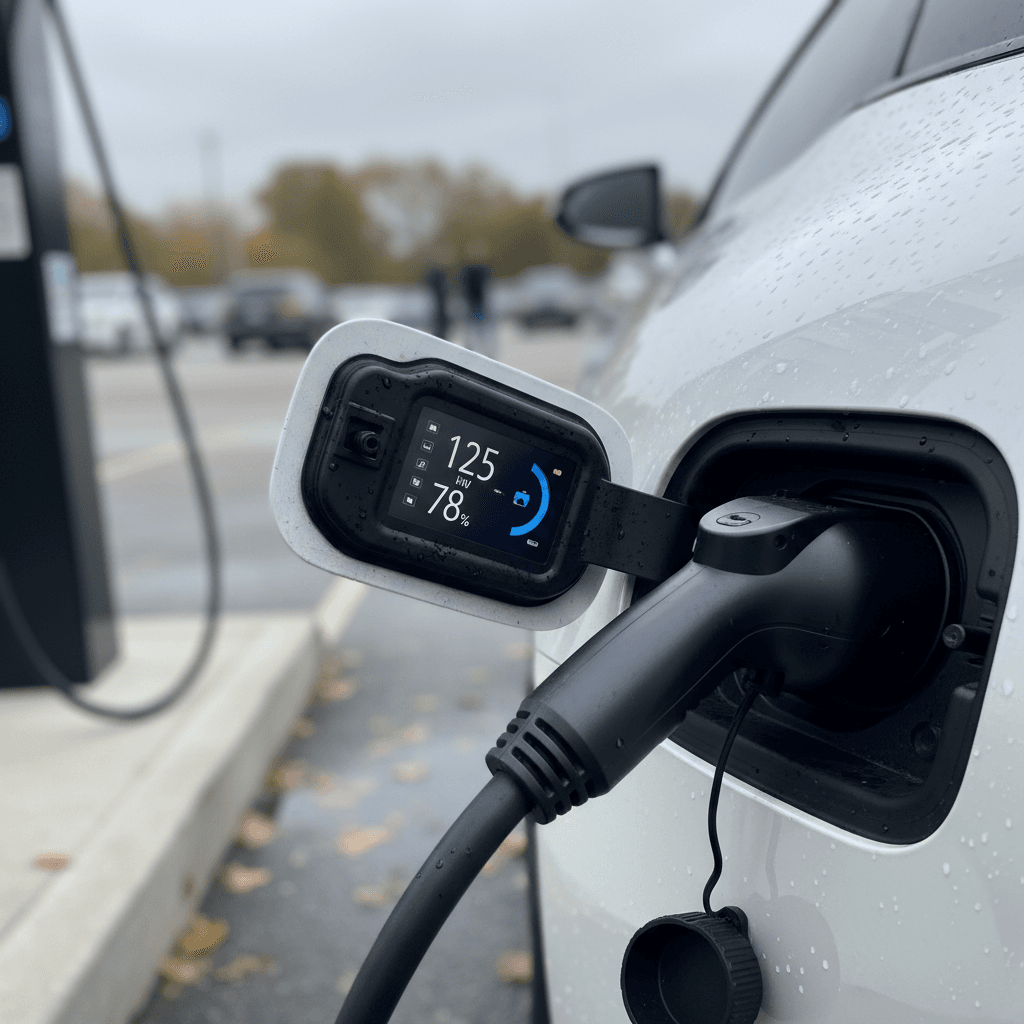
Why most EV DC fast charging times are quoted 10–80%
When you search “how long to charge an EV at a DC fast charger,” almost every answer focuses on 10–80% state of charge. That’s not a random range; it’s where EV batteries can safely accept high power without excessive stress.
- Below about 10%, the car limits power to protect the battery from very low voltages.
- Between roughly 10% and 60–70%, many EVs can hold near‑peak power and charge very quickly.
- Above about 70–80%, the car gradually reduces power (the “taper”) to avoid over‑charging and to keep heat under control.
- The last 10–20% can take as long as the first 40–50%, great for squeezing out maximum range, but bad for minimizing stop time.
Think in miles per minute, not 0–100%
Planning road trips around DC fast charging stops
Once you internalize that DC fast charging is fastest between roughly 10% and 60–80%, the way you plan road trips with an EV changes. Instead of driving until nearly empty and then filling to 100%, you build your trip around shorter, more frequent, high‑speed charging sessions.
Simple road-trip strategy for DC fast charging
1. Start your day with a full (or high) charge
Use home or hotel Level 2 charging to start the day at 80–100% so your first leg is as long as possible on cheap, gentle AC power.
2. Aim to arrive around 10–20%
Plan legs so you pull into DC fast chargers with the battery low but not empty. Your car will charge fastest when it’s not nearly full.
3. Limit fast-charging stops to ~60–80%
Rather than waiting for 90–100%, unplug once you have enough buffer to reach the next stop plus a margin. This often cuts total trip time.
4. Favor higher‑power sites when possible
If you can choose between a 50 kW and a 150–350 kW charger, pick the higher‑power option, especially if your EV can take advantage of it.
5. Use navigation with charger integration
Most new EVs and network apps will suggest charging stops based on your route, consumption, and live station status, use those tools to avoid surprises.
6. Build in real breaks
A 25–35 minute charge every few hours aligns well with restroom, snack, and stretch breaks. Plan around what’s comfortable, not just the spec sheet.
DC fast charging (Level 3)
- Best for: Road trips and quick top‑ups on the go
- Typical power: 50–350 kW
- Time: 20–60 minutes for a big chunk of range
- Cost: Often higher per kWh than home charging
Level 2 charging (home & workplaces)
- Best for: Daily charging, overnight at home
- Typical power: 7–11 kW (sometimes up to ~19 kW)
- Time: 4–12 hours for a full charge
- Cost: Usually the cheapest and easiest way to “fuel” an EV
Battery health: how much DC fast charging is too much?
Modern EV batteries are managed by sophisticated software and cooling systems, and most automakers explicitly support regular DC fast charging. That said, frequent high‑power fast charging does accelerate degradation compared with mostly Level 2 use, especially in hot climates or on older designs with limited thermal management.
- Occasional road‑trip fast charging is generally fine and expected in the battery design.
- Daily or near‑daily DC fast charging, especially to 100%, can noticeably increase long‑term degradation.
- High ambient temperatures and aggressive driving between fast charges compound the stress on the pack.
- Some models limit peak power or taper sooner as the battery ages, effectively making fast charging slower over time.
Don’t treat DC fast charging like a gas pump
Used EVs, fast charging, and the Recharged Score
If you’re shopping for a used EV, how it was charged in the past can affect not just range, but also DC fast charging performance. A battery that has seen hard use, frequent fast charging to 100%, lots of heat, or high mileage, may charge more slowly or deliver fewer miles per minute than it did when new.
That’s why every EV sold through Recharged includes a Recharged Score Report with verified battery health diagnostics. Instead of guessing how a previous owner used the car, you get a transparent view of usable battery capacity and how it compares to similar vehicles. That helps you understand whether a particular used EV will still deliver the kind of DC fast charging times and road‑trip usability you’re expecting.
How Recharged helps with fast-charging expectations
Practical tips to reduce your DC fast charge time
You can’t change your battery size or your car’s maximum charging power, but you can charge smarter. These habits can easily shave several minutes off each stop and make your EV feel much more road‑trip friendly.
Fast-charging tips that actually work
Arrive with a warm battery
Driving 20–40 minutes before fast charging is usually enough to warm the pack. Many EVs also let you precondition the battery automatically when you navigate to a charger in the built‑in nav.
Target the 10–60% sweet spot
The closer you stay to the mid‑SoC band during fast charging, the higher your average power. On long trips, several shorter sessions can beat one long 10–100% slog.
Use higher-power chargers when your car can use them
If your EV tops out around 75 kW, a 150 kW unit is great, but a 350 kW unit may not help. If your car can take 200+ kW, seek out the highest‑rated stalls on your route.
Avoid power‑sharing stalls when possible
Some networks pair stalls that share a power stack. If you have the choice, pick a stand‑alone unit or a cabinet with only one car plugged in.
Unplug once the taper gets slow
Watch the kW number on the screen. When it falls to roughly <strong>25–40% of your car’s peak</strong> and you already have enough range to comfortably reach the next stop, it’s usually time to go.
Don’t chase 100% unless you have to
That last 10–20% is painfully slow. Save it for when you truly need maximum range, for example, before a remote stretch with no charging options.
Be realistic about older or slower-charging EVs
FAQ: DC fast charging times answered
Frequently asked questions about DC fast charging times
Bottom line: how long to charge at a DC fast charger?
If you’re wondering how long it takes to charge an EV at a DC fast charger, the honest answer is a range: for today’s EVs, expect about 20–45 minutes for a typical 10–80% session in good conditions, and up to an hour or more for older or very large‑battery vehicles. What matters most is understanding your specific car’s battery size, peak charging power, and charging curve so you can plan realistic stops.
Use DC fast charging as a powerful tool for road trips and occasional top‑ups, not your everyday energy source. And if you’re shopping used, lean on transparent battery‑health data, like the Recharged Score report, to make sure the EV you’re considering will still charge quickly enough to match your lifestyle. That combination of realistic expectations and good information turns fast charging from a source of anxiety into just another part of smooth EV ownership.