If you’re looking at a used Chevrolet Bolt EV or EUV, your first question is usually range. The very next one is, naturally, “how long does it take to charge?” The honest answer: it depends a lot more on the outlet and charger than on the car, but we can pin the Bolt down to some reliable real‑world numbers.
Short answer
Chevy Bolt charging time at a glance
Typical Chevy Bolt EV/EUV charging times
Those are broad strokes; the details matter. A 2019 Bolt EV plugged into a 16‑amp portable charger behaves very differently from a 2023 Bolt EUV on an 11.5 kW wall box. Before we dive into each scenario, let’s ground ourselves in what the Bolt is working with.
Bolt EV battery and charging basics
Every U.S.‑market Chevrolet Bolt EV and EUV sold through 2023 uses roughly a 65 kWh lithium‑ion battery pack and supports three ways to charge:
- Level 1 (120V AC) using the included portable charge cord and a regular household outlet.
- Level 2 (240V AC) using a home or public J1772 charging station.
- DC fast charging (CCS1) using public DC fast chargers, up to about 55 kW peak power.
The Bolt’s onboard AC charger, the hardware that converts AC from the wall into DC for the battery, is the bottleneck for Level 2 speeds. Earlier model years were limited to about 7.2 kW; 2022–2023 refresh models step up to about 11.5 kW, which noticeably shortens home charging time.
Model‑year rule of thumb
How long to charge a Chevy Bolt at home
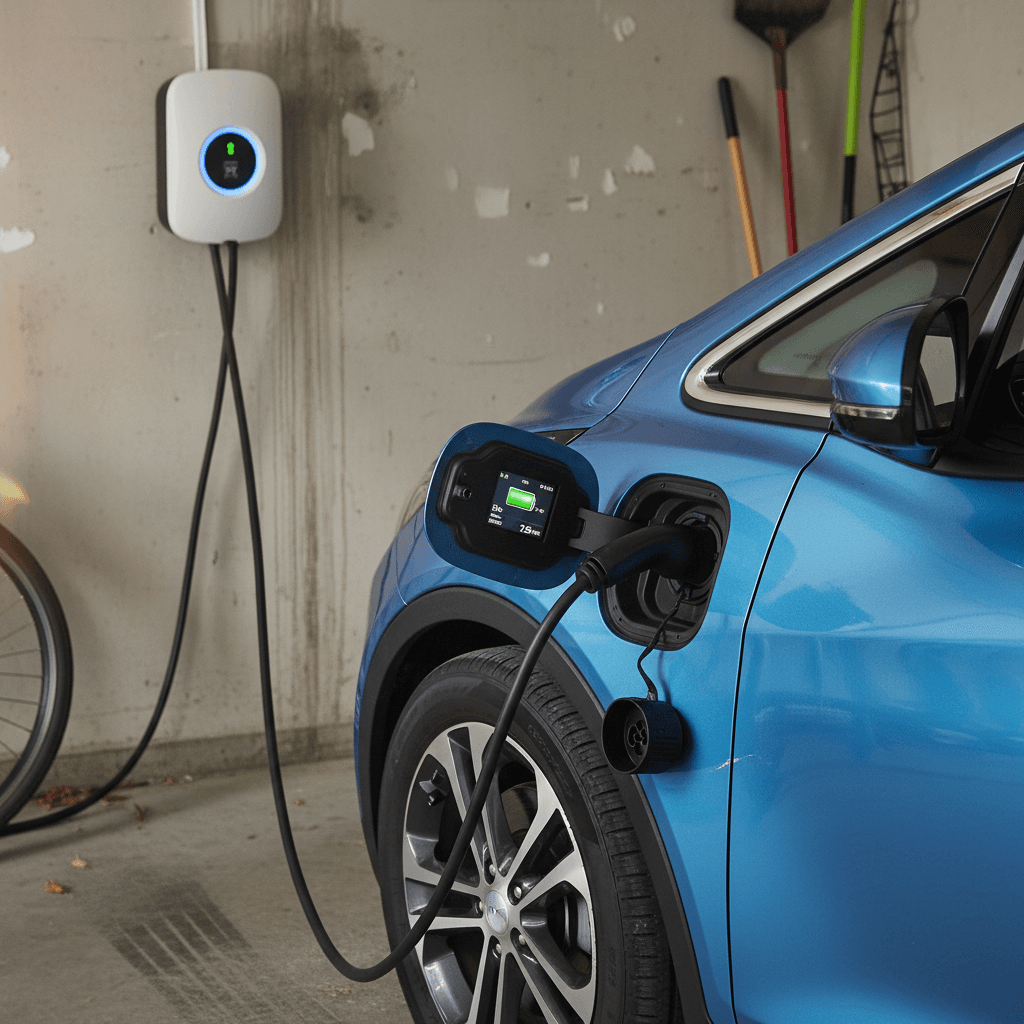
Home is where a Bolt really makes sense. You trade gas‑station time for plug‑in‑and‑forget‑it time. The key question is what you’re plugging into.
Chevy Bolt EV/EUV home charging times (rough estimates)
Approximate time from around 10% to near 100% state of charge on an empty or nearly empty battery in mild temperatures.
| Charging type | Outlet / charger | Approx. power | Approx. time 10–100% | Miles of range per hour* |
|---|---|---|---|---|
| Level 1 | 120V, 12A portable cord | ~1.3 kW | 50–70 hours | 3–4 mi/hr |
| Level 2 (slow) | 240V, 16A portable EVSE | ~3.8 kW | 18–24 hours | 10–12 mi/hr |
| Level 2 (typical) | 240V, 32A home wall box | ~7.2 kW | 9–12 hours (early Bolt EV) | 22–26 mi/hr |
| Level 2 (max on 2022–2023) | 240V, 40–48A wall box | up to ~11.5 kW | 6–8 hours (2022–23 EV/EUV) | 30–39 mi/hr |
Real‑world times vary with temperature, driving, and how full you actually charge. Most owners rarely go from 0% to 100%.
Don’t count on a wall outlet for deep charges
In practice, you’re almost never charging a Bolt from 0–100%. Most owners arrive home with 30–60% left and charge up to 70–90%. On a 32A Level 2 charger, that’s typically 3–6 hours. On a higher‑power 40–48A unit feeding a 2022–2023 car, it’s more like 2.5–4.5 hours for that daily top‑up.
How long to charge a Chevy Bolt on DC fast charging
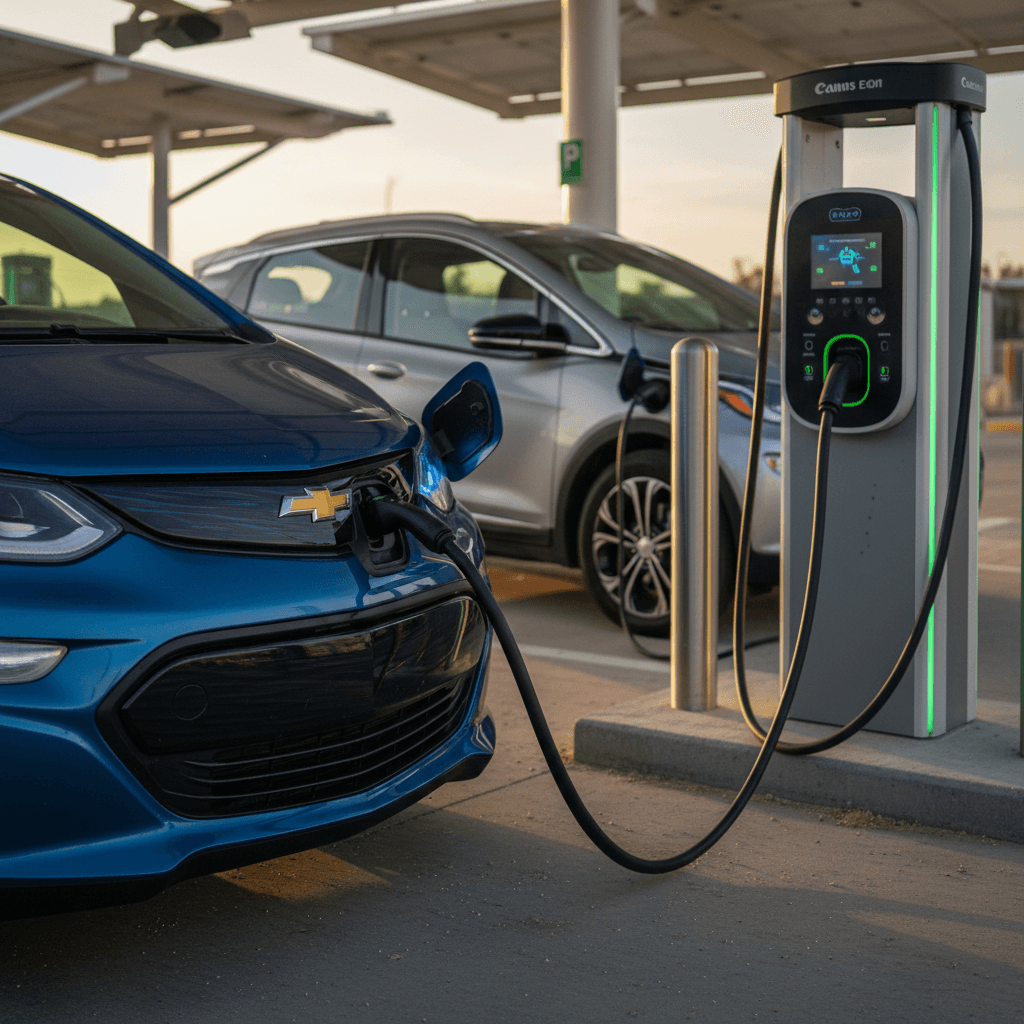
DC fast charging is where the Bolt’s otherwise excellent value shows its age a bit. While many newer EVs now peak at 150–350 kW, the Bolt EV and EUV top out at about 55 kW peak on DC fast chargers and often average in the 35–45 kW range over a full session.
Typical Chevy Bolt DC fast charging time bands
Assuming mild weather, a healthy battery, and a properly working 50–150 kW station
10% → 60%
Roughly 25–35 minutes.
Good for grabbing ~120–150 miles of range on a lunch stop.
10% → 80%
About 45–60 minutes.
Most efficient use of time and money on the Bolt; above 80% the charge rate nosedives.
10% → 100%
75–100+ minutes.
The last 20% can take as long as the first 70%; usually not worth it unless you absolutely need the range.
Don’t chase 100% on DC fast
Compared with other modern EVs, the Bolt’s DC fast charging is slow. Compared with sitting at a gas station, it’s glacial. But in the real world, many owners use DC fast mostly for the occasional road trip, not every day. If you have solid Level 2 access at home or work, the Bolt’s modest fast‑charge speed is annoying, not a deal‑breaker.
Real‑world Bolt charging scenarios
What charging time looks like in real life
1. Daily commuter with Level 2 at home
You drive 35 miles a day and plug into a 32A wall box each evening. You’ll typically add those 35 miles back in about 90 minutes, but you’ll be plugged in 8–10 hours while you sleep. The car just finishes early and waits for you.
2. Apartment dweller on Level 1
You can only reach a 120V outlet, and you drive 15–20 miles per day. Level 1 can add 30–40 miles overnight, which technically works but leaves little buffer. You’ll want to plug in every chance you get and strongly consider Level 2 at work or public chargers.
3. Weekend road‑tripper
You head out in a Bolt EUV at 100%, drive 200 miles, and arrive at a 125 kW DC fast charger with 20% left. A 40–50 minute session to ~80% gives you another 150 or so highway miles, enough to reach the next stop without drama.
4. Used‑EV shopper
You’re comparing a used Bolt EV to other affordable EVs on Recharged. The Bolt might be slower to DC fast charge than some rivals, but if your daily driving is under 50 miles and you can install a Level 2 charger, your real‑world charging time is effectively “overnight.”
Bolt EV vs. Bolt EUV charging times
Chevrolet built two flavors of this car: the original Bolt EV hatchback and the slightly larger Bolt EUV. From a charging‑time perspective, they’re fraternal twins.
Bolt EV
- Same ~65 kWh usable battery as the EUV.
- 2017–2021 models: ~7.2 kW AC onboard charger.
- 2022–2023 refresh: up to ~11.5 kW onboard charger.
- EPA range up to 259 miles; slightly more efficient than EUV.
Bolt EUV
- Same battery pack and 55 kW DC fast‑charge limit.
- All EUVs use the newer ~11.5 kW AC charger.
- EPA range up to around 247 miles, so a hair fewer miles per hour of charge.
- Real‑world charging times are essentially identical; you just get a bit less range from each kWh.
So which one charges “faster”?
5 factors that change your charging time
Charging‑time charts are clean, clinical things; real‑world Bolt ownership is messier. Your actual experience can be shorter or longer than the numbers above based on a handful of variables.
What really affects your Chevy Bolt’s charging time
Same car, same charger, wildly different outcomes
1. Battery temperature
Lithium‑ion batteries hate extremes. In very cold weather, a Bolt may start a DC fast session at 15–25 kW instead of 40–55 kW, stretching a 30‑minute stop into an hour. In extreme heat it may slow to protect itself.
2. State of charge (SoC)
All EVs charge fastest from low states of charge, then taper off. On the Bolt, expect the sweetest spot to be roughly 10–55%. Above 60–70% the power drops, and above 80% it can be downright leisurely.
3. Charger power & sharing
A 50 kW station, a 150 kW station, and a 350 kW station all look similar on the app, but your Bolt will see them differently. And if you’re sharing a dual‑head unit with another car, your slice of the power pie can shrink unexpectedly.
4. Circuit amperage at home
A Bolt can only draw what the circuit can safely deliver. A 16A portable EVSE on a 20A circuit is night‑and‑day slower than a hard‑wired 40A or 48A unit, even though both are “Level 2.”
5. Battery age & health
As packs age, internal resistance can change. A healthy Bolt with good battery management should be fairly consistent for many years, but a heavily fast‑charged pack may slow a bit sooner during DC sessions.
Tips to charge your Bolt faster and smarter
You can’t rewrite physics, but you can work with it. A few simple habits have much more impact on your Bolt charging experience than obsessing over which fast‑charger brand has two more kilowatts on the sticker.
Practical charging tips for Chevy Bolt drivers
1. Prioritize Level 2 where you live or work
If you’re buying a used Bolt through Recharged, plan your home setup at the same time. A properly installed 240V Level 2 charger is the difference between “this car is always ready” and “this car is a science project.”
2. Charge between roughly 20% and 80%
For daily driving, you rarely need a full tank. Keeping your Bolt between about 20–80% not only shortens charging time, especially on DC fast, but is also gentler on the battery over the long haul.
3. Use DC fast as a road‑trip tool, not a lifestyle
The Bolt can handle occasional DC fast charging just fine, but using it as your primary fuel stop is slower and typically more expensive than Level 2. Think of fast charging as a highway rest‑stop espresso shot, not your main caffeine drip.
4. Precondition in extreme temperatures when possible
If you can warm or cool the cabin while plugged in, using the myChevrolet app or schedule features, you’re effectively using grid power instead of battery power, which preserves range and can help the pack be in a friendlier temperature window when you start charging.
5. Time home charging for off‑peak rates
Many utilities offer cheaper overnight electricity. Set your Bolt’s charge schedule or your smart charger’s schedule so most of that 6–8‑hour Level 2 session happens while rates are low. You’ll care more about the bill than the clock.
6. Match your hardware to your car
If you’re shopping chargers, there’s no sense in buying a 19.2 kW monster for a Bolt that peaks around 7–11.5 kW. A 32–40A Level 2 unit is the sweet spot for most Bolt owners and is often simpler to install.
Where Recharged fits in
Ready to find your next EV?
Browse VehiclesIs the Chevy Bolt too slow to charge?
On paper, yes, the Bolt is one of the slower DC fast‑charging EVs you can buy. On the highway, that means you spend a bit more time lingering at chargers than the driver of a newer Hyundai, Kia, or Tesla. If you do 1,000‑mile cannonball runs every other weekend, you’ll notice.
But that criticism misses the way most Bolts live. In the daily grind, school runs, commutes, errands, a Bolt with a decent Level 2 charger is effectively “instant refill.” You plug it in at night, it quietly takes 4–7 hours to top up while you sleep, and you wake up with another 200‑plus miles waiting in the driveway. Whether that took 3 hours or 5 becomes an academic detail, not a quality‑of‑life problem.
Compare it to your current gas routine
Chevrolet Bolt EV charging FAQ
Frequently asked questions about Chevy Bolt charging time
Bottom line: how long it really takes to charge a Bolt
If you strip away the charts and opinions, the Chevy Bolt EV and EUV are “overnight chargers” at home and “coffee‑plus‑lunch chargers” on the road. On Level 2, they quietly refill while you sleep or work. On DC fast, they’ll ask you to linger a bit longer than the latest Korean or German EVs, but the trade‑off is a lower purchase price and a usefully long range for the money.
For most drivers who can install or regularly access Level 2 charging, the more important question isn’t “Is it 45 minutes or 60 minutes on a road trip stop?” but “Will this car easily cover my life between stops?” If the answer is yes, and for a lot of households it is, the Bolt’s charging times are less a deal‑breaker and more a quirk you learn to drive around. And if you’re shopping used, Recharged can help you find a Bolt with verified battery health and the right charging setup to fit your routine.