If you’re considering a BMW i4, or already own one, the first question you probably have is simple: how long does it take to charge a BMW i4? The honest answer is that it depends on where you plug in. At home you’ll be thinking in hours, while on a DC fast charger you’re often done in about half an hour. This guide breaks down your likely charging times by charger type, battery size, and real‑world use so you know exactly what to expect day to day and on road trips.
Quick answer
BMW i4 charging time at a glance
Typical BMW i4 charging times (modern U.S. models)
Those are ballpark figures for modern U.S. i4 trims like the eDrive35, eDrive40, and M50. Your exact time will vary based on battery size, starting charge, charger power, temperature, and software limits. Let’s unpack what’s going on under the hood so the numbers make more sense.
BMW i4 battery and charging basics
Recent BMW i4 models in the U.S. (eDrive35, eDrive40, xDrive40, M50) all follow a similar pattern: a large battery, roughly mid‑60s to low‑80s kWh usable, paired with an 11 kW onboard AC charger and up to about 195–200 kW DC fast‑charging capability. That combo is what lets you both replenish overnight at home and grab a quick 10–80% boost on the highway in roughly half an hour when conditions are ideal.
BMW i4 trims, battery size and charge power (recent model years)
Approximate usable battery capacity and advertised charging capability for common BMW i4 trims in the U.S. Exact figures can vary by model year and market, but this is a solid reference for charging‑time estimates.
| Trim | Approx. usable battery (kWh) | Max AC Level 2 | Max DC fast (10–80%) | Typical use case |
|---|---|---|---|---|
| i4 eDrive35 | ~67 kWh | 11 kW | Up to ~180–190 kW | Lowest price, plenty for commuting |
| i4 eDrive40 / xDrive40 | ~81 kWh | 11 kW | Up to ~195–200 kW | Longer‑range daily and highway driving |
| i4 M50 | ~81 kWh | 11 kW | Up to ~195–200 kW | Performance‑focused with the same fast‑charge hardware |
Use this table to map your trim to realistic home and DC fast charging expectations.
AC vs. DC in plain English
How long to charge a BMW i4 at home
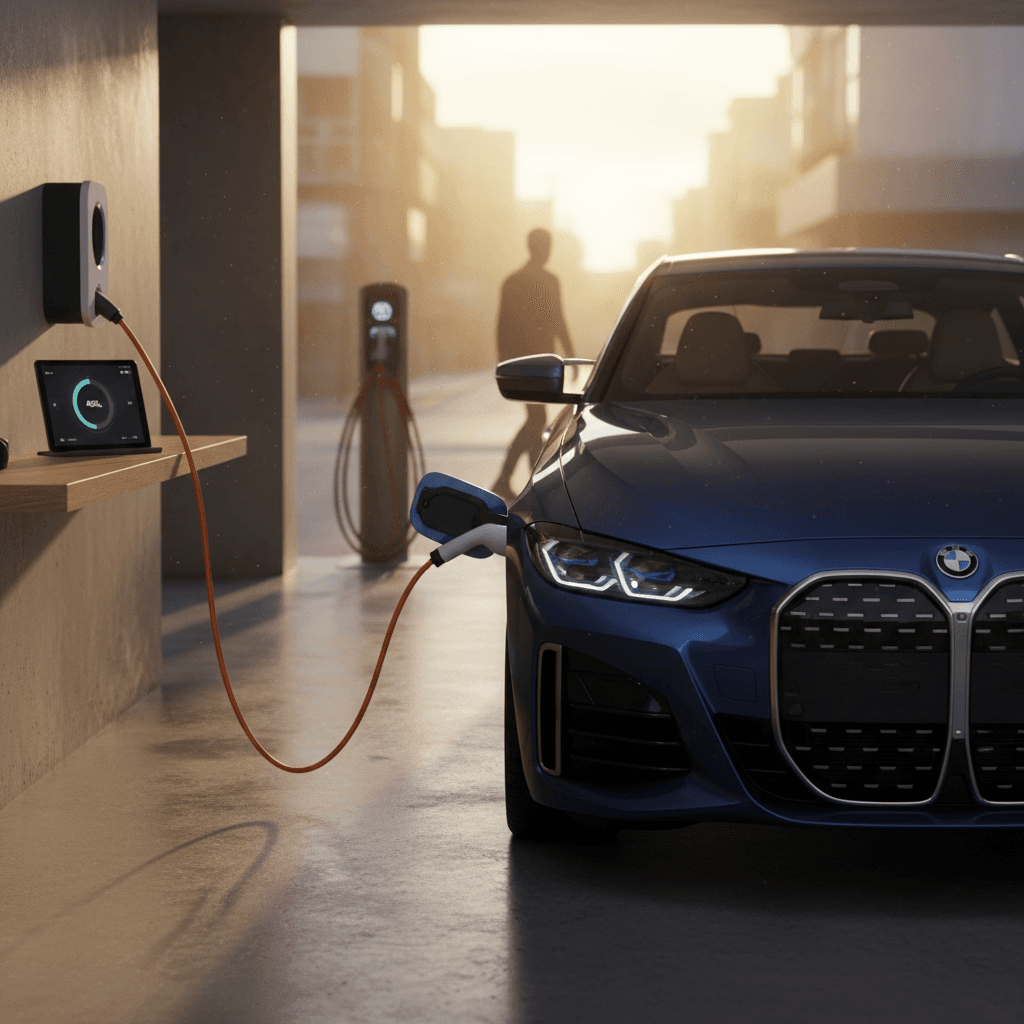
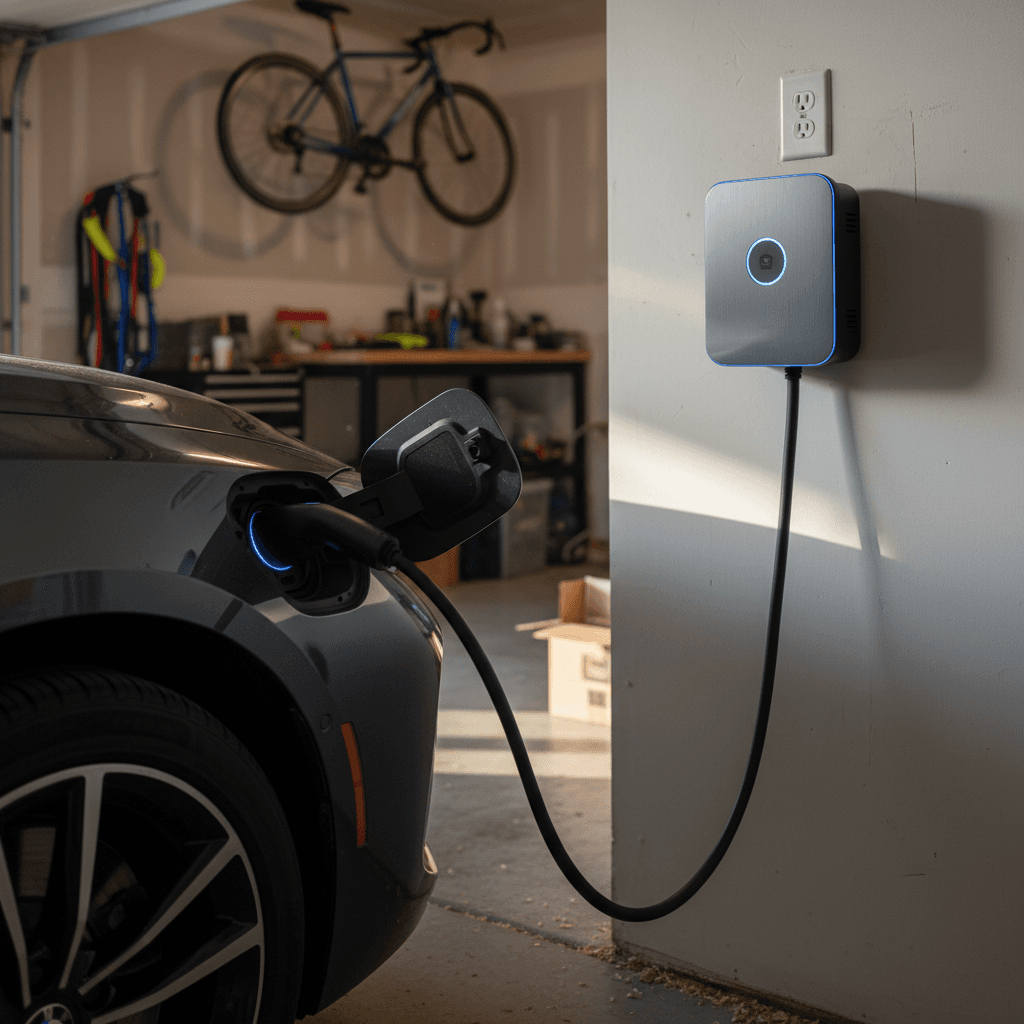
For most i4 owners in the U.S., home charging is where the car actually "refuels". You plug in when you park, and the car quietly fills up while you sleep. Time depends heavily on whether you’re using Level 1 (120V) or Level 2 (240V).
BMW i4 home charging options
What to expect from Level 1 vs. Level 2 at home
Level 1 – regular 120V outlet
Best for: Occasional top‑ups, low‑mileage drivers, or temporary setups.
- Power: ~1.3–1.8 kW (10–15A at 120V)
- Adds: roughly 3–4 miles of range per hour
- 0–100%: often 30–40 hours or more on a large‑battery i4
Think of this as "emergency" charging. It works, but it’s slow, days, not hours, from very low state of charge.
Level 2 – 240V home charger
Best for: Primary home charging for most i4 owners.
- Power: up to 11 kW if your circuit and charger support it
- Typical 40A charger: ~9.6 kW
- Adds: roughly 30–35 miles of range per hour
- 0–100%: about 8–10 hours for most recent i4 trims
This is the sweet spot for overnight charging and is what BMW designs the i4’s daily routine around.
Don’t rely on Level 1 for daily deep charges
Typical BMW i4 Level 2 charging times at home
0–100% from empty
On a solid 11 kW Level 2 circuit, most recent i4 trims go from 0–100% in roughly <strong>8–9 hours</strong>. On a slightly lower‑power 7.2–9.6 kW charger, expect <strong>8–11 hours</strong> depending on battery size and how much the car tapers near full.
20–80% daily top‑up
Many owners stay in the 20–80% window for long‑term battery health. From 20% to 80% on Level 2, you’re typically looking at about <strong>4–6 hours</strong>, again depending on charger power and trim.
30–80% "after work" charge
Arrive home at ~30%, plug into Level 2 around 6 p.m., and you can usually reach 80% by <strong>10–11 p.m.</strong> on a 9.6–11 kW setup, plenty of time before a midnight or early‑morning departure.
Top‑off from 60–90%
Shorter top‑offs are common before a road trip. Going from 60% to 90% on Level 2 typically takes <strong>2–3 hours</strong>, with charging slowing slightly over 80% as the battery protects itself.
How long to charge a BMW i4 on DC fast chargers
High‑power DC fast chargers are what make the BMW i4 road‑trip friendly. Instead of waiting overnight, you grab energy in short bursts during bathroom and snack stops. BMW’s own guidance, and our testing at Recharged, puts 10–80% at roughly 25–35 minutes on a good 150–350 kW station when the battery is warm and you arrive low on charge.
BMW i4 DC fast charging time benchmarks
Approximate times on a strong DC fast charger, assuming the charger can deliver the power the car requests and the battery is properly preconditioned.
| Charge window | Typical time | When to use it | Notes |
|---|---|---|---|
| 10–80% | ~25–35 minutes | Highway road trips | Sweet spot for speed vs. battery health; i4 can peak near 200 kW then taper. |
| 20–80% | ~20–30 minutes | Quick boost on the highway | Arriving slightly higher reduces peak time but still gives a fast turn‑around. |
| 10–50% | ~10–15 minutes | Short restroom or coffee stop | Enough to add 80–120+ miles depending on trim and conditions. |
| 80–100% | 30+ minutes extra | Only when you truly need full range | Charging slows sharply above 80%; usually better to leave and take one extra stop. |
Use these numbers for trip planning, not precise promises, conditions on the day matter.
Aim for 10–20% arrival SOC on fast chargers
Real-world BMW i4 charging time examples
Daily commuter with home Level 2
You drive 40–50 miles a day and plug into a 9.6–11 kW Level 2 charger when you get home around 6 p.m.
- You arrive with roughly 60–70% most days.
- Charging to 90% typically takes 2–4 hours.
- You can easily schedule charging for off‑peak electricity rates overnight.
In practice, you almost never see "0–100%", you just wake up to a nearly full battery.
Road trip with DC fast charging
You set out on a highway trip in an i4 eDrive40. You plan stops every 2–2.5 hours, arriving at chargers with roughly 10–15% remaining.
- You plug into a 150–350 kW DC fast charger.
- Going from 10% to 80% usually takes 25–35 minutes.
- Each session adds roughly 180–220 miles of usable range, depending on speed and weather.
Your total trip time looks a lot like a gas car with slightly longer, better‑timed breaks.
What we’ve seen in testing
Ready to find your next EV?
Browse VehiclesFactors that change how long your BMW i4 takes to charge
Charging‑time charts tell only part of the story. In the real world, several variables can add, or subtract, minutes and hours from the numbers above. Understanding them helps you avoid surprises and pick the right setup for your situation.
Key factors that affect BMW i4 charging time
Why two identical cars can charge at different speeds
Battery temperature
The i4 protects itself when the pack is too cold or too hot. A cold winter morning can cut fast‑charge power dramatically until the battery warms up. Using preconditioning (via navigation or the app) helps a lot.
State of charge (SOC)
Charging is fastest at low states of charge and slows as you approach 80–100%. That’s why automakers quote 10–80% times and why topping from 90% to 100% can feel painfully slow.
Charger power & wiring
A "Level 2" charger on a 20A circuit is not the same as one on a 60A circuit. The i4 can use up to 11 kW AC, but only if your wiring, breaker, and EVSE support it. Similarly, some "fast" DC stations only deliver 50–75 kW in practice.
Utility limits & scheduling
Time‑of‑use electricity plans, smart‑charger apps, and even vehicle settings can intentionally slow or delay charging. Great for your bill, not great if you expect full power at all times.
Battery size and trim
The bigger‑battery i4 trims naturally take longer to go from 0–100%, even at the same charging power. That’s why an eDrive35 might hit 100% noticeably sooner than an M50 on the same wallbox.
Station load & reliability
On public DC fast chargers, your speed can depend on how many cars share that cabinet, how healthy the hardware is, and whether the site is derated. It’s common to see lower power than the spec sheet in the wild.
Tips to charge your BMW i4 faster and smarter
You can’t change physics, but you can stack the deck in your favor. A few simple habits will keep your i4’s charging times predictable, your electricity costs lower, and your battery happy over the long haul.
Practical charging tips for BMW i4 owners
1. Install a proper Level 2 setup at home
If you own or can influence your parking spot, a dedicated 240V Level 2 charger is the single biggest upgrade you can make. Aim for a 40–48A unit on an appropriately sized breaker so you can get close to the i4’s 11 kW AC limit.
2. Use scheduled charging for off‑peak rates
Most utilities now offer cheaper overnight electricity. Use the BMW app or your wallbox app to schedule charging for off‑peak hours so the car still hits your desired state of charge by departure time.
3. Plan DC fast stops around 10–80%
On road trips, treat 80% as your "practical full." Leaving early to chase 100% costs time with little real‑world benefit. Two 10–80% stops are often faster than one 10–100% marathon session.
4. Precondition the battery before fast charging
Use the in‑car navigation to set a DC fast charger as your destination, or precondition via the BMW app when supported. Arriving with a warm pack helps the i4 pull closer to its 195–200 kW peak and shortens that 10–80% window.
5. Avoid living at 0% or 100%
Occasional deep cycles won’t ruin the pack, but day‑in, day‑out behavior matters. Aim to live in the 20–80% window and only charge to 100% before long trips. That won’t change a given 10–80% charging time much, but it can help long‑term battery health.
6. Test your actual home charging speed
After you install a Level 2 setup, plug in from a known state of charge and compare how many % you gain per hour. If your real‑world rate seems far below expectations, it could be as simple as a derated circuit, a mis‑set amperage limit, or a weak outlet.
Safety first with home upgrades
BMW i4 charging times when you’re shopping used
If you’re looking at a used BMW i4, charging time isn’t just a spec‑sheet number, it’s part of how livable the car will feel in your daily routine. Two i4s with the same battery size can exhibit slightly different real‑world behavior depending on how they were driven and charged in the past.
Questions to ask about charging
- Where was the car primarily charged? A car that lived on Level 2 at home and only occasionally used DC fast charging is ideal.
- How often was it charged to 100%? Occasional is fine; a history of daily 0–100% fast charges is less desirable.
- Has the owner noticed slower DC fast charging? That could point to station issues, software behavior, or in rare cases, battery concerns.
How Recharged helps
Every EV sold through Recharged comes with a Recharged Score Report that includes verified battery health and charging data. Our diagnostics go beyond the dash estimate so you can see how the pack has aged and whether real‑world charging performance aligns with what you’d expect for that model and mileage.
If you’re comparing a BMW i4 to other used EVs, our specialists can walk you through how its Level 2 and DC fast‑charging behavior stacks up and what kind of home setup you’ll want.
Try before you buy
BMW i4 charging time FAQs
Frequently asked questions about BMW i4 charging times
Bottom line: how long does it take to charge a BMW i4?
If you boil all the numbers down, a BMW i4 is designed to feel straightforward to live with: overnight at home on Level 2 gives you a "full tank" for the next day, and a 25–35 minute DC fast‑charge stop on a capable station is usually enough to get you back on the road on longer trips. Level 1 works in a pinch, but it’s too slow to rely on as a primary fuel source for most drivers.
If you’re exploring a BMW i4, especially on the used market, the real question isn’t just "how long does it take to charge," but "how does this specific car charge in the real world, and what home setup will I need?" That’s where Recharged can help. With verified battery health via the Recharged Score, transparent pricing, nationwide delivery, and EV‑specialist support, we make it easier to choose the right i4 and match it with the right charging plan from day one.