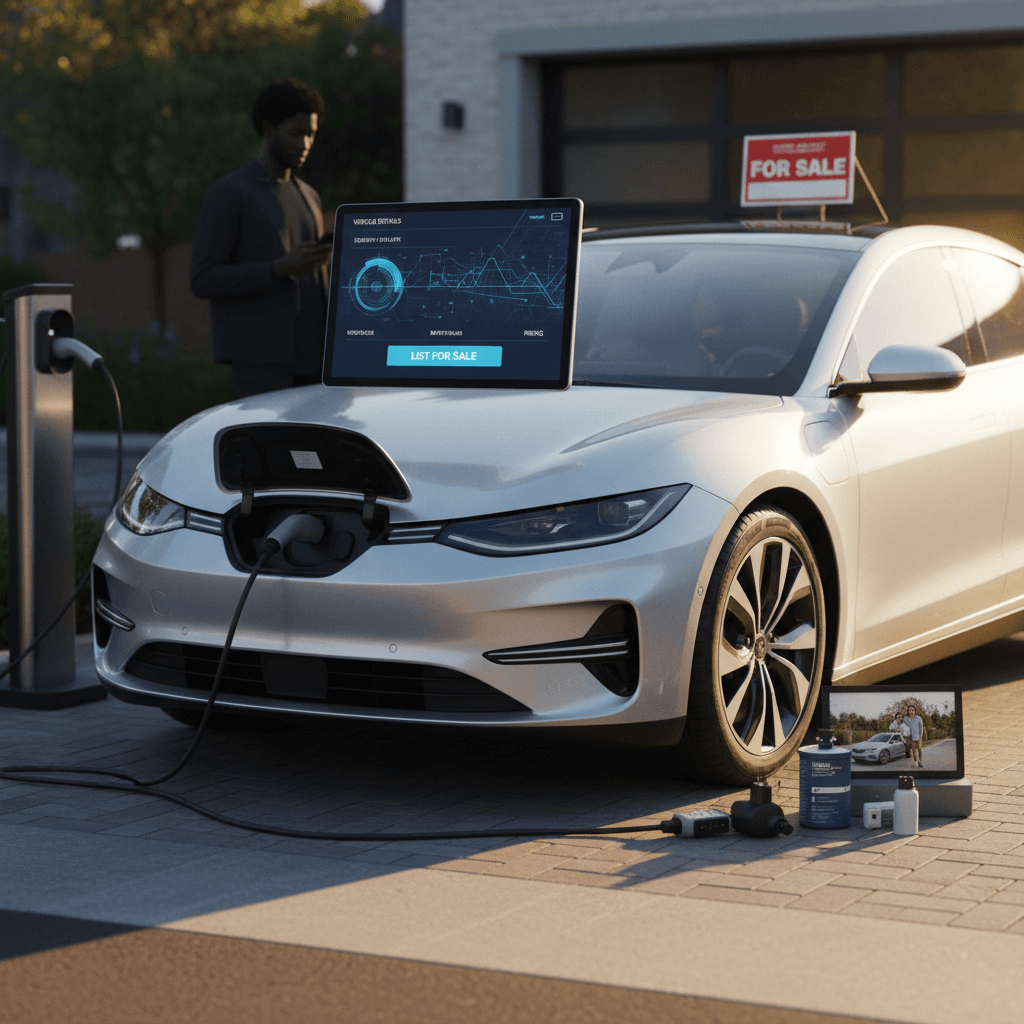
If you’re staring at your driveway wondering how long it will take to sell your electric car, you’re not alone. The used EV market has grown up fast, and in 2026 the answer is: your car could move in as little as a day, or sit for a month or more, depending on where and how you sell, plus the specifics of your vehicle.
Quick answer
How long it really takes to sell an electric car
Industry data over the last two years shows used electric vehicles changing hands roughly as fast as, and in many pockets faster than, comparable gas cars. Recent reports point to used EV inventory clearing in about 30–40 days on average in the U.S., with some regions seeing sub‑30‑day turn times as prices normalize and more mainstream shoppers enter the EV market.
Typical EV selling timelines in 2025–2026
Those averages hide a lot of nuance. A late‑model Tesla in California will not behave like a first‑generation Nissan Leaf in a cold‑weather rural market. The rest of this guide breaks down what actually controls your days on market, and how to tilt those odds in your favor.
7 factors that change how fast your EV sells
Key levers that speed up (or slow down) an EV sale
Understand these and you’ll understand your realistic timeline.
1. Battery health
2. Location & climate
3. Make, model & demand
4. Your asking price
5. Listing quality
6. Title, history & paperwork
7. How you choose to sell
Data + story sells faster
Selling options and how long each usually takes
You can’t control the broader market, but you can choose a channel that matches your timeline. Here’s how long the major options typically take from the moment you decide to sell to money in your account.
Typical timelines by selling method
These are realistic ranges for a well‑priced, clean‑title EV in an average U.S. market in 2026.
| Selling method | Time to first serious offer | Total time to get paid | Pros | Cons |
|---|---|---|---|---|
| Dealer trade‑in | Same day | 1–3 days | Fast, simple, can roll equity into your next car | Lower price, limited EV expertise at many dealers |
| Instant‑offer EV retailer | Same day to 48 hours | 3–7 days | Quick quote, minimal legwork, often EV‑savvy pricing | Offer may be below what a private buyer will pay |
| Consignment with EV specialist (e.g., Recharged) | 3–10 days | 7–30 days | Professionals handle pricing, marketing, and paperwork; access to wider EV‑focused audience | You wait until the car sells; fees/commission apply |
| Listing on used EV marketplace | 3–14 days | 14–40 days | Large EV‑interested shopper base, tools for pricing | You manage inquiries and screening buyers |
| Private sale (general classifieds or marketplace apps) | 7–21 days | 21–45+ days | Potentially highest price if you’re patient and responsive | More legwork, tire‑kickers, safety and paperwork are on you |
Actual times vary by model, region, and condition, but this gives you a planning baseline.
Where Recharged fits
Timeline walkthrough: from thinking about selling to cash in hand
Fast‑track: 1–7 days (dealer or instant‑offer)
- Day 1: Gather VIN, payoff info, photos, and any service records. Request online offers from one or more EV retailers or visit a dealer.
- Day 1–2: You receive firm offers pending inspection. If you accept, schedule appraisal or mobile inspection.
- Day 2–5: Vehicle inspected, payoff confirmed, paperwork signed.
- Day 3–7: Funds arrive or your loan is paid off and equity is sent to you.
This route is best if you’re prioritizing speed and simplicity over squeezing the last dollar out of the deal.
Market‑max: 3–6 weeks (consignment or private listing)
- Week 1: Prep the car, get a battery health check, photograph it, and write a detailed listing. Decide on your pricing strategy and where to list (or sign a consignment agreement).
- Week 2–3: Active marketing phase. Most serious interest shows up in the first 10–14 days if your price is realistic.
- Week 3–4: Test drives, buyer financing, any pre‑purchase inspections.
- Week 4–6: Finalize the deal, handle payoff and paperwork, and transfer funds.
This path usually delivers a higher sale price, especially for desirable, late‑model EVs with strong battery health.
How to sell your electric car faster
You can’t change your car’s birthdate, but you can control how it shows up to buyers. These are the levers that consistently shorten selling timelines for used EVs.
7 steps to cut your EV’s days on market
1. Get a battery health report
Battery uncertainty is one of the top reasons buyers hesitate on used EVs. A third‑party battery diagnostic, like the <strong>Recharged Score</strong> that comes with every vehicle sold on Recharged, gives buyers real numbers on usable capacity and projected range.
2. Price inside the real market band
Use multiple data points (EV‑focused marketplaces, valuation tools, recent comps) and target the middle of the fair‑market range, not the top. If you haven’t had serious inquiries after 10–14 days, plan a structured price adjustment.
3. Lead with charging and range details
Spell out how you charge (home Level 2, workplace, nearby DC fast chargers), what real‑world range you see at different states of charge, and whether you’re including any home charging equipment or adapters.
4. Fix the easy stuff first
Minor curb rash, a cracked windshield, or a check‑engine/EV warning light can scare off buyers or hurt offers. Handle low‑effort fixes and software updates before listing to prevent delays and renegotiations.
5. Write an EV‑savvy description
Answer the questions EV shoppers actually have: usable range, software features, over‑the‑air update history, warranty status on the battery and drive unit, and any accessories (winter wheels, charging cables) included in the sale.
6. Respond quickly and screen smartly
Most serious shoppers are talking to multiple sellers. Fast, clear replies and a simple pre‑screen (“Are you pre‑approved?” “Do you have a trade‑in?”) help you focus on buyers who can actually close.
7. Consider hybrid strategies
You don’t have to pick one path forever. You might start with consignment through an EV specialist like Recharged for 30 days, then accept an instant offer if the right buyer hasn’t materialized.
How Recharged can help you move faster
Ready to find your next EV?
Browse VehiclesPricing strategy: what to expect for used EVs in 2026
Timelines and pricing are joined at the hip. In 2026, several forces are reshaping used EV values: a large wave of off‑lease EVs hitting the market, the sunset of key federal incentives, and still‑growing mainstream demand for affordable electric cars. All of that makes correct pricing more important than ever if you care how long your sale takes.
What’s pushing your EV’s price up or down in 2026
These trends help explain why some EVs sell in days and others take weeks.
Off‑lease supply surge
Incentive whiplash
Battery warranty window
As a rule of thumb, pricing your EV just under similar local listings with weaker equipment, worse mileage, or no battery documentation is the fastest way to win attention without giving the car away.
Beware old pricing headlines
Common pitfalls that delay an EV sale
- Setting your price based on what you paid, not what the market says today.
- Listing without a clear explanation of current battery health and real‑world range.
- Ignoring serious cosmetic or mechanical issues that will surface during inspection.
- Letting the listing go stale after the first week, no price adjustments, no fresh photos, no feature call‑outs.
- Being slow to respond to messages or rigid about test‑drive windows.
- Trying to sell a car with negative equity privately without a plan for payoff logistics.
- Advertising only on generic classifieds instead of EV‑focused platforms and retailers.
Title or payoff issues can freeze your sale
When it might make sense to wait to sell
No one can time the used market perfectly, but there are cases where waiting a bit can improve both your price and your odds of a quick sale.
Good reasons to wait
- Your battery warranty is about to transfer tiers: Some warranties extend coverage for a set number of owners or years. Waiting until you can advertise “still under battery warranty” can draw more buyers, faster.
- Your local charging picture is improving: If a big public charging project or new DC fast station is opening nearby, your EV becomes more practical for more buyers.
- You’re still upside‑down on the loan: A few more months of payments can shrink negative equity and give you more flexibility on price.
Times to move sooner, not later
- Newer version of your model just launched with big discounts: That can drag prices down on older trims. Selling before lots of those hit the used market can protect your value.
- Your mileage is about to cross a psychological threshold: If you’re at 59,000 miles today, many buyers will filter searches at “under 60,000 miles.” Selling before the odometer flips can help your listing pop up in more searches.
- You know a big repair is coming: If your EV is nearing out‑of‑warranty items or expensive wear‑and‑tear, today’s price plus a fast sale may beat next year’s net value.
FAQ: How long does it take to sell an electric car?
Frequently asked questions about EV selling timelines
Bottom line on EV selling timelines
Selling an electric car in 2026 doesn’t have to be a guessing game. For most owners, a realistic expectation is about a month from listing to sale, give or take, with faster outcomes if you pick a speed‑first channel and slower ones if you chase a top‑of‑market price.
If you want out quickly and cleanly, an instant offer or trade‑in will get you there in days, not weeks. If you’re willing to let the market work to your advantage, pairing smart pricing with strong battery documentation and EV‑savvy marketing can help you capture more value without dragging the process out.
Either way, you don’t have to navigate it alone. Recharged is built specifically around used EVs, with battery health reports, fair market pricing, multiple ways to sell, and experts who live and breathe this segment. Start with your VIN and zip code, get a data‑driven view of what your EV is worth, and choose the selling path, and timeline, that fits your life.