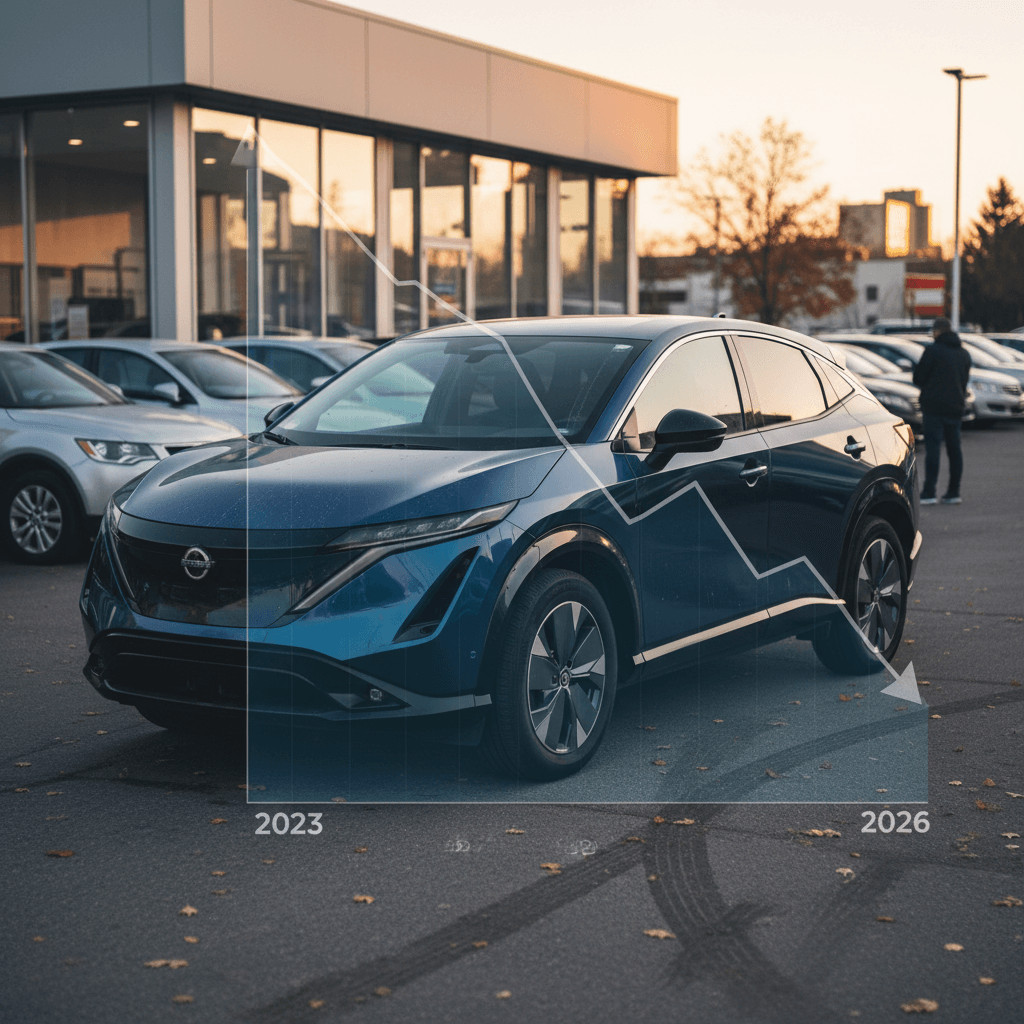
You’re not imagining it: the Nissan Ariya is one of the quickest‑depreciating electric SUVs on the market right now. If you’re wondering how fast the Nissan Ariya depreciates, and whether that’s a red flag or a buying opportunity, you’re in the right place.
The short version
Overview: How fast does the Ariya really depreciate?
Depreciation is simply how much value a vehicle loses over time. With the Ariya, the curve is aggressive. Different data sources measure slightly differently, but they all rhyme: the Ariya gives up a lot of value very early in its life compared with other compact electric SUVs.
Nissan Ariya depreciation at a glance
Depreciation varies by trim and deal
Key Nissan Ariya depreciation numbers at a glance
Approximate Nissan Ariya depreciation curve
Big picture: what a typical Ariya might be worth over time relative to original MSRP, based on public data and 2026 used‑market behavior.
| Age | Estimated value | % of original price | Approx. value lost |
|---|---|---|---|
| 1 year | $35,000–$38,000 | ≈70–76% | $12,000–$15,000 |
| 3 years | ≈$28,000–$30,000 | ≈57–60% | ≈$20,000–$22,000 |
| 5 years | ≈$18,000–$20,000 | ≈36–40% | ≈$30,000–$32,000 |
Illustrative values assuming a notional $50,000 original MSRP on a mid‑trim Ariya.
Think of it this way: on a $50,000 Ariya, it’s entirely plausible to see $20,000–$22,000 in value evaporate in the first three years and roughly $30,000 or more gone by year five. Put differently, the market is treating the Ariya more like a heavily discounted luxury gadget than a slow‑burn family appliance.
Why this is good news if you’re buying used
Why does the Nissan Ariya depreciate so fast?
Four big forces behind Ariya’s steep depreciation
It’s not just "EVs depreciate", the Ariya has some model‑specific headwinds.
Launched into a crowded, discount‑heavy segment
The Ariya arrived late to the compact electric‑SUV party, and it walked into a room already owned by Tesla, Hyundai, Kia and Ford. To move metal, Nissan and dealers have leaned heavily on incentives and lease cash.
Once the market sees big rebates on new inventory, used prices sink to match the new effective transaction prices.
Range, charging and efficiency are merely OK
The Ariya is pleasant to drive, but it’s not a spec‑sheet assassin. Range is competitive but not class‑leading, DC fast‑charging speeds trail the best (Hyundai Ioniq 5, Kia EV6), and efficiency is only mid‑pack.
Used‑car shoppers increasingly know these numbers; when the SUV doesn’t stand out technically, they demand a lower price.
Brand and product story lag rivals
The Ariya is a handsome crossover from a brand whose last big EV story, Leaf, became synonymous with heavy depreciation and early battery degradation. Fair or not, used‑market psychology still remembers the Leaf.
Meanwhile, rivals trade on strong narratives: Tesla’s tech halo, Hyundai/Kia’s design and charging speed, Ford’s heritage.
MSRP vs perceived value gap
Many Ariya trims launched with MSRPs in the high‑$40Ks to $60K range, but the interior and driving experience land more in "nice mainstream" than "entry‑luxury" territory.
When expectations and reality diverge, resale fills the gap. The market simply reprices the car to where it feels it should have been.
Don’t confuse depreciation with durability
Nissan Ariya vs rival EVs: depreciation comparison
A useful way to understand Ariya depreciation is to set it next to the usual suspects: Tesla Model Y, Hyundai Ioniq 5, Kia EV6 and Ford Mustang Mach‑E. These are the crossovers your neighbors actually buy instead.
How Ariya depreciation stacks up against key rivals
Approximate 5‑year depreciation outlook for popular compact electric SUVs based on 2024–2025 resale analyses and price‑tracking.
| Model | Est. 5‑year value retained | Depreciation character |
|---|---|---|
| Nissan Ariya | ≈35–40% | Among the weakest 5‑year performers; some rankings flag it as the worst‑retaining EV on sale. |
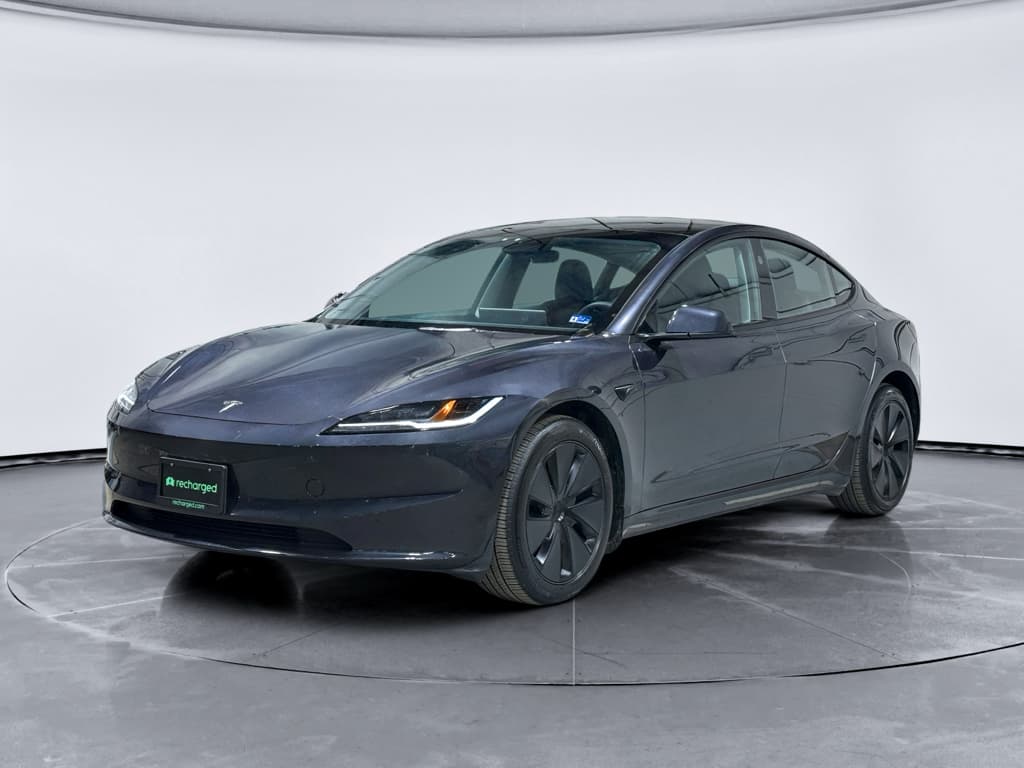
| Tesla Model Y | ≈50–55% | Benefits from brand demand, software updates and Supercharger access; holds value noticeably better. |
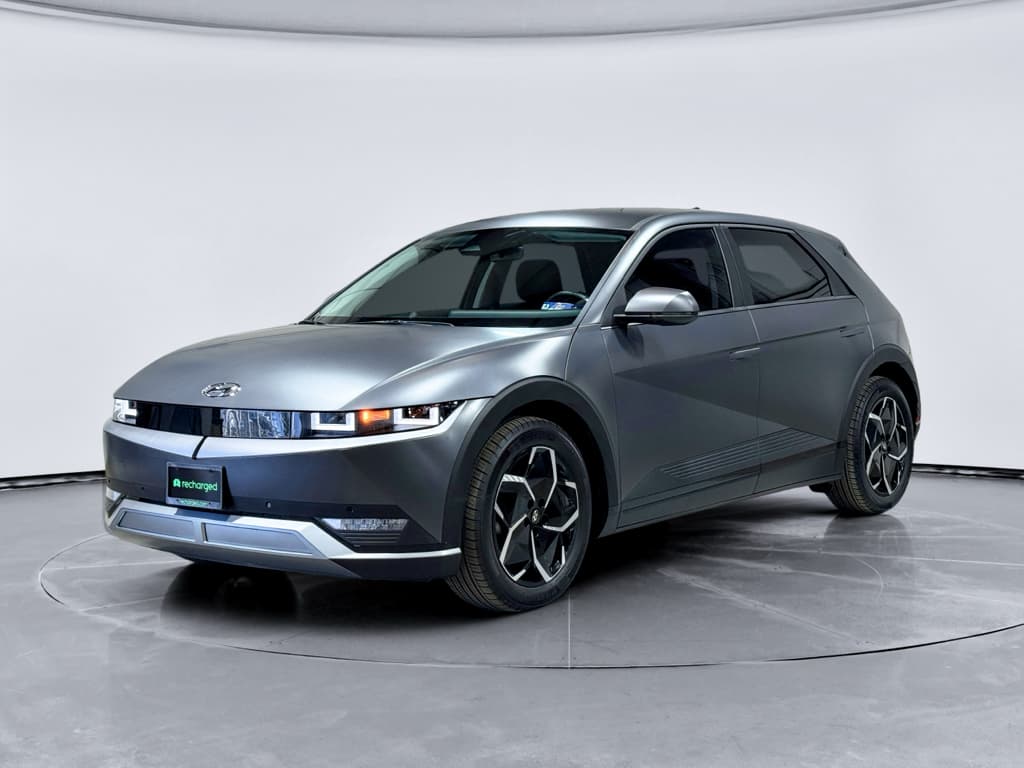
| Hyundai Ioniq 5 | ≈45–50% | Moderate depreciation; strong charging tech and design help, but heavy incentives can push prices down. |
| Kia EV6 | ≈45–50% | Similar story to Ioniq 5; sportier image and decent demand support used values. |
| Ford Mustang Mach‑E | ≈40–45% | Discounts and price cuts have hurt resale, but generally still better than Ariya. |
The Ariya tends to lose value faster than the segment leaders, which hold closer to 45–50% of original value at five years.
Where the Ariya wins: value per dollar used
What used Nissan Ariya prices look like in 2026
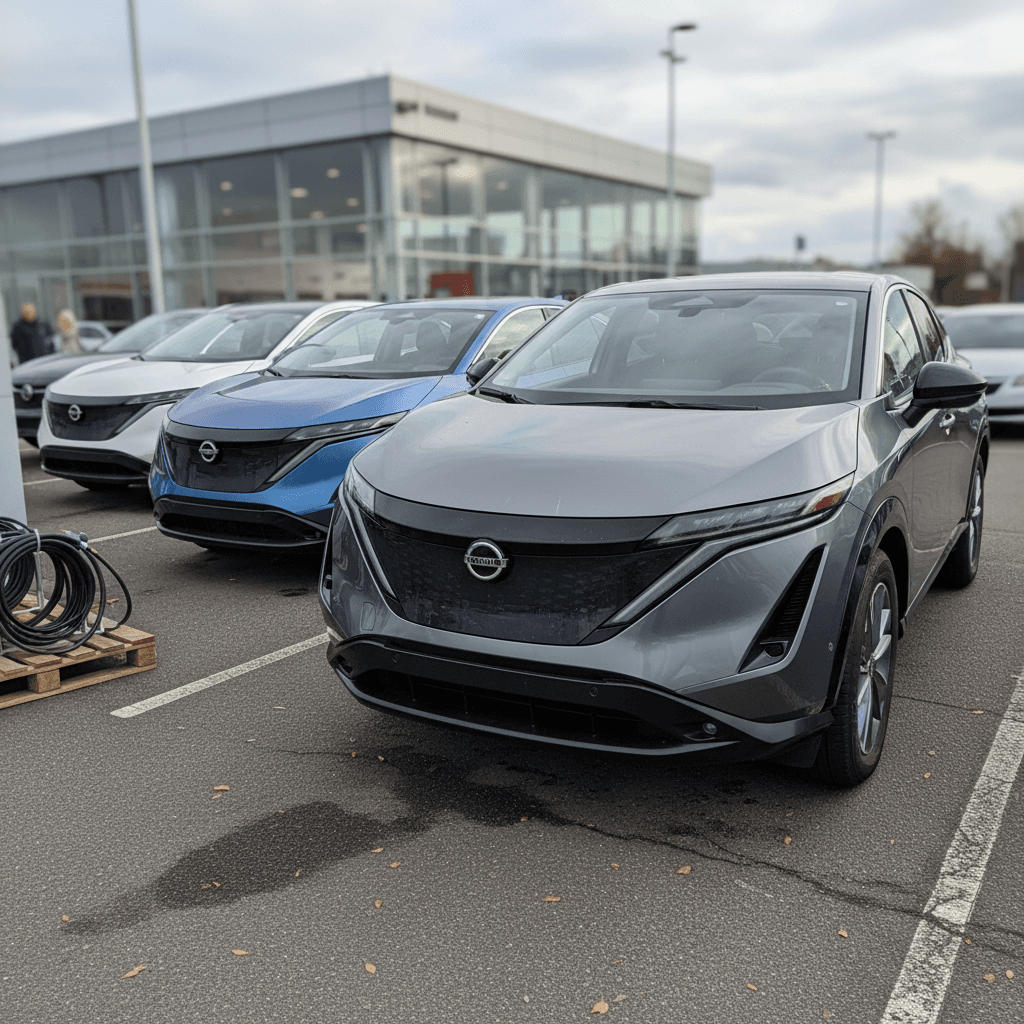
By spring 2026, we finally have a real used‑market history for the Ariya. The short version: early model years have come down hard, especially where original MSRPs were ambitious and incentives were rich.
Typical asking prices
- 2023 Ariya: often in the low‑$20,000s for non‑CPO examples, depending on mileage and trim.
- 2024 Ariya: generally mid‑$20,000s, with nicer trims stretching higher if mileage is low.
- 2025 Ariya: still mostly new or off‑lease, but early used listings cluster around the low‑$30,000s.
Those numbers mean some 2–3‑year‑old Ariyas are already down close to 50–60% from original MSRP.
What the data trackers show
Used‑price indexes and resale‑value rankings consistently place the Ariya at the weak end of the EV spectrum. In some 3‑year resale lists, it’s grouped with the worst performers in the class; in several 5‑year projections, it’s singled out as the lowest‑retaining EV currently on sale.
For you, that translates into a simple equation: if the price doesn’t feel surprisingly low, you’re probably not being compensated for the model’s reputation.
Use CPO pricing as a sanity check
How depreciation affects leasing vs buying an Ariya
If you’re coming at the Ariya as a new‑car shopper, depreciation isn’t an academic exercise, it’s what decides whether you should lease, buy, or walk away. Because Nissan and its finance partners know the Ariya’s resale is soft, lease programs have been…creative.
Leasing a new Ariya vs buying used
Same vehicle, radically different financial stories.
Leasing new: high residuals, big incentives
Many Ariya leases have been written with surprisingly high residual values, on paper, the bank assumes the SUV will be worth more at lease‑end than the real market likely will.
To make the payment attractive in spite of that, Nissan has piled on large rebates and lease cash. Great for your monthly bill, but it often means:
- Buying the car at lease‑end for its residual rarely makes sense.
- You’re better off handing it back and letting the bank eat the difference.
Buying used: value already reset
On the used side, depreciation has already done its worst. You’re not playing games with theoretical residual values; you’re paying what the market has actually decided the Ariya is worth.
If you shop carefully, ideally with verified battery health and a transparent history, owning a used Ariya outright can cost less over 5–7 years than hopping between new‑car leases, even with juicy incentives.
Lease math: beware the buyout trap
How to buy a used Nissan Ariya smartly
Steep depreciation doesn’t make the Ariya a bad car. It makes it a mispriced car when new, and a potentially excellent buy when used. The trick is making sure you’re on the right side of that equation.
6 rules for outsmarting Ariya depreciation
1. Anchor on MSRP and age, not just asking price
Before you fall in love with the leather and ambient lighting, find the original window sticker or MSRP for that trim. If a 3‑year‑old Ariya is still priced at 70% of its original MSRP, walk, there are better‑priced examples out there.
2. Cross‑shop rival EVs at the same price
At $25,000, you may have your pick of an Ariya, an older Tesla Model Y with more miles, or a lower‑spec Ioniq 5. Lining up range, charging speed, interior and warranty side by side is the best way to see if the Ariya is really the standout at that price.
3. Treat battery health as the trump card
An Ariya with a healthy battery pack is a very different proposition from one that’s been fast‑charged hard and lives at 100% all day. Ask for a battery‑health report if it’s available. With Recharged, the <strong>Recharged Score</strong> includes detailed battery diagnostics so you’re not guessing from a dash‑bar graph.
4. Favor remaining factory warranty or strong CPO coverage
Ariyas sold in the U.S. came with an 8‑year/100,000‑mile battery warranty. The closer your used example is to that safety net, the more comfortable you can be with long‑term ownership. A reputable CPO program or a Recharged purchase adds another layer of protection.
5. Don’t overpay for top trims
A fully loaded Platinum+ might have been a $60,000‑plus experiment in 2023. The used market does not care. Unless you absolutely need every tech toy, a mid‑trim Ariya at a lower price usually represents better value and gentler future depreciation.
6. Think in total cost of ownership, not just sticker
Factor in energy costs, insurance, taxes and projected resale. Because the Ariya’s steepest depreciation is already behind you, a sensibly priced 3‑year‑old example can have a very friendly cost‑per‑mile over the next five to seven years.
Where Recharged fits in
Ready to find your next EV?
Browse VehiclesBattery health and depreciation on the Ariya
One reason the Ariya’s resale is so sensitive to perception is Nissan’s history with the Leaf. Early Leafs lost range quickly in hot climates, and that story still echoes in the heads of used‑car shoppers. The Ariya’s thermal management is more sophisticated, but the market remains skittish.
What we know so far
- Real‑world reports from early Ariya owners do not suggest catastrophic battery fade in the first few years.
- Most used examples in 2026 are still well within the 8‑year/100,000‑mile battery warranty.
- Battery‑health variation tends to track usage patterns, high‑mileage fast‑charge commuters vs garaged low‑milers, more than model‑wide defects.
Why battery data matters for price
Because the Ariya is already a "discount" EV used, any hint of weak battery health can crater its value further. Conversely, documented strong health can justify paying at the upper end of the price band for that year and trim.
That’s why we lean on instrumentation, not guesses. At Recharged, our Recharged Score uses specialized diagnostics to quantify battery condition so depreciation is based on reality, not rumor.
Ask for numbers, not adjectives
FAQ: Nissan Ariya depreciation questions answered
Common questions about Nissan Ariya depreciation
Bottom line: should rapid depreciation scare you off?
The Nissan Ariya is not a resale hero. The data is plain: it sheds value faster than the Tesla Model Y and most of the Korean competition, and five‑year projections put it near the bottom of the EV pack. But depreciation is not a moral failing; it’s a pricing story. As a second‑owner proposition, especially at the right price and with proven battery health, the Ariya starts to look less like a misstep and more like a quiet coup.
If you’re the kind of shopper who values comfort, design and serenity over spec‑sheet domination, the Ariya’s resale troubles are your opportunity. Let someone else eat the first $20,000. Then, whether through a trusted marketplace like Recharged or a carefully vetted private sale, you can step into a well‑equipped electric SUV for compact‑car money, and enjoy all the upside, with most of the downside already priced in.