If you’re considering a Honda Prologue, you’re probably not just comparing sticker prices. You want to know the true cost of ownership over 5 years, payments, charging, maintenance, insurance, and what you’ll get back when you sell or trade it in. This guide walks through real‑world assumptions so you can see how a Prologue stacks up against a comparable gas SUV over a typical 5‑year ownership window.
What “true cost of ownership” means here
Why Honda Prologue 5‑Year Ownership Costs Matter
A new EV like the Honda Prologue often carries a higher MSRP than a similarly sized gas SUV. But over five years, lower energy and maintenance costs can more than offset that difference, especially if you qualify for federal or state incentives. Understanding the Prologue’s total cost of ownership helps you answer three key questions: how much you’ll spend each month, when the EV starts saving you money versus gas, and what your exit looks like when you trade or sell.
Key questions this 5‑year Honda Prologue cost guide answers
Use these as a checklist while you shop and budget
Monthly budget
What will your total monthly outlay look like once you include payment, insurance, and charging, and how does that compare with a gas SUV?
Running costs
How much can you realistically save on fuel and maintenance over 5 years of typical driving?
Resale and battery health
What might your Prologue be worth after 5 years and 60,000 miles, and how does battery health affect that value, especially if you buy used?
Honda Prologue pricing and assumptions used in this 5‑year model
No two households drive, finance, or insure their cars exactly the same way, so any 5‑year cost of ownership model has to make a few reasonable assumptions. Here’s the baseline we’ll use for the Honda Prologue in the U.S. today, with numbers rounded to keep the math easy to follow.
Assumptions for Honda Prologue 5‑year ownership cost model
Baseline numbers for a typical U.S. owner. Adjust these to match your situation.
| Category | Assumption we’ll use | Notes |
|---|---|---|
| Trim and price | $50,000 out‑the‑door (including tax/doc) | Think well‑equipped EX/LT equivalent. If you pay less, your total cost drops accordingly. |
| Down payment | $5,000 | 10% down; many buyers put anywhere from 0–20%. |
| Loan terms | 5 years, 5.5% APR | Common for new EV loans with good credit. |
| Annual mileage | 12,000 miles | Total 60,000 miles over 5 years. |
| Electricity cost | $0.16 per kWh (home), 80% of miles at home | Blended U.S. average; assumes some public charging on trips. |
| Gas comparison vehicle | 30 mpg midsize SUV, $3.75/gal average | Used for fuel vs. charging comparison. |
| Insurance | $1,800 per year | Will vary by driver, location, and coverage. |
| Maintenance & repairs | $350 per year average | Covers tires, cabin filters, brake fluid, wipers, etc.; EVs usually need less than gas counterparts. |
| Depreciation horizon | 5 years / 60,000 miles | We’ll assume the Prologue retains around 50–55% of its value. |
You can plug in your own commute, electricity rate, and insurance quote to personalize this model.
These are estimates, not guarantees
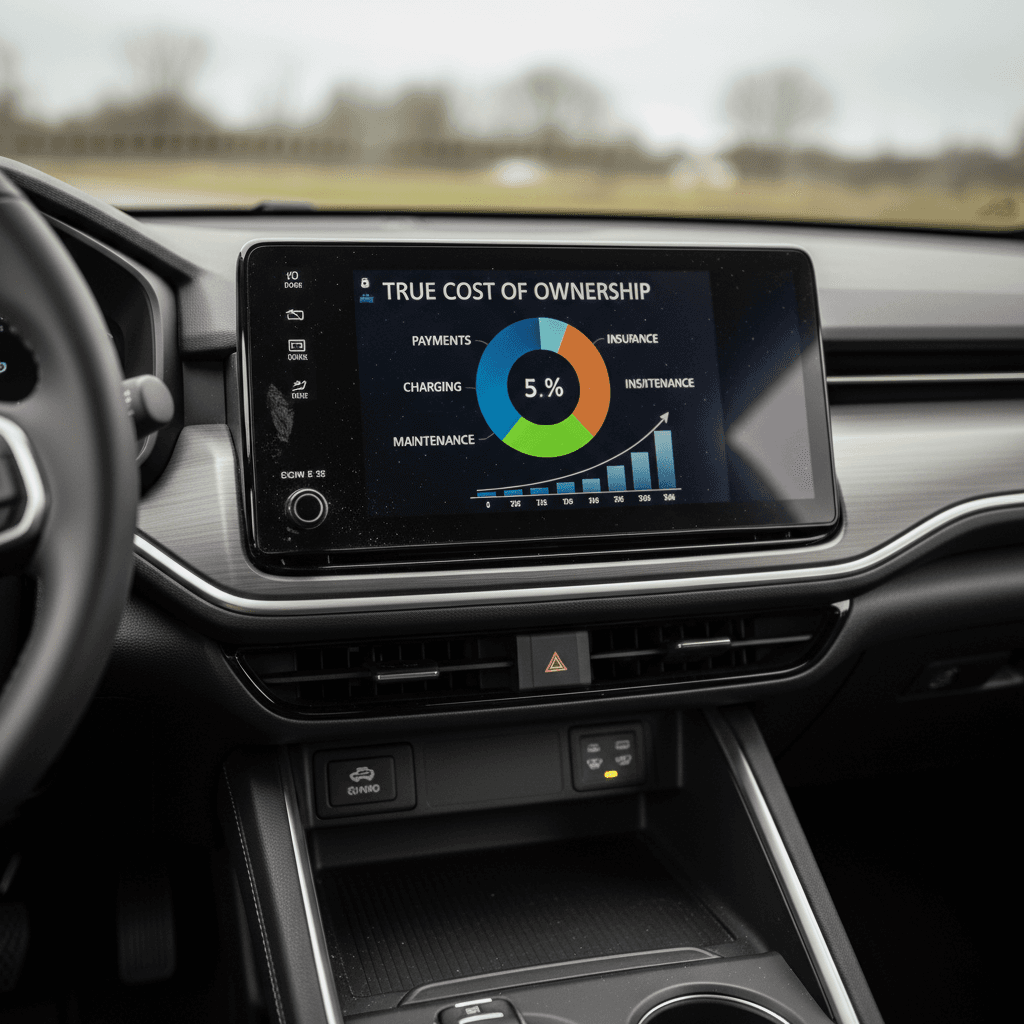
5‑year Honda Prologue cost of ownership: quick summary
Honda Prologue 5‑year ownership snapshot (based on our assumptions)
At a high level, buying a new Honda Prologue and driving it 12,000 miles per year for 5 years comes out to a net cost of roughly $41,000 in this model. The exact figure will move up or down with incentives, electricity rates, and resale conditions, but the direction is clear: the Prologue tends to cost less to own than a comparable gas SUV once you factor in fuel and maintenance savings.
Purchase price, financing, and interest costs
For most buyers, loan payments are the single largest line item in 5‑year ownership costs. Using our $50,000 out‑the‑door price, $5,000 down payment, and 5.5% APR over 60 months, your monthly payment lands in the low‑to‑mid $800s, and you’ll spend roughly $6,000–$6,500 in interest over the life of the loan.
Financed Honda Prologue (new)
- Loan amount: $45,000
- Term: 60 months at 5.5% APR
- Est. payment: ≈$860/month
- 5‑year principal paid: $45,000
- 5‑year interest paid: ≈$6,200
How incentives affect financing
If you qualify for the federal clean vehicle credit (up to $7,500 for eligible new EVs) and apply it effectively as part of your deal, it can:
- Reduce your effective purchase price into the low‑$40,000s.
- Lower your monthly payment by $100+ depending on how it’s structured.
- Cut your total interest paid, because you’re borrowing less.
Tip: Shop financing, not just price
Charging cost vs. gasoline: where the Honda Prologue saves you money
Energy is where EVs like the Honda Prologue really pull away from gas SUVs over a 5‑year window. Instead of paying for gasoline, you pay for electricity, mostly at home, if you can. The Prologue’s efficiency will vary by trim and driving style, but a reasonable estimate is around 2.8–3.0 miles per kWh in mixed driving.
5‑year fuel vs. charging cost: Honda Prologue vs. similar gas SUV
Based on 12,000 miles per year, 60,000 miles over 5 years.
| Metric | Honda Prologue (EV) | Comparable gas SUV |
|---|---|---|
| Energy use | ~22 kWh/100 miles | ~3.3 gal/100 miles (30 mpg) |
| Energy price | $0.16/kWh home (80% of miles), higher on road trips | $3.75/gal average |
| Annual energy cost | ≈$800–$900 | ≈$1,500–$1,800 |
| 5‑year energy cost | ≈$4,000–$4,500 | ≈$7,500–$9,000 |
| 5‑year energy savings | , | ≈$3,000–$4,500 in favor of the Prologue |
Your actual numbers will vary with electricity and gas prices, but the EV typically stays well ahead on energy cost.
Home charging vs. public fast charging
Honda Prologue maintenance and repair costs over 5 years
One of the biggest advantages the Honda Prologue has over a gas SUV is its low routine maintenance. There’s no engine oil, spark plugs, timing belts, or exhaust system to service. You’re mainly dealing with tires, brake fluid, coolant checks for the battery and power electronics, wiper blades, and cabin air filters.
Typical 5‑year maintenance items: Honda Prologue vs. gas SUV
Same 60,000‑mile window, very different service needs
Honda Prologue (EV)
- Tires (likely 1 full replacement set in 5 years)
- Brake fluid service
- Cabin air filter changes
- Battery coolant checks at specified intervals
- Occasional software updates (often over‑the‑air)
Estimated 5‑year spend: ≈$1,500–$2,000 depending on tire choice and driving.
Comparable gas SUV
- Regular oil and filter changes
- Engine air filter, spark plugs, belts
- Transmission fluid service
- More complex exhaust/emissions system maintenance
- Tires and brakes (similar to EV)
Estimated 5‑year spend: ≈$2,500–$3,500 for a mainstream midsize SUV.
EV brakes last longer
Insurance, registration, and other recurring fees
Insurance is one of the most variable parts of EV ownership costs. New electric SUVs like the Honda Prologue can be slightly more expensive to insure than mainstream gas counterparts because of higher vehicle values and specialized repair procedures, but location and driver history matter even more.
- For this model we’ve assumed about $1,800 per year for full‑coverage insurance, or $9,000 over 5 years.
- In high‑cost states or for younger drivers, it’s easy to see quotes $500–$1,000 per year higher.
- In lower‑cost states with clean records and strong credit, your annual premium could be well below the assumptions here.
- Registration and plate fees are usually comparable to gas SUVs, though a few states add EV‑specific fees to replace lost gas‑tax revenue, often $100–$250 per year.
How to keep insurance costs in check
Honda Prologue depreciation and 5‑year resale value
Depreciation, how much value your Prologue loses over time, is usually the single biggest cost of ownership, even if you never see it as a line item. EV depreciation has been volatile in recent years as incentives change and new models arrive, but mainstream crossovers with strong brands like Honda tend to hold value relatively well once the first couple of model years settle in.
Estimated 5‑year depreciation for a Honda Prologue
Simple straight‑line model; real‑world markets will move this number up or down.
| Item | Amount | Notes |
|---|---|---|
| Purchase price (out‑the‑door) | $50,000 | Including tax and fees. |
| Estimated value after 5 years / 60,000 miles | ≈$26,000 | About 52% of original price retained. |
| Total depreciation | ≈$24,000 | Largest single component of your true ownership cost. |
| Average annual depreciation | ≈$4,800/yr | Front‑loaded in early years, slower later. |
Because EV pricing, incentives, and technology are evolving quickly, treat these figures as directional rather than precise forecasts.
Risk factor: Rapid EV price moves
Tax credits and incentives that change your true cost
Federal and state incentives can dramatically shift the 5‑year cost of ownership equation. For a qualifying new Honda Prologue, a federal clean vehicle credit of up to $7,500 may apply, depending on current rules, income limits, and how Honda structures eligibility. Several states and utilities also offer rebates or bill credits for EV buyers and home charging equipment.
Incentive checklist for Honda Prologue shoppers
1. Confirm federal credit eligibility
Check the latest IRS and manufacturer guidance to see whether the Prologue qualifies for a federal clean vehicle credit and whether income or price caps apply to your situation.
2. Look for state and local EV rebates
Many states, cities, and utilities add <strong>$500–$2,500</strong> in additional incentives, often as rebates after purchase or bill credits for installing a Level 2 home charger.
3. Understand how the credit is applied
Depending on the year and transaction structure, the federal credit may reduce your tax bill at filing time or be treated as a point‑of‑sale reduction. That affects both your immediate out‑of‑pocket cost and your loan amount.
4. Factor incentives into total cost, not just price
If you can knock $7,500+ off the effective cost of a Prologue, that savings flows through your 5‑year ownership: lower monthly payments, less interest, and a lower net cost once you resell or trade in.
How costs change if you buy a used Honda Prologue
Buying a used Honda Prologue shifts the 5‑year ownership math in two big ways: you usually pay a lower upfront price, and much of the steep first‑year depreciation has already happened. On the other hand, you may lose access to certain new‑EV incentives, and your maintenance and repair risk rises slightly with age.
Typical used Prologue scenario (example)
- 3‑year‑old Prologue originally priced at $50,000, now selling for ≈$30,000.
- Finance $27,000 (10% down) over 60 months at modestly higher APR.
- 5‑year ownership for you = years 3–8 of the vehicle’s life.
- Estimated value at your exit (Year 8 total) ≈$15,000, if maintained well.
In that case, you might see only ≈$12,000 in depreciation over your 5 years, versus ≈$24,000 if you bought new.
Why battery health matters so much used
On a used EV, the biggest unknown is how the battery has aged. A Prologue with a well‑cared‑for pack can deliver years of low‑cost driving; one with excess fast‑charging or abuse may see reduced range and lower resale value.
That’s where Recharged’s Recharged Score Report comes in. Every used EV we list, including Prologue and similar models, includes independent battery health diagnostics, fair‑market pricing, and a transparent vehicle history, so you’re not guessing about the most expensive component on the car.
New vs. used: 5‑year cost in a nutshell
Practical ways to lower your Honda Prologue 5‑year ownership cost
7 steps to reduce your Honda Prologue true cost of ownership
1. Optimize your financing
Shop multiple lenders, shorten your term if you can handle the payment, and consider a slightly larger down payment to reduce total interest paid.
2. Charge at home whenever possible
Home Level 2 charging at a reasonable utility rate is almost always cheaper than public fast charging, and far cheaper than gas on a per‑mile basis.
3. Take advantage of time‑of‑use rates
If your utility offers off‑peak or EV‑only rates, schedule your Prologue to charge overnight when electricity is cheapest. That can shave hundreds of dollars off your 5‑year energy bill.
4. Keep tires properly inflated and rotated
EVs are heavy and torquey, so tires matter. Proper inflation, alignment, and rotation extend tire life and improve efficiency.
5. Stay current on software and service bulletins
Software updates can improve efficiency, range estimates, and charging behavior. Keep an eye on Honda’s recommended service schedule to avoid deferred‑maintenance surprises later.
6. Compare insurance annually
Don’t let your policy auto‑renew forever. Re‑quote coverage each year, especially if your mileage changes or your credit improves.
7. Think ahead to resale or trade‑in
A clean history, documented service, and a healthy battery make your Prologue more attractive when you decide to sell. Recharged can provide an <strong>instant offer or consignment</strong> path when you’re ready to move on.
FAQ: Honda Prologue true cost of ownership
Frequently asked questions about Honda Prologue 5‑year costs
Bottom line: Is the Honda Prologue affordable to own for 5 years?
When you look beyond the window sticker and add everything up, payments, interest, charging, insurance, maintenance, and resale, the Honda Prologue can be very competitive, or even cheaper to own than a comparable gas SUV over a 5‑year, 60,000‑mile window. Energy and maintenance savings offset a higher purchase price, while incentives and smart financing can push your effective cost down even further.
If you’re shopping new, focus on the full picture: not just MSRP, but total monthly outlay and 5‑year net cost. If you’re open to used, a well‑priced Honda Prologue with verified battery health can unlock even better economics. Recharged makes that easier by combining transparent pricing, Recharged Score battery diagnostics, EV‑specialist support, and nationwide delivery, so you can choose the Prologue, or any used EV, that fits your budget with confidence.