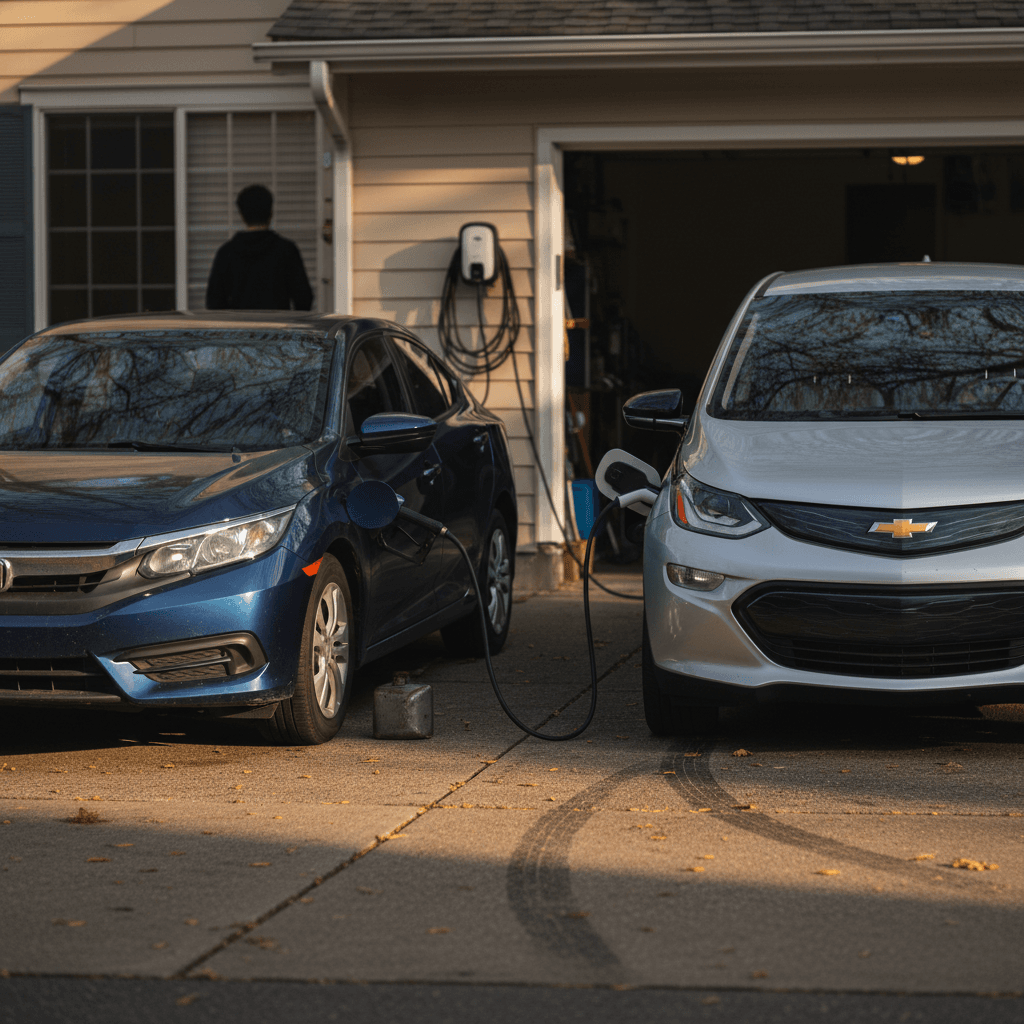
If you’ve been daily-driving a Honda Civic for years, you already know what a sensible compact car feels like: easy to park, cheap to run, and dead simple to live with. But if rising gas prices or curiosity about EVs have you eyeing a Chevrolet Bolt EV, it’s natural to wonder how big a leap you’re about to make. This review-style guide walks through the switch from Civic to Bolt EV in real-world terms: how it drives, what it costs, how far it goes, and what changes day to day.
Quick take
Who this review is for
This article is written for current or recent Honda Civic owners considering a used Chevrolet Bolt EV as their next daily driver. Maybe you’re stepping out of a 2012–2021 Civic sedan or hatchback that averages around 30–34 mpg in mixed driving, and you’re wondering what it’s really like to go all-electric. We’ll focus on real-world use in the U.S., commuting, school runs, and weekend trips, rather than theoretical lab numbers.
Civic to Bolt EV: key numbers in context
Honda Civic vs Chevy Bolt EV at a glance
Honda Civic vs Chevrolet Bolt EV: spec and cost basics
These are typical figures for a recent Civic and a first-generation Bolt EV, exact numbers vary by year, trim, and your local electricity and fuel prices.
| Category | Typical Honda Civic (gas) | Chevrolet Bolt EV (2020–2023) |
|---|---|---|
| Powertrain | 1.5L or 2.0L gas, FWD | Single electric motor, FWD |
| EPA efficiency | ~34 mpg combined | ~120 MPGe (259-mile EPA range) |
| Real-world range | 300–450 miles per tank | 200–260 miles per full charge depending on conditions |
| Refueling/charging time | 5 minutes at a gas station | ~9–10 hours on 240V home Level 2 from empty; 30–45 minutes DC fast charge for a big top-up |
| Fuel/energy cost | Gasoline only | Electricity (home/work/public); very low routine cost |
| Maintenance | Oil changes, filters, belts, exhaust, transmission fluid | Tires, cabin filter, brake fluid; no engine oil, spark plugs, or exhaust |
| Transmission feel | Conventional automatic or CVT | Single-speed; instant torque, no shifting |
| Cargo | Sedan or hatch; good trunk | Tall hatchback; more vertical cargo space |
A side-by-side look at the Civic you know and the Bolt EV you might buy used.
How to read MPGe
Driving experience: how the Bolt EV feels vs a Civic
What will feel familiar
- Compact footprint: The Bolt EV is roughly Civic-sized, easy to park, easy to thread through traffic.
- Front-wheel drive: Like your Civic, the Bolt pulls from the front, so winter manners will feel familiar with proper tires.
- Daily-driver comfort: Ride quality is tuned more for commuting than canyon carving, much like the Civic.
What will feel completely new
- Instant torque: The Bolt EV jumps off the line in city traffic; it feels noticeably quicker than most non-Si Civics up to legal speeds.
- One-pedal driving: In "L" mode and with regen paddles, you can slow the car just by easing off the accelerator, addicting in stop-and-go.
- Silence: No engine noise, no shifts, just a hum from the tires and electric motor.
If you enjoy how light and tossable a Civic feels, the Bolt EV won’t disappoint. The battery sits low in the chassis, so even though it’s a tall hatch, it’s stable in corners. Steering feel is similar, light but predictable. The bigger change is in how effortlessly the Bolt surges through gaps in traffic; you don’t have to wait for a downshift or a turbo to wake up.
Seat comfort check
Range and refueling: EV charging vs gas stops
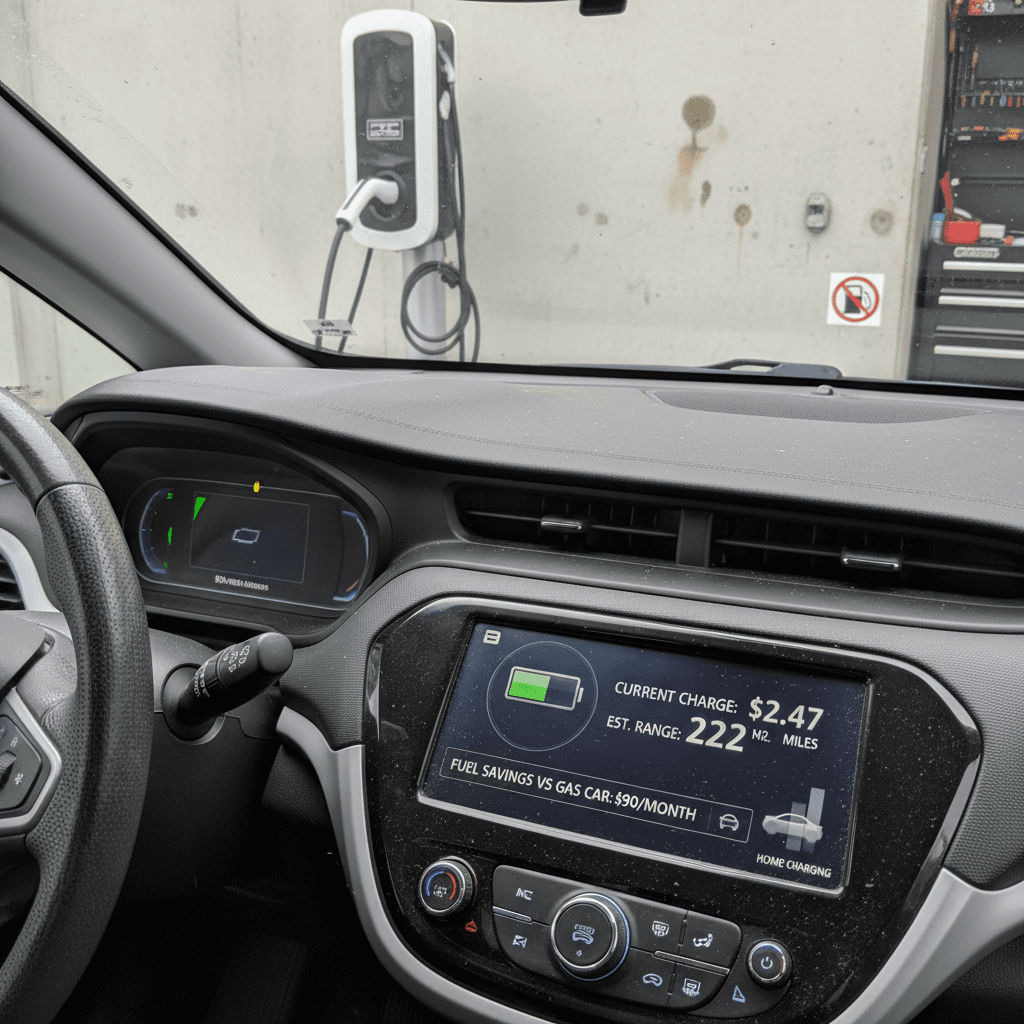
Range anxiety is usually the first hurdle for Civic owners. You’re used to a gas tank that takes you 300–450 miles and a five‑minute splash of fuel. A healthy Bolt EV offers roughly 220–260 miles in mild weather in mixed driving, with shorter range at 75‑mph highway speeds or in deep winter. The trick is that instead of refueling on the road, you "refuel" at home while you sleep.
How range and refueling change when you go electric
From gas station sprints to waking up with a full "tank."
With a Honda Civic
- 300–450 miles between fills depending on driving.
- 5 minutes at a gas station, whenever you like.
- You rarely think about planning fuel stops.
With a Chevy Bolt EV
- Roughly 200–260 miles per full charge in everyday use.
- Most charging happens at home overnight on Level 2.
- DC fast charging for road trips or emergencies.
What it means for you
- Daily commute under ~80 miles round‑trip? You’ll barely think about range.
- Frequent 200+ mile highway trips? You’ll need to plan charging stops.
- Home or workplace charging turns inconvenience into routine.
Real-world range band
Ownership costs: from MPG to miles per kilowatt-hour
Civic owners tend to be cost-conscious, and this is where the Bolt EV shines. Instead of tracking mpg, you’ll think in miles per kWh. Take a typical 3.5 miles per kWh and a household electricity rate of $0.15 per kWh: that’s about 4–5 cents per mile. At $3.75 per gallon and 34 mpg in a Civic, you’re closer to 11 cents per mile. Over 12,000 miles a year, that’s hundreds of dollars in your pocket, before you factor in reduced maintenance.
Approximate energy cost: Civic vs Bolt EV
Illustrative comparison using typical U.S. fuel and electricity prices. Your numbers will vary based on local rates and driving style.
| Scenario | Honda Civic (gas) | Chevy Bolt EV (electric) |
|---|---|---|
| Vehicle efficiency | ~34 mpg | ~3.5 mi/kWh |
| Energy price example | $3.75 per gallon | $0.15 per kWh (home) |
| Cost per mile (approx.) | $3.75 ÷ 34 ≈ $0.11 | $0.15 ÷ 3.5 ≈ $0.04 |
| Annual energy cost at 12,000 miles | ~$1,320 | ~$480 |
Energy for a Bolt EV is usually much cheaper per mile than gasoline for a Civic.
Maintenance savings add up
Charging your Bolt EV: what a Civic owner needs to know
The biggest mental shift from Civic to Bolt EV is learning how and where you’ll charge. Instead of asking "Where’s the cheapest gas?" you’ll ask "Where can I plug in, and how fast is it?" There are three practical levels of charging to understand.
- Level 1 (120V household outlet): Adds roughly 4–5 miles of range per hour. Fine for very short commutes or as a backup, not ideal as your only source if you drive much.
- Level 2 (240V home or workplace): A properly installed 240V circuit and Level 2 charger can refill a near‑empty Bolt EV battery in about 9–10 hours, great for overnight charging.
- DC fast charging: Highway stations that can add a large chunk of range in 30–45 minutes, depending on charger power and conditions. You’ll use this mostly on road trips.
Charging readiness checklist for Civic owners
1. Confirm where you’ll park overnight
If you have a driveway or garage, you’re in the best position. Apartment dwellers should check for on‑site charging or nearby public options before committing to a Bolt EV.
2. Check your electrical panel
A licensed electrician can tell you whether adding a 240V circuit for a Level 2 charger is straightforward. Many homes can accommodate a 30–40A circuit without expensive upgrades.
3. Decide on a home charger
You can hard‑wire a wall unit or use a portable Level 2 charger with a 240V outlet. Look for 32A–40A units from reputable brands, and be sure the outlet and wiring are sized correctly.
4. Learn your local public networks
Download apps for nearby networks (like Electrify America, ChargePoint, or EVgo) and create accounts. Think of this as your backup to home charging, much like knowing which gas stations you trust.
Don’t fast-charge all the time
Practicality, space, and commuter duty
Many Civic owners are surprised at how practical the Bolt EV feels. It’s shorter overall but taller, so it offers a more upright seating position and generous headroom. The hatchback layout and split‑fold rear seats make it easy to carry bikes, boxes, and weekend‑project gear. If your Civic already handles your life well, the Bolt will likely do the same, with a little extra vertical cargo flexibility.
Living with a Bolt EV as a former Civic owner
Where it’s better, where it’s different, and where it’s the same.
City and suburbs
- Short wheelbase and tight turning radius.
- Instant torque makes merges and left turns feel easier.
- No hunting for gas stations on the way home.
Family and errands
- Upright doors make loading kids and car seats easier.
- Hatchback opening is taller than most Civics.
- Rear space is adequate for two adults, tight for three across.
Weekends and trips
- Plenty of room for luggage and groceries.
- Road‑trip comfort limited more by charging needs than space.
- For frequent 300+ mile days, you’ll need to accept planned stops.
Reliability, battery health, and the recalled Bolt packs
Honda Civic owners are used to near-bulletproof reliability. The Bolt EV has a different set of considerations: the electric motor and single‑speed drive unit are mechanically simple, but the high‑voltage battery pack is both the heart of the car and the most expensive component. Early Bolts were affected by a well‑publicized battery recall, which led to many 2017–2019 cars receiving newer, higher‑capacity replacement packs. That’s good news if you shop carefully, but it’s also why you want clear, verified battery information on any used Bolt you consider.
Battery warranties
Because the battery is so central to the ownership experience, Recharged includes a Recharged Score Report with every used EV we sell. That report uses battery diagnostics to give you a clear view of current health, estimated remaining capacity, and fair market pricing. For a Civic owner who’s used to judging a car by oil‑change records, it’s the EV equivalent of looking under the hood, without guesswork.
Is a used Bolt EV a smart upgrade from your Civic?
When the Bolt EV is a clear upgrade
- Your daily driving is predictable: Most of your miles are local, and trips over 150–200 miles are occasional.
- You can charge at home or work: A driveway, garage, or reliable workplace charger makes ownership easy.
- You’re watching every dollar: Lower energy and maintenance costs matter more than long‑distance convenience.
- You like tech: Instant torque, app‑based controls, and modern safety tech appeal to you.
When you might want to wait or choose differently
- You road‑trip constantly: If you’re used to spontaneous 400‑mile days, the charging curve will feel like a compromise.
- No home charging: Living on public chargers is possible but can feel like living at the gas station every other day.
- You need a bigger back seat: Families with tall teens or three‑across needs may prefer a larger EV or plug‑in hybrid.
Why many Civic owners buy used
Ready to find your next EV?
Browse VehiclesStep-by-step: how to go from Civic to Bolt EV
Your Civic-to-Bolt EV transition plan
1. Map your real driving needs
Track your daily mileage for a couple of weeks in your Civic. If you’re typically under 80–100 miles per day and only occasionally go farther, a Bolt EV will likely fit well.
2. Confirm your charging plan
Decide where you’ll charge most of the time. Get quotes for a 240V home Level 2 setup or confirm access to reliable workplace charging.
3. Set your budget and prioritize years
Later Bolt EVs (2020–2023) offer the longest EPA range and updated batteries, while earlier cars with recall replacements can be excellent values. Decide which mix of price, range, and features works for you.
4. Use battery health data, not guesses
Shop where you can see verified battery diagnostics. On Recharged, every used Bolt EV comes with a <strong>Recharged Score Report</strong> so you’re not guessing about pack health or paying Civic money for a tired battery.
5. Plan your current Civic’s exit
Estimate your Civic’s trade‑in or sale value. Recharged can give you an instant offer or help you consign your car, so the transition into a Bolt EV is as smooth as possible.
6. Test-drive with your real life in mind
Bring your family, your commute route, and your weekend gear to the test drive. Try one‑pedal driving, check seat comfort, and test visibility and parking in the kinds of places you use your Civic now.
FAQ: Honda Civic owner switching to a Chevy Bolt EV
Common questions from Civic owners
Bottom line: should you make the switch?
If you’ve appreciated your Honda Civic for its rational blend of economy, practicality, and reliability, a well‑chosen Chevrolet Bolt EV can feel like the natural evolution of that formula. It’s quicker, quieter, and dramatically cheaper to feed, with a hatchback body that’s every bit as useful around town. The trade‑offs are real, learning to live within an EV’s range envelope and making a plan for charging, but for many drivers those become background noise after a few weeks.
The key is to be honest about your driving patterns and to buy with eyes wide open about battery health and charging access. That’s where an EV‑centric marketplace like Recharged can tilt the odds in your favor: every car includes a Recharged Score Report, expert guidance, and nationwide delivery, so your move from Civic to Bolt EV is less of a leap of faith and more of a well‑planned upgrade.