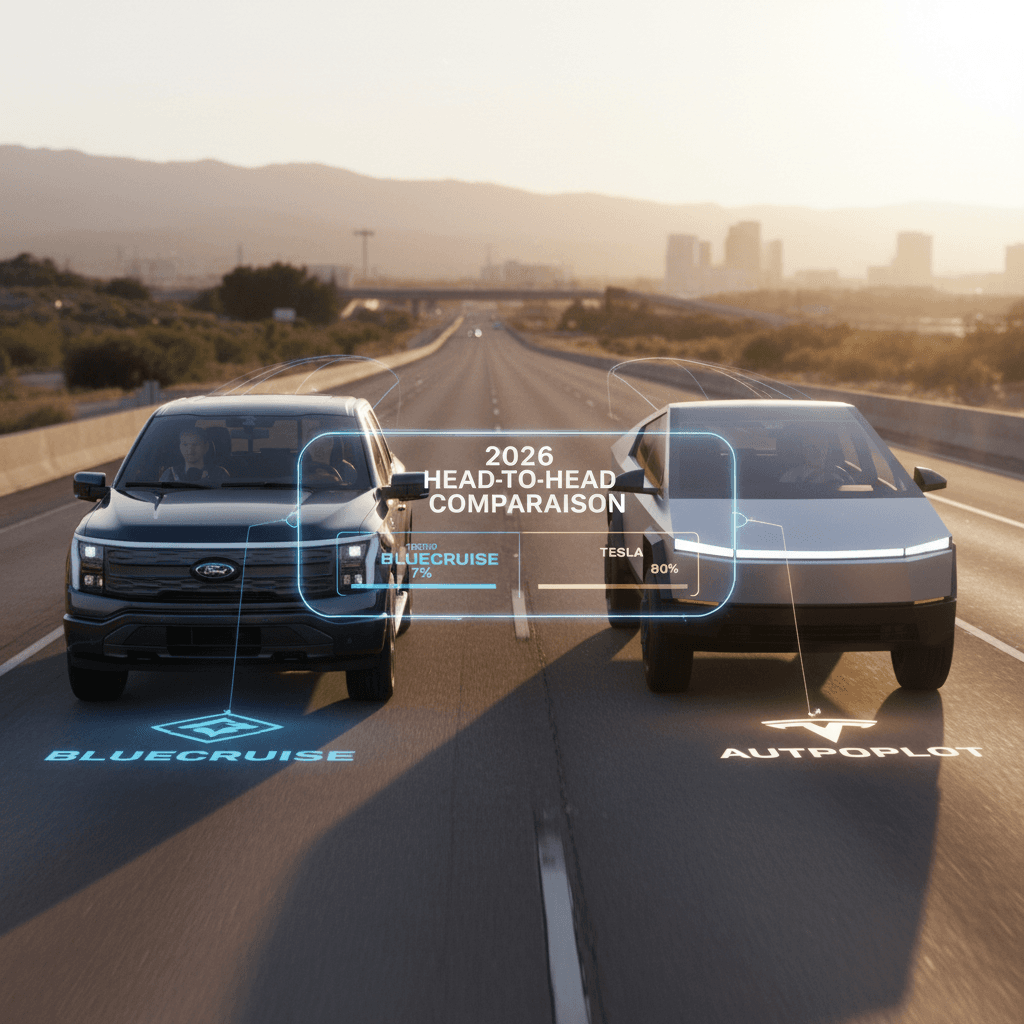
You don’t have to look far to find big promises about “hands-free driving.” Two names dominate the conversation: GM Super Cruise and Tesla Autopilot / Full Self-Driving (Supervised). Both can steer, brake, and accelerate for you, but they do it in very different ways, with very different guardrails. If you’re comparing a GM EV to a Tesla, especially on the used market, understanding those tradeoffs is just as important as battery size or range.
Level 2, not self-driving
Why this comparison matters in 2026
In 2026, advanced driver-assistance is no longer a party trick you demo in a parking lot. It’s a real factor in how relaxing your commute feels, how tiring a road trip is, and even which used EVs hold their value better. GM has steadily expanded Super Cruise across more models and more roads, while Tesla has doubled down on its subscription-based Full Self-Driving (Supervised) suite after retiring the old “Autopilot” package name in North America.
For you as a shopper, that raises some very practical questions: Which system is easier to live with? Which feels safer? Where can you actually use it? And, if you’re looking at a used EV on a marketplace like Recharged, what’s the smartest way to factor these features into the price you’re willing to pay?
Super Cruise vs Tesla driver-assist: quick stats
GM Super Cruise vs Tesla Autopilot: key differences at a glance
Super Cruise vs Tesla: core philosophy and features
A side-by-side look at how GM and Tesla approach hands-free driving in 2026.
| Aspect | GM Super Cruise | Tesla Autopilot / FSD (Supervised) |
|---|---|---|
| Basic idea | Hands-free driving on pre-mapped highways with strict limits on where it works. | Driver-assistance that aims to handle a wide range of roads, from highways to city streets, with the driver supervising. |
| Hands on wheel? | Hands can be off the wheel on approved roads, but your eyes must stay on the road. | Hands technically needed on wheel in many situations; newer FSD builds rely more on camera-based attention monitoring than steering torque. |
| Where it works | Limited to LiDAR-mapped, divided highways and select roads across North America. | Highways and surface streets almost anywhere the vision system can see lane lines and traffic, though performance can vary. |
| Driver monitoring | Infrared camera focused on your eyes and head position; warns and will disable system if you look away too long. | Cabin camera plus steering input; attention enforcement has historically been more lenient, though recent software tightens this. |
| Business model | Typically a one-time option or part of a trim package; ongoing connectivity may be required for updates. | As of 2026, advanced features are bundled into paid FSD (Supervised) subscription on new vehicles; TACC remains standard. |
| Best use case | Long, predictable highway drives where you want to relax but stay in your lane, literally and figuratively. | Drivers who want cutting-edge features, rapid over‑the‑air updates, and are comfortable with occasional quirks and interventions. |
Both systems are advanced, but they make very different bets on mapping, monitoring, and business model.
Think of them as very different personalities
How each system actually works
GM Super Cruise
Super Cruise sits on top of traditional adaptive cruise control and lane-centering. What makes it special is the combination of:
- High-definition LiDAR maps of approved roads
- GPS and onboard sensors to locate the car with lane-level precision
- Infrared driver-monitoring camera watching your eyes and head
- A light bar on the steering wheel that tells you when hands-free is available and active
When everything lines up, mapped road, good conditions, attentive driver, the light bar goes green and the system takes over steering, braking, and acceleration within its lane. If you look away too long or conditions change, it prompts you to retake control.
Tesla Autopilot & FSD (Supervised)
Tesla leans heavily on cameras and neural networks. The car uses a surround-view camera suite, radar on older vehicles, and powerful onboard computing to interpret the world in real time:
- Traffic-Aware Cruise Control (TACC) handles speed and following distance.
- Autosteer keeps you in your lane on clearly marked roads.
- FSD (Supervised) adds highway navigation, on-ramp to off-ramp lane changes, city-street steering, and stopping for lights and signs.
Instead of limiting usage to a mapped network, Tesla’s philosophy is "let the car learn everywhere," which gives you more places to try it, but also more variation in how well it works from road to road.
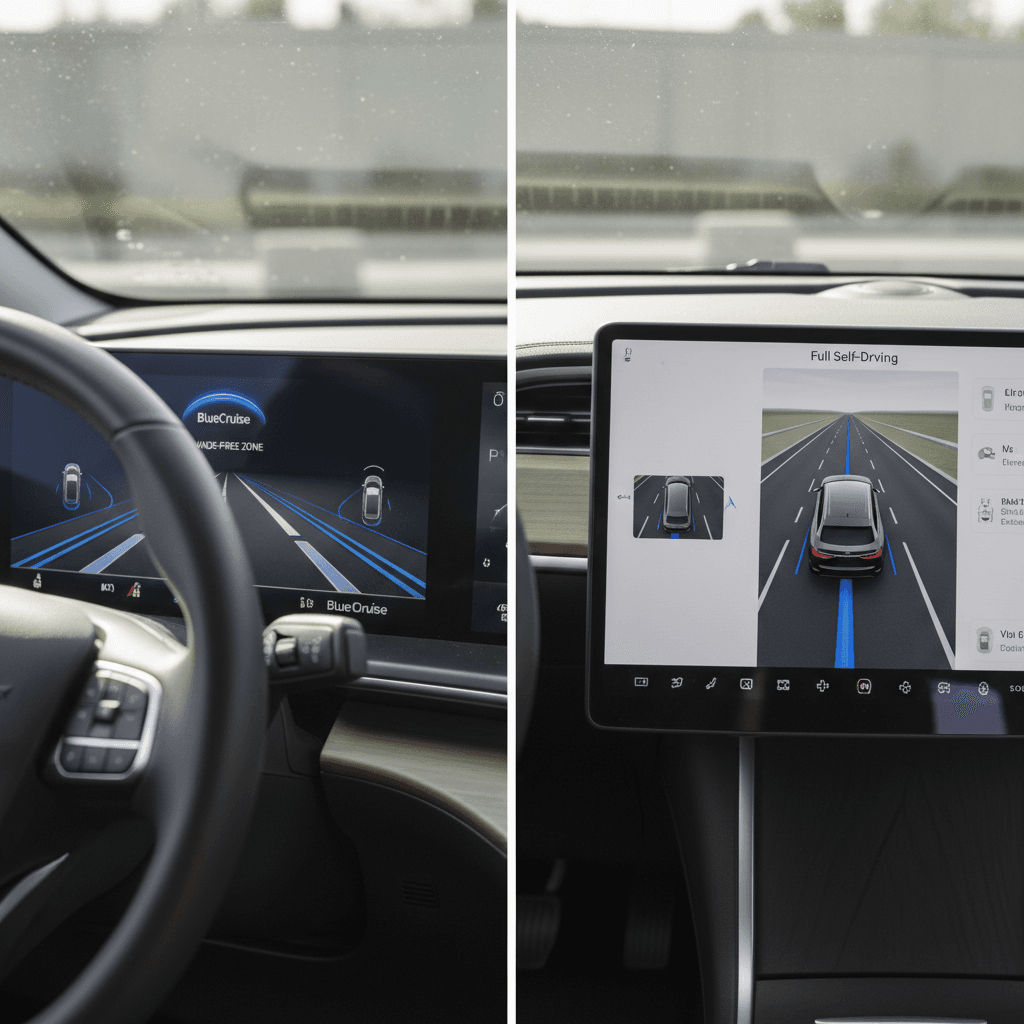
Hands-free coverage: where can you use them?
Super Cruise and Tesla’s systems take opposite approaches to where you can turn them on. That shows up in how predictable each feels on a long drive.
Coverage philosophy
Mapped network vs go‑anywhere vision
GM Super Cruise coverage
GM has been steadily expanding its Super Cruise network since 2017. The company uses detailed LiDAR scans to pre-map compatible highways and some undivided roads:
- More than 585,000 miles of roads currently enabled in the U.S. and Canada.
- Plan to reach about 750,000 miles by the end of 2025, adding more minor highways and rural connectors.
- You’ll see clear indicators in the cluster when you enter or leave Super Cruise territory.
The upside is consistency. The downside is that you may be on a perfectly nice highway that simply isn’t mapped yet, and Super Cruise will refuse to engage.
Tesla Autopilot & FSD coverage
Tesla doesn’t limit Autosteer or FSD (Supervised) to a mapped network. If the cameras see usable lane lines and the system is confident enough, it will usually let you turn it on:
- Works on most divided highways worldwide.
- FSD (Supervised) extends operation to surface streets, neighborhood roads, and complex intersections.
- Updates roll out over the air, sometimes changing behavior overnight.
The upside is flexibility: you can try it on many roads. The tradeoff is that performance can feel brilliant in one neighborhood, confused in the next.
Don’t confuse coverage with capability
Safety and driver monitoring: who watches the watcher?
The biggest philosophical split between Super Cruise and Tesla isn’t how they steer. It’s how seriously they take your attention. GM designed Super Cruise from day one around the idea that the car must know your eyes are on the road. Tesla, historically, leaned more on steering-wheel torque and driver honesty, though recent software has tightened camera-based attention checks.
Attention and misuse: how the systems keep you honest
GM Super Cruise safety approach
- Infrared camera tracks your head and eye position, even at night and with sunglasses (most styles).
- If you look away for too long, the system escalates from visual warnings to chimes to gently slowing the vehicle and shutting off hands-free mode.
- Super Cruise is geo-fenced to mapped roads specifically to reduce the odds of encountering situations it isn’t designed to handle.
- GM has publicly emphasized the lack of crashes attributed directly to Super Cruise in its monitored mileage, a point it uses to justify the conservative design.
Tesla safety approach
- Historically relied on steering-wheel torque nudges to confirm you were paying attention, which owners often found ways to trick.
- Newer builds of FSD (Supervised) can use the in‑cabin camera to watch your gaze and issue warnings or in some cases limit use if you’re repeatedly inattentive.
- Because Autosteer and FSD can be engaged on many road types, there’s more room for driver overconfidence or outright misuse.
- Regulators have scrutinized Tesla’s marketing and crash record, which is part of why the company has had to adjust its language and enforcement around “self‑driving.”
Hard truth: neither system prevents all crashes
Real-world driving experience: what it feels like from the driver’s seat
Specs are one thing; how these systems feel after three hours on an interstate is another. Based on testing and owner feedback, here’s how the personalities shake out.
On the road: how they behave
Living with Super Cruise
- When you’re in the green zone (mapped highway, good weather), Super Cruise feels calm and predictable. It holds the lane with minimal ping‑ponging.
- Automatic lane changes tend to be deliberate and smooth, more like a conscientious human than a video game.
- Hands-free towing support on some trucks and SUVs is a genuine game‑changer if you haul a boat or camper.
- The tradeoff: you may hit a favorite route where the light bar stays stubbornly gray because the road isn’t in the database yet.
Living with Tesla Autopilot/FSD
- On most highways, Tesla’s lane‑keeping feels confident and natural, and Navigate on Highway can manage ramps and lane changes with minimal input when traffic cooperates.
- FSD (Supervised) on city streets can feel like magic when it threads through traffic, but you’ll still see occasional hesitation, late braking, or odd lane choices.
- Updates can dramatically change behavior; a route that was flawless last month may feel less polished after an update, or vice versa.
- Because the system works in more places, it’s easier to slip into overtrust. Many owners report they have to consciously remind themselves to stay engaged.
Costs, subscriptions, and the fine print
From a budget standpoint, Super Cruise and Tesla’s driver-assistance stack work very differently, especially if you’re shopping used.
How you pay for Super Cruise vs Tesla’s FSD (Supervised)
Pricing changes regularly, but these are the patterns you’ll want to understand before buying.
| Cost factor | GM Super Cruise | Tesla FSD (Supervised) / Autosteer |
|---|---|---|
| On new vehicles | Usually packaged as a one-time option or within an upper trim; some models include a trial period. | As of early 2026, advanced lane‑keeping and navigation features are bundled into the FSD (Supervised) subscription on new vehicles. TACC remains standard. |
| On used vehicles | If the original owner bought Super Cruise and it’s tied to the vehicle, you may benefit without paying the original option price, though a data plan or subscription may be required for continued service. | Some used Teslas still carry legacy Autopilot or FSD purchases that stay with the car. Newer cars rely on a $99/month subscription for FSD (Supervised), which you can start or stop. |
| Ongoing costs | May require an active connectivity plan (often via OnStar) to receive map updates and maintain functionality. | Monthly subscription for FSD (Supervised) on newer vehicles; basic driver-assistance is more limited without it. |
| Resale impact | A used GM EV or SUV with Super Cruise often commands a premium versus a similar trim without it, especially for highway commuters. | Used Teslas with transferable FSD or legacy Autopilot can be more desirable, but buyers are increasingly savvy about whether they actually need the most expensive software. |
Always confirm exact pricing and feature levels on the specific vehicle you’re considering, especially with used Teslas.
How Recharged helps you sort the details
Shopping used EVs: what to look for with Super Cruise or Tesla tech
On the used market, driver-assistance can be the difference between two otherwise similar EVs, especially if you do a lot of highway miles. But it’s not as simple as “has it or doesn’t.” You need to confirm exactly which version you’re getting and what it will cost you to keep it active.
- Confirm whether a GM vehicle actually has Super Cruise hardware (camera, steering-wheel light bar) and whether it’s enabled in software.
- Check if the Super Cruise trial period, if there was one, has expired, and what it costs to continue service.
- On Teslas, pull up the software screen to see which packages are currently active: legacy Autopilot, Enhanced Autopilot, or FSD (Supervised).
- Ask the seller whether any FSD/Autopilot purchase is still tied to the car or has been removed by a previous owner or over-the-air change.
- Factor connectivity and subscription costs into your monthly budget, just like insurance and charging.
- Test-drive with the system turned on, on the kind of roads you actually drive, don’t just take the salesperson’s word for it.
Leaning on experts pays off
Ready to find your next EV?
Browse VehiclesChecklist: questions to ask before you buy
Hands-free tech due diligence for used EVs
1. Which driver-assistance package is installed today?
Have the seller show you the exact package name in the vehicle settings (Super Cruise, Autosteer, FSD (Supervised), etc.), not just “it has Autopilot.” Names and capabilities have changed over time.
2. Is the system active and working on a test drive?
Take the car on a highway, engage the system, and see how it behaves. Confirm that any required subscriptions (OnStar, FSD, connectivity) are active, or know what you’ll need to do after purchase.
3. What are the ongoing subscription or data costs?
Ask for current monthly pricing for Super Cruise connectivity or Tesla FSD (Supervised). Build those into your total cost of ownership, especially if you’re stretching for a higher trim.
4. Does the coverage match your driving?
If most of your miles are on mapped interstates, Super Cruise might be ideal. If you live in a dense city grid, Tesla’s broader FSD (Supervised) capabilities may be more useful, if you’re comfortable supervising them closely.
5. How long do you plan to keep the car?
If you keep cars a long time, paying more up front for a vehicle with Super Cruise or a transferable Tesla package may make sense. If you switch cars often, a monthly subscription you can turn off may be more flexible.
6. How important is peace of mind vs bleeding-edge tech?
Be honest with yourself: do you want the most conservative, buttoned-down experience (Super Cruise), or are you comfortable with a system that’s still evolving in public (FSD (Supervised))?
FAQ: GM Super Cruise vs Tesla Autopilot
Common questions about Super Cruise and Tesla’s systems
Bottom line: which system is right for you?
If you crave a calm, predictable co-pilot on long highway runs and you like clear boundaries, GM Super Cruise is hard to beat. It’s conservative by design: limited to mapped roads, strict about your attention, and relentlessly focused on doing one thing, hands-free highway driving, very well.
If you’re drawn to rapid software evolution and the idea of your car learning new tricks overnight, a Tesla with FSD (Supervised) offers a broader playground. It can tackle more types of roads and scenarios today, but it asks more of you as the human backstop and comes with ongoing subscription math to consider.
Either way, remember that driver-assistance is just one piece of the EV puzzle, alongside battery health, charging speed, and total cost of ownership. When you’re ready to compare real cars, not just spec sheets, Recharged can help you line up Super Cruise–equipped GMs and Teslas with verified battery diagnostics, transparent pricing, and EV specialists who’ve lived with this tech in the real world. That’s how you move from buzzwords to a car that genuinely makes your daily drive easier.