If you started shopping for a pre-owned electric car in Georgia because you heard about a $4,000 federal used EV tax credit, you’re a little late to the party. As of 2026, that credit is gone. The landscape for Georgia used EV incentives in 2026 is leaner, more confusing, and, if you know where to look, still surprisingly workable.
Quick snapshot for 2026
Overview: Georgia used EV incentives in 2026
The story in 2026 is less about big headline-grabbing checks from Washington and more about a patchwork of smaller, practical savings. The federal used EV tax credit that once offered up to $4,000 off eligible used EVs ended for purchases made after September 30, 2025. At the same time, Georgia has not reinstated its old, generous state EV tax credit that disappeared back in 2015. What you’re left with is a mix of charging incentives, utility programs, and the cold, hard math of cheaper electricity versus gasoline.
Georgia’s EV landscape heading into 2026
Key reality check
What happened to the federal used EV tax credit?
Under the original Inflation Reduction Act rules, qualifying buyers could claim up to $4,000 off a used EV (or 30% of the sale price, whichever was lower), as long as the vehicle and buyer met certain conditions, price caps, income limits, model year requirements, and so on. In practice, that credit helped move a lot of Bolts, Leafs, Konas and similar sub-$25,000 EVs.
That era ended on September 30, 2025, when federal legislation rolled back both the new and used EV credits. If you bought a used EV before that date and either had the credit applied at the dealership or intend to claim it on your 2025 taxes, you’re grandfathered. But for purchases made on or after October 1, 2025, there is no federal used EV tax credit to claim in 2026.
- No federal used EV credit for vehicles purchased on or after October 1, 2025
- No federal new EV credit for 2026 purchases under the prior IRA rules
- You may still need to file IRS Form 8936 for a 2025 purchase where the dealer applied the credit at the point of sale
- Lease structures may still bake in some manufacturer incentives, but they’re not the same thing as the old federal tax credit
Don’t bank on “creative” workarounds
Does Georgia offer a state used EV tax credit in 2026?
Short answer: No. Georgia was once the belle of the EV ball, offering a state income tax credit worth 20% of a zero‑emission vehicle’s cost, capped at $5,000 for purchases before July 1, 2015. That program was wildly effective, and, in the eyes of lawmakers, a little too generous. It was allowed to expire and has not been revived for used or new EVs.
As of early 2026, there is no Georgia state income tax credit specifically for buying a used electric vehicle. Current state policy leans more toward modest support for charging infrastructure and, on the other side of the ledger, higher registration fees for EVs to replace lost fuel-tax revenue.
Georgia incentives that impact used EV owners in 2026
What still exists, and what doesn’t, for Georgia used EV buyers this year.
| Program | Applies to used EV purchase? | Type | Status in 2026 | Notes |
|---|---|---|---|---|
| Georgia state EV income tax credit | No | Tax credit | Ended 2015 | Previously 20% of vehicle cost up to $5,000; not available in 2026. |
| Federal used EV tax credit | No (for 2026 purchases) | Tax credit | Ended 9/30/2025 | Available only for purchases before Oct 1, 2025. |
| Georgia EV registration fee | Yes | Extra fee | Active | Additional annual fee on EVs instead of fuel tax; factor into your budget. |
| Georgia Power residential charger rebate | Indirectly | Utility rebate | Active (2026–2028) | Helps offset the cost of installing a home Level 2 charger. |
| HOV lane access with AFV tags | Partially | Non-cash perk | Narrowed | Rules have tightened; check current GDOT guidance for eligibility. |
State and quasi-state programs that matter when you run the numbers on a used EV.
Why this matters for your math
Utility and charging incentives: Georgia Power & more
For most Georgia used EV buyers in 2026, the most tangible incentive is linked not to the car itself, but to the charger on your wall. Georgia Power and some co‑ops offer rebates for installing a qualifying Level 2 home charger, effectively knocking down your upfront cost of making an EV truly convenient to live with.
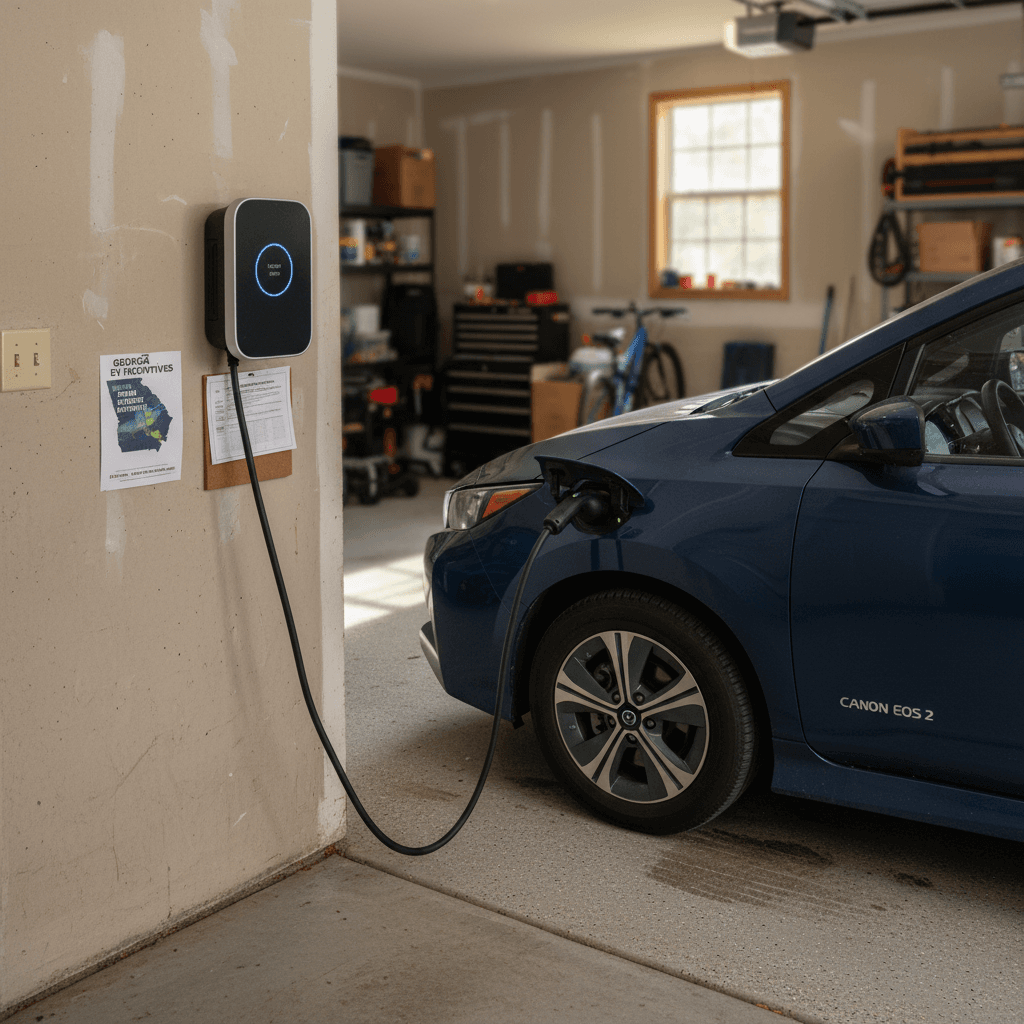
Key charging-related incentives for Georgia households in 2026
These don’t put cash on the hood, but they do make living with a used EV cheaper.
Georgia Power home charger rebate
What it is: A rebate toward the cost of purchasing and professionally installing a Level 2 charger at home.
Why it matters: Reduces your installation cost and lets you charge much faster than a standard 120V outlet.
Off-peak EV rates
What it is: Time-of-use or EV-friendly rate plans in some territories, where electricity is cheaper overnight.
Why it matters: If you charge after dark, your per‑mile cost can drop to just a few cents.
Public charging buildout
What it is: Ongoing investment by utilities and private networks in DC fast chargers along Georgia highways.
Why it matters: Increases the real-world usability of a lower‑range used EV for road trips and cross‑state drives.
How to actually capture these savings
Other ways Georgia drivers save with used EVs
With the big-ticket tax credits gone, the argument for a used EV in Georgia leans heavily on everyday economics. You’re swapping gasoline for electricity, oil changes for tire rotations, and complicated mechanical systems for software updates. None of that comes with a rebate code, but it shows up every month in your checking account.
Lower fuel costs
- Electricity is cheaper per mile: Many Georgia drivers pay the equivalent of roughly $0.03–$0.05 per mile at home, compared with $0.12–$0.18 per mile for a typical gas commuter, depending on fuel prices and MPG.
- Predictable pricing: Electric rates move, but they don’t swing with refinery outages or geopolitics the way gasoline does.
Reduced maintenance
- Fewer moving parts: No engine oil, spark plugs, timing belts, or exhaust system. Brake wear is often lower thanks to regenerative braking.
- Time savings: Fewer trips to the shop, more charging while you sleep or work.
Where incentives quietly hide now
How to stack your used EV savings in 2026
Without that tidy $4,000 federal line item, the smart Georgia shopper becomes a stacker of smaller wins. Think in layers: vehicle price, financing, utility programs, and operational costs. Each layer isn’t impressive alone, but together they can eclipse yesterday’s tax credit.
Playbook for maximizing Georgia used EV savings
1. Start with total cost of ownership, not sticker price
Compare monthly fuel and maintenance costs for your current or a comparable gas car against the EV you’re considering. Over three to five years, a slightly higher EV payment can still leave you ahead once you factor in energy savings.
2. Hunt for dealer and manufacturer incentives
Even without government money on the hood, dealers and OEMs run low-APR financing, loyalty bonuses, and aged-inventory discounts on used EVs. Ask explicitly about current EV-specific offers.
3. Capture home charging rebates
If Georgia Power or your local co‑op offers a Level 2 charger rebate, bake it into your budget. A $300–$500 rebate can effectively take a big bite out of installation costs.
4. Use EV-friendly rate plans
Enroll in a time-of-use or EV charging rate if available. Shift your charging to off-peak hours to squeeze every last cent out of your per‑mile energy cost.
5. Shop insurance with an EV lens
Insurance pricing for EVs is evolving. Get quotes from multiple carriers and ask whether specific safety tech or mileage-based policies can lower your premium.
6. Choose the right range for your life
Don’t overpay for range you never use. A lower-priced 200‑mile used EV with strong battery health can be a better value than a longer-range model that stretches your budget.
Let the math drive the decision
Georgia used EV costs vs. gas car costs
Think of 2026 Georgia as an A/B test, not a yes/no question: used EV versus used gas car. Tax policy is now just background noise. What matters is the running cost delta between the two choices for someone who lives in, say, Gwinnett County and drives 12,000–15,000 miles a year.
Illustrative 5-year cost comparison: used EV vs. used gas car in Georgia
Ballpark comparison for a typical commuter. Your exact numbers will vary by model, driving style, and local utility rates.
| Cost category (annualized) | Used compact EV | Used compact gas car |
|---|---|---|
| Vehicle payment | $4,200 | $3,600 |
| Fuel/energy | $500–$700 | $1,500–$1,900 |
| Maintenance & repairs | $500–$700 | $900–$1,300 |
| Insurance (typical range) | Comparable | Comparable |
| Registration & fees (incl. EV surcharge) | Slightly higher | Lower |
| Estimated total annual running cost | Often lower overall | Often higher overall |
An example of how a used EV can pencil out favorably even without major tax credits.
Why a higher payment can still make sense
Buying a used EV in Georgia: Step-by-step playbook
Used EVs are not just gas cars without tailpipes; they’re rolling battery packs with software on top. In Georgia’s 2026 incentive climate, the quality of that battery and the transparency of the deal matter far more than chasing a vanished tax break.
Two buying paths for Georgia used EV shoppers
Value-maximizer (budget-focused commuter)
Target mainstream models with strong reliability records and efficient powertrains (Bolt EV/EUV, Nissan Leaf, Hyundai Kona Electric, Kia Niro EV, etc.).
Prioritize vehicles with documented battery health and a clean history report over cosmetic perfection.
Use a marketplace that provides third-party battery diagnostics, Recharged includes a <strong>Recharged Score Report</strong> so you can see verified battery health and fair market pricing.
Capture any available utility charger rebate and choose a Level 2 charger that matches your home’s electrical capacity.
Run a 5‑year total-cost-of-ownership comparison against a similar gas car before you sign anything.
Feature-seeker (tech and comfort oriented)
Look at slightly newer used EVs with more advanced driver-assistance and infotainment features, which can make your daily Atlanta traffic more bearable.
Cross-shop trims and wheel sizes; large wheels and performance trims can hurt efficiency and tire costs in the long run.
If range anxiety is real for you, focus on 250+ mile EPA range models, but verify real-world reports in Georgia’s summer heat.
Consider nationwide inventories and delivery options, Recharged can deliver a used EV to your driveway and supports you with EV‑specialist guidance throughout.
Negotiate around software features (like paid connectivity or upgraded driver-assistance packages) that may or may not transfer with the vehicle.
Georgia used EV inspection checklist
Verify battery health
Battery condition is the heart of a used EV deal. Ask for a recent battery health report. With Recharged, every vehicle comes with a Recharged Score that includes verified battery diagnostics so you’re not buying blind.
Check charging compatibility
Confirm the car’s charge port type and what adapters are included. Make sure it’ll work with the chargers you’ll actually use, home Level 2, workplace, or public DC fast chargers along your typical routes.
Review charging history and usage
Heavy DC fast charging or frequent 100% charges can accelerate degradation on some models. Ask the seller how the car was charged and look for patterns in telematics or service records when available.
Inspect tires and brakes
EVs are heavier and can be harder on tires. Check for uneven wear and budget for a quality replacement set if needed. Verify that brake pads and rotors are in good shape, even if mileage is low.
Confirm remaining warranty
Many EVs carry 8‑year/100,000‑mile (or similar) battery warranties. Verify the in‑service date, mileage, and whether the battery and high‑voltage components are still under coverage.
Test real-world range
On a test drive, watch the range display versus miles driven at highway speeds. You’re looking for stable, predictable behavior, not a range estimator that plummets as soon as you hit I‑75.
Don’t ignore the EV registration fee
FAQ: Georgia used EV incentives in 2026
Frequently asked questions about Georgia used EV incentives
Bottom line: Should you buy a used EV in Georgia now?
In 2026, Georgia is no longer the place where a tax credit fairy drops $4,000 on your used EV purchase. That era ended on September 30, 2025, and the state hasn’t stepped in with a new credit of its own. But that doesn’t mean the used EV story is over. It just means the plot has shifted from subsidy-chasing to fundamentals: what you pay for the car, what you pay to keep it moving, and how long you keep it.
If you choose carefully, prioritizing strong battery health, realistic range, and the right charging setup, owning a used EV in Georgia can still feel like a permanent discount compared with a gas car, just one that shows up silently every time you skip the pump. And if you’d rather not navigate all of that alone, buying through Recharged gives you a used‑EV‑only marketplace, transparent battery reports, and human experts who live and breathe this stuff so you don’t have to.