If you’re eyeing a Genesis Electrified GV70, the big money question is simple: what does the depreciation curve over 5 years look like? Luxury EVs can lose value fast, but that same drop is exactly what makes a gently‑used Electrified GV70 such a strong buy if you time it right.
Quick context: the Electrified GV70’s place in the market
How the Electrified GV70 Depreciates Over 5 Years
Genesis Electrified GV70 Depreciation at a Glance
Third‑party cost‑to‑own tools put the Electrified GV70’s five‑year depreciation in the low‑$40Ks for a well‑equipped example, leaving mid‑$20Ks of residual value from an original price in the mid‑$60Ks. That lines up with broader 2025–2026 research showing many luxury EV SUVs losing around 60–70% of their value over five years, depending on incentives, mileage, and condition.
These are directional, not guarantees
Sample 5‑Year Genesis Electrified GV70 Depreciation Curve
To make the Genesis GV70 Electrified depreciation curve over 5 years concrete, let’s walk through an illustrative example. We’ll assume a new Electrified GV70 with an MSRP of $70,000 including options and destination, average U.S. mileage (about 12,000 miles per year), and normal wear.
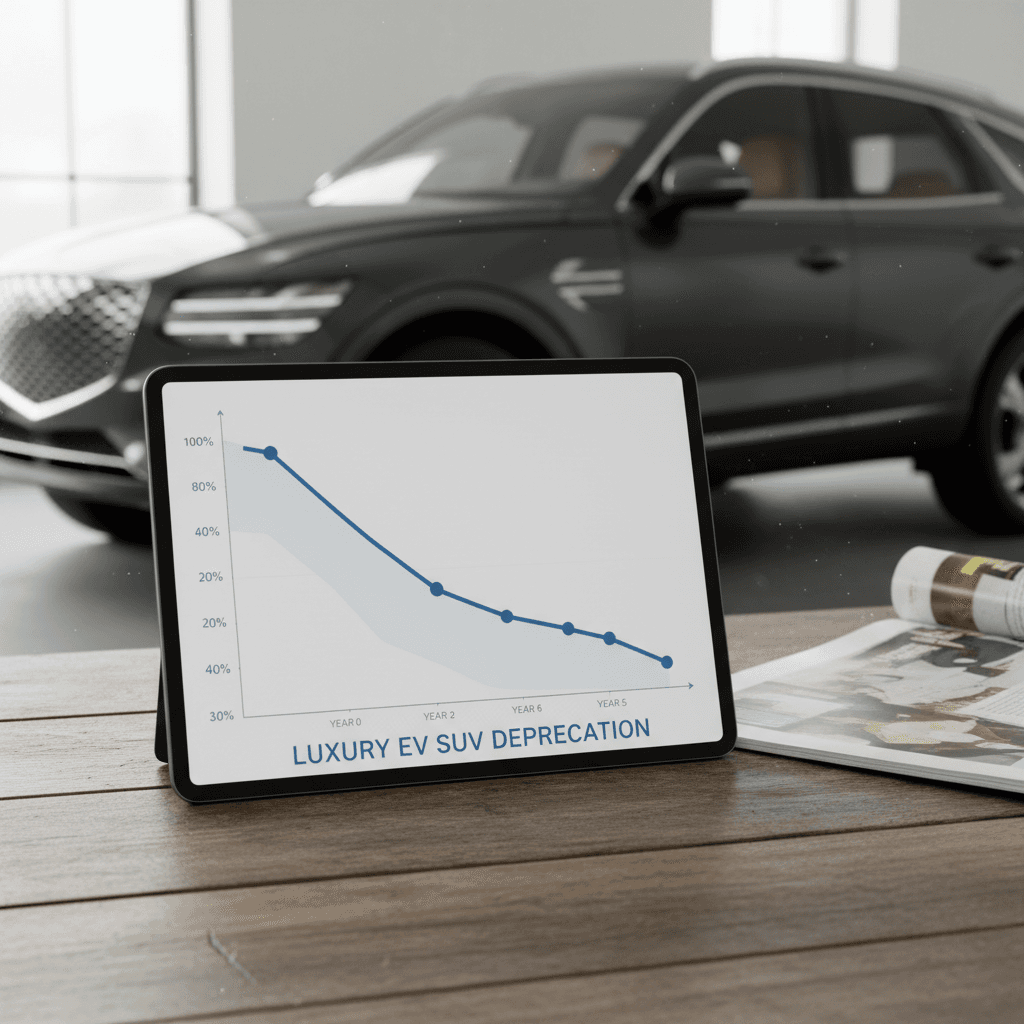
Illustrative 5‑Year Electrified GV70 Depreciation Curve
Example resale values for a Genesis Electrified GV70 that originally stickered for $70,000. Real prices will vary, but the shape of the curve is similar for most luxury EV SUVs.
| Year in Service | Approx. Mileage | Est. Depreciation From New | Illustrative Resale Value | What It Means For You |
|---|---|---|---|---|
| New (Month 0) | 0 miles | 0% | $70,000 | Full MSRP. Discounts, incentives, and tax credits reduce your real out‑of‑pocket, but depreciation is measured from sticker. |
| End of Year 1 | ~12,000 miles | ≈22–25% | $52,500–$55,000 | The first big step down. Demo units and loaners can be thousands less than new with very low miles. |
| End of Year 2 | ~24,000 miles | ≈32–38% | $43,000–$47,500 | Early tech updates and heavy leasing pressure values down; many "nearly new" GV70 EVs live here. |
| End of Year 3 | ~36,000 miles | ≈45–50% | $35,000–$38,500 | Often the inflection point where depreciation slows and cost‑per‑mile looks especially attractive for buyers. |
| End of Year 4 | ~48,000 miles | ≈55–60% | $28,000–$31,500 | Vehicle is out of most bumper‑to‑bumper coverage; value tracks battery health, condition, and local EV demand closely. |
| End of Year 5 | ~60,000 miles | ≈60–65% | $24,500–$28,000 | By now, much of the curve has played out. Further annual drops are usually smaller in dollar terms. |
This table is an example, not an appraisal. It shows how a $70,000 Electrified GV70 might depreciate under typical conditions.
Use curves as a negotiating framework
Year‑by‑Year: What Happens to Value
Inside the Electrified GV70’s First 5 Years
How depreciation tends to behave from day one through year five
Years 0–1: The brand‑new cliff
From the second a new Electrified GV70 is titled, it’s no longer "new." Even with just a few thousand miles, buyers expect a meaningful discount over MSRP.
- Loss vs. MSRP: commonly 20–25% by the end of year one.
- Best roles: leases, corporate fleets, or buyers who must have latest color/trim.
Years 1–3: Fast but rational drop
In years two and three, the market digests incentives, lease returns, and early tech changes. Luxury EV SUVs often lose another 10–20 percentage points of value in this window.
- Sweet spot emerging: loaded examples with 20–40k miles.
- Risk: pricing can reset quickly if new EV incentives arrive.
Years 3–4: Warranty and confidence pivot
By year four, many Electrified GV70s approach the end of comprehensive warranty coverage. Buyers put more weight on battery health reports, maintenance records, and cosmetic condition.
- Well‑documented cars keep more value.
- Unknown history pushes examples to the bottom of price ranges.
Years 4–5: Flattening curve
Once the big early tech and incentive shocks are priced in, yearly dollar losses usually shrink.
- Retail shoppers look at total cost per mile, not just age.
- Battery health and accident history become as important as mileage.
Where smart money often buys
How the Electrified GV70 Compares to Other Luxury EVs
The Electrified GV70 isn’t alone. Across the segment, luxury EVs tend to depreciate faster than gas counterparts because of rapid tech change, shifting incentives, and a smaller used‑EV audience. Industry studies in 2024–2025 show many premium electric SUVs dropping 60–70% of their value by year five, with some models doing even worse.
Electrified GV70 vs. Typical 5‑Year Luxury EV Depreciation
High‑level comparison of how the Genesis Electrified GV70’s curve lines up with other luxury vehicles over five years.
| Vehicle Type | Typical Original MSRP | Typical 5‑Year Depreciation | 5‑Year Retained Value | How Electrified GV70 Stacks Up |
|---|---|---|---|---|
| Mainstream gas SUV | $40,000 | ≈45–50% | ≈50–55% | Usually holds value better than most luxury EVs but offers less performance and tech. |
| Luxury gas SUV | $70,000 | ≈55–60% | ≈40–45% | A familiar curve; Electrified GV70 isn’t far off this path on percentage basis. |
| Luxury EV SUV (segment avg.) | $70,000–$90,000 | ≈60–70% | ≈30–40% | Electrified GV70 broadly fits here, though real outcomes vary with incentives and battery health. |
| Early‑generation luxury EVs (e.g., first‑wave models) | $80,000+ | Often 70%+ | Under 30% | Some early EVs suffer especially heavy depreciation; the Electrified GV70 generally fares better than the worst cases. |
Numbers are representative segment ranges, not valuations of any specific VIN.
Why luxury EVs fall harder than mainstream cars
Factors That Move the Depreciation Curve Up or Down
- Battery health: A strong pack with minimal degradation supports top‑of‑market pricing. A weak pack can knock thousands off value.
- Mileage and usage pattern: 10–12k miles per year is considered normal. Far more (or far less with no history) invites extra scrutiny.
- Accident and repair history: Structural damage, airbag deployments, or poor‑quality repairs push an EV into the bargain bin fast.
- Trim, options, and color: High‑demand specs (e.g., Prestige trims, popular colors) will hold more value than niche colors or sparse builds.
- Warranty remaining: Time and mileage left on both the basic and EV‑component warranties is a direct input into what buyers will pay.
- Local EV incentives and fuel prices: Rich state rebates or high gas prices can firm up used EV values; weak incentives or cheap gas can soften them.
- Charging access: In regions with dense fast‑charging networks and easy home charging, used EVs, including the Electrified GV70, are simply easier to live with and thus more desirable.
The biggest value killers for an Electrified GV70
Buying a Used Electrified GV70: Where the Curve Favors You
If you’re on the buy side, your goal is to land on the right part of the Genesis GV70 Electrified 5‑year depreciation curve, after the steepest drop but before the vehicle has been run hard or neglected. For most shoppers, that means targeting 2.5–4‑year‑old vehicles with clear history and strong battery reports.
Smart‑Buyer Checklist for a Used Genesis Electrified GV70
1. Aim for the "second‑owner" sweet spot
Look for Electrified GV70s roughly 30–50 months old with 20–50k miles. In this zone, you’re often buying for 35–45% of original MSRP while the vehicle still feels nearly new inside.
2. Get a real battery‑health read
Battery condition is the backbone of EV value. At Recharged, every vehicle comes with a <strong>Recharged Score</strong> that quantifies pack health, fast‑charging exposure, and range performance so you’re not guessing.
3. Scrutinize history and usage
Review accident reports, service records, and any evidence of rideshare or commercial use. A lightly‑used personal vehicle will sit on a much flatter depreciation curve than a hard‑driven fleet example.
4. Compare asking price to original MSRP
If a seller doesn’t list the original window sticker, ask for it. A $45k asking price on a $70k‑MSRP GV70 EV is a very different deal than the same price on a $60k build.
5. Evaluate warranty runway
Map the in‑service date against Genesis warranty terms. Extra years of EV‑component and basic coverage support higher pricing and protect you if something goes wrong.
6. Price‑shop your financing
The impact of depreciation is bigger if your loan terms are weak. Recharged can help you compare offers and <strong>structure financing</strong> so your payoff schedule aligns with the vehicle’s remaining value.
Buying an Electrified GV70 on Recharged
Recharged specializes in used EVs like the Electrified GV70. Every vehicle includes:
- A Recharged Score battery‑health report, not just a generic OBD scan.
- Fair market pricing informed by current EV depreciation data, not guesswork.
- Flexible financing options and the ability to trade in your current vehicle.
- Nationwide delivery and the option to visit our Experience Center in Richmond, VA.
Why this matters for depreciation
When the data behind the asking price is transparent, you can see where a given GV70 EV sits on the curve. That helps you avoid overpaying at the top of the market or walking away from a legitimately good deal because you’re unsure.
If you already own an EV, Recharged can provide an instant offer or consignment option, letting you roll equity into your next Electrified GV70 more efficiently.
Selling or Trading In an Electrified GV70
On the sell side, understanding the 5‑year curve helps you decide whether to keep, trade, or sell privately. Because the Electrified GV70’s depreciation slows later in life, the decision often hinges on warranty coverage, your charging situation, and how quickly your needs are changing.
Should You Keep, Trade, or Sell?
How timing affects what your Electrified GV70 is worth
Selling in years 1–2
You’ll capture the highest absolute dollars but also realize the steepest percentage loss from MSRP. This window can make sense if:
- You leased and have equity because market values outran residuals.
- Your situation changed (move, family size, charging access).
Trading in years 3–4
By mid‑life, you’re on the flatter part of the depreciation curve. Trading at this point can be efficient if:
- You want to reset your warranty clock.
- You’re upgrading to a newer EV platform or more range.
Keeping 5+ years
If the battery is healthy and your needs are stable, holding beyond five years often yields the lowest cost‑per‑mile. Each additional year costs less in depreciation than the early ones, assuming no major failures.
Use multiple value benchmarks
How Recharged Evaluates Electrified GV70 Depreciation
Depreciation isn’t just a number on a chart; it’s baked into how Recharged inspects, prices, and supports every used EV we list, including the Genesis Electrified GV70. Our goal is to make the real cost of ownership transparent so you’re not surprised three years down the road.
The Recharged Approach to Electrified GV70 Value
1. Battery‑first diagnostics
We run specialized diagnostics to understand pack health, charging patterns, and estimated real‑world range, not just the dashboard percentage. This feeds directly into the Recharged Score and pricing.
2. Condition and history deep‑dive
Our team reviews accident history, service records, and a multi‑point inspection, including common EV wear items like tires, brakes, and suspension components that can impact near‑term ownership costs.
3. Market‑aligned pricing
We track live auction data, retail listings, and segment‑level depreciation for luxury EVs. That lets us price Electrified GV70s competitively while reflecting their true condition and equipment.
4. Clear comparison to similar EVs
Shopping a GV70 Electrified against other luxury EV SUVs? Our listings and advisors help you compare pricing, battery health, and warranty coverage across models, not just within Genesis.
5. End‑to‑end support
From helping you decide when to sell your current EV to structuring your next purchase or lease, Recharged’s EV specialists walk through the full picture, not just the monthly payment.
Genesis Electrified GV70 Depreciation FAQ
Frequently Asked Questions About Electrified GV70 Depreciation
Key Takeaways on the Electrified GV70 5‑Year Depreciation Curve
The Genesis Electrified GV70 follows a familiar luxury‑EV story: big early depreciation, then a flatter, more predictable curve in years four and five. For first owners, that means understanding that a sizeable chunk of value disappears in the first 36 months. For second and third owners, it’s an opportunity to buy a high‑spec, comfort‑focused electric SUV for the price of a new mainstream model.
If you’re considering buying, selling, or trading an Electrified GV70, anchor your expectations on where the vehicle sits on its 5‑year depreciation curve, then layer in battery health, history, and local market conditions. Recharged exists to make that process transparent, from the Recharged Score battery report to fair market pricing, financing, trade‑in, and nationwide delivery, so you can enjoy the GV70 EV’s strengths without being surprised by what it’s really worth.