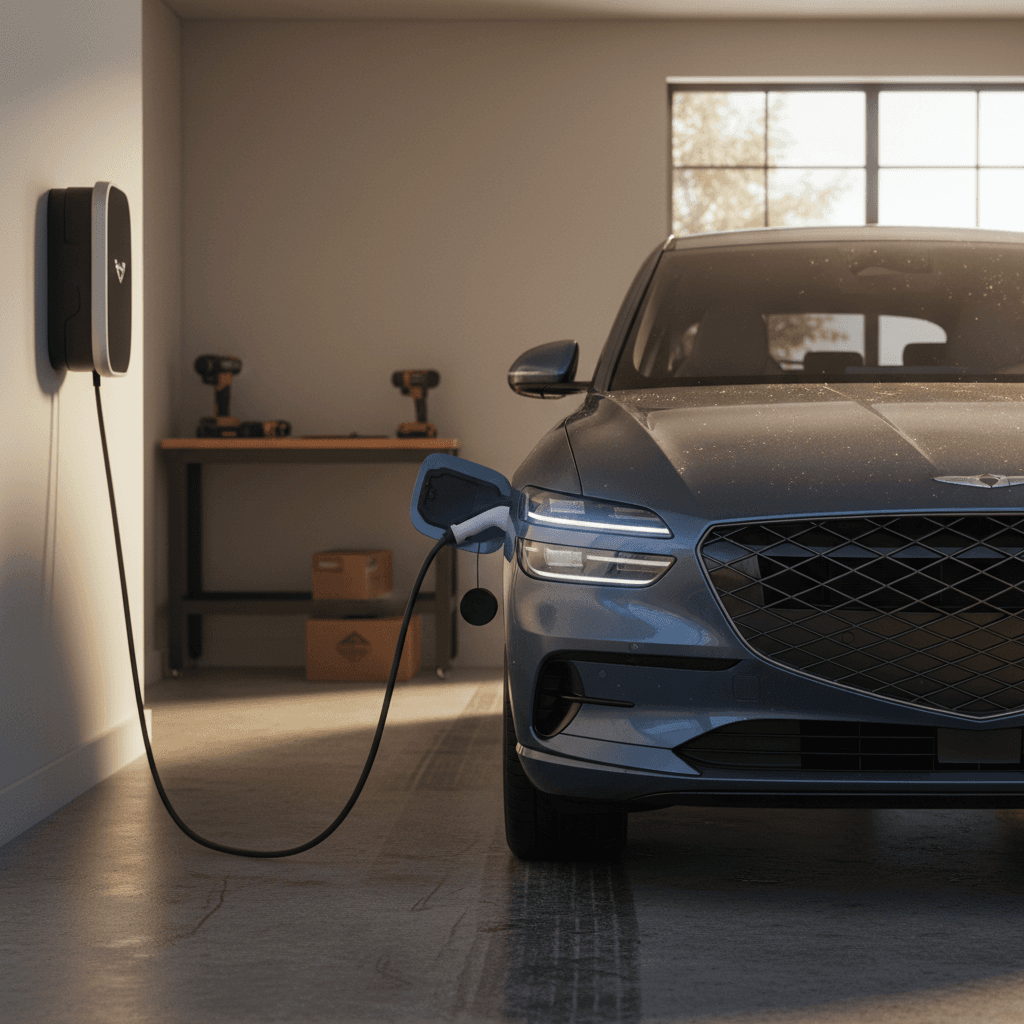
If you own a Genesis GV60 or you’re shopping for one, the best upgrade you can make isn’t bigger wheels or a louder stereo. It’s a properly sized Level 2 home charger that lets the car quietly refill overnight while you sleep. In this guide, we’ll cut through the marketing noise and show you exactly what the best home charger for a Genesis GV60 looks like, how many amps you actually need, and which specific units are worth buying.
Quick takeaway
Why the Genesis GV60 Needs a Good Home Charger
The GV60 rides on Hyundai–Kia’s E‑GMP platform, with an 800‑V architecture and a battery around 77.4 kWh. On a DC fast charger, it can go from 10–80% in about 18 minutes, headline stuff for road trips. But 90% of your charging life won’t be road‑trip heroics. It will be the boring, essential work of adding 40–70 kWh overnight in your driveway.
Genesis includes a portable cord that can plug into a standard 120‑V outlet, trickling in roughly 1–1.4 kW. That’s fine as an emergency backup or for very light drivers, but it can take well over 40 hours to go from empty to full. A dedicated Level 2 home charger turns the GV60 into a normal appliance: you plug in at night, and you wake up with a full “tank” and a predictable electricity bill.
Genesis GV60 home charging in real numbers
GV60 charging basics: specs that actually matter at home
You don’t need the entire engineering white paper to pick a charger, but a few key GV60 numbers matter:
- Battery capacity: roughly 77.4 kWh usable, depending on trim and model year.
- Onboard AC charger: about 10.5–11 kW on U.S. models, which is the ceiling for home Level 2 charging.
- Connector: J1772 for AC Level 2 (on U.S. cars with CCS fast charging); future GV60s with NACS DC ports will still use a J1772‑style inlet for AC home charging or a J1772 adapter.
- Realistic home power: many homes end up with 30–48 A EV circuits after you account for existing panel load and code requirements.
At home, the only battle worth fighting is amps × volts. A 240‑V circuit at 32 A gives you about 7.7 kW; at 40 A, about 9.6 kW; at 48 A, around 11.5 kW. The GV60 can happily use that full 40–48 A window, so the real question is how fast you need to refill and what your electrical panel can reasonably support.
Rule of thumb
How many amps do you really need for a GV60?
32 A Level 2 (about 7.7 kW)
- Good for: Apartment or older homes with limited panel capacity; light to moderate commuters.
- Overnight recovery: Adds roughly 25–30 miles of range per hour of charging for a GV60.
- Pros: Cheaper wiring, often easier to get permitted, less stress on older infrastructure.
- Cons: Full 0–100% charges from low state-of-charge may push into 10+ hours.
40–48 A Level 2 (9.6–11.5 kW)
- Good for: Most GV60 owners with a garage and decent service panel; families sharing one charger.
- Overnight recovery: Realistically restores a deep discharge in 6–8 hours.
- Pros: Takes full advantage of the GV60’s ~11 kW onboard charger, more future-proof.
- Cons: Requires a 50–60 A circuit and usually a licensed electrician.
About that 48 A sweet spot
For most U.S. households, 40 A on a 50 A circuit is the pragmatic answer: it’s fast, stable, and easier on both the wiring and the GV60’s thermal management, while still refilling a low battery overnight.
Top home charger picks for the Genesis GV60
There isn’t one single “Genesis‑branded” wall box you must buy. In fact, that’s freeing. The GV60 plays well with almost every mainstream J1772 Level 2 EVSE. Here’s how the field shakes out for real‑world GV60 owners in the U.S.
Best‑fit Level 2 chargers for Genesis GV60 owners
All of these work with the GV60’s ~11 kW onboard charger; the best choice depends on budget and how smart you want your setup to be.
ChargePoint Home Flex (40–50 A sweet spot)
Why it’s great for GV60: Flexible amperage (up to 48 A), polished app, and excellent utility‑program support for rebates and time‑of‑use scheduling. Many electricians know it well, which keeps install time down.
- Hardwire or plug‑in options
- Easily set to 40 A if you want to avoid high‑amp heat issues
- Perfect if you also use ChargePoint public stations
Best for: Homeowners who want a well‑known, utility‑friendly smart charger.
Grizzl‑E Classic / Grizzl‑E Smart
Why it’s great for GV60: Brutally simple hardware that just works, with 40 A output in most home installs. Owners of Hyundai/Genesis/Kia EVs routinely call it the "+never think about it again+" option.
- Rugged metal case, outdoor‑ready
- Configurable amperage (max ~40 A in typical setups)
- Smart version adds app control if you want it
Best for: Drivers who value reliability over flashy apps.
Wallbox Pulsar Plus / Emporia Level 2
Why they’re great for GV60: Compact, app‑driven units with flexible amperage. Emporia in particular gets praise for value pricing and deep energy‑monitoring features.
- Up to 40–48 A depending on configuration
- Smart scheduling for off‑peak charging
- Good choice if you’re watching every kWh on your bill
Best for: Tech‑minded owners who want data and automation without paying ChargePoint money.
Genesis‑promoted options
Genesis GV60 home charger comparison
How the most common GV60‑friendly home chargers stack up on the basics.
| Charger | Max Amps | Wifi / App | Outdoor Rated | Best For |
|---|---|---|---|---|
| ChargePoint Home Flex | 48 A | Yes | Yes | Rebate‑friendly smart charging with polished app |
| Grizzl‑E Classic | 40 A | No | Yes | Set‑and‑forget reliability, lowest drama |
| Grizzl‑E Smart | 40 A | Yes | Yes | Same hardware as Classic with optional smart control |
| Wallbox Pulsar Plus | 40–48 A | Yes | Yes | Compact design, strong smart‑charger features |
| Emporia Level 2 | 40–48 A | Yes | Yes | Budget‑friendly with detailed energy tracking |
Any of these will charge a GV60 well; the right answer depends on your electrical panel, your budget, and how much you care about apps and analytics.
Smart vs. “dumb” chargers for GV60 owners
The GV60 can schedule and manage charging itself through the Genesis Connected Services app. That means you don’t strictly need a smart charger with Wi‑Fi and its own app. But there are clear pros and cons on both sides.
Smart charger advantages
- Better time-of-use control: Many utilities offer off‑peak discounts. A smart charger can obey those windows even if the car or app misbehaves.
- Energy tracking: Want to know exactly what the GV60 costs to run per month? A smart EVSE gives you line‑item data instead of guessing from your utility bill.
- Multi‑EV households: If you add a second EV later, a smart charger can juggle schedules or load‑share.
When a "dumb" charger is enough
- You mostly charge overnight: If your schedule is simple, plug in after dinner, unplug in the morning, the GV60’s own scheduler plus a basic 32–40 A EVSE can be perfectly adequate.
- Budget and simplicity: Fewer radios, fewer apps, fewer things to break. A rugged unit like the Grizzl‑E Classic is basically an on/off switch with a brain stem.
- Spotty Wi‑Fi: No need to fight your router across a concrete garage wall.
Utilities and rebates
Installation, safety, and avoiding common GV60 issues
The charger itself is only half the equation. The wiring behind the drywall matters just as much, especially with a power‑hungry EV like the GV60. Done right, you’ll never think about it again. Done wrong, you’ll spend your evenings resetting breakers and arguing with error codes.
Safe, future‑proof installation checklist
1. Have an electrician inspect your panel
Ask a licensed electrician to look at your main service panel, subpanels, and major loads (HVAC, electric range, dryer, etc.). Tell them the GV60 can draw up to ~11 kW and you’d like a 40–48 A Level 2 circuit if feasible.
2. Choose the right circuit size and wiring
Most GV60 owners end up with a 50 A circuit (for 40 A charging) or 60 A (for 48 A). Undersized wiring or sharing the circuit with other loads is a recipe for nuisance trips and hot breakers.
3. Decide on plug‑in vs. hardwired
A NEMA 14‑50 outlet with a plug‑in EVSE is flexible and easier to swap later. A hardwired charger is cleaner and sometimes required for 48 A operation. Your electrician can walk you through local code and your options.
4. Mount the charger where the cable naturally falls
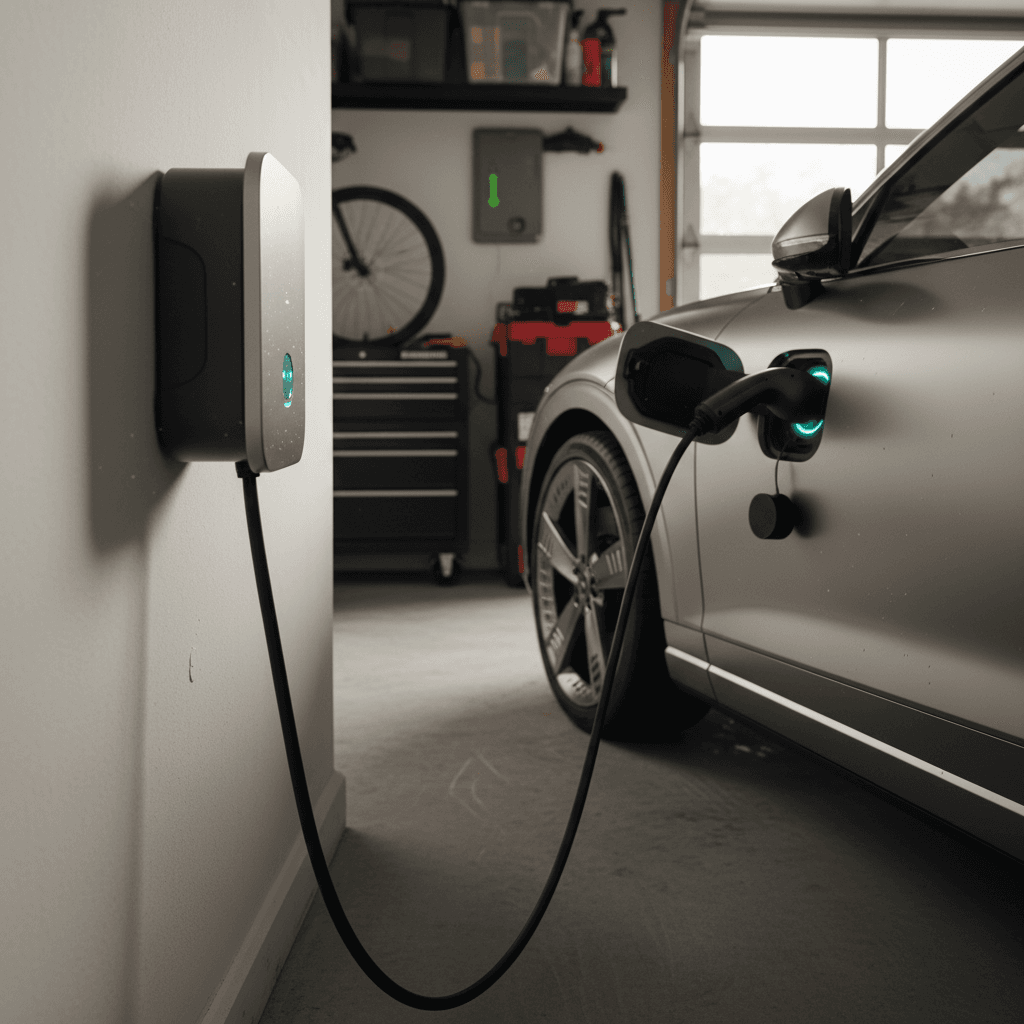
The GV60’s charge port is on the left rear quarter. Mount the EVSE so the cable drapes cleanly without stretching, crossing walkways, or kinking around the bumper.
5. Set the max amps in both the charger and the car
Most smart chargers let you set a max output; the GV60 also has charging‑current settings. Match these to your circuit rating, never assume the car will protect a too‑small breaker.
6. Test a full overnight session
After install, run the car from a low state‑of‑charge up past 80% at your chosen amp setting. Watch for unexpected stops, heat, or errors before you declare the setup "done."
Don’t "fix" bad wiring with software limits
"The charger on the wall is only as good as the copper behind it. A solid 40‑amp circuit will always beat a sketchy 48‑amp experiment."
Daily usage tips to protect your battery and wallet
Once the hardware is in, your day‑to‑day habits do most of the work in protecting the GV60’s battery and your power bill. The 800‑V pack is sophisticated, but it still responds to the same basic principles of EV life.
- Live in the middle of the battery. For daily use, living between roughly 20–80% state‑of‑charge is kinder to long‑term battery health than ping‑ponging between near‑empty and 100% every day.
- Schedule charging for off‑peak hours. Whether through the GV60’s settings or a smart EVSE, aim to finish charging close to your departure time, especially if you’re topping up to 100% before a road trip.
- Dial back the amps in extreme heat. On very hot days, consider limiting to 32–40 A. The GV60 will thank you, and you won’t notice the difference on an overnight schedule.
- Let the car handle pre‑conditioning. Use the GV60’s cabin pre‑conditioning while plugged in, so that heating or cooling comes from the grid, not the battery.
- Keep the cable and port clean. Dust, ice, and corrosion are the enemies of reliable charging. A quick wipe and a look at the connector pins every so often is cheap insurance.
Think in miles added per hour, not "full"
Step‑by‑step: how to choose your GV60 home charger
Choosing the best home charger based on your situation
Homeowner with a garage
Have an electrician confirm panel capacity and quote a 50–60 A circuit near the GV60’s parking spot.
Pick a 40–48 A charger from reputable brands like ChargePoint, Grizzl‑E, Wallbox, or Emporia.
Decide whether you want smart features for TOU rates and energy tracking; if your utility pays you to use a specific smart EVSE, factor that heavily.
Install, set max amps correctly, and run a full overnight test charge from low state‑of‑charge.
Townhouse / shared parking
Confirm what’s allowed by your HOA or building: dedicated circuit, shared circuit, or no permanent install.
If a dedicated circuit is allowed but limited, a 32–40 A charger is often a realistic cap that still works well with the GV60.
If you can’t install anything permanent, consider a 240‑V outlet plus a portable Level 2 EVSE you can take with you.
Document everything for resale value, future buyers will care that the EV charging was done right.
Apartment dweller
Start by mapping public Level 2 and DC fast options near home and work; your "home charger" might be a garage at the office.
Ask your property manager about future EV charging plans or pilot programs, many are just waking up to the demand.
If you have access to a 120‑V outlet near your space, the included trickle charger can help, but plan around DC fast for deeper charges.
If you expect to keep the GV60 long‑term, consider whether relocating to EV‑friendly housing is part of the total ownership picture.
Two‑EV household (now or soon)
Over‑spec the wiring: a 60 A circuit and a smart dual‑port or load‑sharing charger saves headaches later.
Look for chargers or ecosystems that support load balancing between vehicles so you don’t trip breakers.
Coordinate charging windows: for example, let the GV60 soak up off‑peak hours, and schedule the second EV later in the night.
If you’re shopping for a second EV, consider connector and charging‑speed compatibility with the GV60 so one charger can comfortably serve both.
Genesis GV60 home charging FAQ
Frequently asked questions about GV60 home chargers
Thinking about a used GV60? How Recharged fits in
A well‑chosen home charger turns the Genesis GV60 from a stunning piece of tech into an easy‑living daily driver. Get the wiring right, pick a reputable 32–48 A Level 2 unit, and you’ll wake up every morning with the equivalent of a fresh tank of premium, without ever visiting a gas station again.
If you’re still shopping for a GV60, or thinking about trading your current EV for one, Recharged can smooth out the entire process. Every vehicle on our marketplace comes with a Recharged Score battery health report, transparent pricing, and expert EV guidance, including realistic charging expectations for your home setup. We can help you compare models, line up financing, explore trade‑in or consignment options, and arrange nationwide delivery, so the first time your new‑to‑you GV60 rolls into your driveway, it’s ready to plug into a charging plan that actually fits your life.