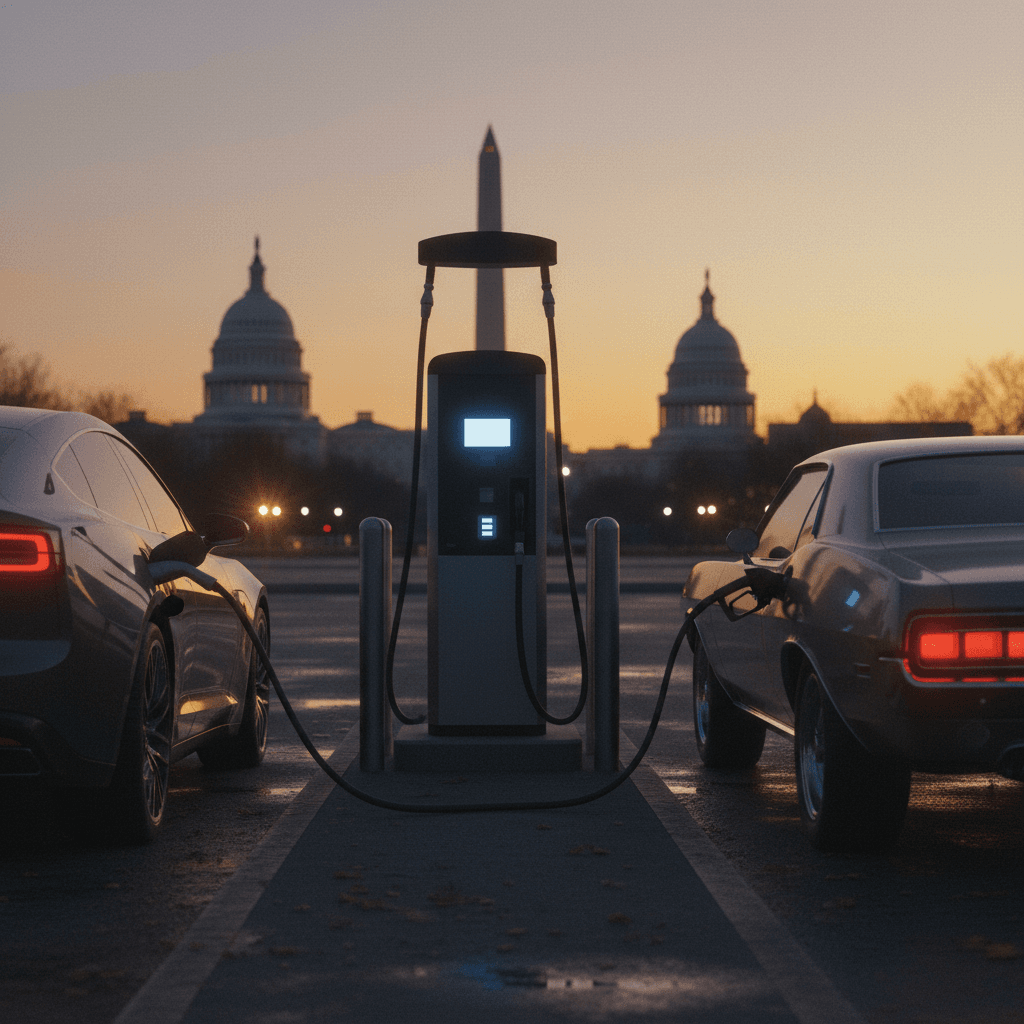
If you live in or around Washington, DC in 2026, you’re feeling fuel prices in your wallet. Between $4‑plus gasoline and rising electricity rates, it’s fair to ask: what’s actually cheaper day‑to‑day, filling up a gas car or charging an EV in DC? This guide breaks down **gas prices vs EV charging cost in Washington, DC in 2026** using realistic local numbers, so you can see what makes sense for your commute and your budget.
About the numbers in this guide
Why DC drivers are rethinking fuel costs in 2026
Washington, DC drivers sit at the crossroads of several cost pressures. You’ve got **big‑city congestion**, short but slow trips that punish fuel economy, and limited street parking that can make home charging tricky. Layer on global volatility that’s pushed **national gas prices back over $4 a gallon** in early 2026, and it’s no wonder EVs, and their lower per‑mile energy costs, are back on a lot of shortlists.
DC‑area fuel cost snapshot for 2026 (big‑picture)
Those last two numbers are important. They tell you that **electricity is usually cheaper per unit of energy than gasoline**, but once you buy it through a highway‑speed fast charger, the price premium for convenience starts to erode your savings. The key to making an EV work financially in DC is understanding how much of your driving you can realistically charge **at home or at slower, cheaper public Level 2 stations**.
What gas costs in Washington, DC in 2026
In 2025, Washington, DC typically saw regular gas prices **a bit above the national average**, hovering in the mid‑$3 range when the U.S. sat just over $3. As of early 2026, global tensions have pushed the **national average back to roughly $4 a gallon**, and dense, high‑demand markets like DC usually pay a premium on top of that. Think of DC pump prices as often living in the **$4.00–$4.40 per gallon** band for regular, with spikes higher during supply shocks or holiday weekends.
- DC’s fuel tax policy adds roughly a quarter per gallon in city taxes on top of federal and wholesale costs.
- Tight urban land and operating costs mean DC stations don’t have much room to discount.
- If you frequently cross into Maryland or Virginia, you may see slightly different prices a few miles away, but not a different world.
Gas prices will move under your feet
How much EV charging costs in DC: home vs public
Charging an EV in Washington, DC in 2026 falls into three buckets: **home charging**, **public Level 2**, and **public DC fast charging**. Each has its own price tag and practicality for city life.
Typical 2026 EV charging prices relevant to DC drivers
Home is cheapest, DC fast is fastest, and you’ll probably use a mix
Home charging (Level 2)
Where: Garage or driveway with a 240V outlet or wallbox.
- U.S. residential average: ~16¢/kWh
- Urban East Coast often: ~17–22¢/kWh
- Off‑peak rates can be lower if your utility offers them.
In DC terms, using 18–20¢/kWh for math is a reasonable starting point.
Public Level 2
Where: Garages, workplaces, retail lots, city facilities.
- Often priced per kWh or per hour.
- Commonly equivalent to 25–35¢/kWh once fees are baked in.
- Sometimes free for limited sessions in employer or municipal lots.
Public DC fast charging
Where: Travel plazas, highway corridors, some urban hubs.
- Typical 2025–2026 prices: ~40–60¢/kWh.
- Membership discounts can shave a few cents per kWh.
- Session or parking fees can raise your effective cost.
Home charging is your money‑maker
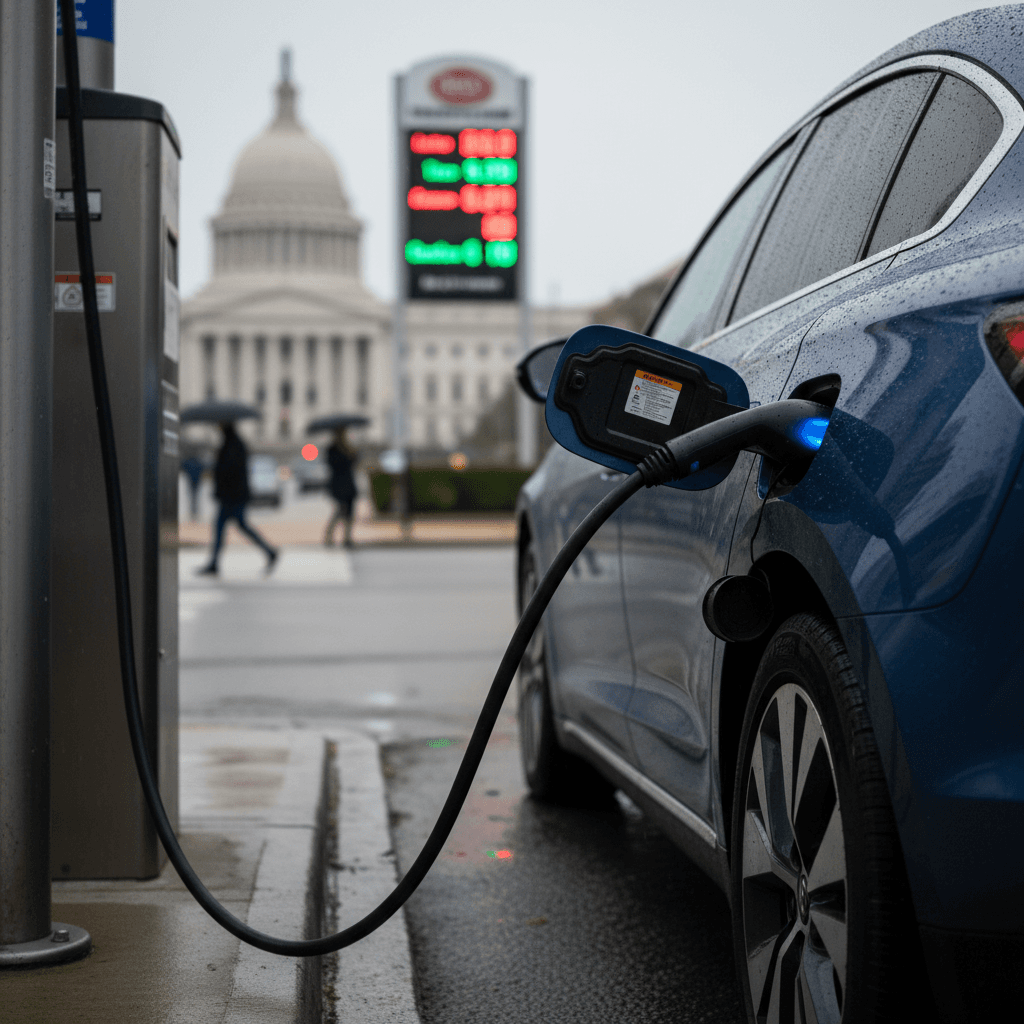
Gas vs EV cost per mile: real DC examples
Let’s get concrete. We’ll use three straightforward scenarios that look a lot like real Washington, DC life: a compact gas car, a hybrid, and a mainstream EV. We’ll keep the math simple and transparent so you can adjust numbers for your own situation.
Baseline efficiency assumptions for DC‑style driving
Real‑world urban and mixed driving, not ideal EPA highway numbers.
| Vehicle type | Example car | Realistic MPG or efficiency | Notes |
|---|---|---|---|
| Gas compact | Toyota Corolla/Elantra | 30 mpg city‑heavy | Stop‑and‑go DC traffic drags down highway EPA numbers. |
| Hybrid sedan | Toyota Prius/Hyundai Elantra Hybrid | 45 mpg mixed | Hybrids shine in city use but still drink gas. |
| Mainstream EV | Nissan LEAF, Chevy Bolt, Tesla Model 3 RWD | 28 kWh/100 mi | Roughly 3.6 mi/kWh in real DC driving. |
You can swap in your own MPG and kWh/100 mi to rerun the math.
Scenario A: Gas compact vs EV, home charging
Assumptions:
- Gas: 30 mpg
- Gas price: $4.10/gal
- EV efficiency: 28 kWh/100 mi (0.28 kWh/mi)
- Home electricity: 19¢/kWh effective
Gas cost per mile:
$4.10 ÷ 30 mpg ≈ 13.7¢/mi
EV cost per mile (home):
0.28 kWh × $0.19 ≈ 5.3¢/mi
That’s roughly a **60% fuel‑cost reduction** when you can charge at home.
Scenario B: Gas compact vs EV, mostly DC fast charging
Assumptions:
- Same gas car, 30 mpg at $4.10/gal → 13.7¢/mi
- Same EV at 0.28 kWh/mi
- DC fast charging at an average of 50¢/kWh
EV cost per mile (fast):
0.28 kWh × $0.50 ≈ 14.0¢/mi
At that price, the EV’s energy cost per mile is basically the same as the gas compact. Your savings come instead from lower maintenance and, depending on purchase price, potential incentives.
Now let’s bring in a hybrid, since many DC shoppers cross‑shop hybrids and EVs.
Scenario C: Hybrid vs EV, home charging
Assumptions:
- Hybrid at 45 mpg
- Gas at $4.10/gal
- Same EV efficiency (0.28 kWh/mi)
- Home electricity at 19¢/kWh
Hybrid cost per mile:
$4.10 ÷ 45 ≈ 9.1¢/mi
EV cost per mile (home):
≈ 5.3¢/mi
The EV still wins by around **3.8¢ per mile**, or $380 per 10,000 miles.
Scenario D: Hybrid vs EV using fast charging
Assumptions:
- Same 45 mpg hybrid at 9.1¢/mi
- EV using mostly DC fast charging at 50¢/kWh
EV cost per mile (fast):
≈ 14.0¢/mi
Here, the hybrid is clearly cheaper per mile on energy. If you buy an EV and mostly rely on pricey DC fast chargers around DC, you’re choosing it for reasons other than fuel savings: emissions, HOV lanes, driving feel, or future‑proofing.
Quick rule of thumb for DC
When an EV saves you money in DC (and when it doesn’t)
Conditions where EVs shine vs where gas still competes
Especially relevant for DC’s mix of dense city and regional commuting
EV wins clearly when…
- You have reliable home charging (garage/driveway with 240V).
- You drive at least 8,000–10,000 miles a year.
- Your current car gets under 30 mpg in DC traffic.
- You can avoid public DC fast chargers for most daily use.
- You keep cars long enough for lower maintenance to matter (5+ years).
Gas or hybrid can still make sense when…
- You park on‑street with no realistic home charging.
- You drive low annual miles (under ~6,000 per year).
- You’d rely heavily on 50–60¢/kWh DC fast charging.
- You can buy a used hybrid for far less than a comparable EV.
- You’re often on road trips where fast‑charging costs add up quickly.
Biggest financial trap for DC EV buyers
Beyond fuel: parking, maintenance, and other city costs
Per‑mile energy cost is only part of the picture. DC drivers pay in other ways: parking, tolls, maintenance, and sometimes fines when street cleaning meets forgetful mornings. EVs can quietly shift some of those numbers.
Other cost factors DC drivers should weigh
1. Parking and charging together
Some DC garages and apartment complexes now bundle **reserved EV spots with Level 2 charging** into a monthly fee. That might be more expensive on paper than street parking, but if it replaces both gas and paid fast‑charging sessions, it can still come out ahead.
2. Maintenance and repairs
EVs skip oil changes, spark plugs, timing belts, and exhaust repairs. Over a few years, that usually means **lower routine maintenance**, though you should budget for tires, EVs are heavier and quick off the line.
3. Congestion, idling, and short trips
Gas cars suffer worst in DC’s stop‑and‑go beltway crawl. An EV doesn’t burn extra fuel while stopped, and its regenerative braking recaptures energy in slow traffic, which helps keep **real‑world efficiency closer to the sticker.**
4. Local perks and policy changes
DC and neighboring states have experimented with EV incentives, HOV access, reduced registration fees, and parking perks. Even modest perks can tilt the math when fuel and electricity costs are close.
5. Depreciation and used‑EV pricing
EV resale values have been shifting quickly as more models hit the market. In 2026, **buying used** can often put you into an EV with years of life left in the battery at a price level comparable to a newer gas car.
How to estimate your own DC driving costs
You don’t need a spreadsheet to compare **gas prices vs EV charging cost in Washington, DC**. A pen, a couple of utility and credit‑card statements, and 10 quiet minutes will do the job.
A simple 3‑step roadmap for your own numbers
Step 1: Know your real fuel economy
Look up your car’s EPA city and combined MPG, but then check your **trip computer** or fuel‑tracking app for what you’re actually getting in DC traffic.
Use the higher of: your personal average MPG or 80% of EPA combined as a realistic number.
Multiply your typical local gas price by your miles per year and divide by your MPG to get annual fuel cost.
Step 2: Estimate EV energy use and mix of charging
Pick a realistic EV efficiency of **27–30 kWh/100 mi** for a compact or midsize EV in DC.
Estimate what share of your charging could be home/work Level 2 vs public DC fast (e.g., 80/20, 50/50).
Assign prices: maybe 19–22¢/kWh for home, 30¢/kWh for most Level 2, 45–60¢/kWh for DC fast.
Step 3: Do the per‑mile and per‑year math
Cost per mile = (kWh/mi × kWh price).
Annual cost ≈ cost per mile × your yearly mileage.
Run 2–3 "what if" versions, for example, gas at $3.25 and $4.25, fast charging at 40¢ and 60¢, to see how sensitive your decision is to price swings.
Shortcut using your current spending
Where Recharged fits in if you’re considering a used EV
Once you’re convinced an EV might make sense in DC, the next question is usually, "Which one, and how do I avoid a bad battery?" That’s where Recharged comes in. Recharged is a retailer and marketplace focused on **used electric vehicles**, with a buying experience designed to make EV ownership simple and transparent.
- Every EV comes with a **Recharged Score Report** that includes verified battery health and fair‑market pricing, so you can see how much real‑world range you’re paying for.
- You can handle the whole process digitally, including **financing, trade‑in, or consignment**, and **nationwide delivery**, or visit the Recharged Experience Center in Richmond, VA if you want to put eyes on a car in person.
- EV‑specialist support can walk you through **what your DC commute would cost** in a specific car, given its efficiency, your home‑charging situation, and local public charging options.
- If you already own a gas car, Recharged can give you an **instant offer or help you sell on consignment**, making the jump to electric smoother on your budget.
Using the Recharged Score to sanity‑check your math
Ready to find your next EV?
Browse VehiclesFAQ: Gas vs EV costs in Washington, DC
Frequently asked questions about DC fuel vs charging costs
Bottom line: should you go EV in DC in 2026?
In a 2026 Washington, DC shaped by $4‑plus gasoline and rising electricity prices, the winner between gas and electric isn’t one‑size‑fits‑all. A **home‑charged EV** will almost always beat a similar gas car on fuel cost, often by a wide margin, and tack on lower maintenance to boot. A **fast‑charge‑dependent EV** may feel more like a lifestyle choice than a clear financial play, especially when hybrids sip fuel so efficiently in city traffic.
The smart move is to start with your **parking and charging reality**: where will the car live at night, and how often can you plug in cheaply and conveniently? From there, run a few simple per‑mile calculations using DC‑appropriate gas and electricity prices. If an EV still comes out ahead and fits your life, the growing used EV market, and tools like Recharged’s battery‑health‑focused **Recharged Score**, can help you find a car that makes sense not just for the planet, but for your monthly budget in the District.