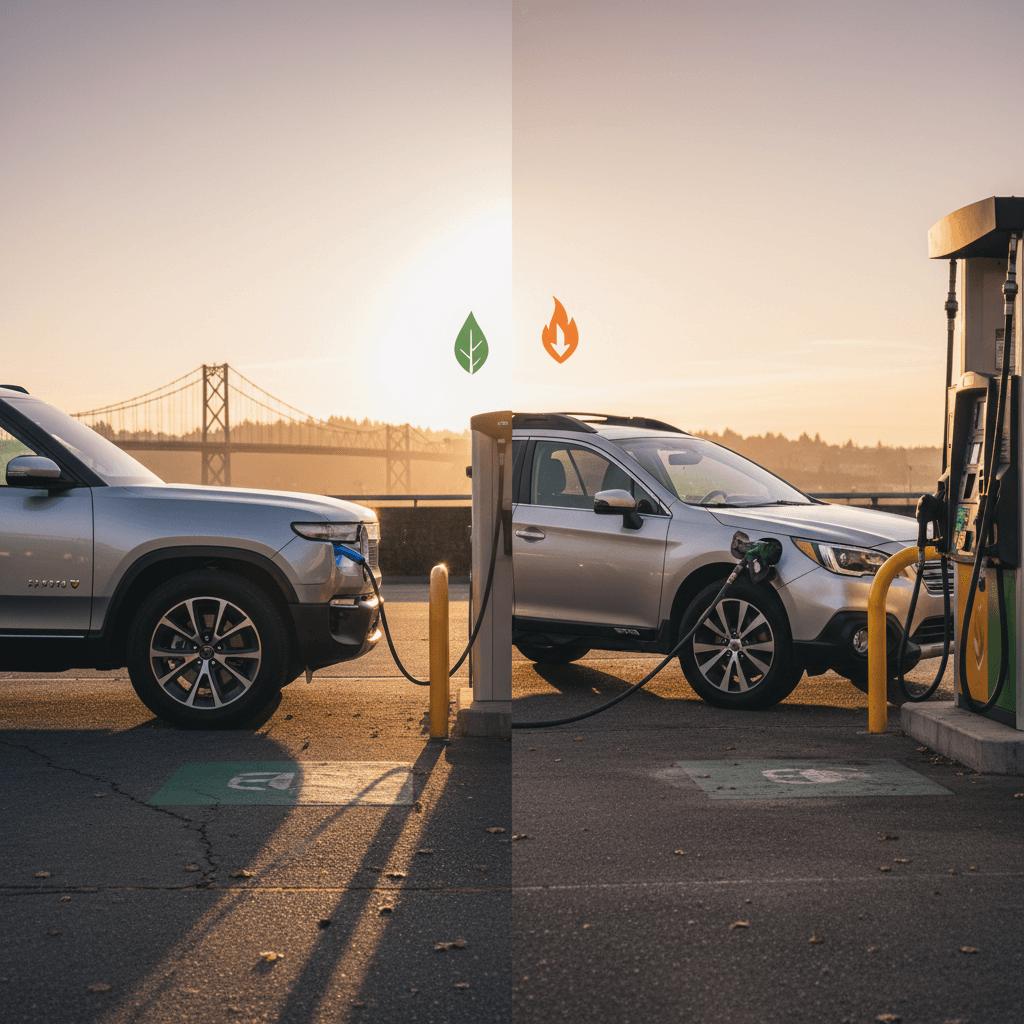
If you live in Portland in 2026, you’re feeling the squeeze from both sides: gasoline is still volatile, and Portland General Electric (PGE) just raised residential electricity rates again. That makes the “gas prices vs EV charging cost in Portland” question more nuanced, but still surprisingly favorable to EVs if you charge smart.
Numbers used in this guide
Why Portland drivers are rethinking fuel in 2026
Portland has always been ahead of the curve on clean transportation, but 2026 is a tipping point. Gas is cheaper than it was at 2022’s peaks, yet it’s still high enough, and volatile enough, that a long commute or regular Mt. Hood trips really add up. At the same time, PGE and Pacific Power customers just saw another rate hike, which makes some would‑be EV buyers wonder if the fuel savings are still real.
The short version: yes, EVs are still cheaper to “fuel” per mile in Portland if you charge primarily at home or work and avoid relying on DC fast charging for everyday use. The gap has narrowed slightly as electricity rates climbed, but the physics advantage of electric drivetrains, and Oregon’s still‑below‑average power prices, keeps EVs ahead in most real‑world scenarios.
2026 snapshot: Portland gas vs EV fueling costs
2026 baseline: gas and electricity prices in Portland
Gasoline prices in Portland
Oregon’s state gas tax is about $0.40 per gallon, on top of the federal 18.4¢ tax and wholesale fuel costs. By spring 2026, that translates to roughly $3.40–$3.60 per gallon for regular unleaded at many Portland stations, with premium typically $0.40–$0.60 higher.
- Prices spike along I‑5 and at convenience‑heavy locations.
- Warehouse clubs and off‑brand stations may be a few dimes cheaper.
- Nothing stops another 2022‑style price shock, your budget is exposed.
Electricity prices for EV charging
On the electricity side, PGE and Pacific Power residential customers saw around a 5% increase to already‑elevated 2020–2025 rates in early 2026. For a typical Portland household on a standard plan, that means:
- All‑in residential rate around $0.18/kWh for flat‑rate service.
- Time‑of‑day (TOD) plans with ~$0.09/kWh off‑peak (roughly 9pm–7am, plus weekends), mid‑teens mid‑day, and steep ~40¢/kWh peak hours.
- Commercial/public DC fast charging usually priced separately, often $0.35–$0.50/kWh in the Portland metro.
Those numbers are the foundation for realistic gas vs EV comparisons.
Rates and prices move
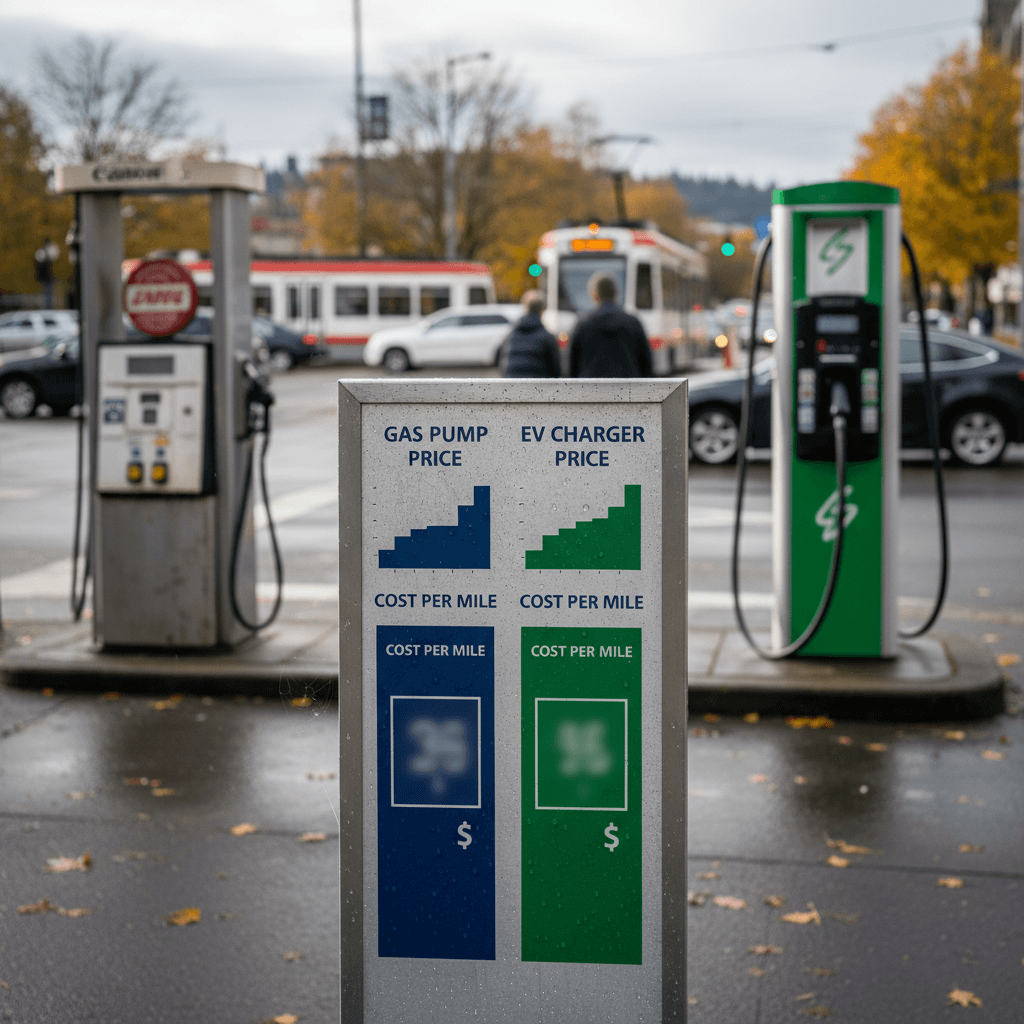
Cost per mile: gasoline vs EV in Portland
To cut through the noise, it’s easiest to compare fuel in cost per mile. We’ll use two common vehicles as baselines:
- A typical compact gas car that averages about 30 mpg in mixed Portland driving.
- A popular compact crossover EV (think Tesla Model Y, Hyundai Ioniq 5, VW ID.4) that uses ≈ 27 kWh per 100 miles (0.27 kWh/mile).
Estimated 2026 cost per mile in Portland
How far $1 of fuel takes you, using realistic 2026 prices and efficiency assumptions.
| Fuel type & scenario | Assumed price | Efficiency | Cost per mile | Miles per $1 |
|---|---|---|---|---|
| Gas – regular (typical Portland price) | $3.50/gal | 30 mpg | $0.117/mi | ≈ 8.5 miles |
| EV – home, flat PGE rate | $0.18/kWh | 0.27 kWh/mi | $0.048/mi | ≈ 20.8 miles |
| EV – home, off‑peak TOD | $0.09/kWh | 0.27 kWh/mi | $0.024/mi | ≈ 41.7 miles |
| EV – workplace / public Level 2 | $0.25/kWh | 0.27 kWh/mi | $0.068/mi | ≈ 14.7 miles |
| EV – DC fast charging (typical) | $0.40/kWh | 0.27 kWh/mi | $0.108/mi | ≈ 9.3 miles |
Home charging keeps EVs dramatically cheaper per mile, even with higher electricity rates, while heavy DC fast charging use narrows the gap.
Key takeaway on $/mile
Home charging vs public charging: what you’ll actually pay
How much does each charging option really cost in Portland?
Think of DC fast charging as a road‑trip tool, and home/work charging as your everyday fuel source.
Home Level 2 (PGE)
If you can install a Level 2 charger and enroll in a time‑of‑day plan, this is the gold standard.
- Overnight rate near $0.09/kWh means fuel at roughly $0.024/mile.
- Charging 30–40 kWh overnight is easy within off‑peak hours.
- Great fit for single‑family homes and many townhomes.
Workplace & public Level 2
Many workplaces and garages in downtown/inner Portland now offer Level 2 charging.
- Typical pricing: $0.20–$0.30/kWh, often plus parking.
- Cost per mile in the $0.05–$0.08 range.
- Good supplement if you can’t charge at home, but watch parking fees.
DC fast charging (50–350 kW)
Best for road trips and occasional top‑ups, not your daily “fuel.”
- Commonly $0.35–$0.50/kWh in the Portland area.
- Roughly $0.09–$0.14/mile, close to or above gas cost per mile.
- Cold weather and high speeds push consumption up, making it pricier.
Apartments and curb‑parking
Real-world scenarios for Portland drivers
Let’s ground this in monthly numbers. We’ll look at roughly 1,000 miles per month, about what you’d rack up with a daily Portland commute plus weekend errands and the occasional coast run.
Sample 2026 monthly fueling costs in Portland
1. 30‑mpg gas compact, 1,000 miles/month
At $3.50/gallon, you’ll burn about 33.3 gallons. Monthly fuel cost ≈ <strong>$117</strong>. If prices swing to $4.00, that jumps to about $133.
2. EV with home off‑peak charging only
At 0.27 kWh/mile, 1,000 miles uses 270 kWh. On a $0.09/kWh overnight rate, your monthly “fuel” is roughly <strong>$24</strong>, about one‑fifth of the gas bill.
3. EV split: 70% home off‑peak, 30% DC fast
• 700 miles at home off‑peak: 189 kWh × $0.09 ≈ <strong>$17</strong>. • 300 miles on fast charge: 81 kWh × $0.40 ≈ <strong>$32</strong>. Total monthly fueling ≈ <strong>$49</strong>. Still less than half the gas cost.
4. EV relying mainly on DC fast charging
If nearly all 270 kWh for the month come from DC fast charging at ~$0.40/kWh, your monthly cost is roughly <strong>$108</strong>. That’s barely cheaper than the 30‑mpg gas car and could be more expensive if you pay higher per‑kWh rates or parking fees.
5. Less efficient gas SUV (20 mpg)
Portland is full of older crossovers and SUVs. At 20 mpg and $3.50/gal, 1,000 miles means 50 gallons, or roughly <strong>$175</strong>/month on fuel. In that world, even a fast‑charge‑heavy EV regimen looks good.
When an EV can disappoint on fuel costs
Beyond fuel: insurance, maintenance, and resale
Fuel is only one piece of total cost of ownership. In Portland’s 2026 market, three other factors matter just as much: insurance, maintenance, and depreciation.
How EVs stack up on non‑fuel costs
Fuel savings are meaningful, but the real story shows up over 3–8 years of ownership.
Insurance
EV insurance in Oregon can run higher than comparable gas cars, especially for new models with expensive bodywork and sensors. On the used side, premiums are improving as repair data matures. When you shop, compare quotes on the exact VIN, not just model name, to avoid surprises.
Maintenance
EVs eliminate oil changes, timing belts, spark plugs, and exhaust systems. You’ll still buy tires, cabin filters, and brake fluid, but overall maintenance spending tends to be lower and more predictable. In rainy Portland stop‑and‑go traffic, regenerative braking reduces pad and rotor wear dramatically.
Depreciation & battery health
Early EVs in the Pacific Northwest proved that cool, mild climates are kind to batteries. Still, battery health is the big question mark for used buyers. This is where tools like the Recharged Score battery report matter, so you’re not guessing about pack degradation when comparing a used EV to a used gas car.
When you combine Portland’s relatively cheap off‑peak electricity, lower EV maintenance, and the weak resale of many thirsty gas SUVs, the economics often tilt toward a used EV even before you factor in future gas‑price risk.
How to lower your EV charging costs in Portland
If you’re already driving an EV, or thinking about making the switch, your goal is simple: maximize cheap kWh and minimize expensive ones. In Portland’s 2026 rate environment, that means planning around PGE’s time‑of‑day windows and being selective about when you plug into DC fast chargers.
Practical steps to cut your EV fueling bill
1. Enroll in a time‑of‑day plan
If PGE is your utility, check whether you can switch from a flat rate to a time‑of‑day plan. For many households, moving most EV charging to the 9pm–7am window at roughly half the standard rate more than offsets the higher 5–9pm peak price, especially if you avoid running big appliances in that peak window.
2. Schedule charging in your car or app
Most modern EVs and smart chargers let you set a schedule. Tell the car to start charging at 9pm and stop at 6 or 7am. You’ll wake up to a full battery while automatically sticking to cheap kWh without thinking about it every night.
3. Install a Level 2 home charger (if feasible)
Even in older Portland housing stock, many garages and driveways can support a 240‑volt circuit with a modest electrical upgrade. With a Level 2 charger at home, you’re no longer competing for public stations, and you lock in the cheapest available fuel.
4. Use DC fast charging strategically
Reserve fast charging for road trips, ski days, and times you truly need a quick top‑up. Portland’s urban form makes it easy to plan around fast‑charge sessions; if you’re hitting a DC fast charger multiple times a week, step back and see whether a different home, work, or community solution could work.
5. Watch for Oregon and utility incentives
Oregon and local utilities periodically offer rebates for home chargers, panel upgrades, or off‑peak charging programs. Before you pay out of pocket, check PGE, Pacific Power, and state incentive portals, you may be leaving hundreds of dollars on the table.
6. Match the EV to your use case
Range and efficiency vary widely between EVs. If most of your miles are short urban trips, a smaller, more efficient hatchback or crossover can save you more than a heavy, high‑performance model, even before you think about purchase price.
Want to go deeper on charging basics?
How Recharged helps you quantify your savings
Because gas prices and electricity rates are both moving targets, shoppers in Portland need more than rules of thumb. That’s exactly the problem Recharged was built to solve for used EVs.
Why Portland buyers use Recharged for used EVs
Transparent battery health, fair pricing, and help thinking through your real‑world fueling costs.
Recharged Score battery health report
Every EV on Recharged comes with a Recharged Score that includes verified battery health. You can see how much usable capacity remains and how that affects real‑world range, critical for estimating how often you’ll need to charge in Portland’s mixed city/highway driving.
Fair market pricing with fuel savings in mind
Recharged benchmarks each vehicle against current used‑EV and gas‑vehicle markets, so you see where you’re getting a deal. Pair that with the cost‑per‑mile math in this article and you can compare, say, a used RAV4 Hybrid to a used Model 3 in honest monthly terms.
Financing, trade‑in, and delivery
Recharged offers financing, trade‑ins, instant offers, consignment, and nationwide delivery. You can handle the entire purchase online or visit the Experience Center in Richmond, VA. If you’re in the Portland area, their EV specialists can help you estimate charging costs with your actual commute, parking, and utility plan.
Ready to find your next EV?
Browse VehiclesAsk specific “what if” questions
FAQ: Gas vs EV costs in Portland (2026)
Frequently asked questions about 2026 fuel costs in Portland
Bottom line: should you go EV in Portland in 2026?
In 2026 Portland, the gas‑versus‑EV equation is more complicated than marketing slogans suggest, but not by much. As long as you can tap into reliable Level 2 charging at home or work, an EV will almost certainly beat a comparable gas car on fuel cost per mile, often by a factor of two to five. Stack on lower maintenance, Portland’s EV‑friendly climate, and the shaky long‑term economics of gasoline, and the case for going electric stays strong even after the latest round of PGE rate hikes.
The key is to match the right EV to your home, commute, and charging reality, not an idealized scenario. That’s where transparent tools like the Recharged Score, fair market pricing, and EV‑savvy guidance come in. If you’re ready to run the numbers on a specific used EV, use this article’s cost‑per‑mile framework as your starting point, then let an expert help you turn today’s Portland utility and gas prices into a clear, confident decision.