If you live in Pennsylvania, you don’t need a news alert to know gasoline is expensive again in 2026. Between one of the **highest gas taxes in the country**, war-driven oil shocks, and the usual seasonal spikes, gas prices in Pennsylvania in 2026 are back to nibbling away at family budgets. The real question is: what does the rest of the year look like, and is it finally time to run the math on an electric car?
Snapshot: Gas prices in Pennsylvania 2026
Gas prices in Pennsylvania 2026 at a glance
Pennsylvania gas prices and taxes in 2026
No one can tell you exactly what you’ll pay at the pump in November 2026, the energy market has a sense of humor that way. But you can bank on a few things: - Pennsylvania will likely stay **above the national average** thanks to state fuel taxes. - Prices will stay **volatile**, reacting to global headlines long before your paycheck catches up. - Over the full year, the **average price** of regular in Pennsylvania is likely to live somewhere in the **low to mid‑$3 per gallon** range, with occasional visits to the high‑$3s during supply shocks or summer.
Forecasts are not promises
Why Pennsylvania gas prices run higher than average
Pennsylvania drivers pay a premium for the privilege of complaining about potholes. A big reason gas prices in Pennsylvania are so sticky‑high is structural, not temporary.
- High state fuel taxes. Pennsylvania’s gasoline tax is roughly 58–59 cents per gallon, plus the 18.4‑cent federal tax. That’s close to 80 cents of tax baked into every gallon before the station owner makes a cent in margin.
- Big, spread‑out state. Pennsylvania has dense metros (Philadelphia, Pittsburgh) and vast rural stretches threaded by interstates. Serving all of that means more transport costs and supply quirks than a compact Sunbelt state.
- Blend and compliance costs. Refineries and distributors pay to meet environmental fuel standards, maintain infrastructure and handle seasonal blend changes. Those costs don’t vanish; they show up on the sign by the road.
- Local competition, or lack of it. In some suburbs you’ll see three big‑name stations fighting on every corner. In rural counties with fewer stations, prices can drift higher because there’s less pressure to match the cheapest guy across the street.
Where your gas dollar goes
2026 market forces: global oil and the Iran war
If 2022 gave us a master class in how war drives up gas prices, 2026 is the sequel. The conflict involving Iran has rattled global oil markets, briefly pushing crude prices higher and dragging U.S. gas prices along for the ride. Even if you’ve never heard of the Strait of Hormuz, your wallet has.
Short‑term: Spikes and headlines
When news breaks about strikes or shipping disruptions, futures traders move first and gas stations follow. That’s why you see prices jump 15–30 cents almost overnight, even though the fuel already in the station’s tanks was bought at yesterday’s price.
In early March 2026, Pennsylvania’s average price did exactly that, climbing sharply in a matter of days before settling into a new, slightly higher plateau.
Medium‑term: Forecasts still point lower
Zooming out, energy forecasters still expect **average gasoline prices in 2026** to be lower than the highs of 2022 and 2024, as increased global production and softer demand tug prices down.
In other words, 2026 may feel rough in the moment, especially after a big headline, but on the graph, it’s still a down‑step from the last oil panic.
Don’t chase the cheapest day
What Pennsylvania drivers are actually paying at the pump
On the ground in 2026, most Pennsylvania drivers are seeing **regular unleaded in the low–$3s, edging higher** when global events flare up or when we head into the summer driving season. Metro areas with heavy commuter traffic and higher overhead, think the Philadelphia suburbs or parts of Allegheny County, often sit a few cents above the statewide average, while stations along highway corridors can be wildly variable from one exit to the next.
Illustrative 2026 gas price snapshots in Pennsylvania
Approximate ranges drivers might see for regular unleaded in different parts of the state during 2026. Exact prices change week to week.
| Region | Typical 2026 range (regular) | Notes |
|---|---|---|
| Southeastern PA (Philly suburbs) | $3.30–$3.70 | Higher real estate and labor costs; lots of commuter demand. |
| Pittsburgh metro | $3.20–$3.60 | Tracks state average closely, with quick reaction to oil shocks. |
| I‑80 corridor/rural north | $3.10–$3.50 | Fewer stations; big swings exit to exit depending on competition. |
| Central PA (Harrisburg/York/Lancaster) | $3.20–$3.60 | State capital + distribution hubs; often within a dime of statewide average. |
Use these as ballpark ranges, not promises, local competition and timing matter.
Beware the lonely highway station
Regional differences across Pennsylvania
Pennsylvania is more like three or four states stuck together with Wawa coffee. Gas prices mirror that patchwork. Local competition, supply routes, and demand patterns make a noticeable difference once you zoom in.
How location shapes your gas bill
Same state, different realities at the pump.
Urban & suburban corridors
Where: Philadelphia collar counties, Pittsburgh suburbs, Allentown–Bethlehem corridor.
- More stations and big-box retailers can mean aggressive price competition.
- But higher land, labor and compliance costs often keep prices slightly elevated.
Interstate & turnpike exits
Where: I‑76, I‑80, I‑81, I‑476 and other major arteries.
- Prices swing widely from exit to exit.
- Tourist and truck stops tend to sit at the upper end of the range.
Rural townships
Where: Northern tier, Appalachian communities, small county seats.
- Fewer stations limit competition.
- Some mom‑and‑pop locations lag when prices fall, but lead the way when they rise.
Will gas prices in Pennsylvania fall in 2026?
The consensus from energy forecasters heading into 2026 was that **average gasoline prices would be lower than in 2024 and below the 2022 peak**, thanks to rising oil production and flattening demand. The Iran war threw a wrench into the timing but not necessarily the direction: as supply routes normalize, crude prices and pump prices are expected to drift down again.
- If the conflict de‑escalates and shipping routes stabilize, crude prices are likely to ease, and Pennsylvania drivers could see regular drift back closer to the **low‑$3s** per gallon on average.
- If disruptions drag on or widen, temporary spikes into the **high‑$3s** (or brief brushes with the $4 sign in pricier metro stations) are very much on the table.
- Regardless of the scenario, Pennsylvania’s **high fuel tax** acts like a floor under prices: even when the national average softens, local drivers see only part of that relief.
What you can actually control
Gas vs. electric: cost per mile in Pennsylvania
The surest way to stop caring about gas prices in Pennsylvania is to stop buying much gasoline. That doesn’t mean everyone needs a brand‑new luxury EV; the used EV market has quietly become the bargain rack of the car world for anyone who hates the pump.
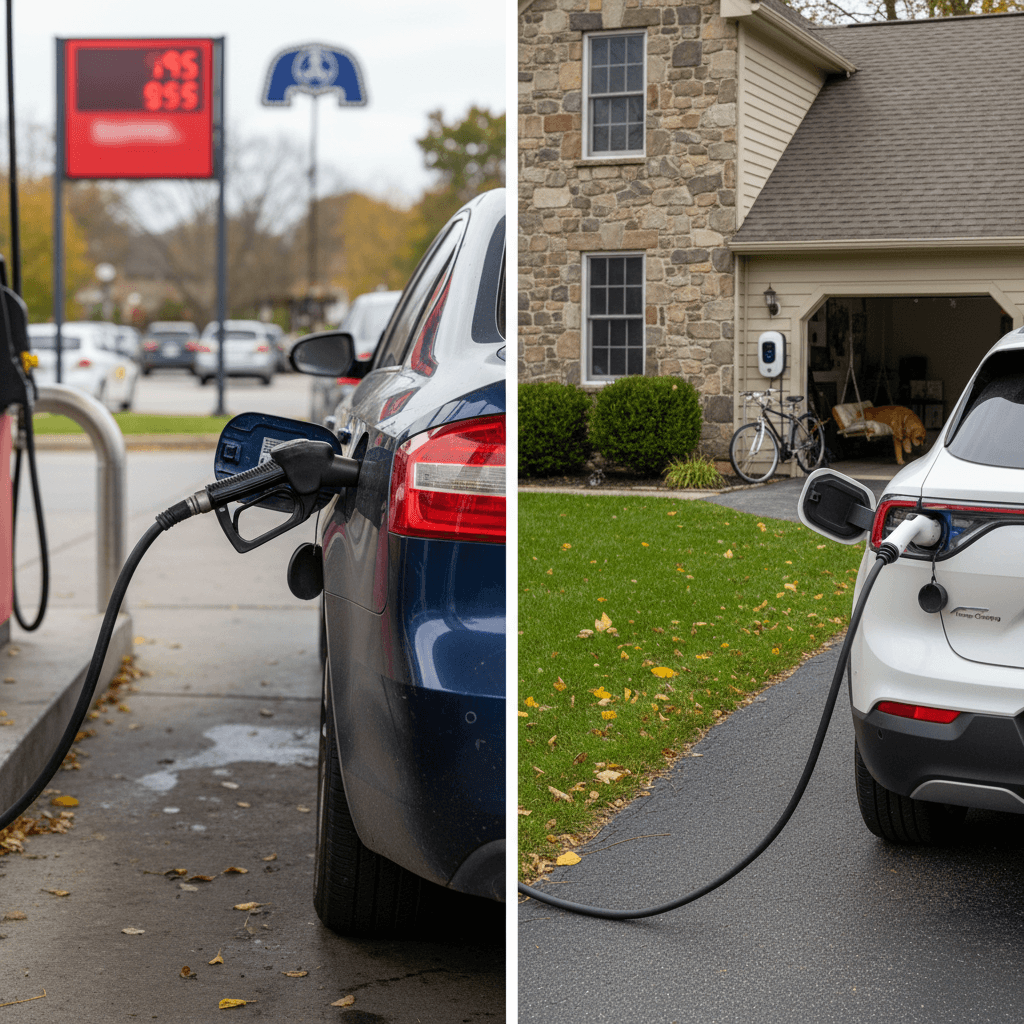
Illustrative cost per mile: gas vs. electric in Pennsylvania, 2026
Ballpark comparisons using typical 2026 gas prices and residential electricity rates in Pennsylvania. Your exact numbers will vary by vehicle and utility.
| Vehicle type | Assumptions | Approx. fuel cost per mile |
|---|---|---|
| Gasoline sedan | 30 mpg, regular at $3.40/gal | ≈ $0.11 per mile |
| Gasoline SUV/crossover | 22 mpg, regular at $3.40/gal | ≈ $0.15 per mile |
| Efficient hybrid | 50 mpg, regular at $3.40/gal | ≈ $0.07 per mile |
| Battery EV (home charging) | 3.0 mi/kWh, $0.16/kWh off‑peak | ≈ $0.05 per mile |
| Battery EV (mixed home + public) | 2.8 mi/kWh, blended $0.18/kWh | ≈ $0.06–$0.07 per mile |
These are estimates, but the pattern is consistent: electricity is usually far cheaper per mile than gasoline.
EVs win twice in Pennsylvania
How switching to a used EV changes your budget
A new EV can feel like a moonshot purchase. A **used EV**, on the other hand, is often cheaper than a comparable late‑model gas car once you factor in fuel and maintenance, and that’s especially true in a high‑tax, high‑volatility state like Pennsylvania.
From gas pump anxiety to predictable electric bills
What a used EV can do for a Pennsylvania household budget.
Lower, steadier “fuel” costs
With gas bouncing between $3.00 and $3.80 in recent years, budgeting fuel in Pennsylvania feels like trying to hit a moving target.
Charging a used EV at home converts that chaos into something closer to a utility bill, often the equivalent of **$0.05–$0.07 per mile** instead of $0.11–$0.15 in a typical gas car.
Less maintenance, fewer surprises
EVs don’t need oil changes, timing belts, or exhaust work. Brakes last longer thanks to regenerative braking.
For many owners, that means shifting money away from the shop and toward the loan payment, or just keeping it in the bank.
Why battery health matters on a used EV
The catch with a used EV is the same as with a used smartphone: the battery. A car that looks perfect on the outside can have lost a meaningful chunk of its original range on the inside.
That’s where something like the Recharged Score Report changes the game. Every vehicle on Recharged comes with verified battery health diagnostics and fair‑market pricing built around what that pack can actually deliver, not just what it could do when it left the factory.
How Recharged fits into the picture
If you’re reading about gas prices in Pennsylvania in 2026, there’s a decent chance your next vehicle won’t be another 18‑mpg truck.
Recharged is built for exactly that moment: a marketplace focused on used EVs, with specialist support, financing, trade‑in options, and nationwide delivery. You can do the whole process digitally or visit the Experience Center in Richmond, VA if you like to kick the tires in person.
Turning gas money into car money
Practical tips to save on gas in 2026
Maybe you’re not ready to switch vehicles yet. Fair. In the meantime, there’s still real money on the table if you’re strategic about how you feed your current car.
Six smart moves for Pennsylvania drivers
1. Treat fuel like a monthly bill
Add up the last three months of gas receipts and average them. Seeing a real monthly fuel number, $180, $240, whatever it is, does more to change behavior than any price sign at the corner station.
2. Use price apps, but don’t drive in circles
Apps that crowd‑source prices can be handy, but burning 10 extra miles to save 4 cents a gallon is how you lose both time and money. Focus on finding one or two consistently fair stations along your normal routes.
3. Avoid the lonely highway outpost
Plan fuel stops in or near towns with several stations so competition keeps prices honest. Top off before those long, empty stretches of I‑80 or the Turnpike where you’ll pay a premium for convenience.
4. Smooth out your right foot
Hard launches and highway sprints destroy fuel economy. Easing your acceleration and keeping to 65–70 mph on the interstate can easily save 5–15% on fuel in many vehicles, basically a free mini‑hybrid system.
5. Keep tires inflated and junk out of the trunk
Under‑inflated tires and 150 pounds of “emergency” stuff you never touch can quietly nibble at your mpg. Check pressures monthly and purge the cargo area of things you don’t actually need to haul everywhere.
6. Start planning your next car now
Whether it’s a hybrid or a used EV, thinking ahead lets you watch the market, line up financing, and get familiar with options on sites like Recharged before gas prices spike again and everyone else panics.
Don’t count on permanent cheap gas
FAQ: Gas prices in Pennsylvania 2026
Frequently asked questions about Pennsylvania gas prices in 2026
Bottom line: 2026 gas prices and your next car
Gas prices in Pennsylvania in 2026 are doing what they do best: bouncing between “mildly annoying” and “how is this legal,” depending on the week and the world news cycle. The state’s heavy fuel taxes make it unlikely you’ll ever see bargain‑basement prices, and global events remind us that gasoline is a volatile commodity first and a household staple second.
You can keep playing that game, hoping the next election, the next OPEC meeting, or the next cease‑fire brings relief, or you can start shifting your budget toward things you can actually control: **how much fuel your car burns, and what kind of fuel it needs at all**. Hybrids, plug‑in hybrids and especially used EVs turn gas‑price anxiety into something closer to a line item on your electric bill.
If you’re ready to run the numbers, take a look at used EV options on Recharged. Every car comes with a transparent battery health score, expert guidance, and financing and trade‑in options that make stepping off the gasoline roller coaster a lot less intimidating. Whether you switch this year or next, planning ahead now means that the next time gas in Pennsylvania makes headlines, you’re mostly reading it for curiosity, not survival.