If you live in California, you don’t need a headline to tell you gas is expensive. In early 2026, average gas prices in California climbed back above $5 per gallon, while the rest of the U.S. hovered closer to $4. For many households, that’s not just an annoyance, it’s a four‑figure line item in the annual budget, and a big reason more drivers are looking seriously at electric vehicles (EVs).
Quick context for April 2026
Overview: Gas prices in California in 2026
To understand where gas prices in California in 2026 are headed, you need to look at three overlapping forces: global oil shocks, California’s unique fuel rules and taxes, and a long‑term transition away from gasoline toward electricity. The first two are pushing prices up in the near term. The third is slowly capping demand for gasoline, but not quickly enough to spare you from short‑term pain at the pump.
California gas prices and EV momentum: key 2025–2026 numbers
These numbers tell a simple story: California drivers are paying more than anyone else for gasoline, even as a rapidly growing share of the state’s new‑car buyers are opting out of gasoline entirely. That tension is exactly why so many households are doing the math on whether their next vehicle should be an EV, often a used one to keep upfront costs manageable.
Current gas prices in California (2026 snapshot)
By early April 2026, California gas prices had climbed sharply from the relatively calm averages seen in 2025. A combination of higher global crude prices, refinery outages, and the broader geopolitical shock of the 2026 Iran conflict has pushed retail prices back into familiar, uncomfortable territory for California drivers.
Average California gas prices in early 2026
Approximate averages for regular unleaded gasoline in key California regions in March–April 2026. Individual stations can be significantly higher or lower.
| Region | Approx. Avg Price (regular) | Notes |
|---|---|---|
| Statewide | $5.30–$5.60/gal | AAA data show California leading the nation in average gas prices. |
| Los Angeles / Orange County | $5.60–$5.90/gal | Tourist demand and higher retail costs keep prices above the state average. |
| San Diego | ~$5.85/gal | Local stations range from around $5.00 at the cheapest to well over $6 at premium locations. |
| Bay Area | $5.70–$6.10/gal | Tight supply and high operating costs push prices to the top of the range. |
| Inland Empire / Central Valley | $5.10–$5.40/gal | Typically a bit cheaper, but still far above the U.S. average. |
| U.S. national average | ~$4.00/gal | California’s premium over the national average is roughly $1.30 per gallon. |
Regional averages help explain why some Californians feel the gas price spike more than others.
Station‑level prices vary a lot
Why gas is more expensive in California than anywhere else
California doesn’t just have high gas prices because of bad luck. The state has consciously built a fuel system that trades cheaper gasoline for cleaner air and climate policy, and then added some uniquely California quirks on top. The result is a structural price premium that shows up every time you fill up.
Four main drivers of California’s high gas prices
Global shocks matter, but California’s rules and infrastructure amplify them.
1. Cleaner, boutique fuel blend
California requires its own CARB‑specification gasoline, a cleaner blend that reduces smog and emissions. That’s good for air quality but bad for price elasticity:
- Only a limited number of refineries can make it.
- Imports from other states are constrained.
- When one refinery goes down, prices spike faster and higher.
2. High state taxes and fees
On top of the federal gas tax, California layers on:
- One of the highest state gasoline excise taxes in the country.
- Additional sales taxes and local add‑ons.
- Cap‑and‑trade and Low Carbon Fuel Standard (LCFS) compliance costs baked into the pump price.
In 2026, all‑in taxes and fees are roughly 80–90 cents per gallon for many drivers.
3. Limited refinery capacity
California has lost refining capacity over the last decade as some facilities have closed or converted to renewable fuels. That means:
- Less slack in the system when demand surprises to the upside.
- Outages at a single plant can move prices statewide.
- Imports of CARB‑grade gasoline are harder to ramp quickly.
4. Global oil and war‑related shocks
Californians pay a local premium on top of global crude oil prices. In 2026, conflict in the Middle East pushed Brent crude back over $100 per barrel, which flows directly into higher rack prices for California refineries and, ultimately, higher pump prices.
Price gouging vs. policy
2026 and beyond: Where California gas prices could go
Forecasting gasoline prices is like forecasting the weather: you can outline scenarios, but anyone giving you a single precise number for December 2026 is selling more confidence than certainty. That said, current policy, supply, and demand trends in California point to a few plausible paths.
Baseline scenario: sticky $4.75–$5.75 averages
In a world where the Iran conflict cools but doesn’t fully unwind, crude prices stay elevated but not extreme, and California avoids major new refinery outages, a realistic baseline is:
- Statewide averages hovering around high‑$4 to mid‑$5 per gallon for regular through late 2026.
- Spikes into the $6+ range during summer driving season or maintenance outages.
- Rural and inland areas staying 20–40 cents below coastal metros.
High‑stress scenario: brief runs toward $7–$8
Several analysts have gamed out a more stressful case where:
- Global crude prices stay above $100 for an extended period.
- California loses additional refinery capacity or faces an extended outage.
- California’s unique fuel blend limits quick imports.
In that case, short bursts near $7–$8 per gallon in high‑cost metros are plausible. Policymakers are already on edge about this, which is why talk of windfall‑profit penalties and strategic tax relief re‑emerges every time prices spike.
Don’t budget off the absolute worst case
Gas prices vs. EV cost per mile in California
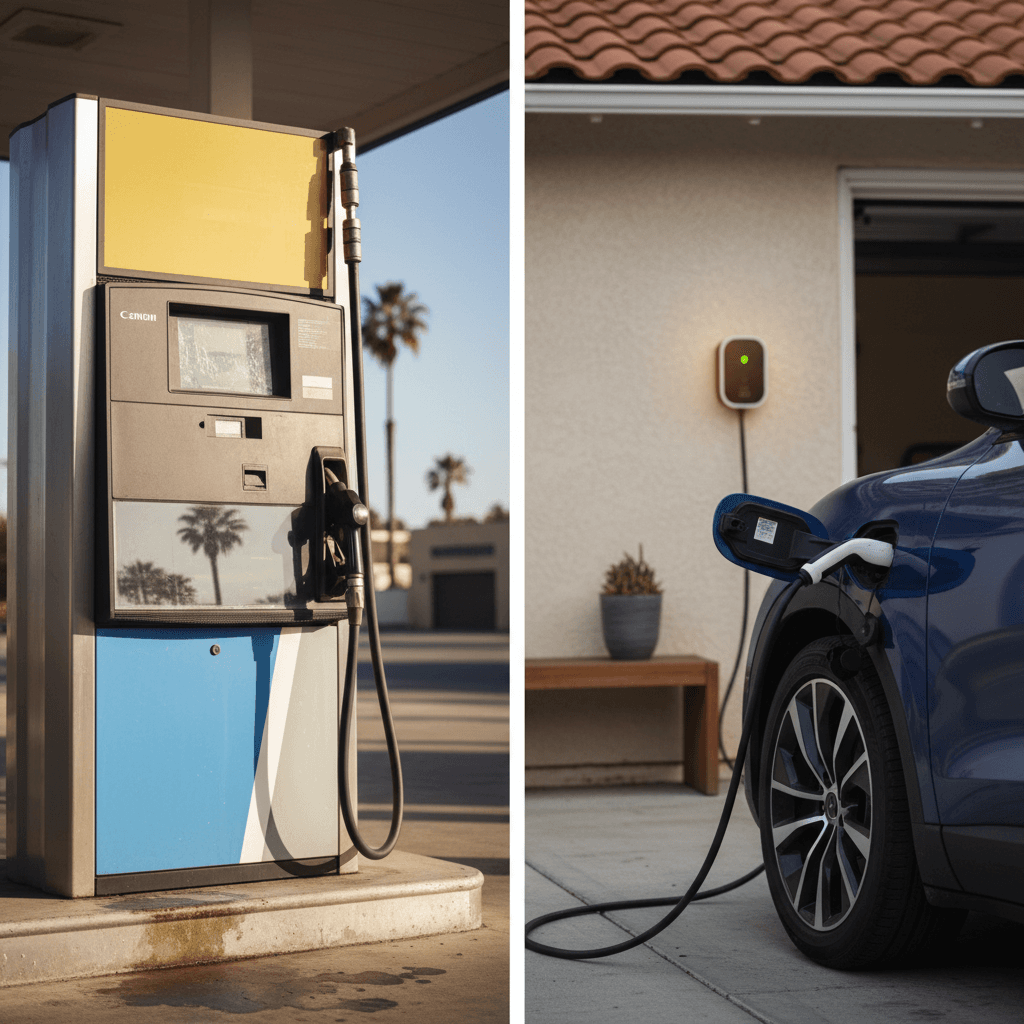
Drivers don’t experience energy markets in barrels or megawatt‑hours; you experience them in cost per mile. That’s where California’s high gasoline prices collide most directly with EV economics, and where EVs, especially used ones, start to look less like a luxury and more like insurance against future price spikes.
Back‑of‑the‑envelope: gas vs. EV cost per mile in California (2026)
Illustrative comparison of energy cost per mile for a typical gasoline car vs. a typical EV in California, using early‑2026 price levels.
| Vehicle type | Assumptions | Energy cost | Approx. cost per mile |
|---|---|---|---|
| Gasoline compact sedan | 30 mpg; $5.40/gal California gas | $5.40 per 30 miles | ~$0.18/mile |
| Gasoline crossover/SUV | 23 mpg; $5.40/gal gas | $5.40 per 23 miles | ~$0.23/mile |
| Efficient EV (e.g., compact hatchback) | 3.5 mi/kWh; $0.26/kWh residential rate | $0.26 per 3.5 miles | ~$0.07/mile |
| Less efficient EV (larger SUV) | 2.8 mi/kWh; $0.26/kWh residential rate | $0.26 per 2.8 miles | ~$0.09/mile |
| EV on off‑peak TOU plan | 3.5 mi/kWh; $0.18/kWh off‑peak | $0.18 per 3.5 miles | ~$0.05/mile |
Actual numbers vary by vehicle, driving style, and local electricity plan, but the directional gap is consistent.
Think in annual dollars, not pennies per mile
Electricity in California isn’t cheap, and charging purely on public DC fast chargers can erode the savings. But for drivers who can charge at home or at work most of the time, the fuel‑only cost of an EV is usually 50–70% lower per mile than a comparable gasoline car at 2026 California price levels.
Who feels the pain most? California driver profiles
Not everyone feels California’s gas prices the same way. Your commute length, housing situation, and car type matter as much as the number on the station’s marquee. Here’s how different kinds of drivers experience today’s prices, and how much an EV might move the needle.
How 2026 California gas prices hit different drivers
From short‑hop city dwellers to long‑distance commuters.
Suburban commuter, 50–60 miles/day
Profile: Drives a compact or crossover 15,000–18,000 miles per year, mostly freeway.
Gas impact: At $5.40/gal and ~27 mpg, annual fuel runs ~$3,000–$3,600.
EV upside: A used EV charged mostly at home at $0.20–$0.26/kWh could cut annual energy cost to roughly $900–$1,400.
Urban driver, low annual miles
Profile: City resident driving 5,000–7,000 miles per year, often in traffic.
Gas impact: Gas costs are lower in absolute dollars, but stop‑and‑go drops real‑world mpg.
EV upside: Savings are smaller, but predictable home charging costs and no idling penalty still help. Convenience and access to bus‑only/EV‑only lanes or HOV perks may matter more than pure fuel math.
Long‑distance sales or gig driver
Profile: 25,000+ miles per year, often in a mid‑size sedan or crossover.
Gas impact: Fuel can easily exceed $5,000 per year at 2026 prices.
EV upside: Even with heavy dependence on public fast charging, many high‑mileage drivers see multi‑thousand‑dollar annual savings, and far less exposure to sudden gas price spikes.
Household with multiple vehicles
Profile: Two‑car garage, one newer vehicle and one older paid‑off car.
Gas impact: High prices hit especially hard if both are thirsty SUVs or pickups.
EV upside: Swapping even one vehicle for a used EV creates a flexible hedge: use the EV for most miles and keep the gas vehicle for occasional long trips or towing.
Should rising gas prices push you into an EV?
The fact that gas is expensive in California doesn’t automatically mean you should buy an EV tomorrow. What it does mean is that sticking with gasoline locks you into a fuel whose price is increasingly shaped by geopolitics and aging infrastructure, while electricity is increasingly shaped by long‑term contracts and regulated rates.
When high California gas prices make an EV a strong financial play
You drive at least 10,000–12,000 miles per year
The more you drive, the more the lower cost per mile of electricity compounds. High‑mileage drivers see the fastest payback from switching to an EV.
You can charge cheaply at home or work
Access to overnight Level 2 charging at a stable residential or workplace rate can lock in predictable, relatively low energy costs compared with volatile gas prices.
You’re shopping used rather than new
Used EVs often carry a discount relative to new models that more than offsets concerns about battery degradation, especially if you have visibility into actual battery health.
You own or can access another gas vehicle
If your household keeps one gasoline or hybrid vehicle for long trips and uses an EV for 80–90% of daily driving, you get most of the fuel savings with little change to your lifestyle.
You live in a region with strong charging infrastructure
California’s dense network of DC fast chargers and Level 2 stations makes public charging feasible for many apartment dwellers, especially in urban and suburban areas.
You want to de‑risk against future price shocks
Even if gas drops temporarily, long‑term policy and refinery trends make California’s fuel market structurally fragile. An EV is one way to diversify away from that risk.
How Recharged fits into the picture
Ready to find your next EV?
Browse VehiclesHow to run your own gas vs. EV cost comparison
Before you change what you drive, it helps to quantify how much California’s gas prices are actually costing you, and what an EV would look like over a realistic ownership window. You don’t need a PhD in energy economics to do this; you just need a few numbers and honest assumptions.
- Calculate your current fuel cost per year. Multiply your annual miles by (1 ÷ your real‑world mpg) and then by your local gas price. For example, 15,000 miles ÷ 27 mpg × $5.40/gal ≈ $3,000 per year.
- Estimate your EV energy cost per year. Pick an EV efficiency (miles per kWh, many compact EVs are 3–4 mi/kWh) and your likely electricity price (home, work, or a mix). Then compute: annual miles ÷ miles per kWh × price per kWh.
- Layer in maintenance differences. EVs typically avoid oil changes, exhaust work, and many transmission‑related issues. You don’t need exact numbers, but plan on at least a few hundred dollars per year in avoided maintenance compared with an older gasoline car.
- Consider financing and depreciation. A used EV with transparent battery health data might cost more upfront than a similar gas car, but lower fuel and maintenance costs can offset part or all of the payment difference over a 5–7 year loan.
- Stress‑test your assumptions. Run the math again at $4.50/gal and $6.50/gal to see how sensitive your total cost of ownership is to California gas price swings.
- Account for your real charging access. If you can’t charge at home and expect to use high‑priced DC fast chargers most of the time, dial down the savings you assume, and focus on vehicles with strong efficiency and good fast‑charging curves.
Use conservative assumptions, not best‑case dreams
FAQ: Common questions about gas prices in California 2026
Frequently asked questions about California gas prices and EVs
Bottom line: California gas prices and the shift to EVs
California has spent decades building a cleaner, lower‑carbon transportation system, and high gasoline prices are a byproduct of that choice. In 2026, those prices are colliding with global oil shocks and tight refinery capacity to create real pain for gas‑only drivers, even as nearly a third of new vehicles sold in the state are now zero‑emission.
You can’t control geopolitics or refinery outages, but you can control your exposure to them. For some Californians, that means squeezing a few more years out of a paid‑off gas car and organizing life around fewer miles. For others, especially high‑mileage commuters with access to home or workplace charging, it increasingly means that a well‑chosen used EV is the simpler, more predictable way to move around the state.
If you’re in that second camp, Recharged exists to make the transition as transparent as possible: from verified battery health and fair pricing to financing, trade‑ins, and even nationwide delivery. In a world where gas prices in California in 2026 can swing by a dollar or more in a matter of months, locking in a lower, steadier cost per mile isn’t just about going electric, it’s about taking back some control over your transportation budget.