You’re in New York City, your phone is clinging to 4% battery, and suddenly every glowing screen in sight looks like life support. You pull out your phone and search for “free phone charging stations NYC” or even just “public phone charging stations near me.” The good news: you do have options. The bad news: some of them are about as safe as leaving your wallet on a park bench.
Short answer
Why Your Battery Is Always Dying in NYC
New York is hostile territory for phone batteries. You’re navigating with maps, ordering rides, paying at turnstiles, scanning tickets, taking photos, streaming music on the subway – your phone is your entire day planner, wallet, and concierge. That constant screen-on time plus spotty service underground means your battery is burning energy just to stay connected.
Layer on top of that: cold winters, hot summers, and long days out where you may never see your own wall outlet. It’s no surprise people are desperate for “free charging” the way drivers hunt for free parking. The trick is to know where the outlets are – and which ones are worth trusting.
Where to Find Free Phone Charging Stations in NYC
Most Common Places to Charge Your Phone in NYC
Think of these as your go-to pit stops when the battery icon turns red.
Public Libraries
NYPL branches across the city typically have standard wall outlets you can use while you sit and work. No purchase required, and you avoid sketchy USB ports entirely.
Parks & Plazas
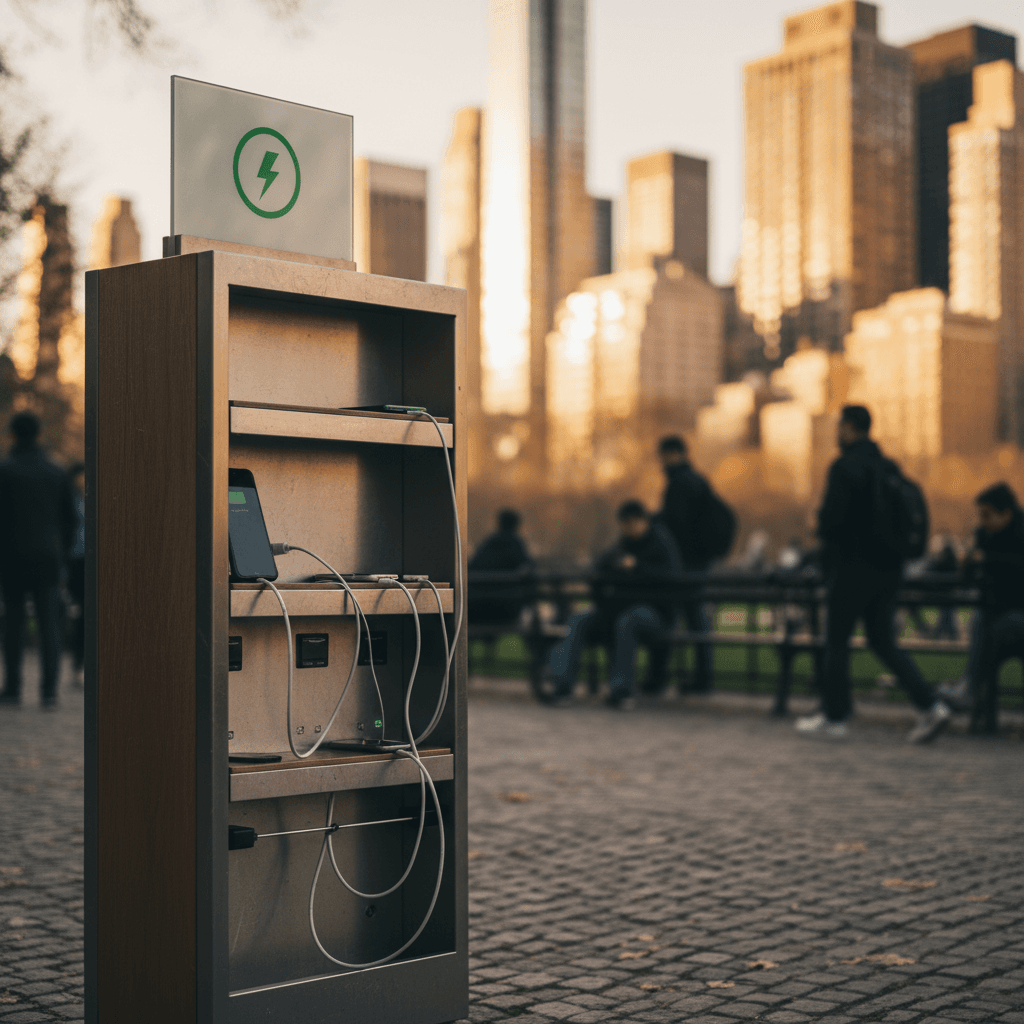
Some parks and plazas offer outdoor outlets or charging kiosks, especially around newer seating areas and near vendor hubs. These come and go, so treat them as a bonus, not a guarantee.
Stores & Malls
Larger retailers, malls, and food courts often have charging hubs near seating. Sometimes they’re labeled, sometimes it’s just an outlet behind a bench. You’ll usually be expected to buy something, even if no one says it out loud.
Coffee Shops & Cafés
Your de facto office. Most NYC cafés have outlets; some have built-in USB ports at banquettes and bars. You’re buying a drink or snack, of course, think of the charge as bundled into your latte.
Transit Areas
Major hubs (think Penn Station, Grand Central, Port Authority) often have dedicated charging counters. Some are wall outlets, others are USB-only bars. We’ll talk about which ones to avoid in a moment.
Hotels & Lobbies
Hotel lobbies and business centers often have charging zones. Technically they’re for guests, but in NYC there’s a lot of gray area as long as you’re unobtrusive and maybe grab a coffee from the lobby bar.
Pro move
Airports and Transit Hubs: What to Know Before You Plug In
Airports and big transit hubs are where you’ll see the most aggressive marketing around “FREE CHARGING.” Rows of shiny USB ports, kiosks with multiple dangling cables, entire counters labeled “POWER BAR.” It looks like salvation; it might be an invitation.
Charging Options You’ll See at Airports & Hubs
Not all charging spots are created equal. Here’s how to rank them, from safest to sketchiest.
| Option | Typical Place | How Safe Is It? | Best Use Case |
|---|---|---|---|
| Your own charger in a wall outlet | Airport gate, waiting areas, some subway mezzanines | Safest | Anytime you can sit for 15–30 minutes |
| Your power bank | Anywhere | Safest (if it’s your device) | On the move, train rides, rideshare trips |
| Public power strip (you bring your brick) | Gate areas, bus terminals | Generally safe, still your cable/brick | Short top‑ups while you wait |
| Built‑in USB port (you bring your cable) | Airport seats, pillars, kiosks | Higher risk, vulnerable to tampering | Only if you must, and for a quick charge |
| Built‑in USB + provided cable | Kiosks with multiple cords, branded stands | Highest risk, avoid when possible | Emergency only, and assume it’s not trustworthy |
Rule of thumb: the more the infrastructure controls the cable and port, the more conservative you should be.
About that “juice jacking” thing
- Prefer a plain wall outlet over any USB-only kiosk.
- If you must use a USB port, use your own cable and switch to “charge only” mode if your phone asks.
- Never plug into a random loose cable that’s already hanging from a kiosk.
- Keep charging time short, enough to get you to a safer option, not from 5% to 100%.
Coffee Shops, Stores, and Hotels: The Semi-Free Options
In NYC, the most reliable way to keep your phone alive is the oldest one: buy something and sit down. A coffee shop or fast‑casual restaurant is essentially a paid charging lounge with better lighting.
Coffee shops & cafés
- Pros: Usually plenty of outlets, Wi‑Fi, and you’re not rushed if you’re a paying customer.
- Cons: Crowded at peak times, and some spots now charge explicitly for laptop use or time at tables.
- Best practice: Grab a drink, sit near a wall outlet, and use your own charger.
Retail, malls & hotel lobbies
- Pros: Seating areas with outlets or charging bars, often less pressure to buy time than cafés.
- Cons: Access can change quickly; a store remodel or new policy can make your favorite outlet vanish.
- Best practice: Be discreet, don’t camp for hours, and again: favor outlets over USB ports.
A note on “free”
How Safe Are Public Phone Charging Stations, Really?
Let’s separate fear from reality. Are hackers lurking behind every USB port? No. But could a compromised port or cable silently push malware onto your phone while it charges? Yes, which is why federal agencies have been loud about it.
Public Charging: Risk Snapshot
What is “juice jacking”?
- A regular wall outlet cannot juice‑jack you; it only supplies power.
- Your charging brick talks to your phone, but if it’s yours, that’s fine.
- A hostile USB port or cable can pretend to be a computer your phone “trusts.”
- Once compromised, your phone might stay infected even after you leave the station.
Safer Alternatives to Public Charging (That Still Feel “Free”)
Better Ways to Stay Charged in NYC
These options trade a little planning for a lot more peace of mind.
Carry a Slim Power Bank
A good 5,000–10,000 mAh bank is thin enough for a pocket and can fully recharge most phones 1–2 times. It’s the closest thing to a personal “charging station near me” that’s always, by definition, near you.
Use Your Own Brick & Cable
Even in airports and stations, you can often find a plain wall outlet. Plug in your own charger and cable and you’ve eliminated the USB risk almost entirely.
USB Data Blocker (“USB Condom”)
If you must use a USB port, a data‑blocking adapter lets only power flow, not data. It’s a cheap, tiny insurance policy for frequent travelers.
Pack once, stop worrying
Phone Charging Tips Specifically for NYC EV Drivers
If you drive an EV in or around NYC, your phone isn’t just a convenience; it’s the key to your car’s entire ecosystem. It’s how you unlock charging networks, pay for sessions, navigate to chargers, and in some cases even unlock or start your vehicle. A dead phone turns a simple charging stop into a logistics problem.
Plan your day like you plan your state of charge
- Top up your phone when you top up your car. While your EV is on a fast charger, plug your phone into your own brick inside the station, cafe, or lounge.
- Don’t let your phone live between 5–15% all day. Just like batteries in cars, your phone battery is happiest in the middle of the gauge.
Use EV stops as phone‑charging anchors
- Many charging stations are near malls, supermarkets, or cafes. That’s two charges in one stop: kWh for the car, watts for the phone.
- If you buy a used EV through Recharged, you’ll get expert guidance on everyday charging habits. Treat your phone the same way you treat your traction battery: charge smart, don’t stress, avoid unnecessary stress on the hardware.
EV owner habit to steal
Quick Checklist: Staying Powered All Day in the City
Your NYC Phone Power Checklist
1. Start the day at 80–100%
It sounds obvious, but many people roll out with 40% because they scrolled in bed. Plug in overnight or at your desk so you’re starting from a position of strength.
2. Pack a power kit
Carry a slim power bank, your own wall charger, and a reliable cable. Add a USB data blocker if you travel through airports or big transit hubs often.
3. Favor outlets over USB ports
When you search for “public phone charging stations near me,” mentally translate that to “places with wall outlets.” Wall outlet + your brick beats any USB kiosk.
4. Time your charges with natural breaks
Top up while you’re eating, working, or charging your car, not standing in a hallway guarding your phone at 7%.
5. Be picky with what you plug into
Avoid random cables, unknown USB hubs, and anything that looks modified or damaged. If you wouldn’t hand that person your unlocked phone, don’t use their cable.
6. Use low‑power modes when you’re in the red
iOS and Android both have low‑power modes. Turn them on below 20% and kill background battery hogs like screen brightness, GPS, and non‑essential apps.
FAQ: Free and Public Phone Charging in NYC
Frequently Asked Questions
The Bottom Line on Free Phone Charging in NYC
New York absolutely has free and public phone charging options, but relying on them is like relying on street parking in Midtown at 5 p.m., possible, not guaranteed, and occasionally full of unpleasant surprises. Your best strategy is to treat public charging as a backup, not your primary plan.
Start the day with a full battery, carry a small power kit, favor wall outlets over USB kiosks, and be stingy about what you plug into. If you’re already living the EV life, or thinking about a used EV through Recharged, apply the same logic you use for your car’s battery to the one in your pocket: think ahead, charge smart, and avoid the obviously sketchy stuff. Do that, and the next time you search for “public phone charging stations near me” in NYC, it’ll be more out of convenience than panic.