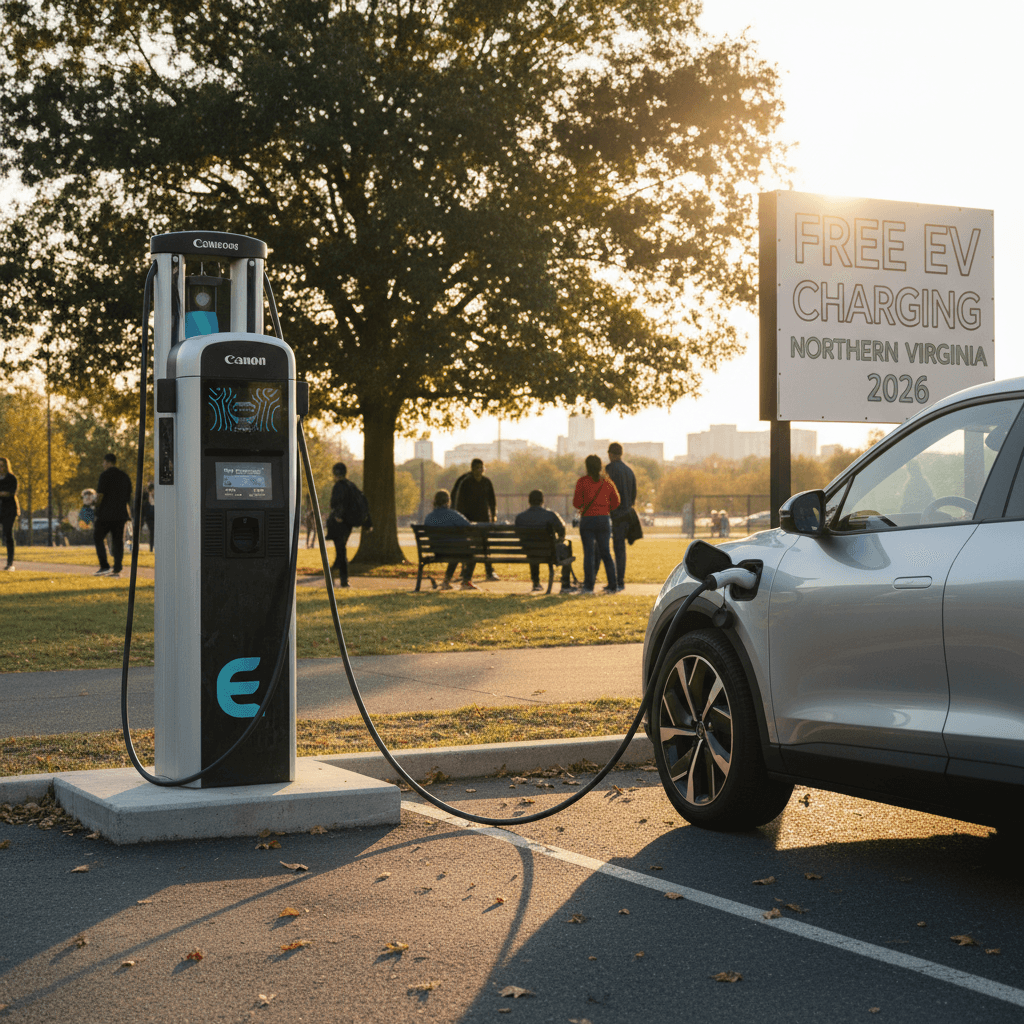
If you own an electric car in Northern Virginia, you’ve probably noticed something over the last couple of years: truly free EV charging is getting harder to find. Many locations that used to offer complimentary Level 2 charging have quietly added fees or parking charges, and hotel chargers that once felt like an open secret now fill up fast or cost extra. But “harder” doesn’t mean “impossible”, especially if you know where to look and how to work the local utility and county programs to your advantage.
What this guide covers
Why “Free EV Charging” Is Getting Harder to Find
Northern Virginia is one of the denser EV markets on the East Coast. That’s good news for charging availability, but it also means the early days of plentiful free charging are mostly over. Retailers and hotels that once treated free charging as a marketing expense are realizing that high power, long dwell times, and crowded lots don’t always pencil out. Many have moved to per-kWh or per-hour pricing, or to “free with paid parking” instead of no-strings-attached kilowatt-hours.
Free usually isn’t the business model anymore
- Targeted free charging at libraries, parks, community centers, or workplaces.
- Utility and county programs that make home or shared charging so cheap it feels free.
- Bundled deals like free sessions with a new EV or low off-peak rates that turn overnight charging into pennies per mile.
Northern Virginia EV charging by the numbers (Virginia-wide context)
Where You’re Most Likely to Find Free Charging in Northern Virginia
While the era of “free everywhere” is fading, Northern Virginia still has pockets of zero‑cost or effectively-free charging. You just need to know which types of places to check first.
High‑probability spots for free or bundled charging
Start here before you drive laps around a paid DC fast charger
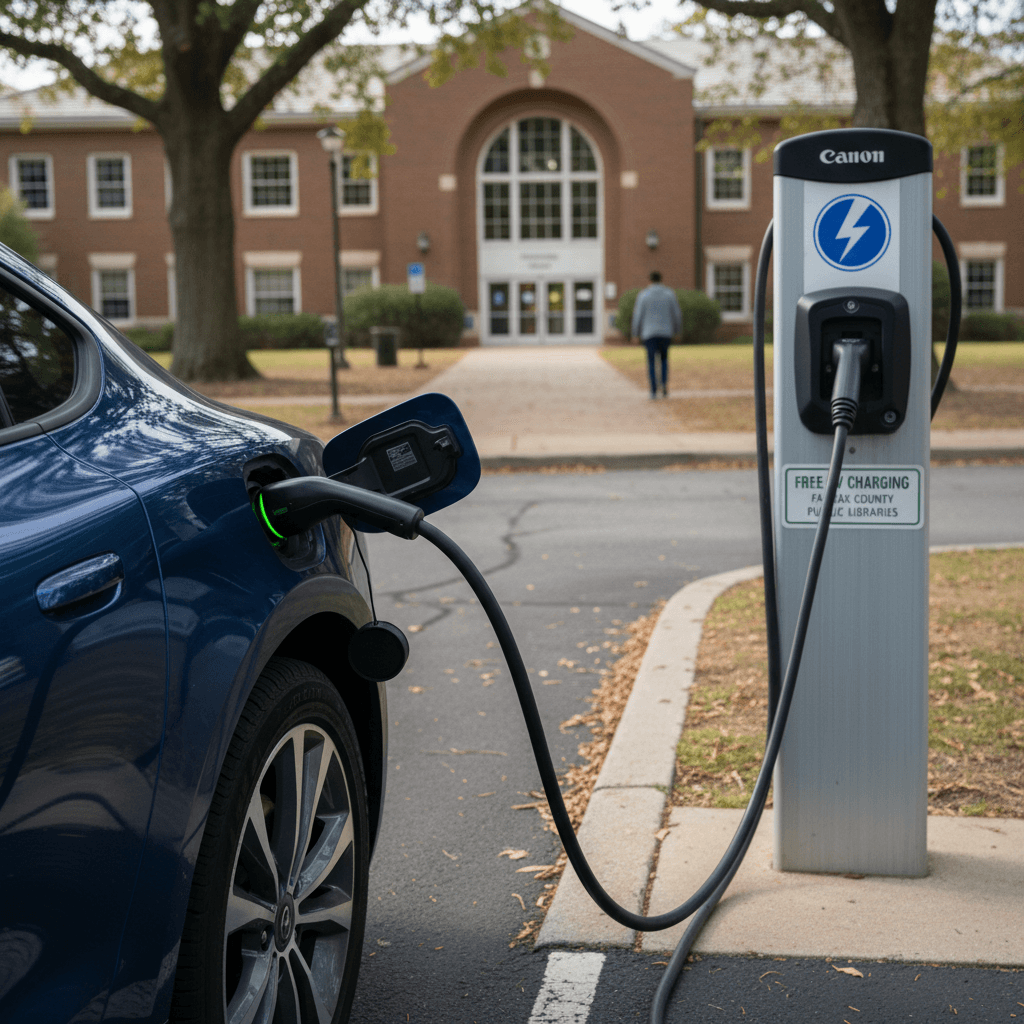
Libraries & community centers
Fairfax County and nearby jurisdictions have been steadily adding Level 2 chargers at some libraries, parks, and civic buildings. Policies vary, some offer a set number of free hours or free charging with paid parking.
Check your nearest branch on apps like PlugShare or ChargePoint before you go; drivers often note whether the station is still free or has switched to paid.
Parks, trails, and recreation sites
Regional parks, lakes, and rec centers occasionally include EV charging as part of a broader sustainability push. In some cases, the charger itself is free but you’ll pay for parking or an entry fee.
This can still be a net win if you were planning to spend a few hours at the park anyway.
Workplaces & office campuses
Many larger employers in Tysons, Reston, Arlington, and Alexandria have installed Level 2 chargers for staff. These may be:
- Completely free as a benefit
- Free up to a time limit, then paid
- Discounted compared with nearby public options
If you commute to an office, ask HR or facilities whether they’ve tapped Dominion or county programs to add workplace charging.
Retail, malls, and entertainment
Shopping centers in Tysons, Reston, Pentagon City, and along major corridors often host EV chargers from networks like ChargePoint, EVgo, or Electrify America. Completely free sessions are less common than they were a few years ago, but you’ll still occasionally find:
- Free Level 2 charging funded by the property owner as a tenant perk
- Promo codes or validation from restaurants or theaters that wipe out your charging cost
- “Free with parking” garage setups where you only pay the standard parking fee
Always read signage carefully, rates can differ even inside the same garage.
Hotels, places of worship, and nonprofits
Some hotels still treat EV charging as a guest amenity, but there’s a clear trend toward metered pricing or “EV parking fee” line items. Consider any free hotel charging a bonus, not a guarantee, and never bank on it for a road‑trip fast charge.
On weekends, churches and nonprofits can be surprisingly good places to find low- or no‑cost charging, especially if they’ve participated in local grant programs that prioritize community access. Stations may be free during services or events but restricted at other times.
Use real‑time check‑ins, not old promises
Dominion Energy programs that can make charging feel “free”
For many Northern Virginia drivers, the cheapest charging isn’t public at all, it’s smart, off‑peak home charging paired with utility incentives. Dominion Energy Virginia has built out a suite of programs that don’t always advertise as “free,” but can dramatically shrink what you pay per mile.
Key Dominion Energy EV programs that affect your charging costs
Availability and details can change, so always confirm on Dominion’s website before you enroll.
| Program | Who it’s for | How it helps | Why it matters for “free” |
|---|---|---|---|
| Residential Charger Program | Homeowners in Dominion territory | Turnkey Level 2 home charger solution; often paired with rebates or on‑bill financing | Spreads the cost of hardware and installation, so your per‑mile cost can undercut public fast charging by a wide margin. |
| EV Charger Rewards / managed charging | Residential customers with qualifying smart chargers | Annual bill credits when you let Dominion shift some charging to off‑peak hours | Those credits effectively offset part of your EV’s energy use each year. |
| EV Charging Access Program | Commercial/property owners in Environmental Justice communities | No‑cost installation and maintenance of chargers at selected sites | Creates new public or semi‑public chargers that may be free to users, depending on how the host sets pricing. |
| Smart Charging Infrastructure pilots | Multifamily, workplace, and fleet sites | Incentives to install Level 2 and DC fast chargers at apartments, offices, and public sites | Reduces site owner’s costs, making it more feasible to offer low‑ or no‑cost charging as a perk. |
These programs won’t make every kilowatt‑hour free, but they can push your <em>effective</em> charging cost close to zero if you charge mostly at home and off‑peak.
Free to install vs. free to use
Fairfax County’s Charge Up Fairfax and local government sites
Fairfax County has quietly become one of the most active local governments in Virginia on EV charging. The Charge Up Fairfax program is a prime example: it offers technical help and reimbursement grants to homeowner associations, condos, places of worship, and other nonprofits that want to install shared chargers.
- Charge Up Fairfax now accepts applications on a rolling basis and has expanded eligibility beyond HOAs to include places of worship and other nonprofits.
- Organizations can often layer Charge Up Fairfax support with Dominion Energy programs for Level 2 charging, reducing the out‑of‑pocket cost of installing shared chargers.
- Fairfax County waives certain EV charging permit fees through at least October 31, 2025, cutting another piece out of the project cost.
Why this matters for drivers
Beyond Charge Up Fairfax, keep an eye on county and city sustainability pages for Arlington, Alexandria, Loudoun, and Prince William. Many have their own green building or climate programs, and as budgets allow, some are adding EV chargers to government lots, garages, and park facilities. Those sites often start out free or time‑limited while utilization is low, then shift to modest fees as demand picks up.
Apartments, condos, and workplaces: How free charging shows up
If you live in an apartment or condo in Northern Virginia, your odds of finding free curbside public charging are lower than they used to be. But your building or employer may already be sitting on incentives that make private or semi‑private charging much cheaper than it looks.
Checklist: Turning your building or office into a low‑cost charging hub
1. Ask property management what’s already planned
Before you assume nothing’s happening, email or call your HOA board, condo association, or property manager. Many are quietly evaluating EV charging because residents keep asking, and programs like Charge Up Fairfax and Dominion’s incentives are on their radar.
2. Point them to Charge Up Fairfax (if in Fairfax County)
If you live in Fairfax County, direct your board or manager to the Charge Up Fairfax program page. It lays out technical assistance and reimbursement grants for shared chargers at townhomes, condos, and community facilities.
3. Highlight Dominion incentives for multifamily and workplace sites
Dominion’s commercial and multifamily programs can cover part of the cost for Level 2 and even DC fast chargers. The cheaper it is for them to install, the more likely they are to offer residents or employees free or low‑cost access.
4. Clarify how pricing will work for residents
Encourage your building to adopt clear, fair rules, such as a set number of free hours per day, or low per‑kWh rates with idle fees after a time limit. That keeps chargers available without turning them into a profit center.
5. For workplaces, frame charging as a recruitment benefit
In NoVA’s tight labor market, being able to say “we offer free Level 2 charging for employees” is a tangible perk. Point HR to utility programs that offset installation costs so they see this as an investment, not a pure expense.
Watch for HOA roadblocks
How to hunt for free or cheap chargers using apps
Even in a region as dense as Northern Virginia, free charging is hyper‑local. The best way to find it is to combine a few charging apps with local knowledge, and to filter ruthlessly for cost and reliability.
Smart app tactics for finding low‑ or no‑cost charging
Don’t just open a map, use filters, notes, and pricing details
Use multiple apps
No single app has a perfect view of NoVA’s charging scene. Combine:
- PlugShare for crowdsourced pricing and “still free?” check‑ins
- ChargePoint, EVgo, Electrify America for network-specific pricing
- Google Maps for basic location and photos
Filter for Level 2 first
Most truly free or low‑cost chargers are Level 2, not DC fast. In the app filters, uncheck DC fast locations when you’re just looking for a free top‑off while you shop, hike, or grab dinner.
Read the most recent comments
Sort or scan for check‑ins from the last few weeks. Drivers will usually call out:
- “Still free as of March 2026”
- “Now charges $0.20/kWh”
- “Free but max 2 hours; strict ticketing”
Search for “free” and “no fee” in comments
When paying a bit beats chasing free
It’s tempting to burn 20 minutes circling Tysons for a free plug. But when you do the math, a short paid session, especially off‑peak or at a reasonable Level 2 rate, often costs less than your time and extra miles are worth.
Think in cost per mile, not just $0 vs. $x
Home Level 2 charging on a fair utility rate in Northern Virginia can easily land in the $0.03–$0.06 per mile range for many EVs. Even a reasonably priced public Level 2 charger might be $0.08–$0.12 per mile.
Compare that with the value of your time. If you make an extra 15‑minute detour to chase free charging that saves you $2 in electricity, you probably lost money in the trade.
Save public charging for what it does best
Public charging shines when it unlocks trips you couldn’t make otherwise, road‑trip DC fast charging, or a top‑off that lets you skip gas entirely. In those moments, paying a fair rate is worth it.
Use free or subsidized charging when it’s on your normal route or attached to something you’d do anyway (work, groceries, the gym). Don’t let the word “free” drive your whole schedule.
Beware idle fees and time‑based pricing
Planning a used EV purchase in Northern Virginia
If you’re still shopping for an EV, or considering a second one, it pays to think about charging before you sign paperwork. That’s especially true in NoVA, where home parking, HOA rules, and commute patterns vary block by block.
- If you own your parking space and can add a Level 2 charger, home charging paired with Dominion’s managed charging credits can make your cost per mile lower than many gas cars, without ever hunting for free public charging.
- If you rent or rely on shared parking, put EV‑friendly apartments, Charge Up Fairfax–participating communities, or buildings that have already installed shared Level 2 chargers at the top of your list.
- If your workplace offers free or low‑cost charging, factor that into which battery size you need. A smaller‑battery used EV may be plenty if you plug in at the office most days.
When you shop used, you’ll also want to understand battery health and how real‑world range will fit your mix of home, work, and public charging. That’s where Recharged comes in. Every EV we sell includes a Recharged Score Report with verified battery health, transparent pricing, and expert help thinking through your charging options in Northern Virginia, not just on paper, but for your actual commute and parking situation.
How Recharged can help
Ready to find your next EV?
Browse VehiclesFAQ: Free EV charging in Northern Virginia
Frequently asked questions
Bottom line on free EV charging in NoVA
Northern Virginia has come a long way from the days when you could assume every new charger in a mall or hotel garage was free. Today, the smarter strategy is to treat free EV charging as one tool in a broader mix: home Level 2 on good utility rates, workplace and community chargers tapped into programs like Dominion Energy’s incentives and Charge Up Fairfax, and selective use of public networks when you really need them.
If you’re already driving electric, use apps and local programs to build a personal charging map that favors low‑cost and free options on your normal routes, not across town. And if you’re shopping for a used EV in Northern Virginia, think about charging up front. The right combination of battery health, parking situation, and local incentives can make your EV feel incredibly cheap to run, even if you never plug into a single “free” charger at the mall. That’s where a transparent partner like Recharged can help you go from theory to day‑to‑day reality.