If you own, or are thinking about buying, a Ford Mustang Mach‑E, its value after 5 years is not just a trivia stat. It’s the single biggest line item in your total cost of ownership. With EV prices and incentives whipsawing since 2021, understanding how the Mach‑E actually depreciates over five years is the difference between a savvy buy and an expensive experiment.
Context: EV values are moving targets
Why Ford Mustang Mach‑E value after 5 years matters now
Depreciation has always been the silent cost of new cars, but with EVs it’s amplified. Transaction prices spiked in 2021–2022, federal and state incentives have shifted, and competition from newer models with faster charging and more range is intense. That means the typical owner who buys a new Mach‑E and keeps it 5 years may see well over half of the original MSRP disappear on paper, long before the battery or drivetrain are anywhere near worn out.
At the same time, that sharp early drop creates a real opportunity on the used side. A 4‑ to 6‑year‑old Mach‑E with documented battery health can deliver modern EV performance at a deeply discounted price, especially when you factor in low fueling and maintenance costs. The key is understanding what “normal” looks like for Mach‑E values and how to separate a good deal from a future headache.
Five‑year value snapshot: Ford Mustang Mach‑E vs market
Quick answer: What is a Mach‑E worth after 5 years?
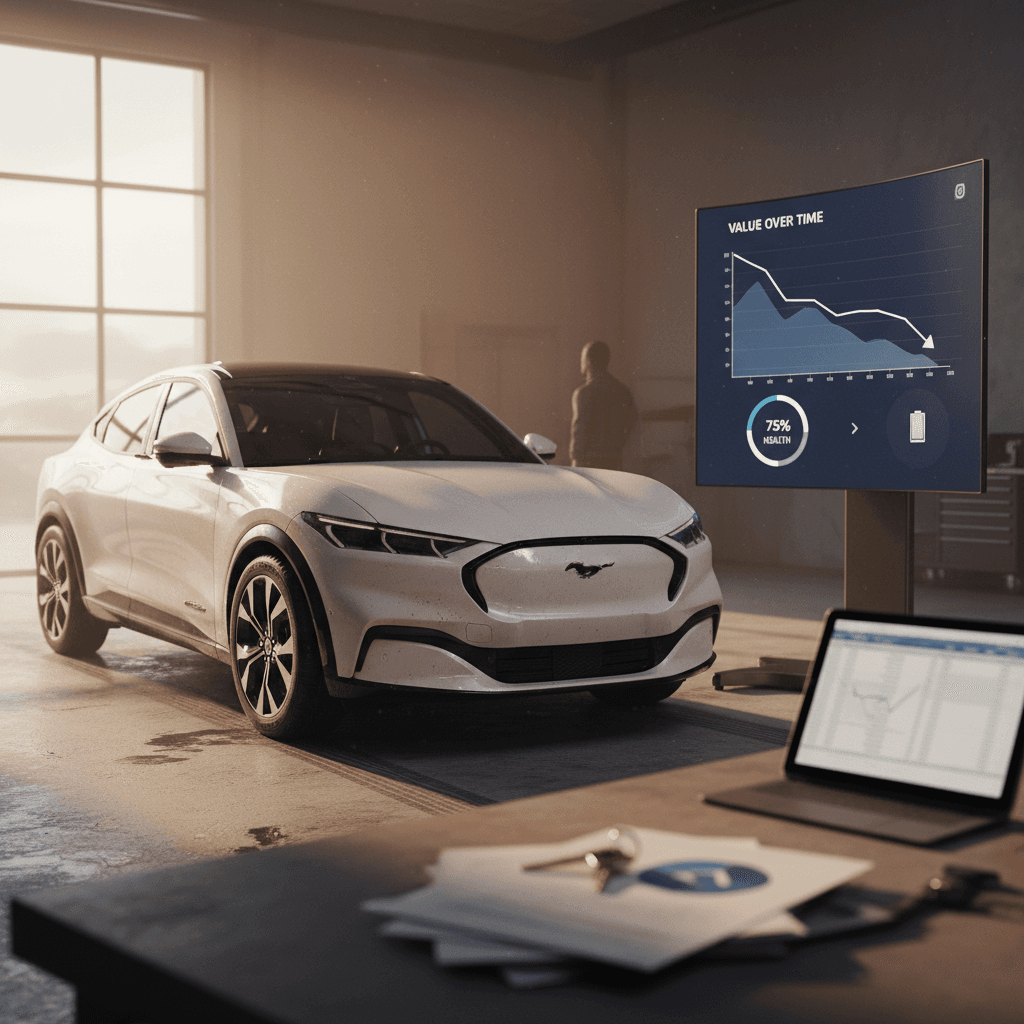
Let’s start with the headline. Data from depreciation tools and valuation guides that track real used‑car transactions suggest a typical Ford Mustang Mach‑E will lose roughly 55–60% of its value over 5 years, assuming about 13,000–15,000 miles per year and normal wear.
Approximate 5‑year Ford Mustang Mach‑E values
High‑level guide based on recent U.S. pricing data and common MSRPs. Real‑world values will vary with incentives, region, condition and battery health.
| Original MSRP | Usage pattern (5 yrs) | Expected value after 5 yrs | Total depreciation |
|---|---|---|---|
| $45,000 (Select / lower trims) | Average miles, good condition | ≈$18,000–$21,000 | ≈$24,000–$27,000 |
| $50,000 (Premium / mid trims) | Average miles, good condition | ≈$20,000–$23,000 | ≈$27,000–$30,000 |
| $60,000+ (GT / Performance Edition) | Average miles, good condition | ≈$23,000–$27,000 | ≈$32,000–$37,000 |
| Any trim | High miles, visible wear | Subtract another 5–10% | Larger dollar loss vs. low‑mile example |
| Any trim | Low miles, excellent condition | Add back 5–10% | Smaller dollar loss vs. typical use |
Use this table as a directional guide, not a quote. Always check real market comps for your ZIP code.
Important caveat on 5‑year numbers
How Mustang Mach‑E depreciation compares to other EVs and gas SUVs
Mach‑E vs other EVs
- Recent multi‑brand studies of 5‑year‑old EVs show average electric‑car depreciation near 60% over five years.
- The Mach‑E typically lands near that segment average, worse than standout EVs that hold value, but better than some low‑demand models.
- Factors like Ford’s brand recognition, crossover body style, and decent real‑world range help keep it from being at the very bottom of the EV pack.
Mach‑E vs gas and hybrids
- Across the wider market, 5‑year depreciation for all vehicles is closer to the mid‑40% range, meaning the average car keeps more value than the average EV today.
- Hybrids and popular trucks often look far better, with some losing only around a third of their value in five years.
- The Mach‑E’s current weakness is used‑EV supply and rapid tech change, not that it’s a poor vehicle, buyers simply price in future uncertainty about charging, incentives and battery longevity.
How to read these comparisons
What actually drives Mach‑E value after 5 years
Depreciation isn’t random. The 5‑year value of a Ford Mustang Mach‑E is driven by a handful of fundamentals you can actually evaluate: initial transaction price, mileage, battery health and range, charging performance, trim and options, plus broader market forces like incentives and fuel prices.
Core drivers of 5‑year Mach‑E value
Four levers that move real‑world resale prices up or down
Purchase price & incentives
Mileage & use pattern
Battery health & usable range
Charging performance & features
Don’t ignore recalls and software history
Battery health, range and how they shape resale value
By year five, most Mach‑E batteries that have been used normally, home charging most of the time, occasional DC fast‑charging, not parked at 100% for days, are showing roughly single‑digit to low‑teens percent degradation. In other words, a pack that started at about 91 kWh gross may only have lost around 7–10% of its usable capacity over the first 100,000 miles. That’s not catastrophically different from an aging gas tank; it’s just more visible because range numbers are right on the dash.
- A Mach‑E that still delivers near‑EPA range in real‑world use (and shows healthy state‑of‑health in diagnostics) will command a premium versus other 5‑year‑old EVs with similar odometer readings.
- Heavy DC fast‑charging, lots of high‑temperature use, or owner habits like constant 100% charging can increase degradation and knock thousands off resale value by shrinking usable range.
- Shoppers are increasingly asking for third‑party battery health verification rather than taking a seller’s word for it, especially once an EV is out of basic warranty.

Why battery reports matter more than Carfax for EVs
Trim, mileage and options: which Mach‑Es hold value best?
Not every Mach‑E is created equal when it comes to 5‑year value. The mix of trim, options and mileage can move resale by many thousands of dollars, even among vehicles with the same model year.
Typical 5‑year value behavior by Mach‑E configuration
High‑level view of how different trims and usage patterns usually perform in the resale market after about 5 years.
| Configuration | Why it tends to hold (or lose) value | 5‑year value tendency |
|---|---|---|
| Premium / mid‑trim RWD or AWD | Balanced range and features; not as niche as GT, not as bare‑bones as base trims. | Often the "sweet spot", retains a bit more value relative to MSRP than extremes. |
| GT / Performance Edition | High MSRP and narrower buyer pool; performance is fun, but not everyone will pay extra for it at year 5. | Can lose more absolute dollars; % depreciation similar or slightly worse than mid‑trims. |
| Select / base trims | Lower purchase price helps, but missing some features used‑EV buyers expect (like longer range or certain driver‑assistance features). | Lower absolute prices, but similar % depreciation; may sit longer on the market if range is modest. |
| Low‑mile examples (<40k mi) | Signal gentle use and more remaining warranty coverage. | Better resale; may offset the general EV‑segment depreciation penalty. |
| High‑mile examples (>90k mi) | Trigger range anxiety and warranty concerns. | Sell at a discount; buyers demand proof the battery and charging behavior are still strong. |
Within each row, assume similar maintenance and cosmetic condition. Actual dollar values will track original MSRP and incentive history.
The 5‑year "value sweet spot" Mach‑E
Selling your Mach‑E around year 5: timing and strategy
From the seller’s perspective, the Mach‑E depreciation curve falls quickly in the first 3 years, then starts to flatten. By year 5, you’re typically in that transition from “new‑ish EV” to “used EV in the sweet spot.” That’s why the 4‑ to 6‑year window is often the best time to sell: you’ve extracted plenty of use, but you’re not yet competing with older, high‑mile examples at much lower prices.
Checklist: Maximizing your Mach‑E’s 5‑year resale value
1. Time the market, not just your loan
If you can, sell before major new‑model price cuts or big incentive changes. When new Mach‑E prices drop suddenly, used values can follow within months.
2. Get ahead of software and recall campaigns
Make sure all open recalls and recommended software updates are handled well before you list. Verified, up‑to‑date vehicles are easier to price aggressively and justify it.
3. Document battery health
Have a recent, independent battery health report ready to share with buyers or dealers. A strong state‑of‑health score supports a higher asking price and faster sale.
4. Price against real comps, not book values
Look at actual listings and recent sales of Mach‑Es similar to yours in age, trim, miles and region. Use guidebook numbers as a reference, not a rule.
5. Decide where to sell
Private sale can yield more money but takes time and effort. Instant‑offer tools or consignment options, like those available through Recharged, trade a bit of margin for convenience and reach.
6. Be transparent about charging history
Buyers are asking smarter questions. Being upfront about how you’ve charged and used the car can build trust and reduce haggling over imagined problems.
Using Recharged to benchmark your price
Buying a 5‑year‑old used Mach‑E: opportunities and risks
If you’re coming in on the used side, a 5‑year‑old Mach‑E can be a smart play precisely because the first owner absorbed that steep initial depreciation. You’re effectively buying the car at its new market‑cleared price, which often bakes in more realistic expectations about range, incentives and charging networks.
Big opportunities at year 5
- Value vs. new: You may be paying 40–50 cents on the dollar vs. original MSRP, while still getting modern EV performance and tech.
- Real‑world track record: Reliability issues, recalls and software updates are mostly known by year 5, so you’re not a beta tester.
- Lower running costs: Even as a used EV, the Mach‑E’s fuel and maintenance savings compared with a gas SUV are still meaningful over your ownership window.
Risks to look out for
- Unknown battery history: A pretty Carfax doesn’t guarantee a healthy pack. You need real diagnostic data, not just seller assurances.
- Out‑of‑warranty exposure: Depending on year and miles, some coverage may be winding down. You’ll want clarity on what’s still covered and what isn’t.
- Tech obsolescence: Newer EVs may charge faster or go farther. That doesn’t make a 5‑year‑old Mach‑E worthless, but it does affect what you should pay.
Red flags on a 5‑year‑old Mach‑E
How Recharged helps you quantify Mach‑E value
One challenge with EVs is that traditional used‑car tools were built for gas vehicles. They’re good at mileage and accident history; they’re not designed to answer the question that matters most for a 5‑year‑old Mach‑E: how strong is the battery and what is this specific car really worth? That’s where Recharged leans in.
What you get with a Mach‑E from Recharged
Battery‑first transparency plus modern EV retail tools
Recharged Score Report
Fair market pricing
Shop, finance & trade digitally
Ready to find your next EV?
Browse VehiclesWhy this matters for 5‑year value
Ford Mustang Mach‑E value after 5 years: FAQ
Frequently asked questions about 5‑year Mach‑E value
Bottom line: When a Mach‑E is a smart value play
Viewed purely through a 5‑year depreciation lens, the Ford Mustang Mach‑E looks like many modern EVs: it loses value faster than an equivalent gas SUV or hybrid, especially for the first owner. But that’s only half the story. Once you get into the 4‑ to 6‑year window, a well‑kept Mach‑E with verified battery health can be an excellent value, delivering most of the experience at a fraction of the original cost.
If you’re selling, your job is to flatten that depreciation curve with timing, documentation and smart channel choice. If you’re buying, your job is to exploit it by focusing on state‑of‑health and real‑world range instead of just model year and trim badges. Either way, tools like Recharged’s battery‑centric Recharged Score Report, transparent pricing, and EV‑specialist support make it much easier to put numbers to what used to be guesswork, and to decide whether a 5‑year‑old Mach‑E is the right EV at the right price for you.