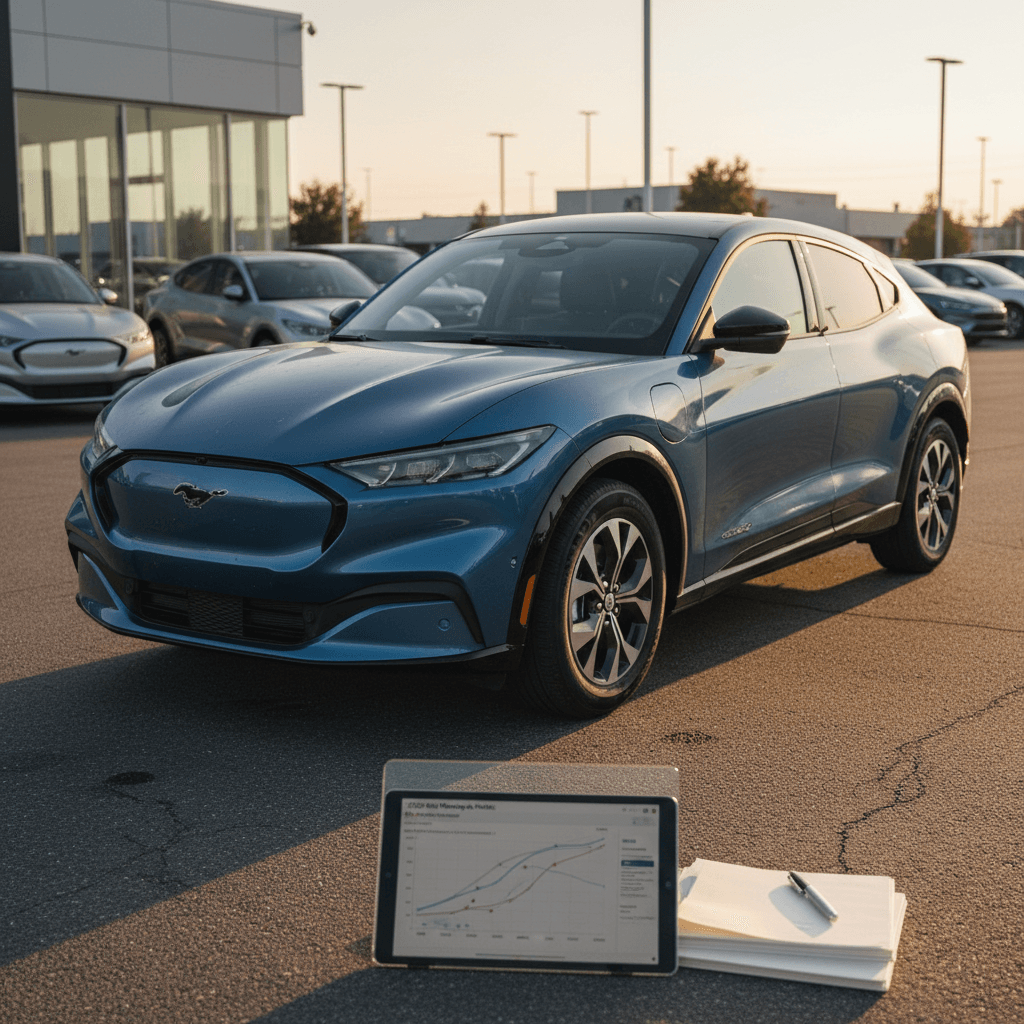
If you’re staring at listings and wondering, “For a Ford Mustang Mach‑E, how much should I offer used?”, you’re not alone. The Mach‑E is a great EV, but it’s also one of the models hit hardest by recent EV depreciation, so paying last year’s prices today is a costly mistake. Let’s walk through what these cars actually trade for in 2026 and how to build a smart offer that protects you.
Key takeaway up front
Why pricing a used Mustang Mach‑E is tricky in 2026
Used EV pricing isn’t behaving like used gas cars. New EV prices have been cut, federal incentives have shifted, and buyers are still learning how to value batteries. The Ford Mustang Mach‑E is a prime example: early models lost value quickly, then stabilized as Ford updated the car and cut new‑vehicle MSRPs. That means **asking prices can be all over the map**, even for similar‑looking SUVs.
- EVs like the Mustang Mach‑E have seen **steeper early‑year depreciation** than comparable gas SUVs.
- Ford has **adjusted new Mach‑E pricing and equipment** several times since 2021, which drags used values around.
- Battery health, fast‑charging history, and software updates now matter as much as leather seats or a sunroof.
Don’t anchor on MSRP
Typical used Mustang Mach‑E prices right now
To decide how much to offer on a used Ford Mustang Mach‑E, you first need a realistic price range. The numbers below reflect recent U.S. retail data as of early 2026 from major pricing guides and listing sites, assuming average mileage and clean history.
Used Mustang Mach‑E price snapshot (early 2026)
Those buckets are **retail selling prices**, not what you should open with. Your target **offer** depends on whether you’re buying from a dealer or a private party, and on the specific vehicle’s story, trim, equipment, miles, accident history, and verified battery health.
Quick reference: realistic used Mach‑E price bands
Approximate U.S. dealer retail price ranges if the vehicle is clean, with typical mileage for its age.
| Model year | Trim examples | Typical retail range* | Notes |
|---|---|---|---|
| 2021–2022 | Select / Premium | $18,000–$27,000 | Early cars with heavier depreciation; price swings a lot with mileage and options. |
| 2023 | Select / Premium / California Route 1 | $22,000–$30,000 | Mid‑cycle models; condition and battery health matter more than model year alone. |
| 2024 | Select / Premium | $25,000–$33,000 | Current sweet spot for value; many are ex‑leases or first owners trading out. |
| 2024–2025 | GT / Rally | $33,000–$42,000+ | High‑performance trims with more power; command a premium if low‑mile and clean. |
| * | , | Varies by region | Use these as starting points, not hard ceilings. High‑demand markets can run higher. |
Use this as a sanity check against wildly optimistic asking prices.
How Recharged prices used Mach‑Es
Understanding depreciation on the Mach‑E
The Mustang Mach‑E has dropped more sharply than some buyers expected. Several independent analyses put the Mach‑E’s **five‑year depreciation in the 55–65% range**, meaning a 5‑year‑old example may be worth **around one‑third to one‑half of its original MSRP**. That sounds brutal, but it can work in your favor as a used buyer, if you don’t overpay.
- Early‑year 2021–2022 Mach‑Es were priced aggressively when new and are now competing with newer, cheaper EVs.
- Ford and competitors have cut prices on new EVs, which pulls used values down behind them.
- Public perception around **battery replacement cost** and **charging access** keeps some shoppers skittish, further pressuring prices.
Why depreciation helps you as a used buyer
Step‑by‑step: how much to offer for a used Mach‑E
Here’s a practical framework you can use for any Ford Mustang Mach‑E, whether you’re shopping a Select commuter or a GT performance model. Think of it as your **offer calculator**.
6‑step offer formula for a used Mustang Mach‑E
1. Establish a clean "fair market" number
Look up the vehicle on at least two guides (for example, KBB and Edmunds) using the correct trim, options, mileage, and ZIP code. Then cross‑check with real listings in your area. Average those into a **working fair‑market price**.
2. Adjust for mileage and condition
Compare the car’s mileage to what’s typical for its age (around 12,000–14,000 miles per year). Add roughly **$300–$500** for significantly below‑average miles; subtract **$500–$1,500** for above‑average miles or noticeable wear, curb rash, or mismatched tires.
3. Factor in battery health and charging history
If you can’t see a **battery health report**, you’re guessing. A strong pack that still holds close to its original usable capacity may justify paying **at or slightly above** guide value. Weak or unknown battery health means you should **discount your offer**, sometimes by several thousand dollars.
4. Account for trim and must‑have options
All‑wheel drive, extended‑range battery, BlueCruise, and popular appearance packages can legitimately raise value. But don’t pay thousands extra for options that don’t matter to you, like a panoramic roof, just because the seller did when new.
5. Decide your walk‑away number
Before you ever test‑drive, decide the **maximum** you’ll pay for this specific car, based on the steps above and your budget. That number should be firm enough that you can walk away if negotiation blows past it.
6. Make a first offer 5–10% below that number
If your research suggests a fair deal is $30,000 from a private seller, an opening offer around **$27,000–$28,000** gives you room to move. With a dealer, you may open **3–7% under** and expect less movement but more perks (detail, software updates, paperwork).
Rule of thumb for offers
Trim, mileage, and options: how they shape your offer
Two Ford Mustang Mach‑Es can look nearly identical in photos but be **thousands of dollars apart** in real value. Trim level, battery size, drivetrain, and mileage all matter when you decide how much to offer.
How key trim choices change what you should offer
Use these patterns to sanity‑check your target price before you negotiate.
Select vs. Premium
Select is the entry trim; Premium adds nicer materials and more features.
- All else equal, a similar‑mile Premium may be worth $2,000–$3,000 more than a Select.
- If you don’t care about upgrades like the panoramic roof, don’t pay top‑of‑market Premium money.
Standard vs. extended range
Extended‑range packs add real‑world range and appeal to road‑trippers.
- They can justify roughly $1,500–$3,000 extra on late‑model used cars.
- Only pay that premium if you’ll actually use the extra range.
RWD vs. AWD
All‑wheel drive helps in bad weather and boosts acceleration.
- In snowy or mountainous regions, expect AWD to add $1,000–$2,000 in used value.
- In warm‑weather urban markets, the gap can be much smaller.
Mileage bands and your offer
Think in broad mileage bands rather than obsessing over tiny differences:
- Under 15,000 miles: Feels almost new; expect to pay near the top of the range for that year/trim.
- 15,000–35,000 miles: Sweet spot for value; modest discount without major wear.
- 35,000–60,000 miles: Increasing discount; scrutinize service history and tire/brake condition.
- 60,000+ miles: Big depreciation; your offer should reflect more wear and unknowns.
Options that actually move value
Some options are nice but don’t move the needle much on resale. Others really do:
- High impact: Extended‑range battery, AWD, performance packages (GT / Rally), advanced driver‑assist suites.
- Medium impact: Premium audio, tow package, upgraded wheels (assuming they’re in good shape).
- Low impact: Cosmetic stripes, minor appearance packages, dealer add‑ons like VIN etching.
When you make your offer, **pay for the things you’d pay for again** if you ordered the car new, and feel free to ignore the rest.
Battery health: the make‑or‑break factor for your offer
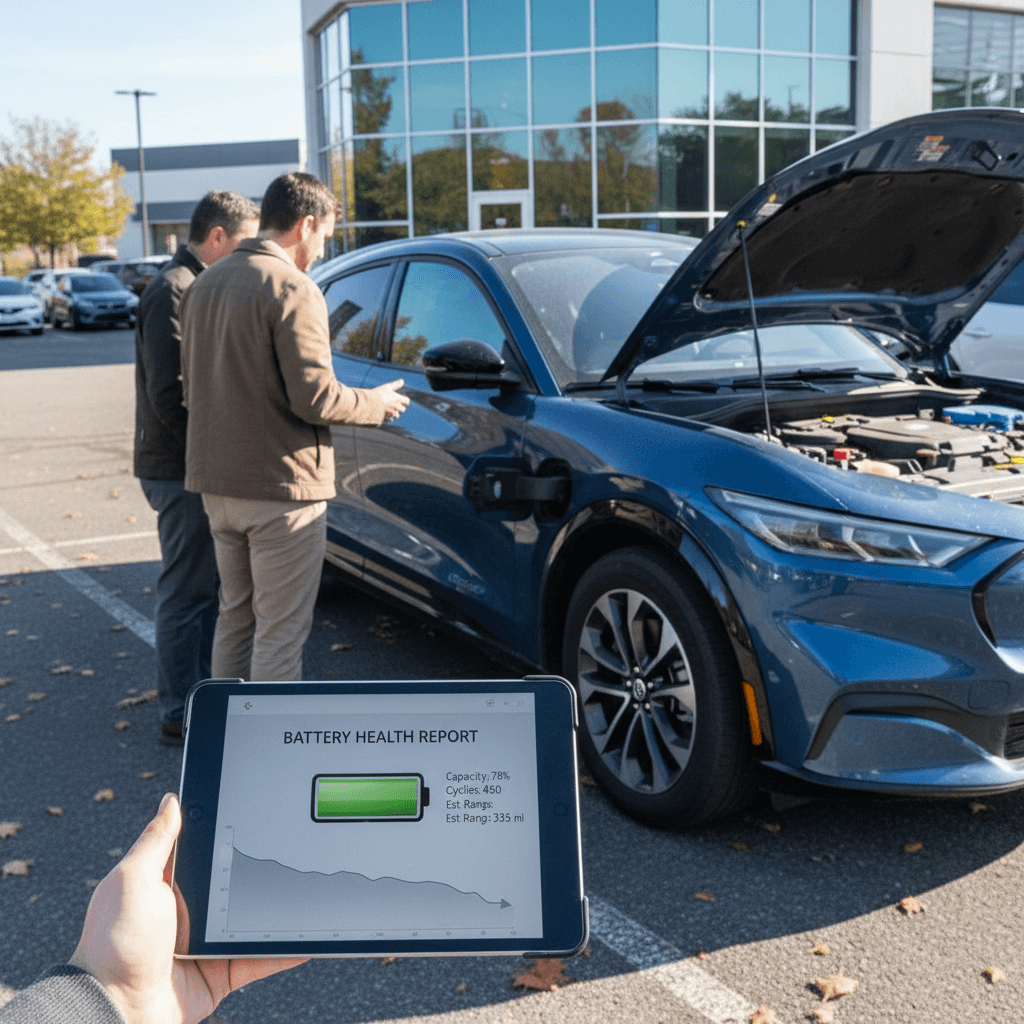
On a used Ford Mustang Mach‑E, battery health is the difference between a bargain and a money pit. Unlike a leather seat, a worn‑down pack quietly steals range and resale value. The smartest buyers treat **battery diagnostics** as non‑negotiable, just like a pre‑purchase inspection on a gas car.
Battery checks before you decide how much to offer
Confirm recent battery diagnostics
Ask for a recent battery health report or have one run. On Recharged, this is included in the Recharged Score so you can see estimated remaining capacity and any fault codes before you bid.
Look for extreme fast‑charging history
A car that lived on DC fast chargers may show more degradation than one mostly charged at home. Heavy fast‑charging isn’t an automatic deal‑breaker, but it may justify a **lower offer**.
Check for software and recall updates
Ford has issued over‑the‑air updates and recalls (including for door latches). A Mach‑E that’s up‑to‑date is both safer and typically worth **more** than a neglected one.
Consider your range needs
If you mostly commute locally, a modestly degraded pack might not matter much, use that to negotiate a discount. If you road‑trip often, pay up for stronger battery health instead of spending on cosmetic extras.
Never skip the battery data
Private seller vs. dealer: how your offer should differ
The same Mustang Mach‑E will support **different offers** depending on who’s selling it. Dealers bake in reconditioning, overhead, and profit. Private sellers often just want to move on, but may be emotionally attached to the car.
How your offer strategy changes by seller type
Use this to calibrate your first number and how hard you push.
Buying from a dealer
- Expect asking prices near the top of market ranges.
- Opening offer: typically 3–7% below fair market value for that car.
- Look for value in the package: reconditioning, fresh tires, warranty, software updates, easy financing.
- On a $32,000 2024 Premium, starting around $29,500–$30,500 is realistic in many markets.
Buying from a private seller
- Asking prices may be ambitious but there’s often more flexibility.
- Opening offer: typically 5–10% below your researched fair price.
- Emphasize recent comparable sales and any costs you’ll have to eat (new tires, detail, registration).
- On that same $32,000‑fair‑value car, a first offer around $28,500–$29,000 is reasonable if the seller is motivated.
Where Recharged fits in
Negotiation playbook for a used Mustang Mach‑E
Once you know your target number, negotiation becomes a lot less stressful. You’re not haggling in the dark, you’re carefully explaining how you arrived at your offer.
- Open with your research, not your number. Start by talking through trim, miles, options, and recent comparable sales.
- Share a concise story: “Similar 2024 Mach‑E Premiums with around 20,000 miles are selling between $28,000 and $31,000 in this area.”
- Then make your first offer and stay quiet. Let the seller react and counter.
- Trade price for real value, not air. If the dealer won’t budge on price, ask for fresh tires, a brake service, or an additional warranty term instead.
- Use time to your advantage. End‑of‑month or a car that’s been listed for weeks is usually easier to negotiate.
“The best offer isn’t about winning a staring contest. It’s about knowing the market better than the person across the table, and being willing to walk when the numbers stop making sense.”
Three example offer scenarios
Let’s plug real numbers into this framework so you can see how “Ford Mustang Mach‑E, how much to offer used?” plays out in practice.
Sample offer scenarios for different used Mach‑Es
Illustrative examples only; always adjust for your local market and the specific vehicle.
| Scenario | Vehicle details | Fair value estimate | Opening offer | Likely landing zone |
|---|---|---|---|---|
| 1. 2024 Select from private seller | RWD, standard range, 18,000 miles, clean history, average options | $26,000 | $23,500–$24,000 | $25,000–$25,500 |
| 2. 2024 Premium from dealer | AWD, extended range, 22,000 miles, great service history, recent tires | $31,500 | $29,500–$30,000 | $30,500–$31,000 |
| 3. 2023 GT from dealer | AWD, performance pack, 32,000 miles, some wheel rash, older tires | $30,000 | $27,500–$28,000 | $28,500–$29,000 |
Target both a fair deal for you and something the seller can realistically accept.
How financing changes the math
Common pricing mistakes to avoid
- Paying a huge premium for a high‑trim GT when you’ll never use the extra performance.
- Ignoring **tire and brake condition**, those wear items can be a four‑figure bill on a heavy EV like the Mach‑E.
- Focusing only on model year instead of range, equipment, and battery health.
- Letting a dealer’s monthly payment pitch distract you from the actual sale price and total interest paid.
- Making a full‑ask offer on day one because you’re afraid someone else will grab the car.
Don’t chase the wrong "deal"
FAQ: used Mustang Mach‑E pricing and offers
Your top questions answered
Bottom line: how much to offer
In early 2026, a realistic offer on a used Ford Mustang Mach‑E usually lands somewhere between the **mid‑$20,000s and high‑$30,000s**, depending on year, trim, miles, and, above all, battery health. Instead of chasing a magic number, use a process: research fair value, adjust for the specific vehicle, and open 5–10% below that number with the discipline to walk away if the deal stops making sense.
If you’d rather skip the guesswork, shopping a used Mustang Mach‑E on Recharged gives you **transparent pricing, a Recharged Score battery report, expert EV guidance, and flexible financing or trade‑in options**. That way, the only real question left is which Mach‑E fits your life, not whether you paid too much for it.