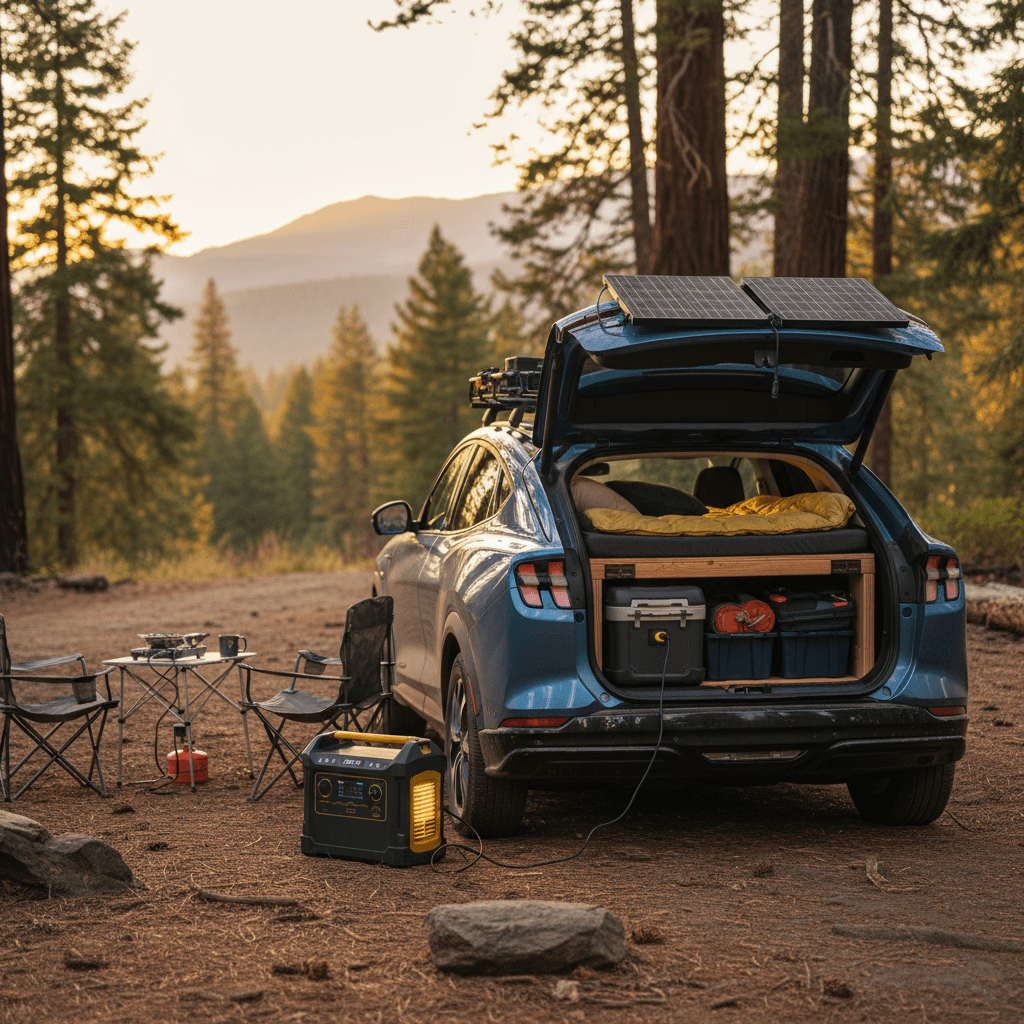
You bought the Ford Mustang Mach-E for its torque and tech, not because you dreamed of sleeping in it. And yet here you are, Googling a Ford Mustang Mach-E camping setup guide and wondering if this electric pony can double as a tiny cabin on wheels. The answer is yes, with a bit of planning, the Mach-E can be a quiet, climate-controlled, battery-powered basecamp that embarrasses half the RVs at the trailhead.
Big Picture
Why the Mustang Mach-E Makes a Surprisingly Good Camper
Four Mach-E Traits That Work in Your Favor
You’re not starting with a Sprinter, but you do have some real advantages.
Silent, Efficient Overnight HVAC
One of the biggest perks of EV camping is silent climate control. No idling engine, no fumes, just the hum of fans. The Mach-E’s heat pump (standard or available on recent model years) makes overnight heating and cooling surprisingly efficient compared with resistive heaters.
Flat(ish) Cargo Area
With the rear seats folded, you get close to 60 cubic feet of cargo space and roughly 69 inches of length from hatch to front seat backs. That’s enough for most folks to stretch out diagonally on a platform or mattress with some creativity.
Big Built-In Power Bank
Your Mach-E’s battery holds far more energy than any camping power station. Even using just a conservative slice of the pack gives you hours of HVAC, lighting, and device charging, perfect for long weekends off-grid between fast-charging stops.
No Idling, No Emissions
Because there’s no tailpipe, you can safely run climate control in enclosed campsites where idling a gas vehicle would be obnoxious or banned. It’s easier on the environment and your lungs.
Reality Check
Key Mach-E Dimensions That Matter for Camping
Mustang Mach-E Interior & Cargo Specs (Camping-Relevant)
Dimensions vary slightly by model year and trim, but you can plan around roughly 70 inches of length with the rear seats folded, just under 60 inches of width at the beltline, and a cargo floor height that makes loading easy but eats into headroom. If you’re over about 6 feet tall, assume you’ll be sleeping diagonally or on a compact platform that extends between the folded seats and the front seat backs.
Measure Your Own Car
Choosing Your Mach-E Camping Style
1. Full Inside Sleeper (Most Common)
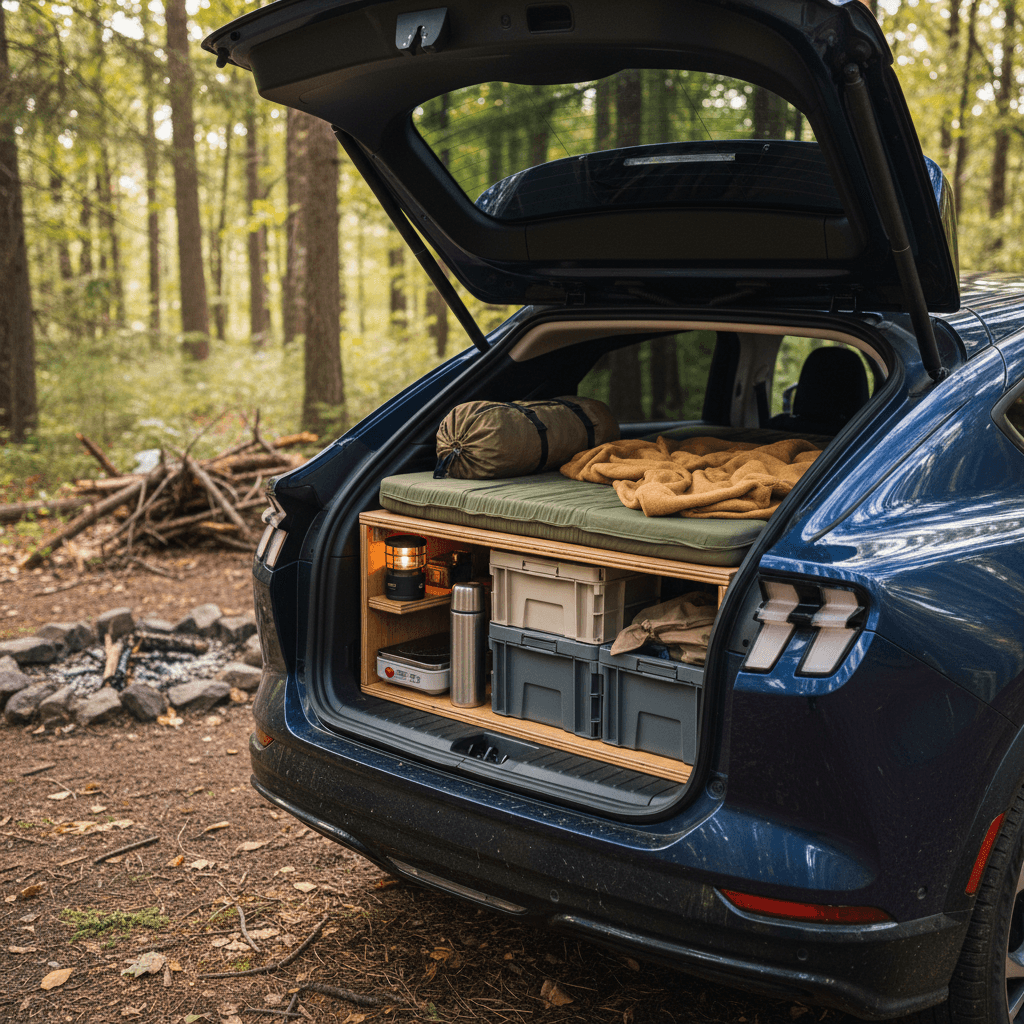
You remove or fold the parcel shelf, fold the rear seats, slide the front seats forward, and create a flat sleeping surface from the hatch to the back of the front seats. Storage goes under and beside the bed plus into the frunk.
- Best for: Solo campers or couples who don’t mind tight quarters.
- Pros: Maximum weather protection, quick setup, stealthy in parking lots.
- Cons: Limited headroom, more gear Tetris.
2. Car + Tent Hybrid
The Mach-E carries your gear, powers your stuff, and may host one person sleeping inside, while others use a ground tent or hatch tent that seals to the rear opening.
- Best for: Families or friends, longer stays at one site.
- Pros: More living space, easier to dress and move around.
- Cons: Slower to set up, loses the stealth factor.
3. Roof Tent + Power Base
If you’re willing to invest, a properly rated roof rack and rooftop tent let the Mach-E act as a battery sled and gear hauler, while you sleep up top.
- Best for: Frequent campers, overland-curious drivers.
- Pros: Comfortable sleep, interior stays free for storage.
- Cons: Added weight and drag, can reduce range noticeably.
4. Minimalist Overnight Mode
You don’t commit to a built-out bed at all. Instead, you pack a folding pad or compact inflatable and only convert the cargo area to a sleeping zone when absolutely necessary, say, when you can’t find a vacancy near a national park.
- Best for: Road-trippers who mostly use hotels or cabins.
- Pros: Cheap, flexible, no permanent mods.
- Cons: Less comfortable, more time to set up at night.
Step-by-Step Mach-E Sleeping Setup
Build a Flat, Comfortable Sleeping Area
1. Clear and Level the Cargo Area
Remove the cargo cover and any rigid floor panels you don’t need. Fold the rear seats flat. If your seats leave a small step between the hatch floor and seat backs, fill it with a foam wedge, cut plywood, or dense camp pads to create a more level surface.
2. Decide on Platform vs. Direct-on-Floor
For most people, a <strong>2–4 inch self-inflating camping mattress</strong> or tri-fold foam pad directly on the floor works fine. If you want organized storage, build a low platform with cubbies underneath for bins and shoes.
3. Slide Front Seats Forward and Upright
Move the front seats forward and tilt the backs more upright to maximize length behind them. If you’re tall, experiment with how much you can slide the passenger seat forward without losing a safe driving position for the next day.
4. Add Window Shades and Ventilation
Use reflective shades or custom-cut insulation panels for the windshield and windows. For side windows, magnetic or clip-on mesh shades add privacy and reduce condensation while still letting air circulate when you crack the glass slightly.
5. Dial In Your Bedding
Bring a compact but warm sleeping bag or a properly sized duvet, plus low-profile pillows. Remember the roofline, tall camp pillows will put your face uncomfortably close to the headliner. Thinner, denser pillows work better in the Mach-E.
6. Set Up a Nightstand Zone
Designate a small area, often the rear door pocket or an organizer hanging from the front seat, for phone, glasses, water bottle, headlamp, and keys. You don’t want to go spelunking at 2 a.m. because your phone slid under the platform.
Safety First
Using HVAC Overnight Without Killing the Battery
This is where the Mach-E shines. You can maintain a comfortable cabin temperature all night without the racket and fumes of a gas engine. The trick is balancing comfort, condensation, and state of charge (SoC) so you wake up warm and still have the range to reach a fast charger.
Overnight HVAC Best Practices
Keep your cabin cozy and your battery happy.
Target 68–72°F (20–22°C)
Set the climate control to a moderate temperature instead of blasting max heat or AC. Lower deltas from outside temp are easier on the battery and still comfortable with a good sleeping bag.
Start Above ~40–50% SoC
As a rule of thumb, try to arrive at camp with at least 50% charge if you plan to run HVAC all night, especially in colder weather.
Understand Cold-Weather Penalties
Below freezing, HVAC can use several kWh over the night. That’s still manageable, but don’t show up at a remote trailhead in January at 25% and expect to wake up with plenty of range.
Crack Windows Slightly
Even with HVAC, sleeping humans add moisture. Crack the front windows a fraction or use vent visors to reduce condensation on glass and keep the cabin fresher.
Use "Auto" Rather Than Micromanaging
Let the car’s climate system modulate fan speed and compressor use. Constantly fiddling burns more power and makes it harder to sleep.
Think in kWh, Not Just Percent
On a large pack Mach-E, 10% might be 7–8 kWh. Overnight HVAC could use a low single-digit kWh in mild temps and more in deep cold. Plan accordingly.
Camp Mode Workaround
Powering Your Camp With the Mach-E
Some Mach-E trims and accessories give you access to 120V outlets or 12V ports you can use for low-draw devices: phones, laptops, LED lights, maybe a tiny fan. Even if you don’t have full-blown vehicle-to-load (V2L) hardware, you still have options to use the car as a giant battery bank.
Common Ways to Tap Mach-E Power While Camping
Match your devices to the safest, most efficient power source.
| Power source | Typical use | Pros | Watch out for |
|---|---|---|---|
| USB ports | Phones, tablets, small gadgets | Most efficient, built-in, low risk | Limited total output; use short, quality cables |
| 12V outlet | Inflators, small fans, low-watt fridges | Widely compatible with automotive accessories | Don’t exceed outlet amp rating; avoid cheap inverters |
| Factory 120V outlet (if equipped) | Laptops, camera chargers, low-watt appliances | Standard AC plug, very convenient | Stay within wattage limits; avoid heat-heavy devices |
| Third-party power station charged from car | Lights, fridge, laptops, drone chargers | Offloads peak draws from vehicle systems | Inefficiencies in double-conversion; charge during driving, not while parked |
Always check your owner’s manual and adapter ratings before plugging in new devices.
Skip the Air Conditioner in a Box
Packing Strategy: Frunk, Hatch, and Cabin Storage
The difference between a Zen EV cabin and an avalanche of nylon and cookware is how you use the Mach-E’s front trunk, rear hatch, and underfloor storage. Newer model years have seen the frunk shrink and even become optional, so you’ll tailor this to your specific car.
Smart Storage Zones in a Mach-E
Assign every item a home before you leave the driveway.
Rear Hatch: Bulky but Light
Sleeping pad or platform, bedding, camp chairs, duffel bags with clothing, and soft-sided food totes live here. Pack light, squishable items on top so you can still close the hatch even if you add a last-minute jacket.
Underfloor Cubby: Dirty or Dense
Use the spare-tire well or underfloor compartment for things you don’t want in bed with you: leveling blocks, small tool roll, compressor, recovery straps, and extra cables.
Frunk: Kitchen & Daily-Use Items
If your Mach-E has a frunk, it’s a great place for camp kitchen gear: stove, compact fuel canisters if allowed where you’re going, pots, and utensils. It keeps smells away from your sleeping area.
Back Seat Footwells: Shoe Locker
Line at least one rear footwell with a small tray or rugged mat. This becomes your muddy boot graveyard at night so you don’t drag half the trail into bed.
Seatback Organizers: Tiny Stuff
Seatback or door-pocket organizers are perfect for toiletries, headlamps, charging cables, and park passes. You’ll touch this stuff constantly, keep it within arm’s reach from the sleeping area.
Cooler or Fridge: Just Behind Front Seats
If you’re using a 12V cooler or compact fridge, place it where you can reach it from the hatch and front seats. Secure it with straps so it doesn’t become a projectile in hard braking.
Battery Planning for EV Camping Trips
Camping in an EV is a range-management game. The good news: the Mach-E’s DC fast-charging ability and big pack make that game winnable. The bad news: remote campgrounds don’t always come with 150 kW DC plugs attached.
Simple Battery Game Plan for a Weekend Trip
1. Start the Weekend at or Near 100%
Top off at a DC fast charger or home Level 2 before you leave civilization. This gives you the most flexibility if weather or traffic changes your plans.
2. Budget Energy for the Drive, the Night, and the Exit
Think in segments: there’s the drive to camp, overnight HVAC and gadgets, and the drive back out to a fast charger. For many trips, you can easily afford <strong>5–10% of the battery</strong> for overnight comfort and still have plenty left to reach the next station.
3. Favor Campsites Near Main Corridors
If you’re new to EV camping, pick sites within reasonable distance of major interstates or towns with multiple fast chargers. As you gain experience and data for your Mach-E, you can push into more remote areas.
4. Know Your Worst-Case SoC
Decide in advance: what’s the lowest state of charge you’re comfortable waking up with? For many owners, <strong>20–25%</strong> is a healthy floor that lets you reach a charger without drama.
5. Charge While You Explore
If there’s a DC station or Level 2 in the nearest town, consider a late-morning top-up while you grab coffee or hike a nearby loop. It’s easier to add 20% opportunistically than to scramble from 8% the next morning.
6. Weather-Adjust Your Plans
In winter or extreme heat, assume higher HVAC usage and lower driving efficiency. Shorten legs between chargers and arrive at camp with extra buffer until you know how your Mach-E behaves in those conditions.
Consider a "Hub and Spoke" Strategy
Essential Gear for a Mach-E Camping Setup
- 2–4 inch compact camping mattress or tri-fold foam pad sized to the cargo area
- Low-profile pillows and a good 3-season sleeping bag or comforter
- Reflective or insulated window covers (especially for windshield and panoramic roof)
- Seatback or hanging organizers for small items and toiletries
- Compact LED lanterns or string lights with USB charging
- Collapsible bins or duffels sized to fit under or beside your bed platform
- A small brush or handheld vacuum to keep grit under control
- 12V tire inflator and basic tool kit
- Optional: a small lithium power station you can charge while driving for extra outlets at camp
- Optional: bug screens or mesh sleeves for slightly open side windows
Used EV Bonus
Common Mistakes to Avoid When Camping in a Mach-E
Don’t Learn These Lessons the Hard Way
EV camping is forgiving, until it isn’t.
Arriving at Camp Nearly Empty
Rolling into a remote campground at 12% and then running HVAC overnight is an anxiety factory. Build a buffer into your trip plan, charge before the last long climb or dirt-road stretch.
Ignoring Condensation
Two humans breathing all night in a tightly sealed cabin equals wet glass and damp bedding. Crack a window slightly and use moisture-wicking fabrics.
Overpacking Hard Gear
Solid crates and giant plastic totes look tidy but don’t flex. Soft duffels and compressible bags are your friends in the Mach-E’s rounded cargo area.
Forgetting About Solar Gain
That big glass roof can turn the cabin into a greenhouse. Use reflective shades on the roof and park in shade when possible, especially in the Southwest.
Blocking Exits and Controls
Don’t bury the front seats, door handles, or hazard switch under piles of gear. In an emergency, you need to be able to drive or exit quickly.
Building Irreversible Mods
Permanent platforms screwed into factory mounting points might hurt resale and complicate maintenance. Favor bolt-in or removable builds that preserve the car’s value.
FAQ: Mach-E Camping Questions Answered
Ford Mustang Mach-E Camping FAQ
How Recharged Can Help You Find a Camp-Ready Mach-E
If you’re reading camping guides for the Ford Mustang Mach-E, you’re clearly not buying a crossover just to sit in traffic. You want a car that can haul you and your gear to the trailhead, then double as your shelter when the stars come out. That’s exactly where a smartly chosen, well-documented used Mach-E shines.
At Recharged, every Mach-E comes with a Recharged Score battery health report, so you know how much real-world range you’re working with before you ever pack a sleeping bag. Our EV specialists can walk you through which trims are best for camping, heat pump vs. resistive heat, glass roof vs. metal, driver-assist features for long highway days, and help you compare total ownership costs against other EVs you’re considering.
You can browse vehicles online, get an instant offer on your trade-in, line up financing, or even handle the entire purchase digitally, then have your Mach-E delivered to your driveway, ready for its first shakedown night in the backyard. When you’re ready to turn those backyard test runs into real trips, you’ll already know exactly how your new electric campsite behaves.
Think of the Mach-E as a fast, quiet, all-electric trailhead shuttle with a cozy studio apartment hidden under the hatch. Get the setup right, and you don’t just own another crossover, you own your own little moving cabin. And that’s when an EV stops being just a commuter and starts becoming part of your life’s best stories.