The Ford Mustang Mach-E is one of the most popular electric SUVs in the U.S., but trims, batteries, software, and recalls can make buying one, especially used, more complicated than grabbing a typical gas crossover. This Ford Mustang Mach-E buying checklist walks you step by step through trims, range, battery health, recalls, and inspection points so you can shop with confidence.
Who this checklist is for
Why the Mustang Mach-E is a smart, but complex, buy
The Mach-E combines Ford’s mainstream dealer network with strong performance, competitive range (up to around 320 miles on certain trims), and a familiar SUV form factor. But it has seen multiple battery configurations, software updates, and several recalls, plus price and feature changes nearly every model year. Going in with a structured checklist keeps you from overpaying or inheriting someone else’s headaches.
Key Ford Mustang Mach-E numbers to know
Quick Ford Mustang Mach-E buying checklist
10 things to verify before you sign
1. Confirm trim, battery & drivetrain
Identify whether the car is Select, Premium, GT, Rally, etc., and whether it has the standard‑range or extended‑range battery and RWD or AWD. These three factors drive range, performance, and price.
2. Match EPA range to your use case
Compare the trim’s EPA‑rated range to your commute, climate, and road‑trip habits. Leave a 20–30% buffer for winter, high speeds, and battery aging.
3. Get an objective battery health report
For a used Mach‑E, don’t rely only on the dash range estimate. Use a <strong>third‑party battery test</strong> like the Recharged Score Report to see remaining capacity and fast‑charging history.
4. Check Ford recall status by VIN
Run the VIN through NHTSA or Ford’s recall lookup to confirm all safety recalls, especially door-latch and camera‑software campaigns, are already completed.
5. Inspect charging hardware & cables
Verify the mobile charge cord is included, test the charge port door and connector, and confirm the car charges properly on both Level 2 and (if possible) a DC fast charger.
6. Inspect interior tech & software
Test the 15.5" SYNC screen, rear camera, parking sensors, Bluetooth, Apple CarPlay/Android Auto, and navigation. Make sure over‑the‑air updates are enabled and the car is on a recent software build.
7. Evaluate BlueCruise status
If the car has Ford BlueCruise hardware, confirm whether the subscription is active, trial‑only, or expired, this materially changes the car’s value for highway drivers.
8. Review service history
Ask for Ford dealer service records. Look for high‑voltage system work, repeated electronic glitches, or accident repairs that might affect alignment or safety systems.
9. Run realistic cost-of-ownership math
Compare payment, insurance, electricity vs. gas, and expected depreciation. A steeply depreciated used Mach‑E can undercut new‑car monthly cost significantly if you plan to keep it.
10. Do a focused EV test drive
On the test drive, focus on ride quality, one‑pedal driving behavior, brake feel, wind noise, and how quickly range drops at your typical speeds.
Step 1: Choose the right Mach-E trim and battery
Your first decision is which Mach‑E you actually want. Across 2021–2026, Ford has offered Standard‑Range and Extended‑Range batteries, rear‑wheel drive (RWD) and all‑wheel drive (eAWD), and trims like Select, Premium, California Route 1 (earlier years), GT, and Rally. Each combination changes range, performance, and price.
Common Mustang Mach-E buyer profiles
Match your use case to a trim and battery setup
Daily commuter & family hauler
Likely best fit: Select or Premium, Standard‑Range battery, RWD or eAWD.
- Lower upfront price, plenty of power.
- EPA range roughly mid‑200 miles is enough for most daily driving.
- Look for heated seats/wheel in colder climates.
Road‑trip & heavy‑mileage driver
Likely best fit: Premium with Extended‑Range battery, RWD or eAWD.
- Target EPA range near the 300–320‑mile mark when new.
- Pair with robust DC fast‑charging access and Level 2 at home.
- Battery health matters more here, prioritize low‑degradation cars.
Performance enthusiast
Likely best fit: GT or Rally (later years) with Extended‑Range battery and eAWD.
- 0–60 mph in the low‑3‑second range on some GT Performance versions.
- More aggressive suspension and tires; expect firmer ride and higher tire wear.
- Make sure performance tires and brakes aren’t worn out if buying used.
Trim & battery considerations at a glance
Use this table as a starting point. Exact figures vary by model year, wheel size, and options, but the patterns hold across the lineup.
| Configuration | Typical EPA range (when new) | Pros | Cons |
|---|---|---|---|
| Standard‑Range RWD | ~240–260 mi | Lower price; lighter weight; enough for many commuters. | Less buffer for winter, high speeds, or future degradation. |
| Standard‑Range eAWD | ~230–250 mi | Better traction; strong acceleration. | More energy use in bad weather; slightly less range vs. RWD. |
| Extended‑Range RWD | ~300–320 mi | Best mix of range and efficiency; great for road‑trip planners. | Higher MSRP; can be hard to find on used market in some regions. |
| Extended‑Range eAWD (GT / Rally) | ~260–300 mi | Maximum performance and traction; still solid range. | Most expensive to buy and insure; firmer ride, higher tire costs. |
Extended‑range batteries cost more upfront but deliver extra comfort for long‑distance drivers.
Trim & battery negotiation tip
Step 2: Check range vs your real-world driving
EPA figures are a useful benchmark, but real‑world Mach‑E range depends on how and where you drive. Cold weather, high interstate speeds, roof racks, heavy cargo, and big‑wheel performance trims can all pull you below the sticker number.
Questions to ask yourself
- What’s your longest regular round‑trip, including kids’ activities and errands?
- How many highway miles at 70–80 mph do you drive each week?
- Do you face winters with sustained freezing temps or mostly mild weather?
- Can you charge every night at home, or will you rely on public charging?
Practical range rule of thumb
Take the original EPA range for that trim, subtract 20–30% to account for winter, highway speeds, and some battery aging. If that reduced number still comfortably covers your normal days with a buffer, the configuration likely works for you.
Example: An extended‑range Premium RWD rated around 320 miles may feel more like 225–260 miles in harsh winter highway use after a few years.
Watch for aggressive wheel/tire packages
Step 3: Evaluate battery health and warranty
With any used EV, battery health is the main asset you’re buying. The good news: Mach‑E packs have an 8‑year/100,000‑mile high‑voltage battery warranty on most model years, and real‑world degradation has generally been moderate when cars are charged and stored reasonably.
Battery health checklist for a used Mach-E
1. Confirm warranty status
Ask the seller for the in‑service date so you know when the 8‑year/100,000‑mile battery warranty clock started. A 2022 Mach‑E first sold in 2023 might still have many years of coverage left.
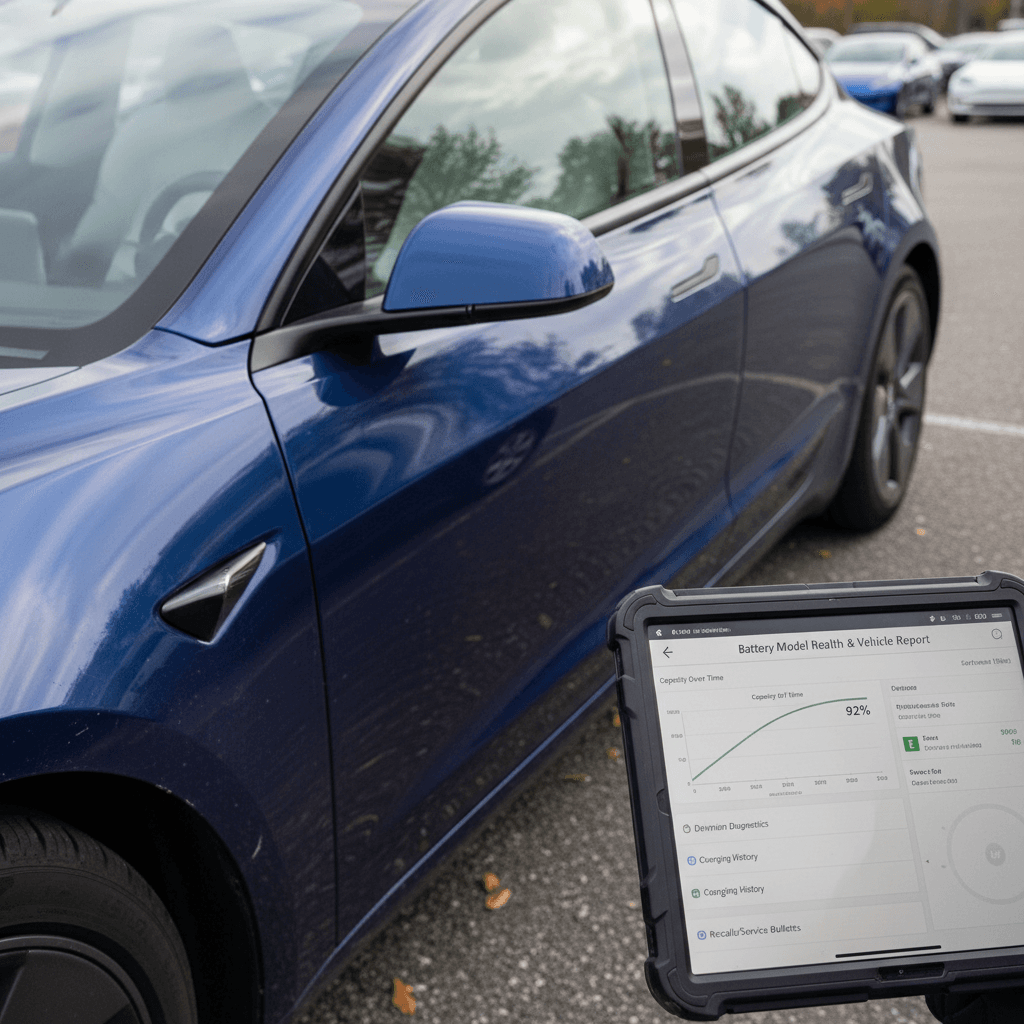
2. Review a battery health report
Use a <strong>Recharged Score Report</strong> or similar diagnostic to measure remaining usable capacity and look for signs of abnormal degradation or frequent DC fast charging.
3. Inspect charging history patterns
If possible, review telematics or app data: was the car often charged to 100% and left sitting, or frequently fast‑charged from very low state of charge? Occasional fast charging is fine; extreme patterns can speed up wear.
4. Compare indicated range to spec
At 80–90% charge, compare the dashboard’s predicted range to the original EPA figure for that trim. A meaningful gap doesn’t always equal battery damage, but it’s a good conversation starter about software updates and usage.
5. Check for error messages or warnings
Scan the cluster for high‑voltage system warnings, reduced power messages, or any amber/red alerts. If any appear, don’t proceed without a professional EV inspection.
How Recharged handles battery risk
Step 4: Inspect charging options, home and public
Charging is where many first‑time EV buyers get tripped up. The Mach‑E supports Level 1 (120V), Level 2 (240V), and DC fast charging, and newer models can use Tesla Superchargers via the BlueOval Charge Network. Before you buy, make sure the car’s charging hardware matches your life.
Your Mach-E charging game plan
Cover home, workplace, and road‑trip needs before you buy
Home charging
- Can you install a 240V Level 2 outlet or wall box in your garage/driveway?
- Verify whether the car comes with Ford’s mobile charge cord.
- Budget for installation if you don’t already have 240V service in place.
Work & destination charging
- Check if your workplace, apartment, or nearby garages offer Level 2 charging.
- Ask about pricing and time limits, some are free, others pricey.
- Test your access card/app before you rely on it.
Road‑trip & fast charging
- Create accounts with major networks (e.g., BlueOval, Electrify America, Tesla where supported).
- Confirm the specific car has access to Tesla Superchargers in your area.
- On a test drive, try at least one DC fast charge session if possible.
Plan around your actual zip code
Step 5: Review recalls and common issues
The Mustang Mach‑E has seen several high‑profile recalls and software campaigns since launch. Most are fixable via software updates or dealer visits, but you do not want to inherit a car that’s behind on safety fixes.
- Electronic door‑latch software that can allow doors to remain locked and trap passengers if the battery is low (affecting many 2021–2025 builds).
- Rearview‑camera software glitches that can freeze or fail to display when reversing.
- High‑voltage contactor issues on some early builds that could cause a loss of power under high load.
- Assorted SYNC infotainment bugs, including freezing screens or lost connectivity, often addressed by over‑the‑air updates.
Recall and reliability checklist
1. VIN recall lookup
Enter the VIN on the NHTSA website or Ford’s recall page. Every listed recall should show as “completed” with dates, or you should get proof the appointment is scheduled.
2. Ask for dealer repair history
A Ford dealer can typically pull a service history report showing recall work, module updates, and major repairs. Repeated visits for the same electrical issue are a red flag.
3. Test manual door releases
With the car in Park, verify that <strong>interior manual door releases</strong> work on all doors so passengers can exit even if electronics misbehave.
4. Stress‑test the camera & sensors
Put the car in Reverse several times, watching the backup camera and parking sensors for lag, freezing, or error messages.
5. Check for current software level
In the settings menu, confirm the car is on a recent SYNC and vehicle‑software version and that over‑the‑air updates are enabled.
Don’t ignore unresolved safety recalls
Step 6: Check tech features and driver assistance
A lot of the Mach‑E’s appeal comes from its tech stack: big center screen, phone‑as‑key, BlueCruise hands‑free driving, and OTA updates. On a used car, you want to verify what’s included, what’s a paid subscription, and what actually works.
Must‑test tech on your Mach-E
Many of these features impact value and safety
Infotainment & connectivity
- SYNC 4A responsiveness: open menus, map, and settings quickly.
- Apple CarPlay / Android Auto: both wired and wireless, if supported.
- Bluetooth pairing with multiple phones; phone‑as‑key where equipped.
- Built‑in navigation and EV route planning (if present).
Driver‑assist & safety
- Adaptive cruise and lane‑centering performance on a test drive.
- BlueCruise availability, activation status, and expiration date.
- Blind‑spot monitoring, cross‑traffic alert, and parking sensors.
- Automatic emergency braking and forward‑collision alerts.
BlueCruise subscription reality check
Step 7: Run the numbers, total cost and resale
As an EV, the Mach‑E can save significantly on fuel and maintenance versus a comparable gas SUV, but depreciation is steep in the first few years. That’s bad news for first owners, and opportunity for used‑car shoppers who buy carefully.
Key cost factors to model
- Purchase price vs. new: Compare your target used price to current new‑car incentives and financing.
- Electricity vs. gas: Estimate home charging cost using your kWh rate and typical monthly miles.
- Insurance: Quotes can vary widely between trims and regions.
- Maintenance & tires: EVs skip oil changes but performance trims wear tires and brakes faster.
Why used can be a sweet spot
Two‑ to three‑year‑old Mach‑E models have already taken a large depreciation hit while still sitting inside the battery warranty window. Provided you confirm good battery health and clean title history, you can often get near‑new tech for a significantly lower monthly cost.
If you’re buying from Recharged, our pricing already bakes in battery condition and current market comparables, so you’re not guessing at fair value.
Step 8: Final physical inspection & test-drive checklist
Once you’ve narrowed down a specific Mustang Mach‑E, use this inspection and test‑drive checklist to catch issues photos and spec sheets won’t show.
Physical inspection & road-test checklist
Exterior & body
Walk the car in good daylight. Look for panel‑gap inconsistencies, mismatched paint, and curb rash on the wheels. Inspect the charge port door for smooth opening and closing and check the tailgate for proper alignment and smooth power operation.
Tires, wheels & brakes
Check for even tire wear and sufficient tread depth, especially on GT and Rally trims. On the test drive, listen for brake squeal or grinding and feel for vibration under hard braking.
Interior condition & features
Test every seat adjustment, window, and lock. Verify heated seats, heated steering wheel, and panoramic glass shade (if equipped) all function. Check for water stains around the glass roof seals.
On‑road behavior
On a mixed test route, pay attention to steering feel, lane‑keeping smoothness, suspension noise over bumps, and wind noise at highway speed. Try one‑pedal drive and make sure you’re comfortable with its behavior.
Charging & thermal control
If possible, start a Level 2 or DC fast charge during your visit and watch how quickly the car ramps up. While driving, verify that cabin heating and A/C work well and don’t trigger odd noises from the heat‑pump system on newer models.
Paperwork & history
Confirm title status (no salvage or flood branding), check for a clean Carfax/AutoCheck, and make sure the VIN on the paperwork matches the car. Ask for both physical keys and make sure each works with phone‑as‑key settings where applicable.
How Recharged helps with used Mustang Mach-E shopping
If you like the idea of a used Mustang Mach‑E but not the idea of deciphering battery reports and recall histories alone, Recharged is built for you. We focus on used EVs only, with tools and services tailored to exactly these questions.
Why shop a used Mach-E through Recharged
EV‑specific data, pricing, and support, not generic used‑car guesswork
Recharged Score battery diagnostics
Every EV we list comes with a Recharged Score Report that verifies battery health using real diagnostic data, not just odometer readings.
Fair market EV pricing
Our pricing reflects current EV market conditions, battery health, and equipment, so you see whether a Mustang Mach‑E is fairly priced in today’s market.
Financing, trade‑in & delivery
Get EV‑friendly financing, instant trade‑in or consignment options, and nationwide delivery, plus in‑person help at our Experience Center in Richmond, VA.
Ready to find your next EV?
Browse VehiclesGuided EV purchase from start to finish
Ford Mustang Mach-E buying checklist: FAQ
Common questions about buying a Ford Mustang Mach-E
A Ford Mustang Mach‑E can be a compelling EV, especially on the used market, if you take a disciplined approach. Use this buying checklist to confirm the right trim and battery, verify range and battery health, check recalls and software status, and put the car through a real EV‑focused test drive. If you’d rather not tackle that alone, browsing Mach‑E inventory on Recharged gives you transparent battery health data, fair pricing, EV‑savvy support, and delivery options that make the switch to electric far easier.