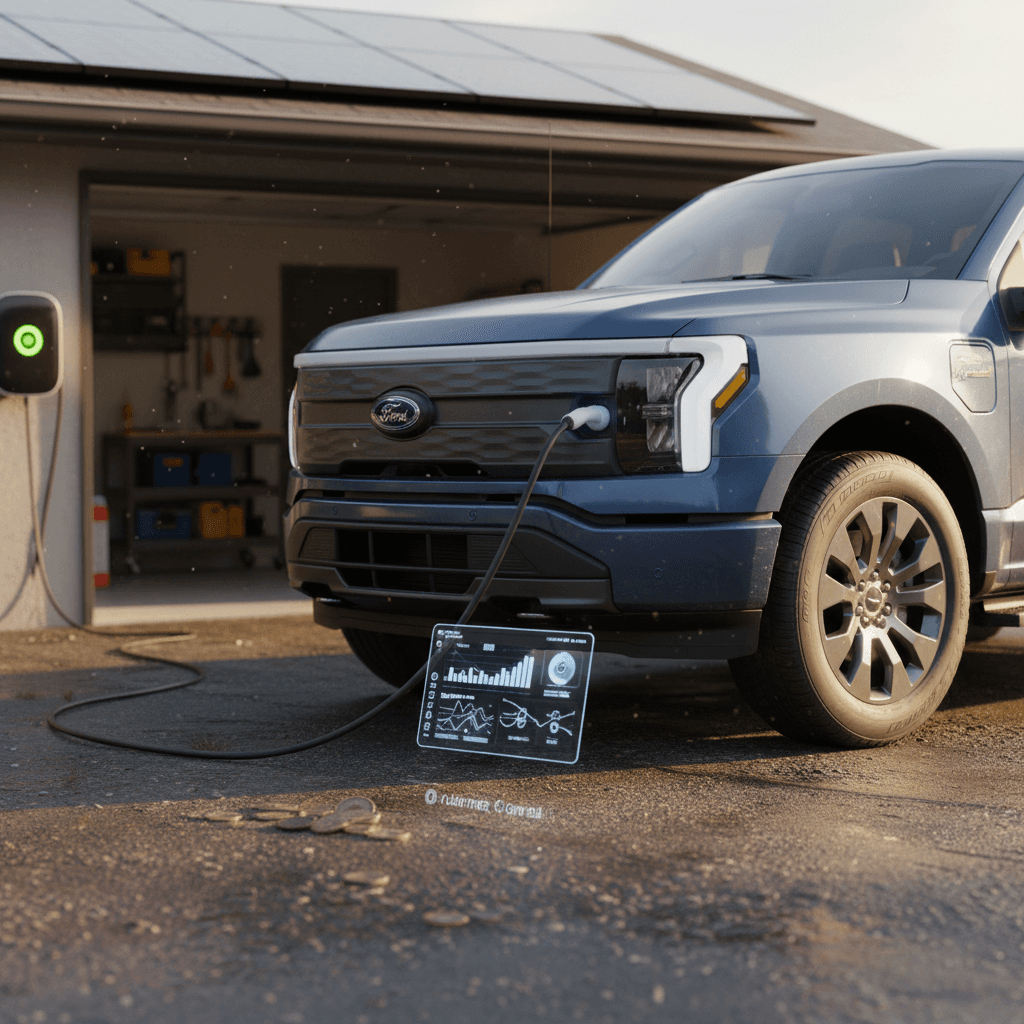
If you’re considering a Ford F-150 Lightning, one of your first questions is simple: what does it cost per mile to drive? Electric trucks promise lower running costs than gas pickups, but real numbers depend on your efficiency, electricity rates, and how you charge. Let’s break down the Ford F-150 Lightning cost per mile to drive in clear, real‑world terms so you can decide if it fits your budget, especially if you’re comparing a new truck to a used Lightning from a retailer like Recharged.
Key takeaway up front
Why cost per mile matters for an electric pickup
With a conventional gas F-150, you’re used to thinking in miles per gallon. With an F-150 Lightning, the more useful lens is cost per mile. Electric trucks use energy very differently depending on load, speed, and weather, and electricity prices vary widely between regions. Looking at cost per mile lets you compare an electric Lightning directly to a gas F-150, a midsize SUV, or even another EV.
- Helps you compare a Lightning to your current gas truck on equal footing
- Makes it easier to budget for commuting, jobsite use, or towing
- Highlights how much charging strategy (home vs public fast charging) affects your wallet
- Shows where buying a used Lightning can lower total cost per mile thanks to a lower purchase price
Quick rule of thumb
F-150 Lightning efficiency: EPA MPGe and kWh per 100 miles
To understand the Ford F-150 Lightning cost per mile to drive, you first need to know how efficiently it uses energy. The EPA doesn’t rate EV trucks in mpg, but in MPGe (miles per gallon equivalent) and kWh per 100 miles. kWh per 100 miles is especially handy because you pay your utility per kWh.
Approximate EPA efficiency ratings for F-150 Lightning
Representative figures for popular configurations. Exact ratings vary slightly by trim and wheel/tire package.
| Configuration | Battery | Drive | EPA MPGe (combined) | EPA kWh/100 mi (combined) |
|---|---|---|---|---|
| Pro / XLT Standard Range | ~98 kWh gross | 4x4 | ~68 MPGe | ~49 kWh |
| XLT / Lariat Extended Range | ~131 kWh gross | 4x4 | ~66 MPGe | ~52 kWh |
| Platinum Extended Range (larger wheels) | ~131 kWh gross | 4x4 | ~60 MPGe | ~56 kWh |
Use kWh per 100 miles when estimating your own cost per mile with your local electricity rate.
Real-world vs EPA
Electricity prices: how much your kWh really costs
Once you know roughly how many kWh your Lightning uses per 100 miles, the second piece of the puzzle is simple: what you pay per kWh. That varies dramatically by state and even by time of day.
Typical electricity costs Lightning owners see
Your exact rate will appear on your electric bill as cents per kWh.
Home off-peak
Common residential rate in many U.S. markets:
- $0.12–$0.18 per kWh off‑peak
- Time-of-use plans can go even lower overnight
Home peak
Daytime or peak pricing in higher-cost regions:
- $0.20–$0.30+ per kWh
- Try to schedule charging overnight to avoid this band
Public DC fast charging
Many non‑Tesla networks and some Ford‑branded DC fast chargers:
- $0.35–$0.55+ per kWh
- Convenient, but often doubles or triples your cost per mile
Check your real rate
Ford F-150 Lightning cost per mile to drive: real-world examples
Let’s put all this together. We’ll use a simple formula for the Ford F-150 Lightning cost per mile to drive: Cost per mile = (kWh per 100 miles × electricity price per kWh) ÷ 100 Below are some representative scenarios to show the range you’re likely to see.
Typical F-150 Lightning cost per mile (home charging)
Sample Ford F-150 Lightning cost per mile scenarios
Illustrative math using common efficiency values and electricity prices. Your results will vary with driving style and climate.
| Scenario | Assumed kWh/100 mi | Electricity price | Cost per mile |
|---|---|---|---|
| Mild weather, mixed driving, home off‑peak | 49 kWh | $0.16/kWh | (49×0.16)÷100 ≈ $0.08/mi |
| Extended‑range, typical mixed driving | 52 kWh | $0.20/kWh | (52×0.20)÷100 ≈ $0.10/mi |
| Higher-cost market, daytime charging | 52 kWh | $0.28/kWh | (52×0.28)÷100 ≈ $0.15/mi |
| Cold winter, highway speeds, no trailer | 70 kWh | $0.25/kWh | (70×0.25)÷100 ≈ $0.18/mi |
| Light towing, hilly highway route | 85 kWh | $0.25/kWh | (85×0.25)÷100 ≈ $0.21/mi |
| Heavy towing, mostly DC fast charging | 100 kWh | $0.45/kWh | (100×0.45)÷100 = $0.45/mi |
Use this table as a starting point for your own calculations with your local rate and typical usage.
Where you can get into trouble
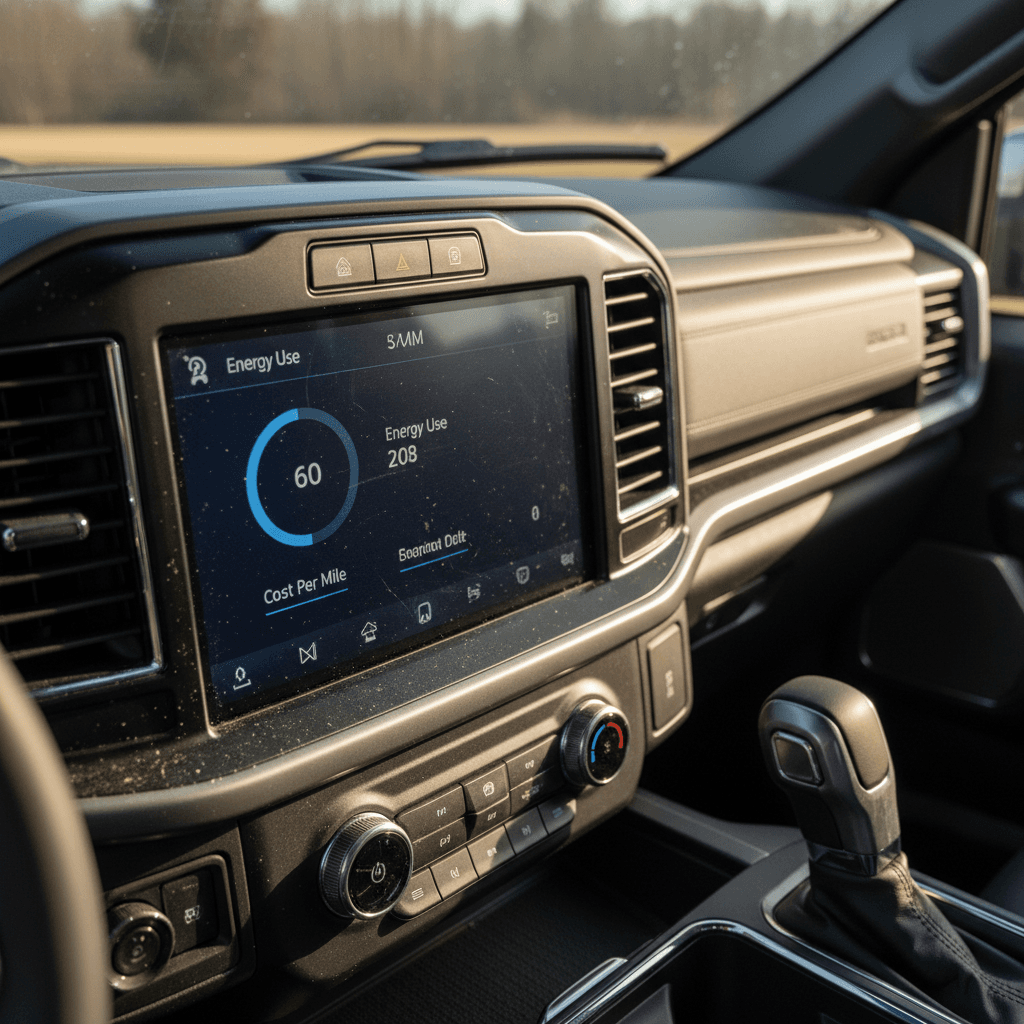
Home charging vs public fast charging: cost per mile
Home charging: lowest cost per mile
If you can plug in at home, that’s where the F-150 Lightning really shines on operating cost.
- Typical off‑peak residential rates often work out to $0.08–$0.12 per mile for mixed driving.
- Many utilities offer cheaper overnight time-of-use plans, perfect for scheduling charging while you sleep.
- You avoid the station fees and idle charges some DC networks add.
For most suburban owners, home charging is what makes the Ford F-150 Lightning cost per mile to drive so compelling compared with a gas truck.
Public DC fast charging: pay for convenience
Public DC fast charging is the Lightning’s road-trip enabler, but it’s rarely the cheapest way to run the truck day to day.
- Per‑kWh rates in the $0.35–$0.55 range are common in the U.S.
- At those prices, a Lightning using 70–90 kWh/100 mi on the highway can cost $0.25–$0.50 per mile in energy alone.
- Some stations bill by the minute, which can be even more expensive if the charge rate tapers.
Think of fast charging as you would think of buying gas at the most expensive station on the interstate, great when you need it, but not where you want to "live" if you care about cost.
Smart strategy for most owners
Ford F-150 Lightning vs gas F-150: cost per mile
To understand the Lightning’s value, it helps to compare its cost per mile with a typical gas F-150. Let’s look at two simple examples, one for a reasonably efficient gas truck and one for a heavier-duty, less efficient configuration.
Fuel-only cost per mile: F-150 Lightning vs gas F-150
Illustrative comparison using national-average fuel prices and typical efficiency figures for full-size pickups.
| Vehicle & scenario | Assumed efficiency | Energy price | Fuel/energy cost per mile |
|---|---|---|---|
| Gas F-150 (mixed driving) | 20 mpg | $3.50/gal | $3.50 ÷ 20 = $0.18/mi |
| Gas F-150 (towing or heavy load) | 12 mpg | $3.50/gal | $3.50 ÷ 12 ≈ $0.29/mi |
| F-150 Lightning (home charging, mixed driving) | 52 kWh/100 mi | $0.20/kWh | (52×0.20)÷100 ≈ $0.10/mi |
| F-150 Lightning (home charging, towing) | 85 kWh/100 mi | $0.20/kWh | (85×0.20)÷100 ≈ $0.17/mi |
| F-150 Lightning (mostly fast charging, towing) | 100 kWh/100 mi | $0.45/kWh | (100×0.45)÷100 = $0.45/mi |
This table isolates energy costs only. Depreciation, insurance, and maintenance will change your total cost per mile further.
Apples-to-apples perspective
Other costs: tires, maintenance, and depreciation
Fuel or electricity is just one piece of the Ford F-150 Lightning cost per mile to drive. To understand the truck’s real financial picture, you also need to factor in maintenance, tires, and depreciation.
Beyond electricity: three big cost drivers
These items can nudge your real cost per mile up or down over time.
Maintenance
EVs like the Lightning generally need less routine maintenance than gas trucks:
- No oil changes or spark plugs
- Fewer moving parts in the powertrain
- Regenerative braking can extend brake life
You’ll still have cabin filters, brake fluid, and coolant service, but in most cases, maintenance cost per mile is lower than a comparable gas F-150.
Tires
Full‑size electric pickups are heavy and torquey. That’s fun from a stoplight, but it can wear tires faster.
- Expect higher-quality, load‑rated tires and possibly shorter replacement intervals.
- Budget a bit more per mile for tire wear than you would for a lighter gas half‑ton.
Depreciation
Depreciation is often the largest single cost in your cost‑per‑mile math, especially on a new truck.
- New EV trucks can see steep early depreciation as incentives, battery tech, and competition evolve.
- Buying a used F-150 Lightning after the worst depreciation has occurred can dramatically lower your total cost per mile.
Battery health matters
How a used F-150 Lightning changes your cost per mile
Electric trucks, including the Lightning, have already shown that first‑owner depreciation can be steep. That’s bad news if you bought brand‑new at launch, but very good news if you’re coming in as a second owner. A lower upfront price spread over the same or similar lifetime miles pulls your total cost per mile down sharply.
New Lightning example
Imagine you buy a well‑equipped new F-150 Lightning for $70,000 and keep it for 8 years and 120,000 miles.
- Assume a resale value of $20,000 at the end.
- That’s $50,000 of depreciation over 120,000 miles.
- Depreciation alone = about $0.42 per mile, before you add electricity, maintenance, and tires.
Used Lightning example
Now suppose you buy a 3‑year‑old used Lightning for $42,000 with a clean battery health report from Recharged and drive it the same 120,000 miles from that point.
- Assume you sell it for $15,000 at the end.
- That’s $27,000 of depreciation over 120,000 miles.
- Depreciation alone ≈ $0.23 per mile, nearly half the new‑truck figure.
Combine that lower depreciation with the same low electricity cost per mile, and a used F-150 Lightning can be a very cost‑effective work or family truck.
Where Recharged fits in
Ready to find your next EV?
Browse VehiclesHow to lower your F-150 Lightning cost per mile
Practical ways to reduce your cost per mile
1. Prioritize home charging
If possible, install Level 2 home charging and take advantage of off‑peak rates. Shifting most of your miles from public DC fast chargers to home charging can cut your energy cost per mile by half or more.
2. Use time-of-use (TOU) rates
Ask your utility about TOU plans that offer cheaper rates overnight. Program the Lightning to start charging when rates drop, and your cost per mile will follow.
3. Drive smoothly and mind your speed
EVs are very sensitive to speed and aggressive acceleration. Keeping highway speeds reasonable and using Eco mode when it fits your schedule can meaningfully reduce kWh per 100 miles.
4. Be realistic about towing
If you tow frequently, build your budget around the higher energy use. When possible, plan routes that let you charge at lower‑cost locations and keep speeds moderate while towing.
5. Choose efficient tires and wheels
Bigger, more aggressive tires look great but can add drag and weight. If maximum range and minimum cost per mile matter more than looks, avoid the heaviest wheel/tire combos.
6. Buy used with verified battery health
Starting with a used Lightning whose battery has been independently checked, like those sold with a <strong>Recharged Score Report</strong>, can reduce your depreciation hit and protect you from unexpected range loss, both of which lower your true cost per mile.
FAQ: F-150 Lightning cost per mile
Frequently asked questions about F-150 Lightning cost per mile
Bottom line: is the F-150 Lightning cheap to drive?
Looked at purely through the lens of energy, the Ford F-150 Lightning cost per mile to drive can be impressively low, especially if you charge at home and don’t tow heavy loads every day. For many owners, electricity runs half or less the cost per mile of gasoline in an equivalent F-150. Where the story gets more nuanced is in depreciation and your personal charging mix.
If you drive a lot of miles, can plug in at home, and are willing to be thoughtful about when and how you charge, the Lightning is one of the most affordable full‑size pickups to operate per mile. And if you pair that approach with a used F-150 Lightning that’s already absorbed the steepest first‑owner depreciation, backed by a Recharged Score Report, you can tilt the economics even further in your favor, without guessing about battery health or overpaying for the truck itself.