If you’re hunting for a **Florida electric car rebate in 2026**, you’ve probably run into confusing, outdated information. Federal EV tax credits changed, state policy shifted, and a lot of “Top 10 rebate” sites simply haven’t caught up. Let’s sort out what’s *actually* available now, especially if you’re looking at a used EV.
Key 2026 takeaway
Florida Electric Car Rebate 2026: Quick Overview
Florida EV incentives in 2026 at a glance
Think of Florida’s 2026 EV landscape this way: **there’s no big, simple check from the state** when you buy an electric car, but there *are* smaller, targeted incentives plus long-term operating-cost savings, especially if you buy used and take advantage of utility programs.
What Changed for 2026: Federal EV Tax Credit Is Gone
Most national “EV rebate” headlines you’ve seen over the last few years were about the **federal clean vehicle tax credits** created under the Inflation Reduction Act. Those were worth up to **$7,500 for new EVs** and **$4,000 for used EVs**, claimed on your federal return.
- Under the **One Big Beautiful Bill Act**, federal new and used EV credits for consumers ended for vehicles acquired after **September 30, 2025**.
- The separate federal credit for EV chargers and other alternative-fuel refueling equipment is scheduled to sunset **after June 30, 2026**.
- You can still claim the old credit on your 2025 return if you bought an eligible EV **before** the cutoff and meet income and other rules.
Don’t bank on "hidden" federal money
That matters in Florida because there’s **no state income tax** and no parallel state EV credit to replace what Washington just pulled back. So buyers here feel the federal change more directly than shoppers in states that layer their own big rebates on top.
Does Florida Have a Statewide Electric Car Rebate in 2026?
Short answer: **no statewide Florida electric car rebate exists in 2026.** There’s no state-run program that sends you a check or refundable tax credit specifically for buying an EV, whether new or used.
What Florida does, and doesn’t, offer for EVs in 2026
State-level help is limited, but local and utility incentives can still add up.
No statewide EV purchase rebate
Florida does not have a dedicated EV purchase rebate or state income-tax credit in 2026. That applies to both new and used electric vehicles.
You won’t find a state application portal or single statewide program like California’s or New Jersey’s.
Targeted incentives & policy changes
Instead, Florida policy has focused on:
- Utility-regulated EV programs and off-peak rates
- Charging infrastructure support and tax treatment
- Commercial and fleet electrification
For everyday drivers, that means bill credits and cheaper charging matter more than a big purchase rebate.
2026 tax change to watch
Florida Utility Rebates and EV Programs in 2026
Where you actually see “rebate-like” money in Florida is on your **electric bill**, not your state tax return. Several large utilities now run EV-specific programs that either pay you once (a credit) or shave dollars off your bill every month if you charge smart.
Major Florida utility EV programs (2026 snapshot)
Exact details, eligibility, and availability can change, always confirm with your utility before you buy.
| Utility | Program type | What it typically offers | Who it’s for |
|---|---|---|---|
| Duke Energy Florida | Charger Prep Credit | One-time bill credit toward wiring, panels or outlets needed for Level 2 home or business charging. | Residential and commercial customers installing EV-ready circuits. |
| Duke Energy Florida | Off-Peak Charging Credit | Monthly bill credit if you enroll and agree to charge your EV overnight during set off-peak hours. | Residential EV owners willing to shift charging to late-night windows. |
| Tampa Electric (TECO) | Commercial charger rebates & fleet support | Rebates or incentives for Level 2 and DC fast chargers at workplaces, multifamily and fleets; evolving by 2025–2026. | Business, multifamily, government and fleet customers in TECO territory. |
| Florida Power & Light (FPL) | Time-of-use & pilot charging programs | Discounted rates or credits for EV charging in off-peak periods; program design varies over time. | Residential customers in FPL territory with EVs and smart meters. |
| Munis & co-ops (e.g., OUC, JEA) | Local EV & charger incentives | Smaller rebates, special rates or free charger pilots depending on the utility’s budget and priorities. | Customers of municipal and cooperative utilities; availability is highly local. |
Representative examples of Florida utility EV incentives in 2026. Programs may be capped or modified, and some pilots end or reopen periodically.
How to find your real rebate
For many Florida households on tight budgets, the **off‑peak charging credits** are the sleeper benefit. If you can reliably plug in between, say, **11 p.m. and 5 a.m.**, you may earn a recurring bill credit that quietly chips away at your ownership costs month after month.
Charging Incentives, Tax Changes and Sales-Tax Breaks
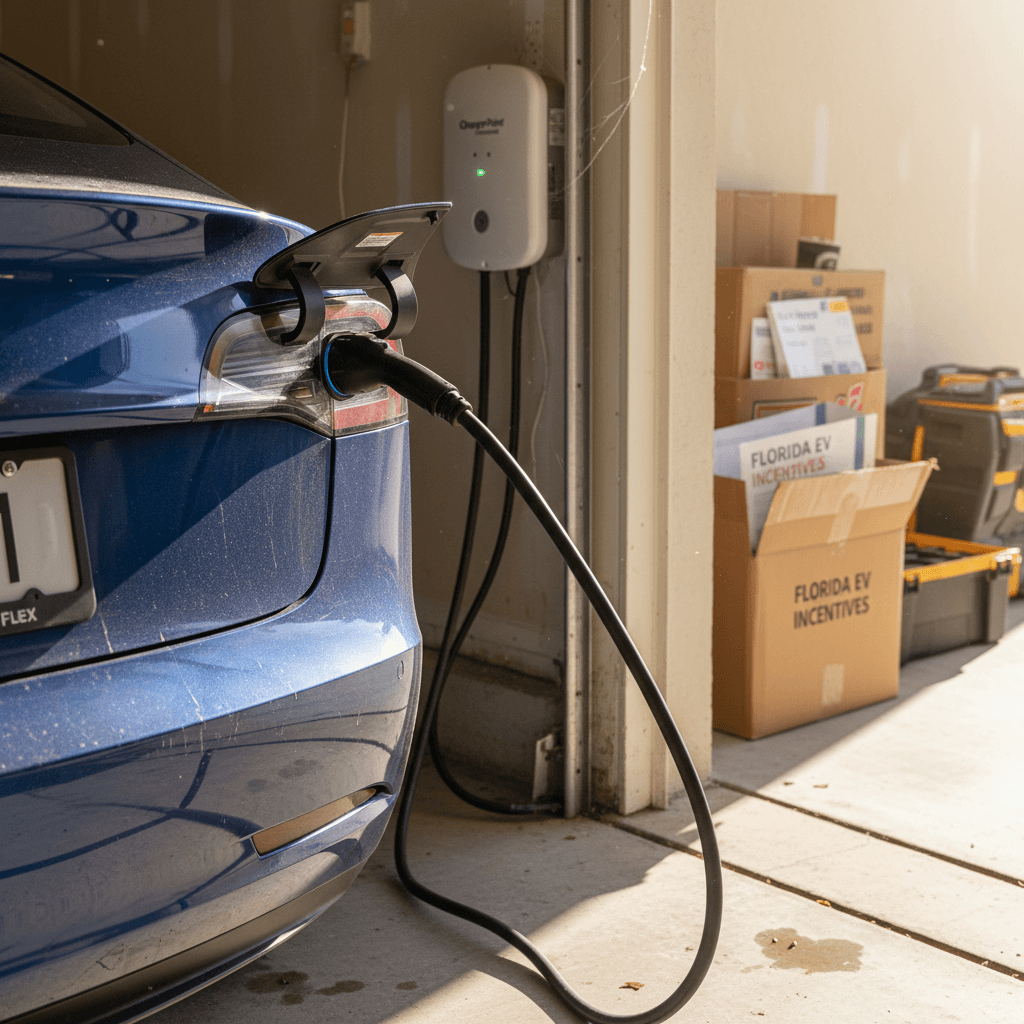
Even if Florida doesn’t cut you a check for buying an EV, **how the state taxes charging and equipment** still affects what you pay over time.
2026 incentives and rules that affect EV charging costs
1. Federal charger credit through June 30, 2026
If you install qualifying home EV charging equipment in 2026, you may still be able to claim a federal tax credit for part of the equipment and installation cost, provided you complete the work and place it in service before the **June 30, 2026** sunset.
2. Sales tax treatment for charging operators
Pending 2026 legislation in Florida aims to exempt certain electricity sold to EV charging station operators from state sales and use tax. If enacted as written, that helps keep **public charging prices** from rising even faster as networks expand.
3. Time-of-use and off-peak deals
Utility time-of-use (TOU) plans and EV‑specific off‑peak programs can cut your per‑kWh price dramatically if you’re willing to charge overnight. That’s often equivalent to saving **hundreds of dollars** a year on fuel.
4. Local building and permitting rules
Some cities count EV-ready wiring toward green-building points or streamlined permitting. The benefit isn’t a cash rebate, but it can trim soft costs and project friction when you add a home charger.
Watch out for fake "Florida EV rebate" sites
Used EVs in Florida: Where the Smart Savings Are
With federal purchase credits gone for 2026, **used electric vehicles become the value play** in Florida, especially when you bake in fuel and maintenance savings.
New EVs in Florida, 2026
- No federal consumer credit on most 2026 purchases.
- Purchase price still relatively high, even as manufacturers discount.
- Monthly payments often similar to a high‑trim gas crossover.
- Best for buyers prioritizing the latest tech, long range and warranty.
Used EVs in Florida, 2026
- Depreciation has already taken a big bite, especially on 2–4‑year‑old models.
- You still get the bulk of the fuel and maintenance savings vs. gasoline.
- With tools like the Recharged Score, you can verify battery health instead of guessing.
- Perfect for budget‑conscious buyers who missed the federal credit window.
How Recharged helps Florida used‑EV buyers
Ready to find your next EV?
Browse VehiclesIf you’re in Florida and working with a fixed payment target, the practical move in 2026 is usually: - Shop **2–6‑year‑old EVs** with strong reliability records. - Compare total cost of ownership (payment + insurance + electricity + maintenance) vs. your current gas car. - Use tools like Recharged’s financing and trade‑in options to close the gap left by lost federal incentives.
How to Stack Florida EV Savings in 2026
You may not have a big headline “Florida electric car rebate 2026” to chase, but you can still **stack several smaller advantages** into meaningful savings over a 3–7‑year ownership window.
Four levers Florida EV buyers can still pull
Think in terms of lifetime cost, not just sticker price.
1. Purchase price
Start with a realistic budget and compare **used EVs** to comparable used gas cars. A fair market price upfront is more impactful now that federal checks are gone.
2. Financing & trade‑in
Use pre‑qualification to understand your rate before you shop. A strong trade‑in offer or consignment can offset the lost tax credit.
3. Charging strategy
Plan to charge overnight at home or at low‑cost workplace chargers. Combine that with any **off‑peak programs** your utility offers.
4. Efficiency & usage
Pick an EV whose range and efficiency actually match your driving. A smaller, efficient model driven 12,000+ miles a year can beat a gas car by thousands in fuel costs alone.
Step‑by‑step: Designing your 2026 Florida EV savings plan
1. Confirm your utility and its EV programs
Look up who supplies your power, then check for EV tariffs, rebates, or off‑peak credits. Screenshot the program details and note any deadlines before you buy.
2. Decide where you’ll charge most
If you live in a single‑family home, home Level 2 charging plus off‑peak rates often yields the biggest savings. Apartment and condo drivers should map workplace and public options before committing to an EV.
3. Build a realistic total-cost budget
Estimate monthly payment, insurance, and electricity based on your mileage. Sites like Recharged can help you compare specific **used EVs** vs. your current car, not just generic averages.
4. Get pre‑qualified for financing
In a world without federal rebates, your **interest rate** and term matter more. Pre‑qualifying (with no hard hit) gives you a ceiling so you don’t stretch for a payment that erases fuel savings.
5. Prioritize battery health when buying used
A discounted used EV with a weak battery can erase your savings when range and value fall off. Use battery diagnostics, like the Recharged Score, to avoid problem cars.
6. Re‑evaluate once a year
Utility rates, TOU plans, and pilot programs change frequently. Make a calendar reminder to re‑check EV programs and confirm you’re still on the cheapest rate plan for your charging profile.
Common Pitfalls With Florida EV Rebates and Incentives
The biggest mistakes Florida shoppers make in 2026 have less to do with the car itself and more to do with **assumptions about incentives**.
- Assuming a **$7,500 federal credit** still applies to 2026 purchases.
- Relying on an outdated blog that lists “Florida EV rebates” that actually expired in 2023–2025.
- Buying an EV that doesn’t fit their home-charging reality (condo, street parking, or unstable landlord rules).
- Ignoring utility programs and just charging whenever, forfeiting easy off‑peak savings.
- Overpaying for a used EV because they didn’t check battery health or local market pricing.
Check dates on every incentive page
Florida Electric Car Rebate 2026: FAQ
Frequently asked questions about Florida EV incentives in 2026
Bottom Line: How to Make an EV Pencil Out in Florida
In 2026, the phrase **“Florida electric car rebate”** is mostly a misnomer. The big federal checks are gone, Florida never launched a parallel statewide program, and a lot of online lists are stuck in the past. But that doesn’t mean EVs stopped making financial sense for Sunshine State drivers.
If you approach the market like a savvy used‑car shopper, scrutinizing **battery health**, grabbing every **utility bill credit** you can, charging off‑peak, and keeping a tight grip on purchase price, an EV can still undercut a comparable gas vehicle over the life of the loan. And if you’d rather not navigate that alone, Recharged can help you compare options, understand each vehicle’s battery condition through the Recharged Score, arrange financing, and even handle trade‑in or consignment.
The incentives game has changed. Instead of chasing a rebate that doesn’t exist, Florida buyers in 2026 win by stacking smaller, reliable advantages into one coherent plan, and by buying the *right* electric car, not just the newest one.