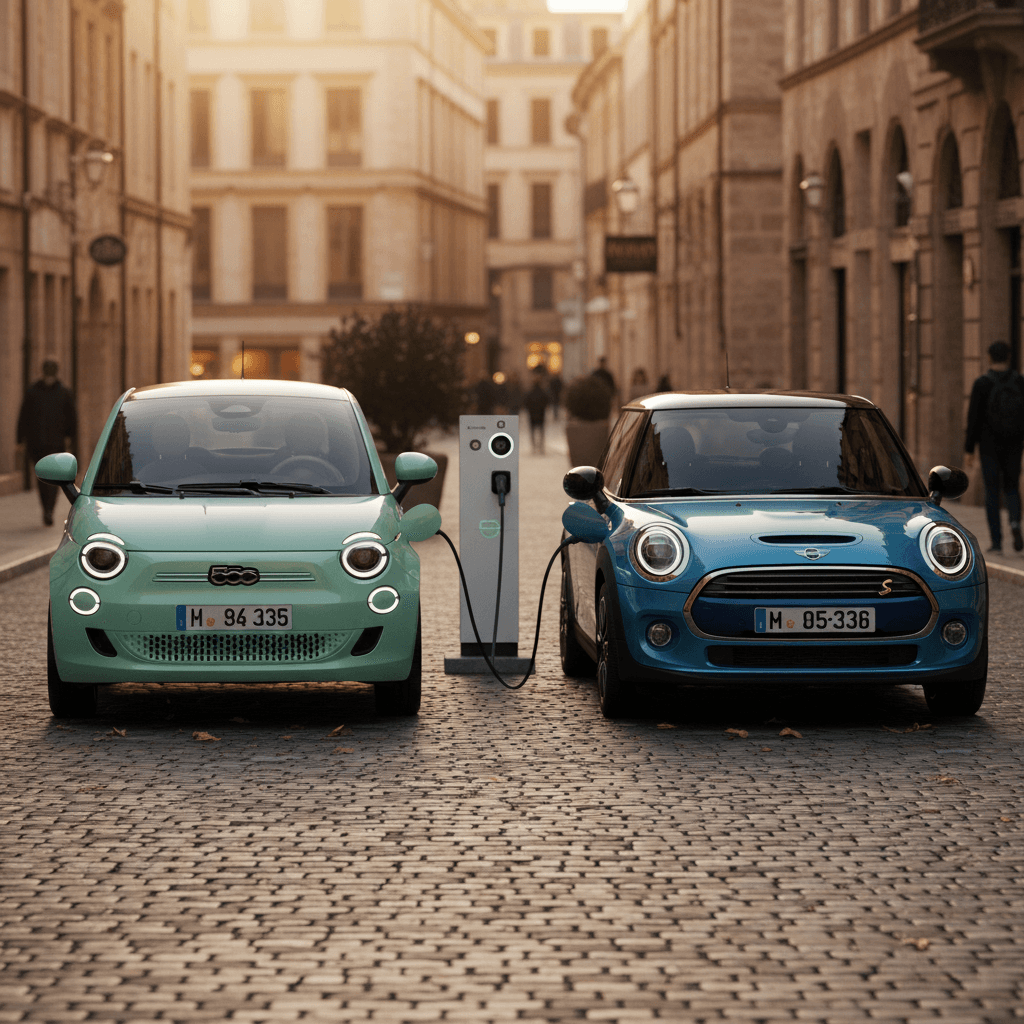
If you’re hunting for a fun, small electric city car, the natural question is Fiat 500e vs Mini Cooper SE – which is better? Both deliver retro style, compact footprints, and zippy acceleration in town, but they don’t shine in the same areas. The right choice depends heavily on how far you drive, what roads you use, and whether you’re buying new or used.
Context for 2026 shoppers
Fiat 500e vs Mini Cooper SE: Overview
Fiat 500e (U.S. 2024–2025)
- Powertrain: FWD single motor, about 117–118 hp
- Battery: ~42 kWh usable (officially 42.2 kWh pack)
- EPA range: roughly 141–149 miles depending on trim
- DC fast charge: peaks in the 80–85 kW range
- Character: ultra-compact, light, optimized for crowded cities
Mini Cooper SE (U.S. 2020–2024)
- Powertrain: FWD single motor, 181 hp, 199 lb-ft
- Battery: ~32.6 kWh gross (about 28–29 kWh usable)
- EPA range: 110–114 miles
- DC fast charge: ~50 kW peak (real-world 0–80% in ~35 min)
- Character: genuinely quick, “go‑kart” feel, more premium cabin
Big-picture takeaway
Quick spec comparison: Fiat 500e vs Mini Cooper SE
Core specs at a glance
Key numbers that matter when you’re comparing the Fiat 500e to the Mini Cooper SE for real-world U.S. driving.
| Spec | Fiat 500e (2024 U.S.) | Mini Cooper SE (2020–2024 U.S.) |
|---|---|---|
| Power (hp) | ~117–118 hp | 181 hp |
| 0–60 mph | ~8.4 seconds (est.) | ~6.9 seconds |
| Usable battery | ~42 kWh | ~28–29 kWh |
| EPA range | 141–149 miles | 110–114 miles |
| Max DC fast-charge rate | ≈ 80–85 kW | ≈ 50 kW |
| On-board AC charging | Level 2 up to 11 kW (trim dependent) | 7.4 kW Level 2 |
| Length | ≈ 143 in | ≈ 151 in |
| Cargo (seats up) | ~6.5 cu ft | 8.7 cu ft |
| Status (U.S.) | New + early used | Used only (discontinued after 2024) |
Approximate U.S.-market specs; always verify the exact year and trim you’re considering.
Used vs. new matters
Driving experience and performance
If you care most about how the car feels from behind the wheel, the Mini Cooper SE is the more entertaining EV. Its 181 hp motor delivers genuinely brisk acceleration, and the chassis is based on Mini’s long-running Hardtop, tuned for sharp steering and flat cornering. Many owners describe it as a classic “go‑kart” with instant EV torque – perfect for darting through traffic or enjoying a twisty back road.
The Fiat 500e is tuned more for charm than speed. With around 117–118 hp, it’s still perfectly quick for city duty, but it won’t pin you to the seat like the Mini does. The steering is lighter, the suspension a bit more relaxed, and the whole experience is about being easy to place in tight spaces and stress‑free at low speeds.
- Mini Cooper SE: noticeably quicker 0–60, stronger passing power, sportier chassis tuning
- Fiat 500e: adequate performance, better ride comfort in broken city pavement, ultra‑easy to park
- Both: quiet, instant EV torque off the line, stable at typical U.S. urban speeds
Who wins on performance?
Range and battery: which goes farther?
Range and battery at a glance
On paper, the Fiat 500e has a clear range advantage. With a roughly 42 kWh pack and EPA estimates in the 140–150 mile ballpark depending on trim, it comfortably covers typical American commuting patterns with extra buffer for errands or an unplanned detour.
The Mini Cooper SE’s 110–114 mile rating is more limiting. For many urban drivers, that’s still more than enough, but frequent highway stints, cold winters, or a long commute can eat into your comfort margin. In owner testing, the Mini SE often delivers around 90–100 miles of usable real‑world range when you factor in weather, speed, and a preferred buffer.
Cold-weather reality check
Charging speeds and real-world convenience
Most owners will charge these cars at home or work on Level 2. The Fiat 500e can accept up to around 11 kW on AC in higher trims, while base trims may cap closer to 7.4 kW. The Mini Cooper SE ships with a 7.4 kW onboard charger. In practical terms, both can go from low state‑of‑charge to full in about 4–6 hours overnight on a typical 240V home setup.
On DC fast chargers, the difference is more noticeable. The Fiat 500e can hit peaks around 80–85 kW in ideal conditions, while the Mini SE is closer to 50 kW. Because the Mini has a smaller battery, total time from 10–80% is still competitive, but the Fiat’s higher peak and larger pack give you more miles added per session, especially if you’re stringing together multiple stops.
- If you occasionally take 100–150 mile day trips, the Fiat 500e’s extra range + faster DC speeds are reassuring.
- If you rarely DC fast‑charge and mostly plug in at home, both are easy to live with.
- Public charging availability in your area matters more than which of these is 5–10 minutes quicker on a rare road‑trip stop.
Think about your infrastructure first
Interior space, comfort, and tech
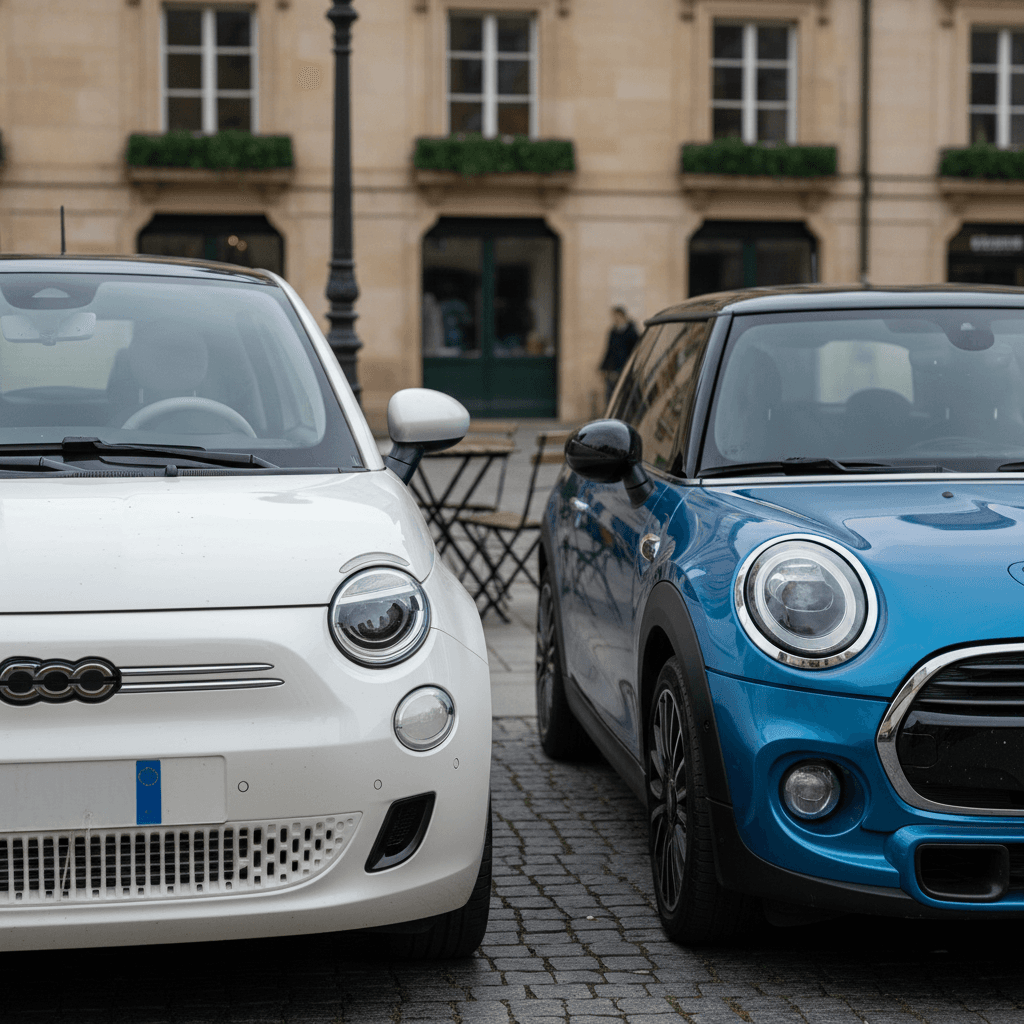
Both of these EVs are small, but the Mini Cooper SE is the more practical of the two. It’s about eight inches longer than the Fiat and offers more rear cargo space – roughly 8.7 cubic feet with the seats up versus the Fiat’s 6.5 cubic feet. Fold the rear seats, and the Mini opens up significantly more room for luggage or a big grocery run.
Up front, the Mini feels more like a shrunken premium car. Materials and switchgear draw from BMW’s parts bin, seats offer better bolstering, and the driving position is more conventional. The Fiat 500e leans into its cute, minimalist aesthetic, with a simple digital cluster and a central touchscreen. It’s stylish and airy, but if you routinely carry adults in the back or load bulky items, the Mini’s added space makes a difference.
Tech and comfort highlights
Where the Fiat 500e and Mini Cooper SE differ inside the cabin
Infotainment
Mini Cooper SE: 8.8-inch screen, Apple CarPlay, no Android Auto on earlier years, solid navigation options depending on trim.
Fiat 500e: 10.25-inch Uconnect 5 display on U.S. cars, with both Apple CarPlay and Android Auto support and a clean, modern UI.
Seating & comfort
Mini: Sportier seats with better lateral support, slightly firmer overall ride.
Fiat: Softer tune and a more upright, relaxed driving position – great for city crawling.
Cargo & usability
Mini: More usable cargo and better folding-rear-seat utility.
Fiat: Tight trunk, best as a 2+2 with light luggage rather than a frequent hauler.
Safety ratings and driver assistance
In small cars, safety can be a deciding factor. The previous‑generation Mini Hardtop – the basis for the Mini Cooper SE – has a strong safety reputation for its size, with solid crash‑test scores and a robust body structure. It typically offers forward collision warning, automatic emergency braking, and lane‑departure warning, with features like adaptive cruise control available on higher trims.
The new Fiat 500e brings Stellantis’ latest small‑car platform and electronics, including modern active‑safety tech like automatic emergency braking and lane‑keeping assistance on many trims. Full U.S. crash‑test data is still ramping up as more cars are sold, but European testing of the platform has been encouraging.
Don’t skip the safety report on a used Mini SE
Costs, including used prices and long-term value
From a pricing standpoint, the Fiat 500e and Mini Cooper SE now occupy different lanes. The Fiat 500e shows up in the U.S. as a higher‑priced new subcompact EV with MSRPs in the mid‑$30,000s when new, though early used examples are starting to appear with mileage in the low five figures. The Mini Cooper SE, by contrast, has moved primarily into the affordable used EV space, with 2020–2024 cars often priced well below many new EVs of any size in today’s market.
Operating costs are low for both: they’re efficient, run on electricity, and have far fewer moving parts than gasoline equivalents. Tires and brakes are inexpensive compared with larger EVs, and both have simple single‑motor layouts.
Cost questions to ask yourself
1. Are you open to buying used?
If yes, the Mini Cooper SE can be one of the most cost‑effective EVs on the market, provided you verify battery health and remaining warranty.
2. How important is maximum range?
If you want as much range as you can get in a tiny package, the Fiat 500e’s larger battery and higher EPA rating justify its higher purchase price for many drivers.
3. Do you plan to keep the car long term?
A newer Fiat 500e may have more warranty coverage and later‑generation hardware. But a well‑priced used Mini SE with documented service records can still be a smart long‑term commuter.
4. What about resale?
Quirky city EVs tend to have niche but passionate followings. Condition, battery health, and mileage will matter more for resale than brand alone.
Use battery health to separate great deals from risky ones
Which one fits your use case best?
Best pick by driver type
Fiat 500e vs Mini Cooper SE for different real-world scenarios
Primarily city driving, some suburbs
Best choice: Either, with a lean toward Fiat 500e.
- If you rarely exceed 60–70 miles a day, both cars work.
- The Fiat’s extra range gives more flexibility for detours or skipped charging days.
- The Mini’s sharper handling makes dense traffic more fun if you enjoy spirited driving.
Frequent short highway hops
Best choice: Fiat 500e.
- Extra range and faster DC charging make it less stressful.
- The Mini SE can do it, but you’ll watch the gauge more closely.
Second car in a multi-car household
Best choice: Mini Cooper SE (used) for value, Fiat for flexibility.
- Mini SE often wins on upfront cost as a used EV.
- If you already have a long‑range vehicle in the driveway, the Mini’s limited range is less of an issue.
Single-car household
Best choice: Fiat 500e, with caveats.
- More range and newer hardware make it easier as your only vehicle, assuming you don’t road‑trip every weekend.
- If you do frequent long trips, you may want to step up to a larger, longer‑range EV altogether.
Practical decision roadmap
If range is your top concern
Set a minimum comfortable range (for most shoppers, that’s 140–200 miles).
Map your regular routes and see how often you’d hit DC fast‑chargers with each car.
If you’d routinely arrive home with less than 20% in the Mini SE, favor the Fiat 500e.
If budget is your top concern
Compare used Mini SE pricing vs early‑used Fiat 500e listings in your region.
Get a third‑party or Recharged battery health report for any used EV you’re serious about.
Factor in insurance costs – subcompacts can be relatively affordable to insure.
If fun-to-drive is your top concern
Test‑drive the Mini SE first; it sets a high bar on feel and feedback.
Drive the Fiat 500e immediately afterward on the same loop.
Decide whether the Mini’s shorter range is a trade‑off you’re willing to make for more grin‑per‑mile.
So… Fiat 500e vs Mini Cooper SE: which is better?
How Recharged can help you shop smarter
Choosing between a Fiat 500e and a Mini Cooper SE isn’t just a spec‑sheet exercise. It’s about finding a car that fits your real life and won’t surprise you on range or repair costs. That’s where Recharged comes in. Every used EV on our platform comes with a Recharged Score Report that includes verified battery health, fair market pricing, and a detailed condition snapshot. If you’re eyeing a used Mini SE or an early‑used Fiat 500e, that transparency matters.
You can finance, trade in, or sell your current vehicle through Recharged, and complete the process fully online. If you’re near Richmond, VA, you can also visit our Experience Center for in‑person help. Our EV‑specialist team can walk you through how each model fits your commute, charging options, and budget – and help you compare a Fiat 500e or Mini Cooper SE against other small EVs you might not have considered yet.