If you drive a long distance every day, the EV vs gas cost for a 100 mile commute isn’t an abstract talking point, it’s your mortgage payment, your vacation fund, or your kid’s college savings. Run the numbers correctly, and you’ll see why so many high‑mileage drivers are hunting for the right electric car, often on the used market, to slash their daily fuel bill.
A 100‑mile commute is more common than you think
Why a 100‑Mile Commute’s Math Matters
A 10‑mile errand run won’t expose the difference between a thirsty SUV and an efficient EV. But stretch that to a 100‑mile daily commute and small per‑mile differences turn into hundreds of dollars a month. That’s why long‑distance commuters are often the first ones to say, “I don’t care about hype, show me the math.”
Who benefits most from switching to an EV?
High‑mileage driving amplifies EV savings, especially if you can charge at home.
Super‑commuters
Homeowners with garages
Used‑EV shoppers
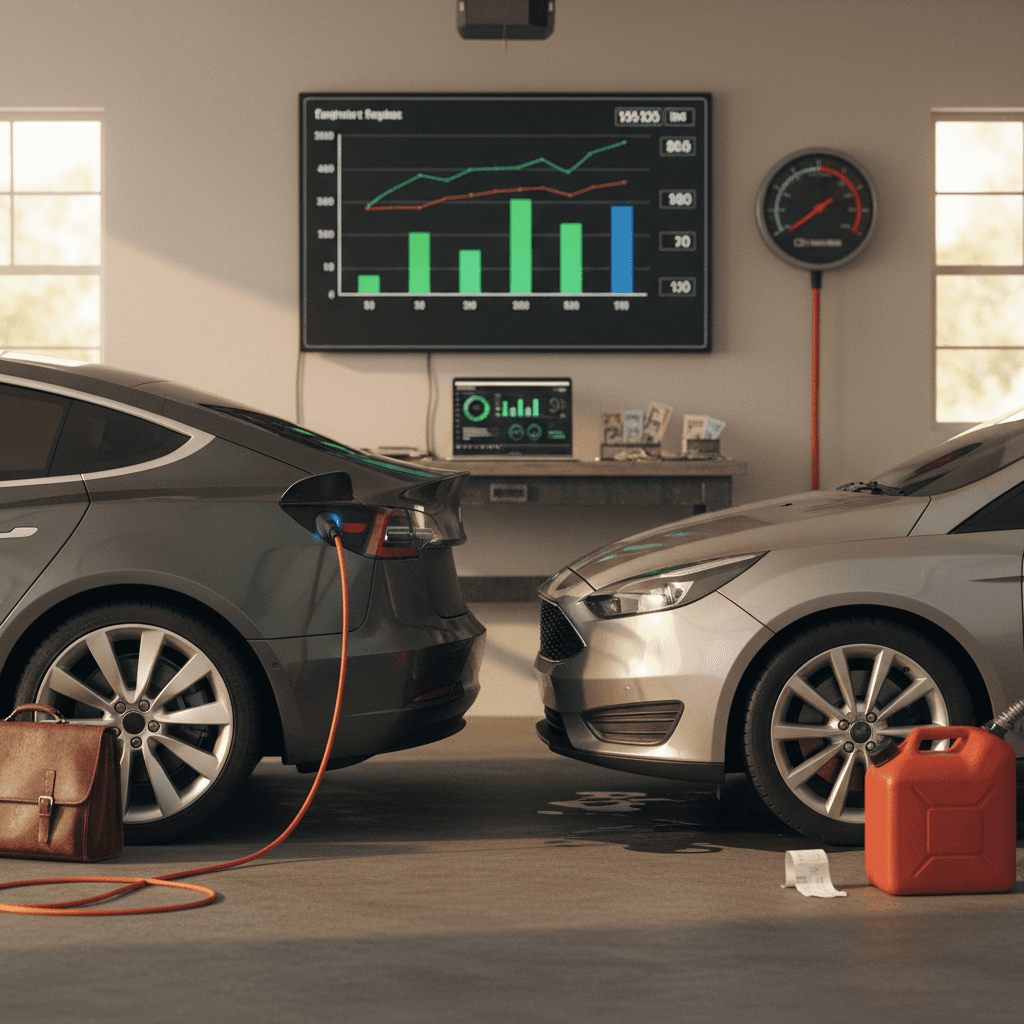
EV vs gas cost for 100 miles: the quick answer
Typical 100‑mile commute energy cost (one day)
Key takeaway
Step-by-step math: how we calculate EV and gas costs
Let’s slow down and walk through the math so you can plug in your own numbers. We’ll keep things simple and use round, realistic figures for the United States in 2025.
1. EV assumptions
- Efficiency: 3.0–4.0 miles per kWh (compact to midsize EVs)
- Electricity price (home): about 14–20¢/kWh, depending on your utility
- Electricity price (public DC): often 30–45¢/kWh
Many commuters with a garage can blend Level 2 home charging with occasional fast charging on busy days.
2. Gas car assumptions
- Efficiency: 25–40 mpg (sedans to small crossovers)
- Gasoline price: assume ~$3.50/gal for regular (adjust to your local price)
If you drive something larger or older that averages closer to 20 mpg, your costs jump fast.
Energy cost per mile: EV vs gas (example math)
Adjust the electricity rate, MPG, or efficiency to mirror your real‑world numbers.
| Scenario | Assumptions | Cost per mile | Cost for 100 miles |
|---|---|---|---|
| EV – home charging (thrifty) | 4.0 mi/kWh, $0.14/kWh | $0.035 | $3.50 |
| EV – home charging (typical) | 3.5 mi/kWh, $0.18/kWh | $0.051 | $5.14 |
| EV – public DC (typical) | 3.0 mi/kWh, $0.35/kWh | $0.117 | $11.67 |
| Gas – efficient compact | 40 mpg, $3.50/gal | $0.088 | $8.75 |
| Gas – typical sedan | 30 mpg, $3.50/gal | $0.117 | $11.67 |
| Gas – small SUV | 25 mpg, $3.50/gal | $0.140 | $14.00 |
These are simplified, but directionally accurate, numbers for a typical U.S. commuter in 2025.
How to plug in your own commute

Monthly and yearly costs for a 100‑mile commute
A hundred miles a day sounds abstract until you convert it into what hits your bank account. Let’s assume you commute 100 miles a day, 22 workdays a month, that’s 2,200 miles of just‑to‑work driving.
100‑mile commute: monthly and yearly fuel bill (example)
In plain English: if you’re paying gas‑station prices to push a 25–30 mpg car down the highway, and you switch to an efficient EV that you mostly charge at home, you can easily free up over a thousand dollars a year. Over just three years of commuting, that’s in the neighborhood of $4,000 in fuel savings alone.
Caution: public fast charging changes the story
Other costs: tires, oil, brakes, and maintenance
Energy is the headliner, but long‑distance commuters also feel every oil change, brake job, and set of tires. One reason EV drivers with long commutes tend to be evangelical is that their service schedules are… kind of boring.
Where EVs save money beyond fuel
A 100‑mile daily commute accelerates everything, including maintenance.
No oil changes
Fewer wear items
Brake wear
What EVs don’t save you from
Home charging vs public charging for commuters
For a 100‑mile commute, where you charge matters almost as much as what you drive. Think of it as choosing between buying in bulk at a warehouse club (home charging) or living off airport snacks (public fast charging).
Home charging: the commuter’s superpower
- Lower cost per kWh than most public fast charging.
- Predictable routine: you plug in at night and leave with a full "tank" every morning.
- Time savings: no detours to gas stations or fast chargers on busy weekdays.
If you can install a Level 2 charger at home, your 100‑mile commute becomes a simple nightly habit.
Public charging: workable, but plan carefully
- Best if your workplace offers Level 2 charging at reasonable rates.
- Relying heavily on DC fast charging is more expensive and can add battery wear.
- You’ll need to build charging stops into your weekly rhythm.
For some apartment dwellers, this is still worth it, but the savings vs gas may be modest.
Blend your charging to maximize savings
Does paying more for an EV ever pay off?
Cost per mile is only half the story. The other half is what you pay for the vehicle itself. A brand‑new, pricey EV may have low running costs but still take years to make financial sense over a modest used gas car. That’s why a lot of long‑distance commuters quietly pivot to used EVs instead of new ones.
Simple payback example
Let’s say you’re comparing:
- A $20,000 used gas sedan that averages 30 mpg
- A $27,000 used EV you can charge at home at ~5¢/mile
If the EV saves you roughly $100 per month in fuel and maintenance compared with the gas car, that’s $1,200 a year in your pocket. Over about 5–6 years, those savings can effectively bridge a big chunk of the price gap.
Why commuters lean used
- They don’t want to eat new‑car depreciation on top of huge mileage.
- They’re more sensitive to monthly cash flow than sticker price bragging rights.
- With the right used EV, you can get modern range and charging speeds for far less than new.
This is where a marketplace like Recharged is designed to help, pairing used EV pricing with verified battery health so the numbers actually pencil out.
How Recharged fits into your cost equation
Used EVs and battery health for long commutes
When you’re piling on 50,000 miles a year, battery health isn’t an academic topic; it’s how many charging stops you’ll make and how long your car will stay in the sweet spot of your commute.
Battery realities for 100‑mile‑a‑day drivers
Think in terms of usable range, not just original EPA numbers.
Degradation is normal
Range buffer matters
Demand data, not guesses
“With a long commute, the best EV isn’t the flashiest one, it’s the one that quietly does 100 miles a day, every day, without drama or surprises at the plug.”
Checklist: can an EV handle your 100‑mile commute?
7 questions to answer before you buy an EV for a long commute
1. How far is your real daily mileage?
Add up both legs of your commute, plus school drop‑offs, errands, and realistic detours. A “100‑mile commute” on paper can easily become 120–130 miles in real life.
2. Can you charge at home overnight?
A dedicated 240V (Level 2) circuit in a garage or driveway is the single biggest factor in lowering your cost per mile and preserving your sanity.
3. What’s your local electricity rate?
Look at your utility bill for off‑peak rates. If you can schedule charging at cheaper overnight prices, your per‑mile cost advantage over gas gets even better.
4. How efficient is the EV you’re considering?
Check real‑world owner reports for miles per kWh. Sleek sedans and hatchbacks can do 3.5–4.0 mi/kWh; boxy SUVs and performance models may use more energy.
5. How healthy is the battery?
On a used EV, ask for objective battery health data, not just “it seems fine.” Tools like the <strong>Recharged Score Report</strong> exist specifically to answer this question.
6. How much do you rely on fast charging?
Be honest. If you’ll be DC‑fast‑charging several times a week at 35–45¢/kWh, your running costs will creep closer to a frugal gas car, and you’ll add more wear to the pack.
7. What’s your ownership timeline?
If you plan to keep the car for 5–8 years of heavy commuting, lower fuel and maintenance costs have more time to offset a higher purchase price.
FAQ: EV vs gas cost for a 100‑mile commute
Frequently asked questions about 100‑mile commutes
Bottom line: what should a 100‑mile commuter buy?
If you boil all this math down, the pattern is clear: for someone driving about 100 miles a day, an efficient EV charged mostly at home is usually the cheapest way to commute, often by a wide margin. The trick is buying the right EV at the right price, ideally with verified battery health, so you aren’t trading fuel savings for surprise headaches.
That’s where a focused used‑EV marketplace like Recharged can tilt the odds in your favor. Every EV comes with a Recharged Score Report detailing battery health, range, and fair pricing, along with expert EV‑specialist support, financing options, trade‑ins, and even nationwide delivery from their digital showroom and Experience Center in Richmond, VA. For a long‑distance commuter, that combination of real data and thoughtful guidance can be the difference between an EV that merely looks good on paper and one that quietly eats a 100‑mile commute for breakfast, year after year.