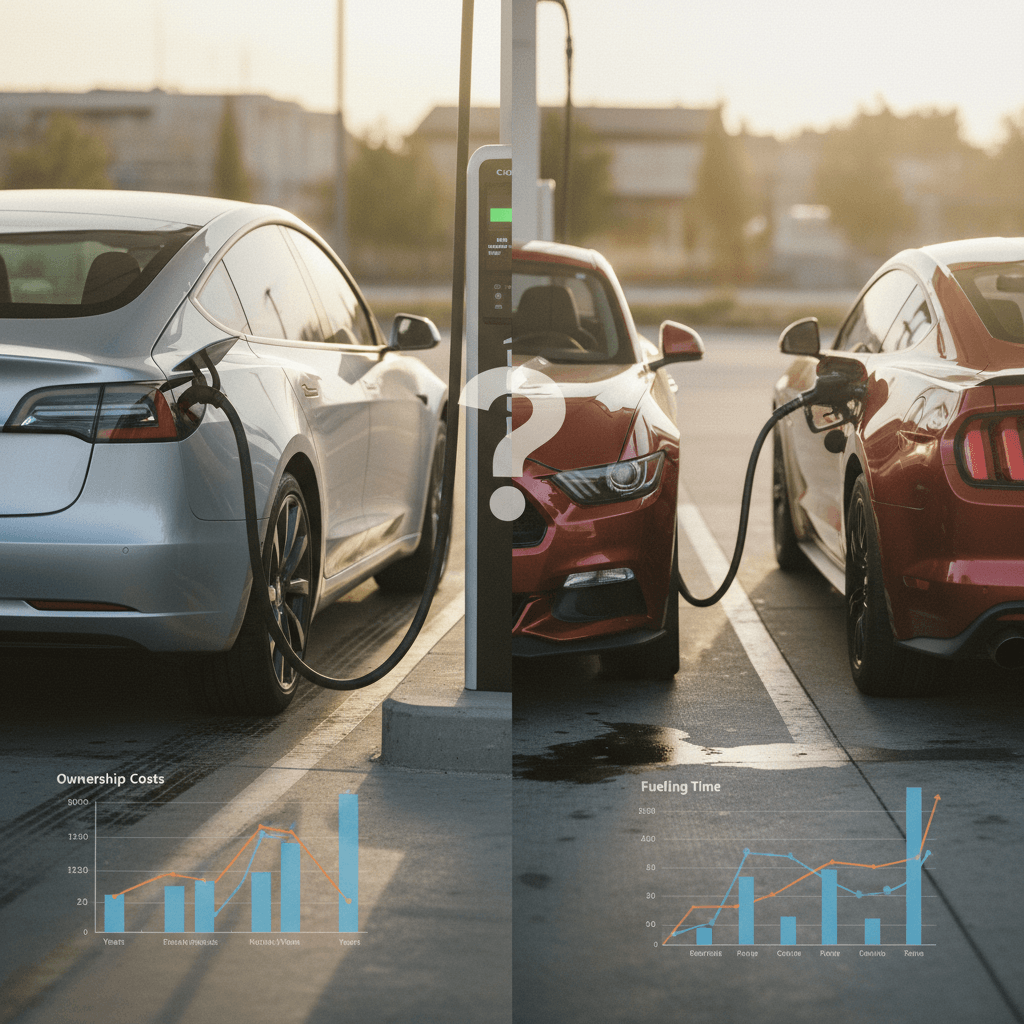
If you’re comparing an EV vs gas car in 2026 and wondering which is better, you’re not alone. EV incentives have shifted, gas prices have cooled a bit, and the used EV market has exploded. The right answer now depends less on tribal loyalty and more on your charging situation, commute, and how long you keep a car.
Context for 2026
EV vs gas in 2026: the quick take
Where EVs win vs where gas still makes sense
Use this as a cheat sheet before we dive into the numbers.
EVs are usually better when…
- You can charge at home or work.
- You drive at least 10,000–12,000 miles/year.
- You’re mostly in urban or suburban areas with public charging.
- You plan to keep the car for 5–8+ years.
- You’re open to buying a used EV to skip the big sticker price.
Gas cars still make sense when…
- You can’t install home charging and don’t have reliable workplace charging.
- You often drive through rural areas with minimal fast chargers.
- You keep cars a short time (3 years or less) and flip them often.
- You tow heavy loads or do unusual duty cycles where EV options are limited.
The short answer
How the EV vs gas equation has shifted by 2026
EV vs gas: market context heading into 2026
The big 2026 twist is incentives. The U.S. federal EV tax credit that had been propping up new EV demand changed and, in many cases, expired at the end of 2025. New EV prices haven’t fallen enough yet to fully offset that for everyone, and EV sales growth has cooled. At the same time, a wave of off‑lease EVs from 2020–2023 is hitting the used market, pushing used EV pricing and total cost of ownership into very attractive territory.
New EV vs used EV vs gas
Cost to buy and finance: EV vs gas in 2026
Sticker price is where gas cars still usually win. Recent data put the average new EV transaction price in the mid‑$50,000s and the average new gas car around the high‑$40,000s, though both depend heavily on segment and brand. With the most generous federal incentives no longer widely available, the upfront EV premium is more visible in 2026 than it was a year or two ago.
Typical upfront costs: new EV vs new gas (simplified)
Approximate U.S. 2026 new‑vehicle pricing patterns for mainstream models, not exotics or ultra‑luxury segments.
| Vehicle type | Typical transaction price | Financing impact | Notes |
|---|---|---|---|
| Mainstream gas compact / sedan | $30,000–$35,000 | Lower monthly payment | Often cheaper to buy but more expensive to fuel. |
| Mainstream gas crossover / SUV | $35,000–$45,000 | Moderate payment | America’s default choice; costs vary widely by brand. |
| Mainstream new EV sedan/crossover | $40,000–$55,000 | Higher payment | Upfront premium, especially without full tax credit. |
| Entry used EV (3–5 years old) | $18,000–$30,000 | Often similar to used gas | Where a lot of the value is right now. |
| Used gas car (3–5 years old) | $18,000–$28,000 | Comparable to used EV | Cheaper upfront but higher running costs. |
Your real numbers will hinge on segment, trim, financing terms, and local incentives.
Where financing can favor EVs
Fuel vs electricity: what you actually pay per mile
This is where EVs quietly crush gas cars, provided you’re not living off DC fast chargers. At recent U.S. averages, gas vehicles typically land around 12–15 cents per mile in fuel cost, while EVs sit closer to 3–4 cents per mile when you charge mostly at home.
EV vs gas: energy cost per mile (2026 assumptions)
Assumes typical U.S. prices: ~3.5 mi/kWh EV efficiency, $0.14/kWh home electricity, $2.80–$3.50/gal gas, and 25–35 mpg for gas cars.
| Vehicle type | Efficiency assumption | Energy price | Approx. cost per mile |
|---|---|---|---|
| Gas car (28 mpg) | 28 miles per gallon | $3.25/gal | ≈$0.12/mi |
| Efficient gas / hybrid (45–50 mpg) | 45–50 miles per gallon | $3.25/gal | ≈$0.07/mi |
| Battery EV (3.5 mi/kWh, home charging) | 3.5 miles per kWh | $0.14/kWh | ≈$0.04/mi |
| Battery EV (mostly fast charging) | 3.0–3.5 miles per kWh | $0.35/kWh | ≈$0.10–0.12/mi |
Your local electricity and gas rates will change these numbers, but the direction of the math rarely flips.
The fast‑charging trap
For a typical driver logging around 12,000 miles per year, an EV charged mostly at home can save on the order of $1,000 or more per year in energy costs compared with a 25–30 mpg gas car at today’s prices. Over 5–8 years, that easily climbs into five figures, often enough to offset much of the higher purchase price.
Maintenance and repairs: what breaks (and what doesn’t)
Why EVs generally cost less to maintain
- No oil changes, spark plugs, or timing belts.
- Fewer moving parts in the drivetrain than an internal‑combustion engine.
- Regen braking means brake pads and rotors last longer.
- No exhaust system, catalytic converter, or complex multi‑gear transmission.
Most analyses find EVs spending roughly 30–50% less on routine maintenance over their life compared with similar gas cars.
Where EVs can cost more
- Tires: EVs are heavier and quicker off the line, so they can chew through tires faster.
- Out‑of‑warranty electronics: Infotainment or power electronics modules can be pricey if they fail.
- Specialty labor: Not every shop is comfortable with high‑voltage repair yet, though that’s improving quickly.
Serious battery failures are rare within warranty, but out‑of‑warranty packs can be expensive, making verified battery health critical on a used EV.
Real‑world pattern
Range, charging, and day-to-day convenience

On pure convenience, gas cars still win for long, unplanned road trips. You can refuel almost anywhere in a few minutes. But for daily driving, if you have a driveway, garage, or reliable workplace charging, EVs flip the script: you “refuel” while you sleep or work, and you almost never think about range unless you leave your routine.
- Most mainstream EVs sold in the last few years offer 240–320 miles of EPA range on a full charge.
- For commuting and errands, that’s way more than most people use in a day.
- Public fast‑charging coverage on major U.S. highways is reasonably good, but still patchy off the beaten path.
- Charging time for a modern EV on a fast charger is typically 20–40 minutes to go from low state of charge to ~80%.
Think in terms of habits, not headline range
Battery life, warranties, and degradation
Battery anxiety has faded as the first big wave of EVs ages. Most modern EVs are sold with 8‑year battery warranties (often around 100,000 miles, sometimes more) that cover major defects and, in many cases, excessive capacity loss. Real‑world data from early Teslas, Nissan Leafs, and others suggest that a well‑designed pack in normal use often retains 70–85% of its original capacity after 8–10 years.
Battery reality vs fear
What actually happens to modern EV batteries over time.
They generally last longer than people expected
Heat and fast charging matter
Warranties buy you time
Used EV red flags
Resale value and the exploding used EV market
EV resale values have been a rollercoaster. Aggressive new‑EV price cuts in 2023–2025, plus the expiration of some tax credits in late 2025, pushed used EV prices down sharply. That’s tough news if you bought new at the peak, but it’s a gift if you’re entering the market in 2026.
What this means if you buy new
- New EVs can depreciate faster than comparable gas cars if automakers keep cutting prices or refreshing tech quickly.
- If you like to flip cars every 2–3 years, you’re more exposed to that volatility with a new EV.
- Leasing can be attractive if you want to hedge against rapid tech and price changes.
What this means if you buy used
- Many 3–5‑year‑old EVs are priced far below their new sticker, often with plenty of battery warranty left.
- Total cost of ownership on the right used EV can undercut a comparable used gas model by thousands, once you factor in fuel and maintenance.
- Battery transparency becomes the key differentiator, more on that in a moment.
The 2026 sweet spot
Environmental impact in plain English
The environmental story is more nuanced than “EVs are magically clean,” but the core conclusion still holds: over its lifetime, a typical EV sold today in the U.S. will emit significantly less CO₂ than a comparable gas car, even after accounting for battery production and the current power mix.
- Building an EV (especially the battery) is more carbon‑intensive than building a gas car.
- Once in use, an EV has zero tailpipe emissions and takes advantage of a grid that’s steadily getting cleaner.
- The more you drive and the cleaner your local grid, the faster an EV “pays back” its higher manufacturing footprint.
- If you rarely drive, the environmental gap between a small, efficient gas car and an EV narrows, but doesn’t vanish.
Used is the greenest option of all
Decision checklist: should you choose EV or gas in 2026?
EV vs gas: 9‑point decision checklist for 2026
1. Where will you charge most of the time?
If you can reliably charge at <strong>home or work</strong>, you’re in EV‑friendly territory. If you’d be 90% reliant on public fast charging, run the numbers carefully, fuel savings may shrink.
2. How many miles do you drive each year?
Under ~8,000 miles/year, the fuel savings from an EV accumulate slowly. Over <strong>10,000–12,000 miles/year</strong>, EVs usually win clearly on operating cost.
3. What does your driving pattern look like?
Mostly local commuting and errands with occasional trips? EV. Constant long‑distance highway travel with tight schedules and rural routes? Gas or a hybrid may be less stressful today.
4. How long do you normally keep a car?
If you keep vehicles <strong>5–8+ years</strong>, you have more time to reap fuel and maintenance savings. Rapid 2–3‑year turnovers favor lower‑depreciation vehicles or leases.
5. Are you shopping new or used?
New EVs still carry a price premium in many cases, especially post‑2025‑credit. <strong>Used EVs</strong> in 2026 can be pricing sweet spots if you have good battery data.
6. What’s your local electricity and gas situation?
Cheap residential electricity and expensive gas tilt hard toward EVs. High electricity rates and cheap gas narrow the gap, but rarely reverse it entirely if you can charge at home.
7. Do you tow, haul, or operate at the extremes?
Some trucks and SUVs now offer capable EV towing, but if you’re frequently at the edge of range with heavy loads, today’s charging network can make a gas or hybrid rig simpler.
8. How sensitive are you to noise and drivability?
EVs are <strong>quiet, quick, and smooth</strong> in ways gas cars simply aren’t. If you care about refinement and instant torque, that subjective upgrade matters.
9. How comfortable are you with new tech?
EVs are software‑defined products. If over‑the‑air updates and touchscreens excite you, great. If you loathe that trend, a simpler gas model may feel more familiar, though it’s increasingly rare in any new car.
How Recharged fits into an EV vs gas decision
If you’re leaning toward an EV but nervous about battery health, resale values, or picking the wrong model, that’s exactly the gap Recharged is trying to close in the market.
What Recharged brings to the EV side of the comparison
Making used EV ownership feel as straightforward as buying a used gas car, if not more so.
Recharged Score battery diagnostics
Fair market pricing for used EVs
End‑to‑end EV‑focused support
Ready to find your next EV?
Browse VehiclesTest the thesis in real life
FAQ: EV vs gas car in 2026
Frequently asked questions about EVs vs gas cars in 2026
Bottom line: EV vs gas in 2026 – which is better?
In 2026, the EV vs gas debate isn’t about ideology; it’s about matching a technology to a use case. If you can charge at home, drive a typical or higher‑than‑average number of miles, and are willing to consider a used vehicle, an EV is usually the superior economic and driving‑experience choice. If you can’t reliably charge, live far from public infrastructure, or constantly push vehicles to their limits, a gas or hybrid car still makes more sense for now.
What’s changed versus a few years ago is where the value sits: in 2026, it’s increasingly in smartly chosen used EVs with transparent battery health, not necessarily the latest shiny new model. That’s the opportunity Recharged is built around. Use the framework in this guide, plug in your own numbers, and when you’re ready to explore the EV side seriously, start with vehicles whose battery, pricing, and history have already been made transparent for you.