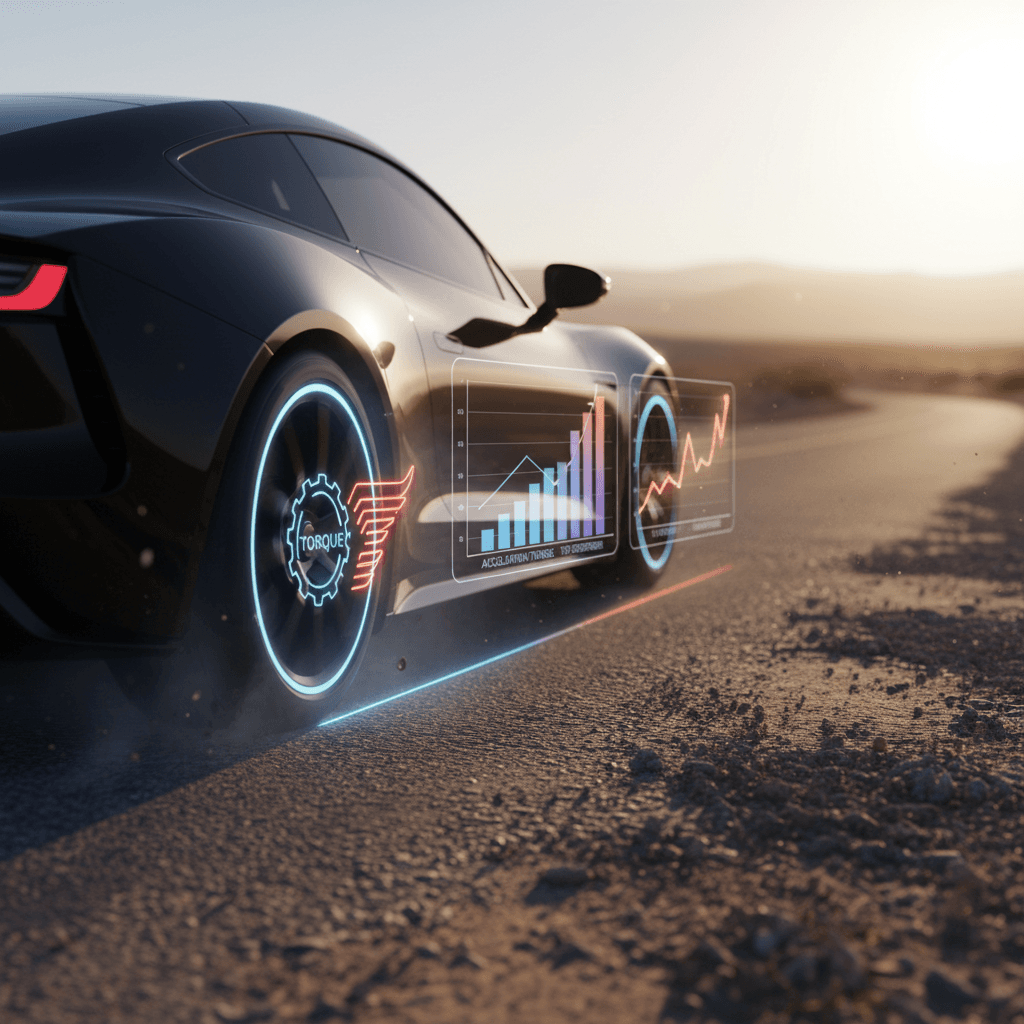
If you’ve ever floored the accelerator in an electric car and felt it surge forward with almost no delay, you’ve experienced one of the big differences between EV torque vs horsepower. On paper, a modest electric hatchback can keep up with old-school performance cars, and on the road, it often feels even quicker. Let’s unpack why.
Short answer
EV torque vs horsepower: the basics
Before we get into charts and curves, it helps to pin down a simple, working definition you can keep in the back of your mind whenever you look at specs.
- Torque is a twisting force. In a car, it’s the force the motor applies to turn the wheels.
- Horsepower is how quickly that force can do work over time, essentially, how fast your car can keep pushing against the air and the road as speed rises.
- In any vehicle, torque and horsepower are linked by the formula: horsepower = (torque × rpm) ÷ 5252. You don’t need the math, but it explains why horsepower climbs as an engine or motor spins faster.
Easy way to remember it
How EVs stack up on torque and acceleration
Why EVs feel so quick off the line
If you’re coming from a gas car, the biggest surprise in an EV is usually how easily it jumps into traffic. That’s the magic of how electric motors make torque.
- Instant torque: Electric motors can deliver near-maximum torque from zero rpm. There’s no waiting for revs to build or a turbo to spool.
- Simple driveline: Most EVs don’t use multi-speed transmissions. The motor’s torque goes through a single reduction gear, then straight to the wheels, fewer losses, less delay.
- Fine control: The motor controller can meter torque extremely precisely, which is why EVs feel smooth but also surge forward the moment you ask.
Watch that right foot
Torque vs horsepower explained in plain English
What torque really is
Picture a long wrench on a stubborn lug nut. The harder you push on the end of the wrench, the more torque you apply. In a car, the electric motor is your muscle, the axle is the wrench, and the wheels are that lug nut. More torque means more ability to twist the wheels against the pavement and get the vehicle moving.
Torque is measured in pound-feet (lb-ft) or newton-meters (Nm). Bigger numbers mean more shove.
What horsepower really is
Horsepower is simply a way of saying, “How fast can this torque keep doing work?” If torque is how hard you push, horsepower is how quickly you can keep pushing as the job gets harder, like sprinting up a hill vs. strolling on flat ground.
At low speeds, you feel torque more. At highway speeds and beyond, you’re asking the car to push through a lot of air resistance, so horsepower becomes the limiting factor.
They’re two sides of the same coin
How EV torque curves differ from gas engines
If you’ve ever seen a dyno chart for a gas car, you know the drill: torque rises as the engine revs, peaks somewhere in the midrange, then falls off; horsepower climbs, peaks higher up, and then drops. Electric motors play by different rules.
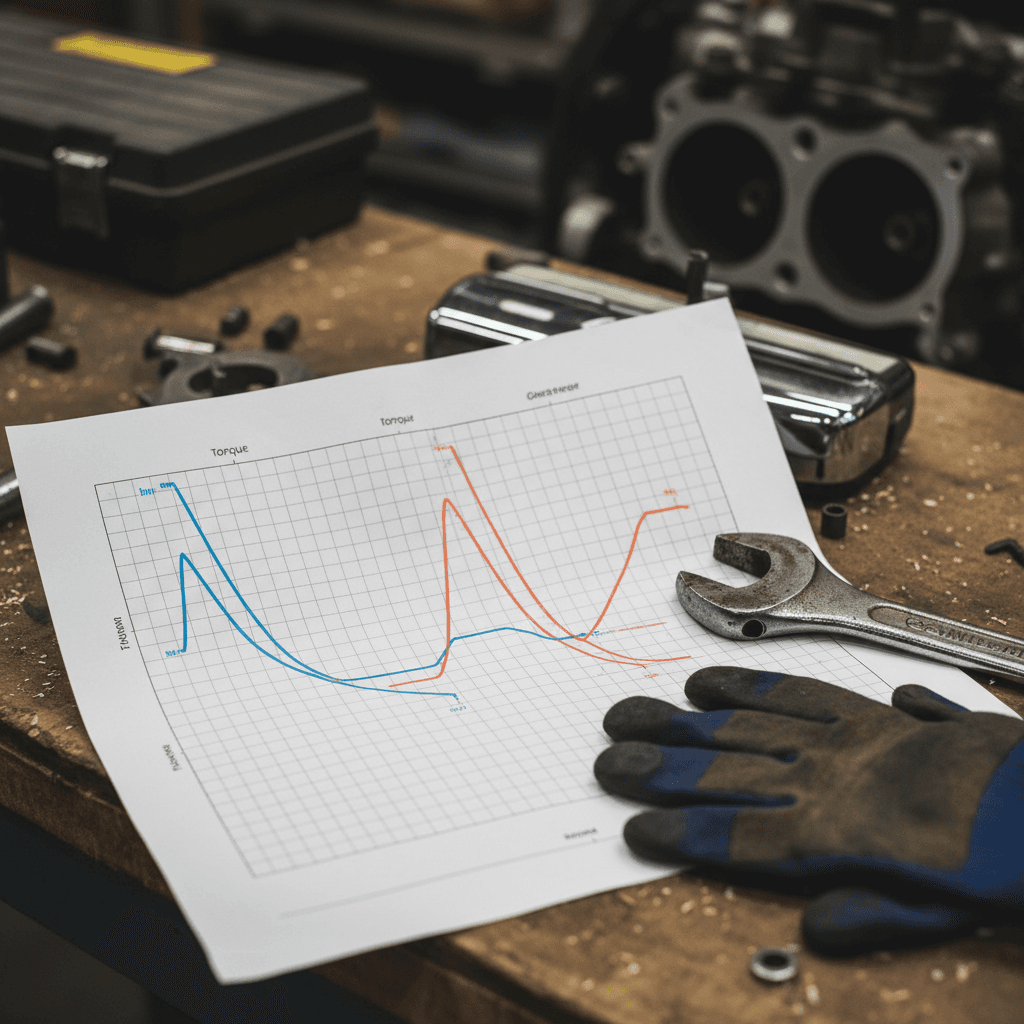
EV torque curve vs. gas torque curve
Same ideas, very different feel from the driver’s seat
Electric motor
- High torque from 0 rpm: Many EVs hit near-peak torque the moment the motor starts turning.
- Broad plateau: Torque stays strong over a wide rpm range, then tapers off as speed climbs.
- Single gear: Most EVs use a fixed reduction gear, so you never feel shifts, just continuous pull.
Gasoline engine
- Peaky torque: Peak torque only appears at a specific rpm (say 3,500 or 5,000 rpm).
- Needs help from gears: A multi-speed transmission keeps the engine near that sweet spot.
- Shifts and lag: Downshifts, turbo spool, and throttle response all add delay before full torque hits.
Why this makes daily driving easier
What matters more for acceleration, towing, and top speed
So which matters more in an EV, torque or horsepower? The honest answer is, “It depends what you’re doing.” Let’s break it down by situation.
Torque vs horsepower in real-world EV driving
Where each spec really matters when you’re behind the wheel.
| Driving scenario | What you feel most | What spec matters more | What to look for in an EV |
|---|---|---|---|
| Launching from a stop (0–30 mph) | Strong shove in your back | Torque | Higher torque and good traction control; dual motors help. |
| Merging & passing (30–70 mph) | How quickly the car responds and builds speed | Both (leaning horsepower) | Healthy horsepower rating and efficient gearing; instant torque still helps initial response. |
| Towing & hauling | Ability to get rolling and stay steady on grades | Torque | High torque, big battery, and a tow rating that matches your trailer, not just raw hp. |
| Top speed & track driving | Pull above highway speeds | Horsepower | Higher peak horsepower and good thermal management so power doesn’t fade. |
| City commuting | Smooth, effortless feel | Torque | You don’t need huge numbers, just enough torque for easy starts and quick lane changes. |
Both torque and horsepower matter, but not equally in every scenario.
Don’t shop specs in a vacuum
How to read EV torque and horsepower specs like a pro
Once you know what the numbers really mean, spec sheets stop being marketing soup and start telling you something useful. Here’s how to translate them into everyday feel.
Quick checklist for understanding EV performance specs
1. Check total system output
Many EVs list separate torque and horsepower for each motor, then a combined system rating. Use the <strong>system number</strong> to compare between vehicles, not the individual motor specs.
2. Look at 0–60 mph and 30–50 mph times
For daily driving, <strong>0–60 mph</strong> tells you the full picture of torque + horsepower + traction. A separate 30–50 or 50–70 time (if available) shows how confidently it passes on the highway.
3. Note drive type: FWD, RWD, or AWD
Dual-motor AWD EVs can put more torque to the pavement without wheelspin, so they often feel dramatically stronger than a single-motor version with similar ratings.
4. Pay attention to weight
Two EVs with identical torque and horsepower will not feel the same if one weighs 800 pounds more. Heavier crossovers need more torque to deliver the same snap as a lighter hatchback.
5. Scan for power limits and modes
Performance modes can unlock extra horsepower for short bursts. Great for fun, but know that some EVs dial power back after repeated hard runs or heavy towing to protect the battery and motors.
Where Recharged helps
Does high torque or horsepower hurt EV range?
It’s natural to assume that more power automatically means worse range. In EVs, it’s a bit more nuanced. The motor’s capability and how you actually use it are two different things.
What affects range the most
- How you drive: Hard launches and high-speed cruising draw a lot of power, no matter how much torque or horsepower the car is capable of.
- Aerodynamics and weight: A tall, heavy SUV needs more power to push through the air and roll down the road than a low, light sedan.
- Temperature and climate control: Cold weather and heavy A/C or heat use can chew into range more than an occasional full-throttle run.
Where big power matters
- Frequent hard use: If you’re constantly flooring it or towing near the maximum rating, a higher-power EV will spend more time in its energy-hungry zone.
- Battery size and cooling: Vehicles with strong motors usually pair them with bigger packs and better cooling, which can help manage efficiency when driven sanely.
- Driving style: Use the power occasionally and drive smoothly the rest of the time, and the range hit is smaller than you’d think.
Power in reserve isn’t the enemy
Used EV shopping: how much torque and horsepower do you really need?
If you’re looking at used EVs, it’s easy to get distracted by eye-popping performance numbers. The right choice depends less on bragging rights and more on how, and where, you drive.
Match your torque & horsepower to your life
You don’t need a supercar to enjoy EV punch.
City & suburban commuters
What you need: Modest horsepower and torque, smooth response, good range.
- Single-motor EVs with 150–220 hp and solid torque feel more than quick enough.
- Focus on efficiency, comfort, and driver-assistance features over raw specs.
Highway-heavy drivers
What you need: Confident passing power and stability at speed.
- Look for 200+ hp and an EV with a strong midrange surge.
- Test drive: merge onto a freeway, roll on from 40–70 mph, and see how it feels.
Towing & adventure
What you need: High torque, a robust cooling system, and a clear tow rating.
- Consider dual-motor SUVs or trucks with strong torque and a battery big enough to handle towing range loss.
- Pay close attention to the manufacturer’s tow rating and real-world owner experiences.
How Recharged fits in
FAQ: common questions about EV torque and horsepower
EV torque vs horsepower: your questions answered
The bottom line: specs, feel, and finding the right EV
When you strip away the jargon, torque is what makes an EV feel alive at your right foot, and horsepower is what keeps that urge going as the world blurs past your windows. Electric motors bend the old rules by serving up big torque right where you use it most, pulling away from lights, threading through traffic, and merging with confidence.
For most drivers, the goal isn’t winning drag races; it’s a car that feels effortless and trustworthy. That might be a single-motor hatchback with just enough torque to feel perky, or a dual-motor SUV ready for snow, trailers, and long trips. If you’re exploring the used market, Recharged is built to make that choice easier with transparent battery health, fair pricing, and EV-specialist support all the way from first question to delivery.
Understand the relationship between EV torque and horsepower, then let real-world needs, not just big numbers, guide your search. The right electric car should fit your life so well that, after a week, the spec sheet is the last thing on your mind.