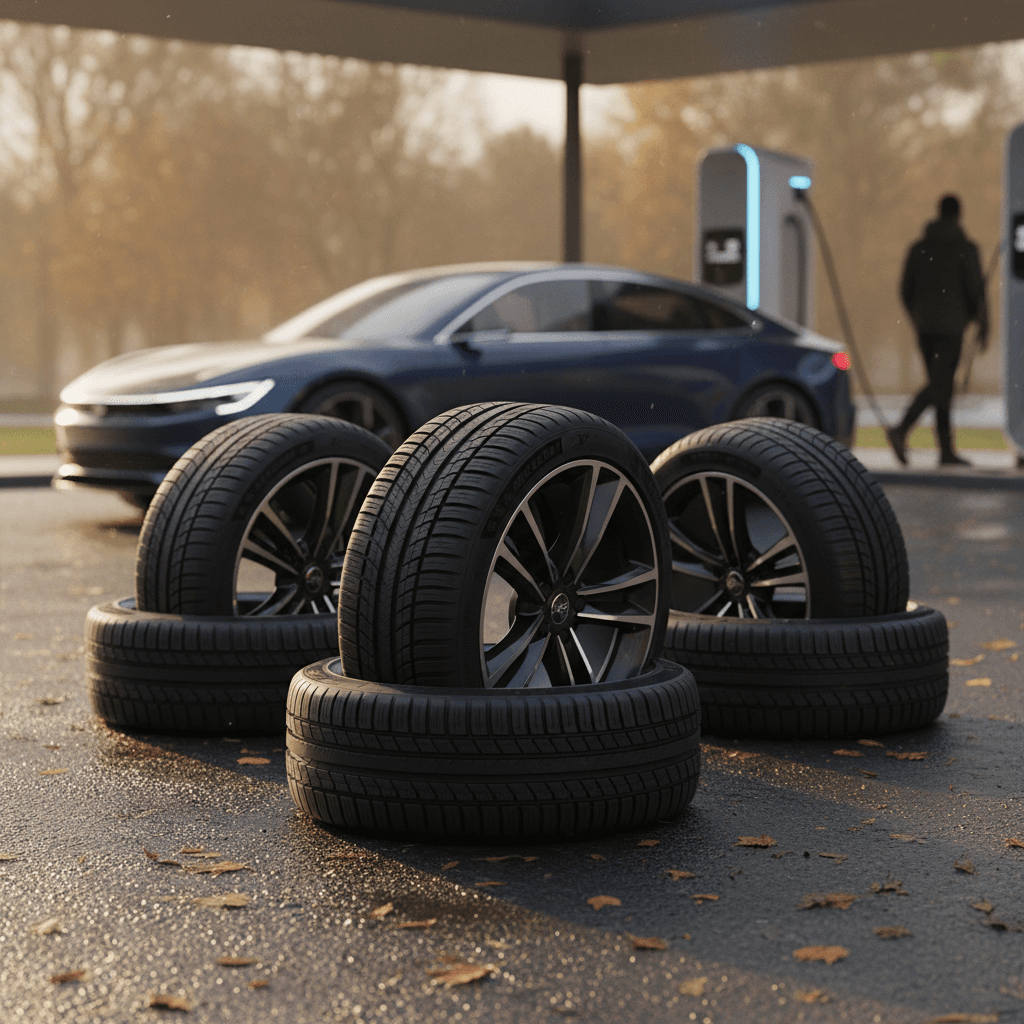
If you’ve shopped for replacement rubber for your electric car, you’ve probably noticed more and more products labeled as EV-specific tires, “EV-ready,” or “EV compatible.” They usually cost more than the same-size tires for gas cars, which raises a fair question: do you really need EV-specific tires, or is this just marketing? In 2025, the answer matters more than ever as EVs get heavier, quicker, and quieter, and tires have quietly become one of the biggest levers you have over range, comfort, and total ownership cost.
Quick answer
Why EVs Use Specific Tires
EVs ask more of their tires than comparable gas cars. Between the heavy battery pack, instant torque, and near-silent powertrain, what used to be a simple black circle has turned into a critical piece of EV engineering. Industry testing and owner data consistently show that EV tires can wear 20–30% faster if you simply bolt on standard rubber designed for lighter, slower, noisier vehicles.
What EV-Specific Tires Are Designed to Handle
Why this matters for you
How EV-Specific Tires Differ From Regular Tires
1. Stronger construction & higher load ratings
Most EVs carry a lot of their weight low in the chassis, directly over the axles. EV-specific tires use reinforced sidewalls and stronger belt packages to support that extra mass and the abrupt weight transfer that comes with instant torque and hard regenerative braking.
You’ll often see higher load indices or newer High Load (HL) markings on EV tires. Those are not optional on heavy crossovers and performance EVs, they’re your safety margin when the car is fully loaded with passengers and cargo.
2. Different rubber compounds and tread design
EV tires are engineered for lower rolling resistance without giving up wet grip. They use advanced silica blends, aramid reinforcements, and carefully tuned tread patterns to reduce energy loss as the tire flexes.
The result: better efficiency and more miles per charge than a conventional tire, with braking and cornering performance that still suits a heavy, powerful EV.
3. Noise reduction for quiet cabins
With no engine noise to mask it, tire roar becomes the dominant sound in many EVs. EV-specific tires often include noise-reducing foam liners, staggered tread block pitches, and closed-shoulder designs that cut cabin noise by several decibels at highway speeds.
That doesn’t just make the car feel more premium, it also reduces fatigue on long drives, something EV road-trippers notice quickly.
4. Braking and grip tuned for EV dynamics
A heavy EV on soft, non-optimized tires can feel vague and take longer to stop, especially in the wet. EV-optimized tires counter this with stiffer shoulders, 3D siping, and asymmetric tread designs that maintain a stable contact patch under hard braking and quick direction changes.
That balance between firmness (for handling) and compliance (for comfort and noise) is where most of the engineering effort goes.
How to spot an EV-ready tire
Impact on Range, Noise, and Safety
When people ask about EV-specific tires, what they really care about is how much those tires will change their day-to-day experience, especially range, noise, and safety. The differences are not theoretical; they’re measurable in kilowatt-hours, decibels, and stopping distance.
EV-Specific Tires vs Regular Tires: What Changes in Real Life?
Approximate real-world effects EV owners typically report when switching between EV-optimized and generic all-season tires of the same size.
| Factor | EV-Specific / EV-Optimized Tire | Standard Passenger Tire |
|---|---|---|
| Highway range | Baseline (0–2% loss vs OEM) | 5–15% loss common on the same route |
| City efficiency | Better at low rolling resistance; more range from each kWh | Higher consumption in stop-and-go driving |
| Cabin noise at 65–75 mph | Noticeably quieter; smoother, more muted hum | More roar and droning, especially on coarse pavement |
| Wet braking | Engineered to maintain grip with low rolling resistance | Performance varies widely; some budget tires lengthen stopping distance |
| Tire wear on EV | Normal to slightly faster than on a gas car | Often accelerated; aggressive EV torque can chew through softer compounds |
| Ride feel | Slightly firmer, more controlled | Can feel softer but less precise at speed |
Actual results vary by vehicle, climate, and driving style, but these ranges reflect what many EV drivers see in practice.
The hidden safety risk
EV Tire Longevity and Cost Expectations
You’ll see plenty of forum posts from EV owners shocked that their first set of tires was done by 20,000–30,000 miles. Some of that is driving style, instant torque makes it easy to spin tires or accelerate harder than you realize, but some of it is simply physics. A 5,000‑pound crossover with a big battery is going to work its tires harder than a 3,400‑pound compact sedan.
What to Expect From EV-Specific Tires
Ballpark expectations for mainstream EV crossovers and sedans in 2025.
Typical tread life
Many EV-focused all-season tires now target 30,000–50,000 miles of life under normal use. Aggressive driving, repeated hard launches, or chronic under-inflation can cut that sharply.
Price range
EV-optimized tires usually run more per tire than generic all-seasons in the same size. You’re paying for extra materials, specialized compounds, and more R&D around noise and efficiency.
Total cost of ownership
Because they can extend range and last longer under EV loads, a well-chosen EV tire often costs less per mile than a cheaper tire you have to replace early, and charge more often with.
Easy way to protect your tire investment
How to Choose the Right EV-Specific Tires
Choosing EV-specific tires is less about chasing a particular brand name and more about matching what you buy to your vehicle, climate, and driving style. Here’s how to narrow it down without getting lost in buzzwords and spec sheets.
Step-by-Step EV Tire Buying Checklist
1. Start with your owner’s manual and door jamb label
Confirm the exact tire size, load index, speed rating, and whether your EV shipped with high-load (HL) or extra-load (XL) tires. Your replacements should meet or exceed those specs.
2. Decide what matters most: range, comfort, or performance
If you road-trip a lot, low rolling resistance and range probably come first. If you mostly drive in the city, you might trade a few miles of range for better grip and braking, especially in bad weather.
3. Look for EV-ready or EV-focused models
Shortlist tires that the manufacturer clearly calls out as EV compatible or EV optimized. Pay attention to notes about noise reduction and rolling resistance as well as wet braking.
4. Match the tire to your climate
In snow-belt states, consider dedicated EV-compatible winter tires or true all-weather options with the 3PMSF symbol. In milder climates, an EV-tuned all-season usually works well.
5. Check warranty and expected mileage
Compare treadwear warranties and owner reviews for similar EVs, not just gas cars. A generous mileage warranty can be a tie-breaker when prices are close.
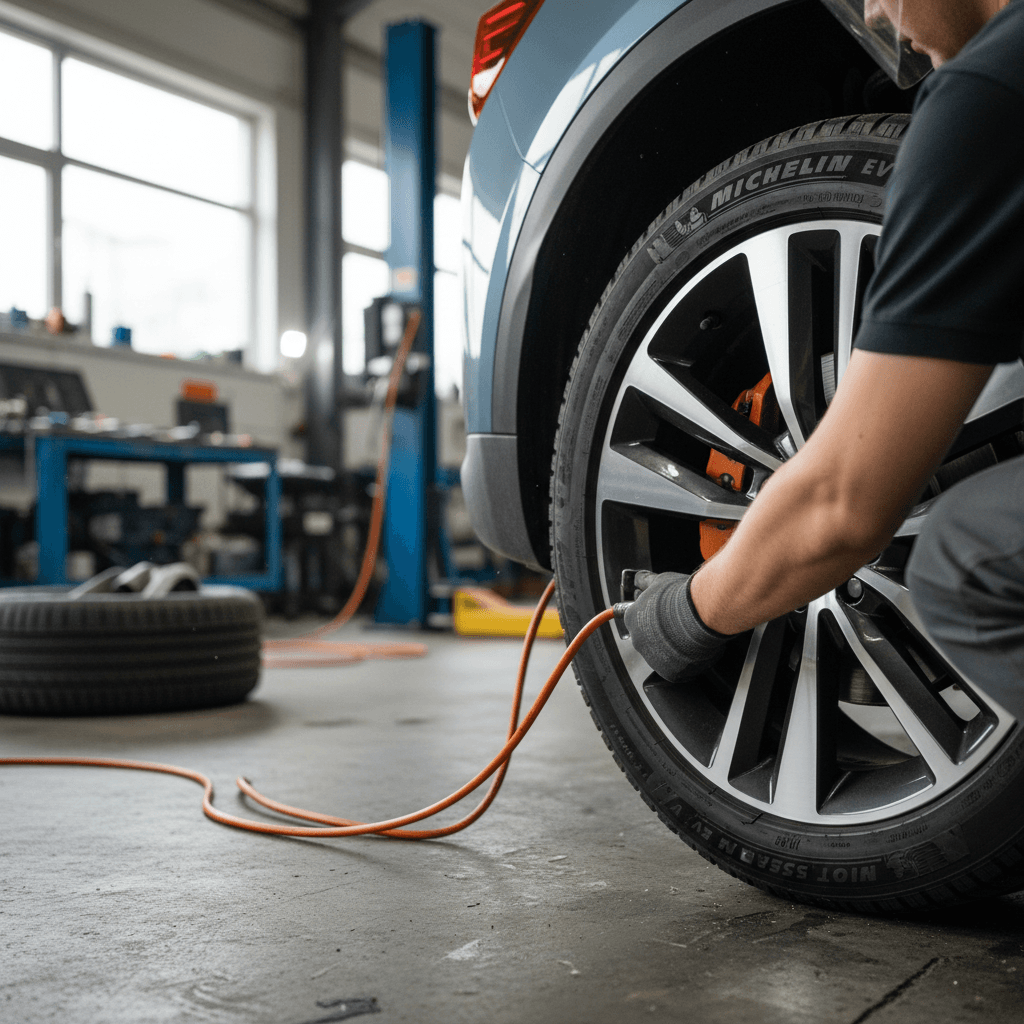
6. Have them installed and balanced by an EV-aware shop
Ask the shop to use appropriate jack points and lifting procedures. After installation, verify pressures, schedule a rotation interval, and monitor efficiency on your usual routes.
Popular EV Tire Lines for 2025
Nearly every major tire brand now offers lines either dedicated to EVs or explicitly tuned for them. You’ll also see many of these as factory equipment on new electric vehicles.
Examples of EV-Focused Tire Families
Not endorsements, but a starting point for your own research.
Michelin e.Primacy & EV-ready lines
Michelin’s e.Primacy All Season in North America targets maximum range and quietness for EVs like the Tesla Model Y, Mustang Mach-E, and Chevy Bolt. Other Michelin lines, such as CrossClimate 3 Sport, are marketed as EV compatible and often appear on premium EVs from the factory.
Goodyear ElectricDrive & EV-tuned models
Goodyear’s ElectricDrive 2 and EV-optimized versions of its performance tires focus on noise reduction, efficiency, and year-round traction. Features like foam-based noise tech and silica-rich compounds are designed with heavier, high-torque EVs in mind.
Hankook iON, Continental, and others
Hankook’s iON evo and iON winter series, plus Continental’s EcoContact lines and PremiumContact 7, are widely used as original equipment on European and global EVs. They’re tuned for low rolling resistance, precise handling, and the extra load of large battery packs.
Where Recharged fits in
Ready to find your next EV?
Browse VehiclesTire Checklist for Used EV Shoppers
Tires are one of the easiest places for a used EV seller to cut corners, and one of the fastest ways for you to rack up unplanned costs if you miss the warning signs. Whether you’re buying through a marketplace, a dealer, or directly from an owner, take a close look at what’s on each corner of the car.
Used EV Tire Inspection Checklist
1. Confirm the tire size and load rating
Make sure the tires match the size and load index in the door jamb or owner’s manual. Be cautious if you see cheaper, lower-load passenger tires on a heavy EV crossover.
2. Check brand and model
Look up the exact model name on the sidewall. If it’s a known EV-optimized or EV-compatible line, that’s a good sign. If it’s a budget tire with no EV mention, factor earlier replacement into your budget.
3. Measure tread depth across the tire
Uneven wear (inside shoulders worn more than the center, or one axle more than the other) can hint at alignment issues or a hard-driven car. Ask for a fresh alignment if you’re close to the limit.
4. Inspect for age and damage
Even with good tread, older tires can harden and lose grip. Check the DOT date code, sidewalls, and tread for cracks, bubbles, cuts, or patches near the sidewall.
5. Budget realistically for near-term replacement
If the tires are marginal or not EV appropriate, price in a new set soon after purchase. When you buy from Recharged, your specialist can help estimate timing and cost so it’s not a surprise.
Frequently Asked Questions About EV-Specific Tires
EV-Specific Tires: Common Questions
The Bottom Line on EV-Specific Tires
EV-specific tires aren’t just a marketing label, they’re a response to how modern electric vehicles behave in the real world. Higher weight, instant torque, and quiet cabins make tire design a key part of range, comfort, and safety. You don’t have to obsess over every buzzword, but you should make sure whatever you buy is built and rated for EV duty, not just sized to fit the wheel.
If you’re already driving an EV, the right tire choice can feel like a small software update for your car, smoother, quieter, and sometimes noticeably more efficient. And if you’re shopping for a used EV, pay attention to what’s on the car today and what you’ll likely need in the next 10,000–20,000 miles. At Recharged, every vehicle includes a Recharged Score Report with verified battery health and a clear picture of tire condition, so you can make a confident decision and budget realistically for your next set of EV-ready tires.