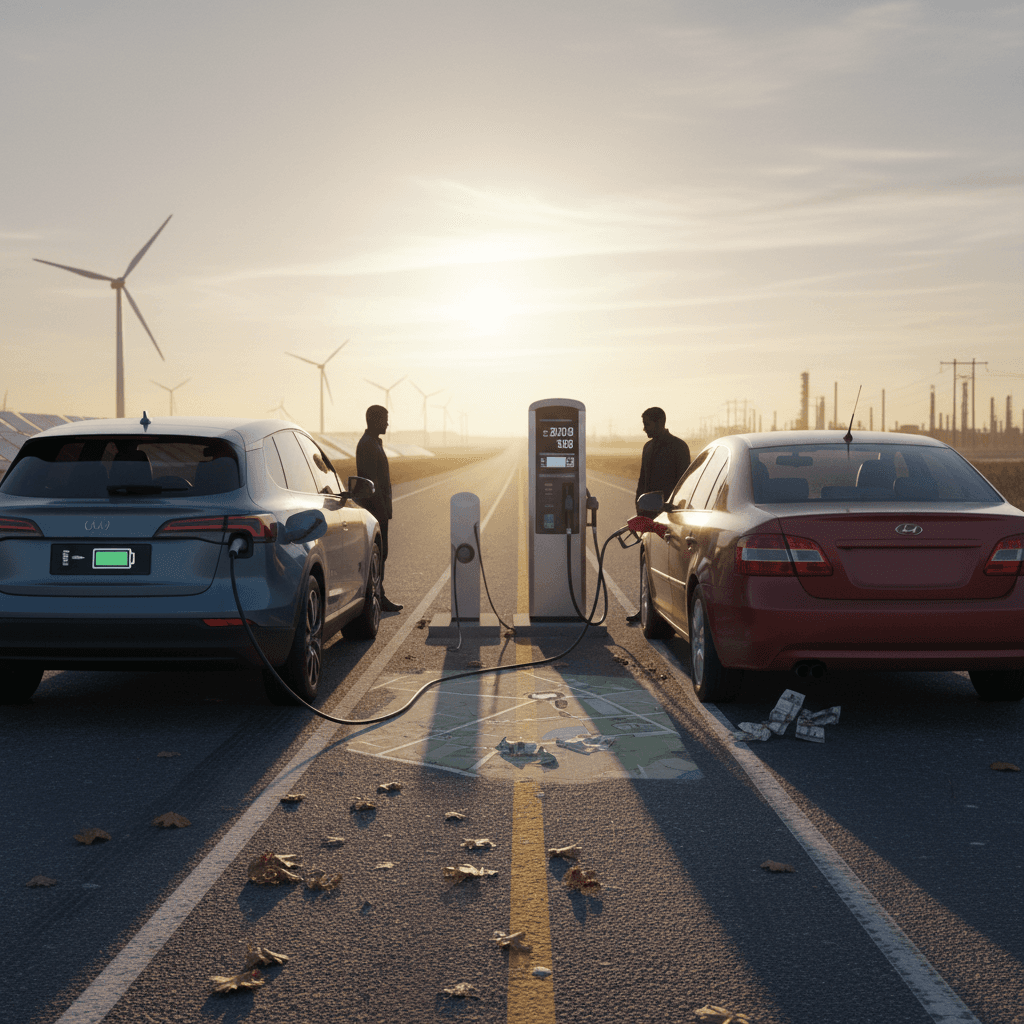
If you’re planning a long drive, it’s natural to wonder whether an EV road trip vs gas car cost comparison still favors electric in 2025, especially with higher electricity prices and volatile gas. The answer is: it depends on where you charge, what you drive, and how far you go. This guide walks through real‑world numbers so you can run the math for your own trip instead of guessing.
At-a-glance answer
Why EV vs gas road trip costs matter in 2025
Sticker price gets all the attention, but total cost of ownership is where EVs quietly win or lose. Road trips are a big part of that picture: they stress your charging plan, expose you to public fast‑charging prices, and highlight differences in comfort and downtime. With more Americans cross‑shopping used EVs against used crossovers and trucks, understanding long‑distance cost is just as important as comparing monthly payments.
As a retailer focused on making used EV ownership transparent, Recharged looks at road‑trip economics not as a thought experiment but as a real‑world budget item. Our buyers often ask, “Will this car actually save me money when I visit family 600 miles away?” The good news is you don’t need a spreadsheet degree to answer that, just a few key numbers.
Cost basics: how EVs and gas cars burn money differently
Gas cars: gallons and MPG
A gas car’s fuel cost is straightforward:
- Fuel cost per mile = gas price per gallon ÷ miles per gallon (MPG).
- Example: $3.50 ÷ 30 MPG ≈ $0.12 per mile.
Small, efficient sedans might see 35–40 MPG on the highway, while trucks and SUVs can be closer to 18–25 MPG.
EVs: kWh and efficiency
An EV’s energy use is measured in kilowatt‑hours per 100 miles (kWh/100 mi) or miles per kWh.
- Typical 2024–2025 EVs fall around 25–30 kWh/100 mi for efficient models and 45–70 kWh/100 mi for big trucks and SUVs.
- Electricity cost per mile = (kWh/100 mi × price per kWh) ÷ 100.
That means the same EV can be cheap or surprisingly pricey to fuel depending on whether you’re charging at home, at a city Level 2 station, or at a highway fast charger.
Quick rule of thumb
2025 energy prices: electricity vs gasoline snapshot
Typical U.S. energy prices in 2025
Local prices matter
Sample road trip cost comparison (1,000 miles)
Let’s make this concrete. Imagine a 1,000‑mile round trip, roughly New York to Chicago and back, or Dallas to Denver and back. We’ll compare an efficient compact SUV in gas and EV form, then look at what happens if you drive something bigger.
Example 1: 1,000‑mile trip in efficient crossover
Assumptions: 30 MPG gas crossover vs 28 kWh/100 mi EV; gas at $3.25/gal; electricity at $0.17/kWh at home, $0.38/kWh at fast chargers.
| Scenario | Assumptions | Total energy used | Trip energy cost | Cost per mile |
|---|---|---|---|---|
| Gas crossover | 30 MPG, $3.25/gal gasoline | ≈33.3 gallons | ≈$108 | 10.8¢/mi |
| EV (mix of home & fast charging) | 50% home @ $0.17/kWh, 50% DC fast @ $0.38/kWh; 28 kWh/100 mi | ≈280 kWh | ≈$77 | 7.7¢/mi |
| EV (all DC fast charging) | 100% DC fast @ $0.38/kWh; 28 kWh/100 mi | ≈280 kWh | ≈$106 | 10.6¢/mi |
| EV (all home charging) | 100% home @ $0.17/kWh; 28 kWh/100 mi | ≈280 kWh | ≈$48 | 4.8¢/mi |
These are simplified averages; real‑world results vary with speed, weather, and driving style.
What this first example shows
Example 2: 1,000‑mile trip in large SUV or pickup
Assumptions: 20 MPG gas truck/SUV vs 50 kWh/100 mi electric truck/SUV; same energy prices as above.
| Scenario | Assumptions | Total energy used | Trip energy cost | Cost per mile |
|---|---|---|---|---|
| Gas truck/SUV | 20 MPG, $3.25/gal gasoline | 50 gallons | ≈$163 | 16.3¢/mi |
| Electric truck/SUV (all DC fast) | 50 kWh/100 mi, pure DC fast @ $0.38/kWh | ≈500 kWh | ≈$190 | 19.0¢/mi |
| Electric truck/SUV (50% home, 50% DC) | Half home @ $0.17/kWh, half DC fast @ $0.38/kWh | ≈500 kWh | ≈$147 | 14.7¢/mi |
Heavier, boxier vehicles magnify both fuel and electricity costs.
Here the picture is less flattering for EVs that are big, heavy, and thirsty. A large electric truck charged only on highway DC fast chargers can cost more per mile than a comparable gas truck on that same route. But if you can anchor your trip with home charging at each end, or find cheaper Level 2 along the way, the electric truck pulls slightly ahead.

When an EV road trip is usually cheaper than gas
Situations where EVs shine on road trips
In these scenarios, an EV is very likely to cut your fuel bill versus a similar gas vehicle.
You start and end at home
You drive an efficient EV
You can plan around cheaper charging
Use apps to find cheaper charging
- You live in a state with relatively cheap power (parts of the South and Midwest).
- You’re comfortable stopping every 150–200 miles, which lets you arrive at chargers with a low state of charge and maximize fast‑charging speed.
- You can use workplace or destination Level 2 charging (hotels, attractions) at low or no cost while you’re doing something else.
When a gas car can still cost less
There are very real situations where the “EV is always cheaper” narrative breaks down, especially if you only look at the road‑trip slice of ownership rather than day‑to‑day commuting.
Common scenarios where gas wins on trip cost
These don’t mean an EV is wrong for you, but they do change the math.
You drive a big electric truck or SUV
Your route is all DC fast, no cheap options
Time is money too
Beyond fuel: tolls, maintenance, and time costs
Maintenance savings still apply
An EV’s road‑trip doesn’t require oil changes, transmission service, or exhaust work. Over years of ownership, that means fewer surprise costs. You’ll still pay for tires and cabin air filters, but the drivetrain is simpler and usually cheaper to maintain.
Tolls and parking are fuel‑agnostic
Bridge tolls, paid parking, and hotel fees don’t care what’s under your hood. However, some cities and resorts offer discounted or free EV parking with charging, which can tilt economics further in your favor if you plan ahead.
Value of your time
On a long‑distance day, a gas car can refuel in 5 minutes, while EV fast‑charging sessions may add 20–40 minutes. Some drivers love using that time for meals or rest, others see it as a cost. Be honest with yourself about how you value that extra downtime.
Think in total cost of ownership, not one trip
How to estimate your own EV vs gas road trip cost
Make your own EV road trip vs gas car cost comparison
1. Find your vehicles’ efficiency
Look up your EV’s <strong>kWh/100 miles</strong> and your gas car’s <strong>highway MPG</strong> on the EPA Fuel Economy site or your window sticker. If you’re cross‑shopping models, use those ratings as your baseline.
2. Check current local prices
Note recent <strong>gas prices</strong> along your route (GasBuddy, etc.) and <strong>electricity rates</strong>: home rate on your utility bill, and kWh prices in your preferred charging apps.
3. Estimate your charging mix
Roughly how much of the trip can be home or cheap Level 2 charging versus highway DC fast charging? For many trips, a 50/50 or 70/30 split between fast and slower charging is realistic.
4. Calculate cents per mile
For each vehicle, multiply energy use by price and divide by miles. Example: 28 kWh/100 mi × $0.30 ÷ 100 = <strong>8.4¢/mi</strong>. Compare that to your gas car’s fuel cost per mile.
5. Add in time preferences
If you hate stopping, give some value to your time. If you’re fine building meal and stretch breaks around charging stops, the EV’s cost advantage may feel more compelling.
6. Sense‑check against your budget
Once you know the approximate cost difference for your route, scale it to how often you road‑trip each year. A $30 difference once a year is trivial; hundreds of dollars across multiple long trips may push you toward one drivetrain or the other.
Road‑trip costs and choosing a used EV
If long drives are part of your life, it’s smart to bake road‑trip costs into your choice of EV, especially in the used market, where you’ll see a wide mix of battery sizes and efficiencies.
Used EV features that matter for road‑trip costs
These don’t just affect comfort, they affect how many stops you make and what you pay for energy.
Battery health and usable range
DC fast‑charging speed
Charging network access
How Recharged can help
FAQ: EV road trip vs gas car cost comparison
Frequently asked questions
Bottom line: what to drive on your next road trip
When you run the numbers, an EV road trip vs gas car cost comparison comes down to three levers you control: how efficient your vehicle is, where you buy your energy, and how you plan your stops. For many drivers, especially those who can charge at home, an efficient EV still wins clearly on energy cost over the course of a year and holds its own or better on most road trips.
If you’re shopping the used market and want an EV that fits your travel habits, focus on range, fast‑charging speed, and battery health rather than just sticker price. At Recharged, every vehicle comes with a Recharged Score battery report, fair‑market pricing, and expert guidance so you can understand not only what you’ll pay at purchase, but what you’re likely to spend every time you hit the open road.