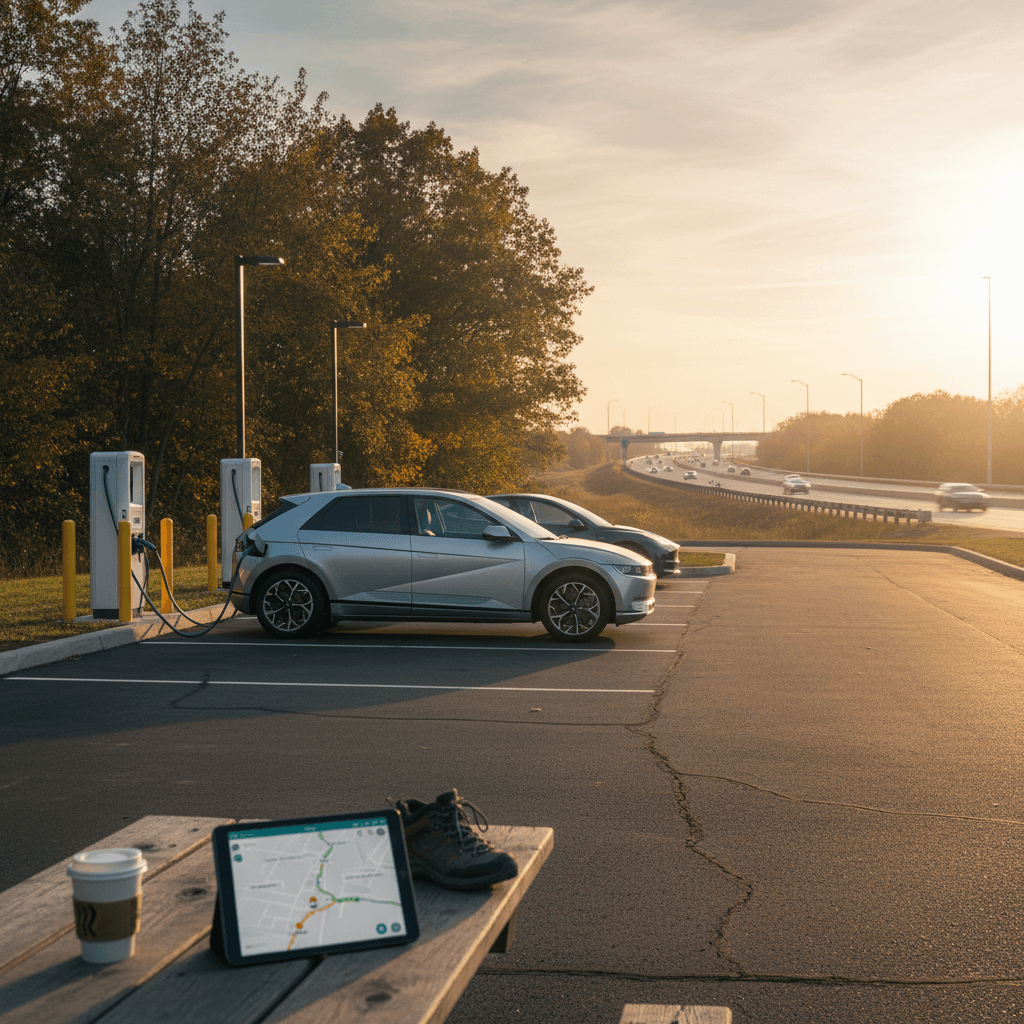
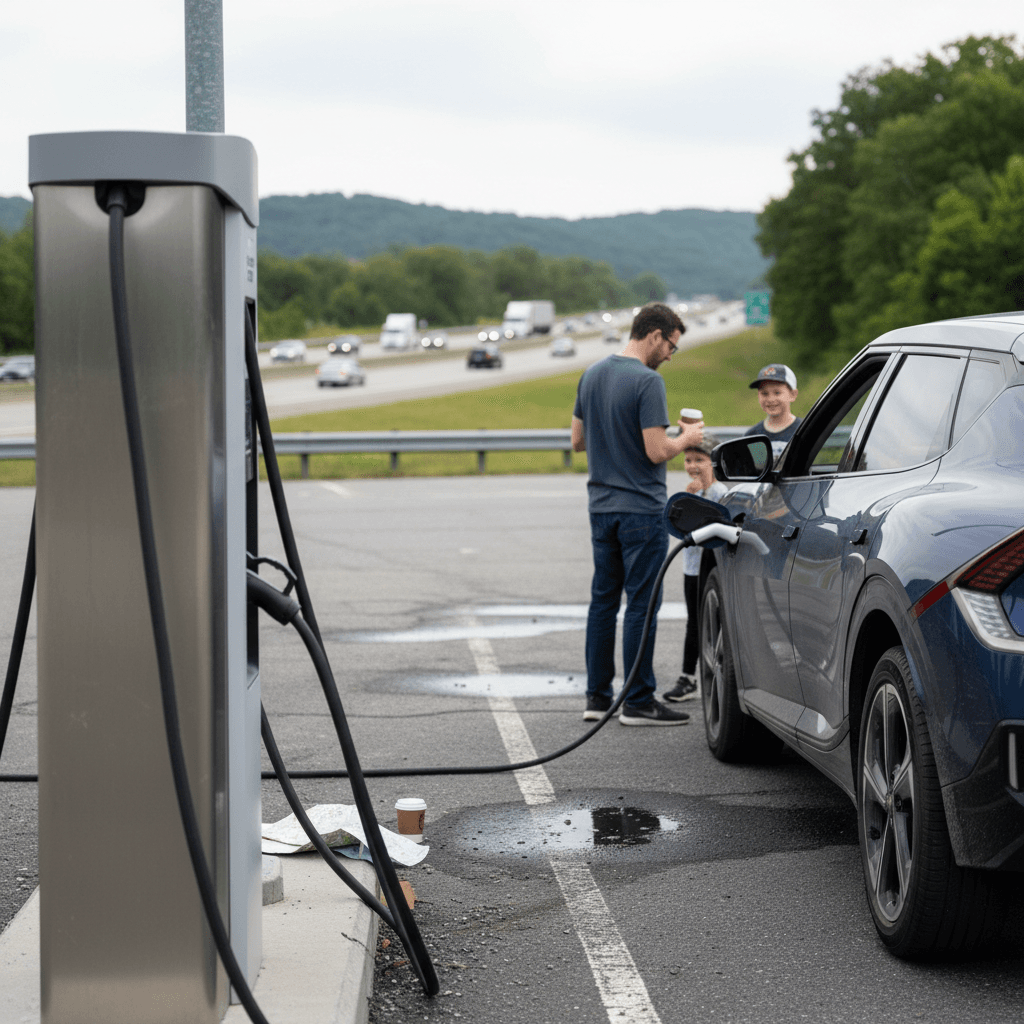
An EV road trip on the I‑95 corridor used to feel like a dare. Today, from Maine to Miami, it’s becoming just…driving. Fast chargers are filling in, federal NEVI funding is pushing stations every 50 miles or so on major corridors, and new hubs are popping up at the exact places you already stop: highway travel centers, convenience stores, and big-box parking lots. The trick is knowing where the coverage is great, where it’s merely okay, and how to match your car’s range to the rhythm of I‑95.
Big picture: I‑95 is ahead of the curve
Why I‑95 Is Actually EV‑Friendly Now
EV Fast Charging Along I‑95 in 2025–2026
What matters for your trip isn’t the national headline number; it’s whether you can leave, say, Boston with kids in the back and not white‑knuckle your way to New Jersey. The answer, increasingly, is yes. Between Tesla Superchargers (many now open to non‑Tesla EVs with NACS/CCS support), Electrify America, BP Pulse at TravelCenters of America, state‑backed NEVI sites, and a patchwork of utility and retail networks, you’re rarely more than half a battery away from a plug on I‑95.
Good news for used‑EV drivers
Where the Chargers Are on the I‑95 Corridor
Think of I‑95 as three distinct personalities when it comes to charging: the Northeast Metro Swarm, the Mid‑Atlantic Ladder, and the Southeast Resort Run. Each drives a little differently, and your EV strategy should adjust accordingly.
Three Charging Personalities of I‑95
Same highway, very different charging rhythms
Northeast Metro Swarm
From Boston to D.C., you’re in EV easy mode.
- Dense DC fast charging every 20–40 miles in many stretches.
- Plenty of urban Level 2 if you stay in cities.
- Traffic is your enemy, not chargers.
Mid‑Atlantic Ladder
Maryland, Virginia, and the Carolinas are like rungs on a ladder.
- Fast chargers cluster at major exits and travel plazas.
- Spacings of 40–60 miles are common.
- Plan ahead late at night in rural areas.
Southeast Resort Run
Georgia to Florida is where the road‑trip myths go to die.
- New 150–400 kW hubs at TravelCenters, truck stops, and plazas.
- Good coverage near Jacksonville, Orlando, and coastal exits.
- Some gaps remain inland off I‑95, don’t improvise with 5% state of charge.
Major Fast‑Charging Networks You’ll See on I‑95
These are the logos you’re hunting for on highway signs and in apps when you road trip an EV along I‑95.
| Network | Typical Power | Common Locations on/near I‑95 | Notes for Road Trippers |
|---|---|---|---|
| Tesla Supercharger | 150–250 kW | Rest areas, shopping centers, travel plazas | Best experience if you drive a Tesla; many sites now open to other brands with NACS access. |
| Electrify America | 150–350 kW | Walmart, Target, highway retail | High‑power hardware; check recent reviews for reliability at specific sites. |
| EVgo | 100–350 kW | Urban centers, grocery and retail | Great for city segments and hotel overnights near downtowns. |
| BP Pulse / TA | Up to 400 kW | TravelCenters of America off I‑95 | New Jacksonville, FL hub is the blueprint: highway‑oriented, high‑power, easy in‑and‑out. |
| NEVI‑funded state sites | 150 kW+ | Rest areas, service plazas, exits selected by states | Look for co‑branding with local utilities or regional networks; spacing aimed at ~50 miles. |
Download their apps before you leave, not at 2% state of charge in a parking lot.
Don’t trust any single network blindly
Planning an EV Road Trip Route on I‑95
The golden rule of EV road‑tripping I‑95 is simple: plan once, then improvise the fun, not the charging. You’re not trying to reinvent logistics; you’re stacking your lunch, coffee, and kid‑bathroom breaks on top of energy stops you’ve already mapped.
Apps That Make I‑95 EV Road Trips Boring, in a Good Way
Use at least two: one for routing, one for live status
Native Car Planner
Tesla, Hyundai/Kia, Ford, and others now build EV‑aware route planning into the car.
- Adapts to your actual consumption and weather.
- Great starting point, especially in Teslas along I‑95.
A Better Routeplanner (ABRP)
The power‑user’s choice.
- Lets you plug in car model, battery health, and speed.
- Can show alternate networks and conservative backups.
PlugShare / Chargeway
Your reality check.
- Shows live station status and user reviews.
- Perfect for confirming that lonely South Carolina charger is actually alive before you commit.
Set a Comfortable “Working Range”
Ignore the marketing number on the window sticker. For I‑95, you care about the distance you can comfortably drive between fast‑charging stops with a buffer.
- Take your car’s real‑world highway range, then use 60–70% of it when planning.
- Factor in winter (expect 20–30% less range in New England cold snaps).
- Leave room for traffic jams around NYC, D.C., and Miami.
Align Charging With Human Needs
Once you know your working range, drop pins along I‑95 where you’d naturally want breaks:
- Breakfast after 2–3 hours? Find a 150 kW site roughly 120–180 miles from home.
- Lunch and a leg stretch? Aim for a 25–35 minute stop.
- Hotel overnight? Prioritize a place with Level 2 charging, even if the nightly rate is a bit higher.
Build in one extra stop you don’t “need”
How Long You’ll Stop to Charge
The most common first‑timer mistake is to think like a gas driver: “I’ll arrive at 5% and charge to 100%.” That’s how you turn a well‑mannered EV into a tyrant. Most batteries charge fastest between about 10–60%; after that the power tapers and you’re sitting there for diminishing returns while the kids ask philosophical questions about boredom.
Typical DC Fast‑Charging Stop Lengths on I‑95
Rough, real‑world numbers for a modern EV with decent DC charging speeds and a healthy battery.
| Situation | Energy Added | Approx. Time at 150 kW+ | Real‑World Use Case |
|---|---|---|---|
| Short top‑up | 10–20 kWh | 10–15 min | You left Boston full, sip in Connecticut before New York traffic. |
| Standard stop | 30–45 kWh | 20–35 min | Combine with a bathroom break and a quick meal. |
| Deep refill | 50–70 kWh | 35–55 min | Cold weather, headwinds, or sparse chargers; use sparingly with kids on board. |
Note: Older used EVs or models with small packs may need slightly longer or more frequent stops; check your specific car’s curve.
Used EV? Know your taper
State‑by‑State I‑95 Charging Highlights
A full exit‑by‑exit atlas would bore even the most obsessive planner, but a few segments along I‑95 deserve special mention, either because they’re over‑served (your cup runneth over with electrons) or still catching up.
I‑95 Segments That Matter for EV Drivers
Where you can relax, and where you should pay attention
Boston–NYC–Philly–D.C.
Verdict: Easiest stretch.
- High density of Tesla Superchargers, EA, EVgo, and state‑backed sites.
- Rhode Island has already reached "fully built‑out" status on key corridors, and Connecticut is adding NEVI sites along I‑95 and I‑91.
- Charger choice matters less than traffic and parking logistics in cities.
D.C.–Richmond–Carolinas
Verdict: Solid but more spaced.
- Virginia and the Carolinas are using NEVI funds to fill gaps along I‑95 and feeder routes.
- Fast chargers tend to cluster near major interchanges, not every tiny exit.
- Overnight Level 2 at hotels in Fayetteville, Florence, and Savannah is worth seeking out.
Savannah–Jacksonville–Central Florida
Verdict: Quietly becoming a fast‑charge showcase.
- New BP Pulse / TravelCenters of America hubs in Jacksonville bring 400 kW hardware to classic road‑trip stops.
- Plenty of additional DC fast charging near beach towns and Orlando detours off I‑95.
- Watch holiday peaks; everyone arriving at the beach at 5 p.m. has the same idea.
New England Winters
Verdict: Easy, if you respect physics.
- New York and New England states are layering NEVI sites on top of existing networks.
- Cold reduces range; plan closer‑spaced 80–120 mile hops when temps plunge.
- A warm battery (after an hour of highway driving) charges faster, arrive low, not frozen‑solid full.
Choosing the Right EV for an I‑95 Road Trip
If you’re shopping the used market with dreams of an annual I‑95 epic, Carolina beaches, Disney runs, or a snowbird migration, the right car choice can make the corridor feel much shorter. Range matters, but it’s not the only character in this drama; charging curve, comfort, and driver‑assist tech all show up in the third act.
Specs That Matter on I‑95
- Real highway range: Look for at least 200 miles at 70 mph with the A/C or heat on; 230–260+ gives you relaxed spacing.
- DC fast‑charge speed: A peak of 120 kW+ with a solid mid‑range curve means 20–35 minute stops instead of 45+.
- Thermal management: Liquid‑cooled batteries tend to hold performance better over repeated fast charges on a long day.
- Driver assistance: Good adaptive cruise and lane centering reduce fatigue on I‑95’s long, straight slogs.
How Recharged Helps You Choose
When you’re browsing used EVs, "road‑trip ready" isn’t a checkbox on the window sticker. At Recharged, every vehicle comes with a Recharged Score Report that:
- Verifies battery health, so you know whether that 250‑mile car is still a 250‑mile car.
- Shows fair‑market pricing so you don’t overpay chasing range.
- Includes expert guidance on how the specific model behaves on long highway runs.
If your dream is an annual I‑95 run, tell the EV specialist that’s the brief. They can steer you toward models and trims that charge quickly and cruise comfortably.
Underrated road‑trip heroes
I‑95 EV Road Trip Checklist
Before You Hit I‑95 in an EV
1. Verify your real‑world range
Check recent highway energy use in your car or owner forums. Plan legs at 60–70% of that number, especially in winter or with a roof box.
2. Confirm fast‑charging compatibility
If you drive a non‑Tesla, confirm you have the right adapter for Tesla sites (if needed) and active accounts for Electrify America, EVgo, or other networks along your route.
3. Install and log into key apps
Download at least two: a route planner (like ABRP or your car’s app) and a status app (PlugShare/Chargeway). Log in and add a payment method before leaving.
4. Map primary and backup stops
For each long leg, pick a primary DC site and a backup 20–40 miles earlier. Save them as favorites in your nav or phone.
5. Book lodging with charging
On multi‑day trips, look for hotels with Level 2 charging. Overnight charging erases a lot of daytime inefficiency and lets you leave at 80–100% each morning.
6. Check weather and traffic patterns
Cold, headwinds, and heavy traffic around major cities change consumption. If forecasts look rough, tighten your leg lengths and consider one extra stop per day.
Don’t ignore battery health on a used EV
Common Pitfalls to Avoid on I‑95
- Arriving at your only planned charger with single‑digit state of charge and no backup.
- Planning winter New England legs using summer EPA range numbers.
- Assuming every place with a green lightning‑bolt icon is a modern 150 kW station, many are older 50 kW units or even Level 2.
- Stopping at 5% and insisting on a 100% charge “to be safe,” then resenting the 75‑minute session.
- Rolling the dice on a lonely rural charger at midnight because you didn’t install the app with better reviews.
The only real way to get stranded
FAQ: I‑95 EV Road Trips
Frequently Asked Questions About EV Road Trips on I‑95
How Recharged Can Help You Get Road‑Trip Ready
An EV road trip on the I‑95 corridor isn’t an eco‑stunt anymore; it’s simply a different cadence of travel. You stop a little more often, but for shorter stretches, and your car becomes part of the conversation instead of just a vessel for gasoline. The key is pairing the right car with honest planning.
If you’re considering a used EV for East Coast adventures, Recharged is built for exactly this moment. Every vehicle comes with a Recharged Score battery‑health report, transparent pricing, and EV‑specialist support that can walk you through how that specific model behaves on a Boston‑to‑Orlando run. You can browse, finance, trade in, and arrange nationwide delivery entirely online, or visit the Recharged Experience Center in Richmond, VA, not far from I‑95 itself. Get the right car, know its true range, and the rest of the corridor falls into place.